
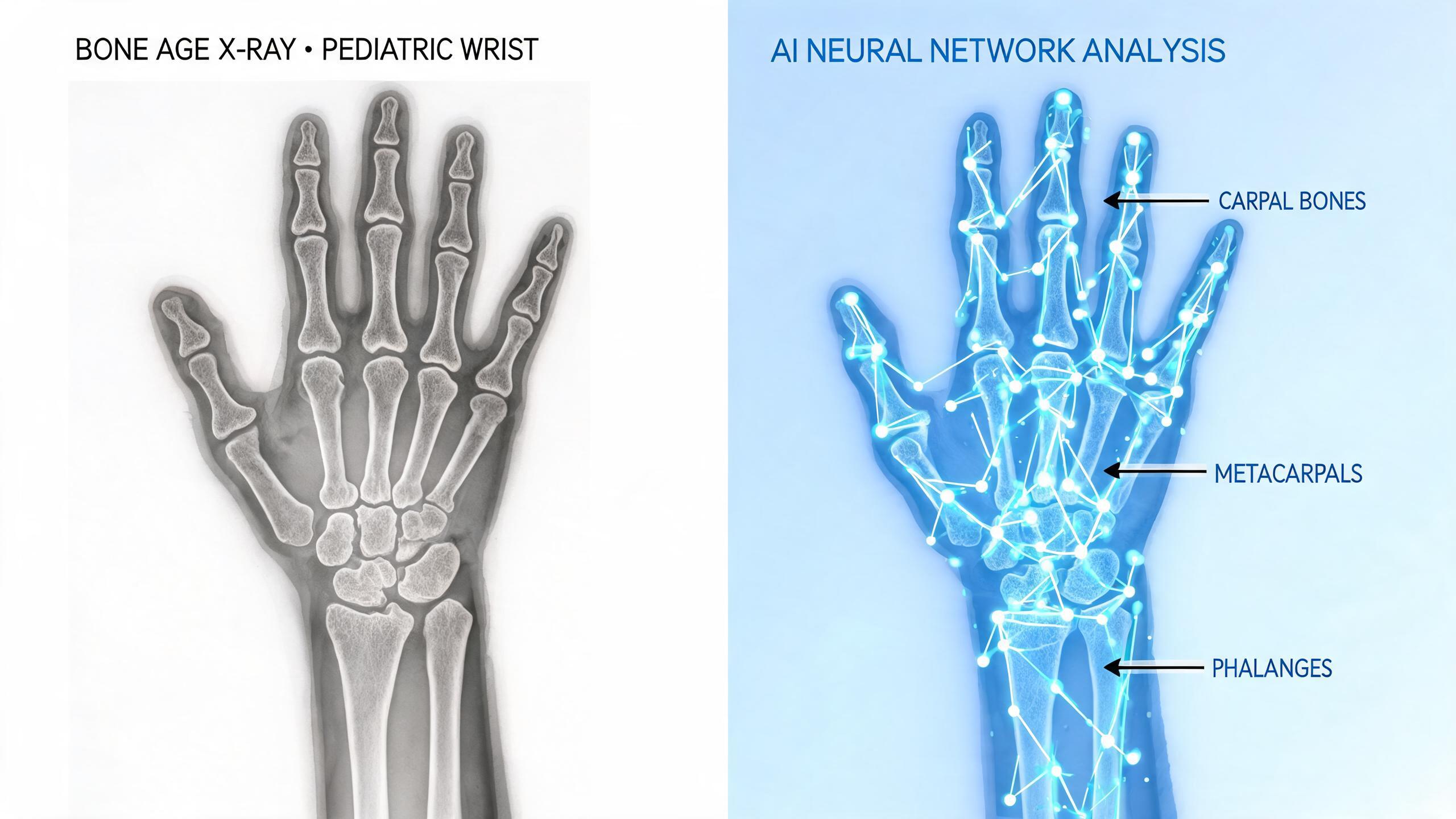
What bone-age estimation measures
Bone age is an estimate of skeletal maturity, commonly assessed from a hand and wrist radiograph. It is one clinical input interpreted by qualified clinicians alongside a patient’s history and other findings; an AI estimate alone is not a diagnosis.
What makes a dataset useful
A useful collection needs a documented population, age and sex distribution, image protocol, label method, reader qualifications and adjudication process. Buyers should also ask how missing, repeated, low-quality and out-of-range cases are handled.
Make the annotation protocol explicit
If labels use Greulich–Pyle (GP), Tanner–Whitehouse (TW) or another approach, name the version and define what each field means. Do not treat scores from different methods as interchangeable. Report reader agreement and the rules for resolving disagreement.
Validate before drawing conclusions
Performance can vary across age groups, populations, imaging equipment and clinical settings. Evaluation should use a clearly defined, appropriately separated test set and report relevant subgroup results. Dataset size by itself does not establish representativeness, clinical benefit or regulatory readiness.
Questions to ask before procurement
Request evidence for the stated image count, source and authorization; a data dictionary and sample records; de-identification and access controls; quality-control records; licensing terms; and a description of intended and excluded uses. Langhui’s reported collection size is a company statement and should be confirmed during due diligence.