
AI BENCHMARK / STANDARDS & EVALUATION DATA
From Question Banks to Benchmarks: How to Build AI Evaluation Data, Prevent Contamination, and Participate in Standards Development
Comparisons of model capabilities increasingly depend on evaluation data, which is itself becoming an engineering discipline that requires sound methodology. This article breaks down the construction process for question banks and benchmarks, annotation and dispute-handling mechanisms, the identification and governance of evaluation contamination, the unique challenges of agent evaluation, and practical paths for enterprises and research institutions to participate in group and national standards. It also provides executable delivery and acceptance criteria.
On the surface, evaluation is about scoring a model; in practice, it is about defining what counts as correct. Unless four questions are clearly answered—where the question bank comes from, who makes the judgments, what happens when a judgment is wrong, and how leaderboard contamination is detected—a score is merely a snapshot of the day. This article treats evaluation data as an engineering system: it first explains the framework and construction process, then examines annotation, contamination, and the distinctive challenges of agent evaluation, and finally shows how these methods can be written into standards. All of them point toward one goal: ensuring that scores still hold up at the next review.
1. Evaluation Data Is Not a Collection of Questions but a Reproducible Judgment Framework
Many teams' first version of an evaluation consists of finding a batch of questions, running a model once, and producing a percentage to report. The process can be completed in ten minutes, but it can hardly answer any substantive question: the score will change when someone else runs it, when it runs on a different day, or with a different prompt version. A fluctuating number cannot be used to compare models or guide the next round of optimization.
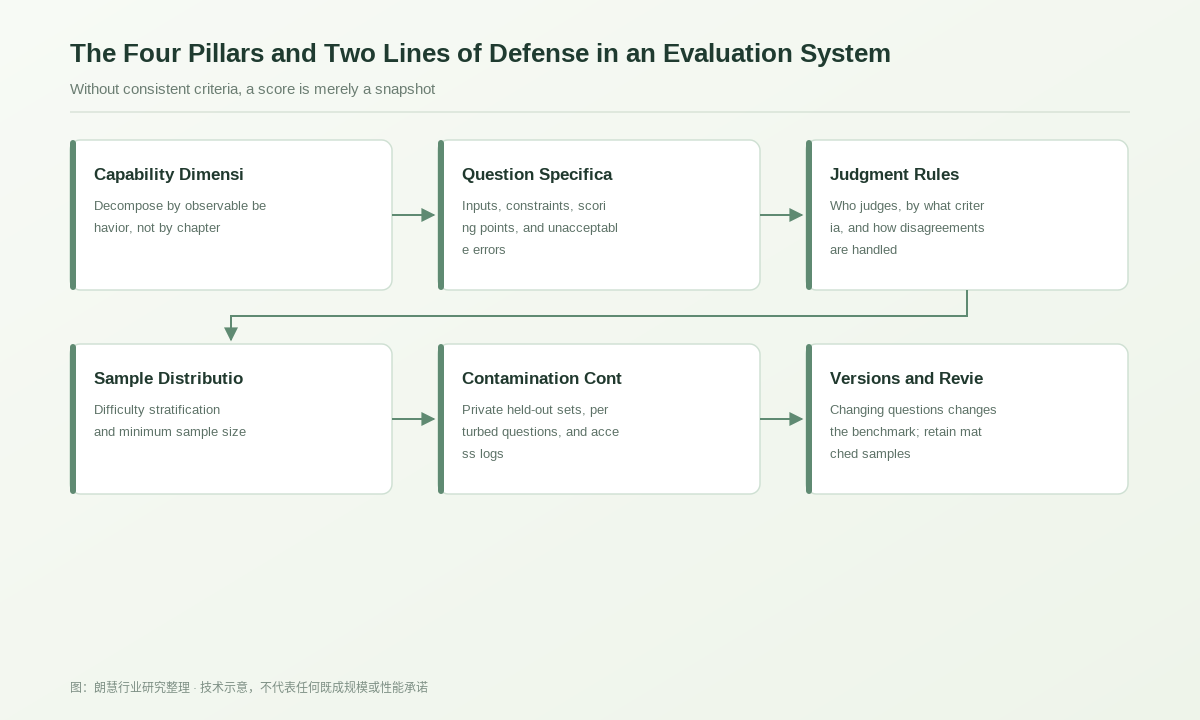
A usable evaluation framework requires at least four pillars. Capability dimensions define what is being tested, question specifications define what a question looks like, judgment rules define who makes the decision and by what criteria, and sample distribution defines the difficulties and boundaries covered. If any one is missing, a score is only a snapshot, not a conclusion. In engineering terms, documenting these four elements is more useful than buying a few more GPUs.
Counterexamples are common. The same model may differ by more than a dozen points on two leaderboards, and a team's first reaction is to suspect a version issue. More often, the judgment criteria differ: one leaderboard allows partial credit, while another accepts only exact matches; one treats refusals as incorrect, while another treats reasonable refusals as correct. Without consistent criteria, the comparison is meaningless.
This is also where evaluation meets standardization. Standardization essentially means writing a set of criteria into text that others can reproduce: what the input is, how it is judged, how samples are drawn, and how results are reported. The longer an evaluation team works, the more it realizes that it is effectively writing a de facto standard—one that simply has no standard number yet.
2. Question Bank Construction: From Capability Dimensions to Testable Specifications
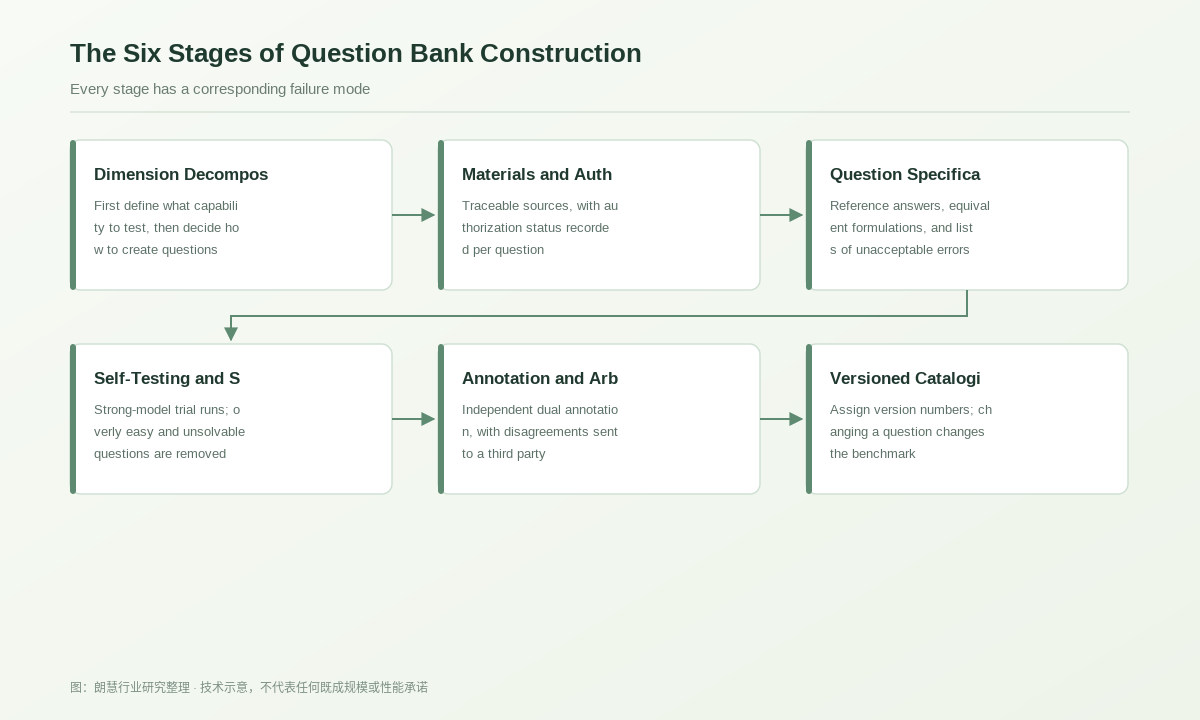
The first step in building a question bank is decomposing capability dimensions. Breaking it down by subject chapter may look orderly, but it is not useful for evaluation because chapters do not equal capabilities. A more effective approach is to break it down by observable behaviors: whether the model can identify key information, perform multi-step reasoning, cite supporting evidence, refuse to answer when information is insufficient, and correctly call tools. Each behavior can be tested and analyzed separately.
The second step is to turn each dimension into a question specification. A specification should clearly define the input, constraints, reference answers or scoring points, acceptable equivalent formulations, and explicitly unacceptable errors. If the specification is unclear, debates will repeatedly arise over whether a partially correct answer counts as correct, with each debate reaching a different conclusion until the outcome is settled by volume rather than evidence.
The third step is sourcing and authorization. Question material may come from public papers, textbooks, industry documents, or proprietary data. Every question should record its source and authorization status. There is a trap here: using a model to generate questions and then manually rewriting them is efficient, but the provenance chain is easy to break. When publishing externally, unclear authorization can make the entire batch unusable.
The fourth step is screening and cataloging. First, a relatively capable model attempts the questions. Overly easy questions are deleted, unsolvable ones return to the drafting stage, and borderline questions are retained and labeled. Every version must be assigned a version number because modifying a question effectively changes the benchmark: old scores cannot be directly compared with new ones, and the trend line must be recalibrated.
3. Benchmark Design: Sampling, Difficulty Distribution, and Statistical Criteria
A benchmark does not become better simply by being larger. Sample size determines the stability of conclusions, difficulty distribution determines discriminative power, and the mix of question types determines what questions it can answer. An all-easy set saturates, with every model approaching full marks; an all-hard set creates a floor effect, with everyone near zero. In either case, the leaderboard carries no useful information—it merely looks busy.
A safer approach is stratified sampling. Divide questions into strata by capability dimension, difficulty, source, and language, ensure a minimum sample size for each stratum, and report stratified results rather than only an overall score. Looking only at the overall score can mask structural differences—for example, a model may be strong on reasoning but weak on long-document questions, a trade-off that the total score cannot reveal.
The statistical criteria must be written into the report. With a small sample, a gap of a few points may fall within random variation and must not be presented as a capability difference. Common practice is to repeat sampling and report confidence intervals; for subjective questions, inter-rater agreement should also be reported. Without these details, readers cannot determine whether a difference is real or merely noise.
Benchmarks have life cycles. Questions can leak, be targeted through optimization, and saturate as models improve. A healthy benchmark needs periodic renewal, but the process should retain matched samples across old and new versions. Otherwise, the trend line will break, and external observers may mistakenly believe capabilities jumped when, in reality, only the questions changed.
4. Annotation and Disputed Questions: Independent Dual Annotation, One Arbitration, and One Record
Objective questions can be judged automatically; subjective and open-ended questions cannot. A common practice is independent dual annotation, with disagreements sent to a third-person arbitrator. Questions that still cannot be resolved are marked as disputed and counted separately rather than being forced into a decision. Forcing a judgment only hides the disagreement, leaving everyone working on an incorrect benchmark.
Disputed questions should be categorized before being handled. Ambiguous wording or non-unique answers are question problems, so the question should be revised or discarded. Conflicting scoring points or incorrect reference answers are answer problems, so the answer should be fixed and previously judged samples reviewed. If the two are mixed together, the typical outcome is that the answer changes while the wording remains ambiguous, and the next group starts debating again.
Every disputed question should leave a record of the point of disagreement, the reasons on both sides, the arbitration outcome, the participants, and the time. The value of this record is most evident for the next batch of annotators. Without it, the same debate recurs monthly, and different groups may reach opposite conclusions, gradually consuming the dataset's internal consistency.
Consistency metrics should be reviewed by question type. High overall agreement paired with low agreement on difficult questions is very common in such datasets because judgments on easy questions are nearly unambiguous, lifting the overall number. Relying only on the total agreement rate can create a false impression that annotation quality is fine, until difficult questions expose the problem during acceptance testing.
5. Evaluation Contamination: Leakage, Saturation, and Leaderboard Inflation
Evaluation contamination generally falls into three categories. The first occurs when test questions are mixed into training data and the model has seen the answers. The second occurs when questions become memorized after publication, allowing equivalent variants to produce the same memorized responses. The third involves targeted optimization around a leaderboard, with question types, formats, and prompt styles fitted to the benchmark; capability does not improve, but the score rises. The third is the hardest to detect because it does not involve data leakage.
There are also several detection methods. Text-overlap detection can identify extensive reproduction. Perturbed-question comparisons are highly effective: changing numbers or rephrasing questions can reveal whether a sharp score drop indicates that the model memorized the questions rather than the method. Time slicing is even more direct—using materials published after the training cutoff date greatly reduces contamination probability.
Leaderboard inflation is a structural problem. When every team focuses on the same leaderboard, it no longer distinguishes capability; it only distinguishes who is better at adaptation. Mitigation strategies include maintaining private test sets, periodically updating questions, and requiring reproducible evaluation configurations: the prompts used, the number of sampling runs, and the judging scripts must all be provided.
Governance also depends on access control. Questions can be authorized by tier, determining who can view the full set and who can see only samples. Evaluation interfaces should log all calls, and new questions should be subject to a release delay. These measures introduce some friction, but they are far cheaper than discovering afterward that an entire leaderboard has become useless—especially when that leaderboard has already been written into procurement documents.
6. Agent Evaluation: From a Single Response to a Trajectory
The evaluation of single-turn question answering follows a simple assumption: provide an input and examine the output. Agents work differently. They must make a continuous series of decisions, calling tools, reading results, and revising plans before producing a final outcome. The same task may follow completely different paths across two executions, so evaluation cannot rely solely on the final answer or a single run.
Evaluation must cover at least five dimensions: whether the task was completed, how many steps were used, whether the correct tools were selected, whether the agent can recover after an error, and whether it caused any unintended side effects. The last dimension is the most easily overlooked but also the most dangerous. A system that exceeds its authority, accesses protected resources, or deletes data in order to complete a task cannot be put into production regardless of how high its completion rate is.
Agent evaluation requires a resettable environment. Before each task begins, the environment must return to its initial state, and tool responses must be reproducible; otherwise, two runs cannot be compared. In engineering practice, this is usually implemented with container snapshots and tool stubs. The trade-off is high environment-building cost, which is the main reason agent benchmarks are harder to create than question-answering benchmarks.
High-risk industries require an additional layer of domain-specific judgment. In clinical research, for example, tasks assigned to an agent can often be divided into subtasks such as image segmentation, pathological grading, lymph node metastasis assessment, prognosis prediction, and recurrence analysis. The definition of “correct” for each subtask must come from domain experts. If an engineering team tests only language fluency without consulting physicians on the judgment criteria, the resulting score will have no relation to clinical usability.
7. Paths for Participating in Industry Standards: From Group Standards to National Standards
The general path for enterprise participation in standards is to first document internal practices as corporate standards or consortium guidelines, then apply to establish a group standard, seek to convert it into an industry or national standard once it is mature, and participate in international standards when conditions permit. Group standards have short development cycles, flexible mechanisms, and technical indicators that may exceed national standards, making them the first step for most enterprises.
The compliance baseline must be clear. A standard must not fall below the requirements of mandatory standards or be used to exclude or restrict market competition. The public consultation period is generally no shorter than thirty days. Experts from the drafting organization's institution must not serve as reviewers. These requirements may look procedural, but they determine whether a standard can stand up and become checkpoints during subsequent spot checks.
Practical constraints must also be recognized. In recent years, group standards have been criticized for being “numerous but not refined, fast but not high-quality,” and regulation is tightening. Standards with too few participating organizations or customized solely for professional title evaluation or project acceptance are a priority for cleanup. Exaggerated naming and commissioning third parties to charge fees for drafting standards are also under correction. Establishment requires an internal vote by the association; approval cannot simply be purchased.
The most valuable entry point is methods and criteria, rather than slogan-like capability requirements. Writing evaluation methods, data specifications, and acceptance rules into reproducible text can directly resolve delivery disputes between buyers and sellers. Such standards are easier to adopt and more likely to be upgraded to higher-level standards later.
8. How to Write Technical Indicators in Standards So They Are Measurable
The most common problem in standards text is stating that “accuracy must not fall below a certain percentage” without defining where the test set comes from, what the judgment criteria are, or how large the sample must be. Such clauses cannot be accepted or rejected objectively: whether the target is met depends on who conducts the test and which questions are used. Both buyer and seller will have their own interpretation, leaving no option but to return to the negotiating table.
A measurable formulation must include five elements: the input distribution (question types, difficulty, and sources), annotation rules (who annotates and how disagreements are handled), the judgment method (exact match or partial credit), the statistical approach (sample size and confidence interval), and the disposition of failures (additional testing, downgrade, or rejection). Only when all five are specified can a clause be executed by a third party.
Capability requirements can be graded rather than reduced to a single score. For example, capabilities can be divided into three tiers: ready for direct use, requiring manual review, and currently unusable. Each tier should specify its applicable scenarios and tolerated error rates. Grading is closer to real-world decision-making than a single threshold because it recognizes that different scenarios inherently have different error tolerances.
Standards must also specify review and revision. Technology iterates quickly, and a standard that is not reviewed for three to five years quickly becomes obsolete. The review cycle, revision triggers, and transition process for older versions should all be clearly stated in the text. A standard without a review mechanism begins becoming outdated on its release date, and implementers will tend to work around it.
9. Data Delivery: Put Disputes Upfront Instead of Leaving Them for Acceptance
Disputes over data-based projects mostly arise during acceptance. The buyer accepts the work based on the usable rate, while the seller settles payment based on delivered volume. The difference between the two has not been defined in advance. The larger the project, the larger the gap. In the end, it is often not a quality problem but a criteria problem: one side says, “This batch of questions cannot be used,” while the other says, “That was never written down beforehand.”
Three measures established upfront can prevent most disputes. First is a specification sheet that clearly defines question types, difficulty, format, fields, and deduplication rules. Second is a sampling inspection rule that specifies how many items to sample, how to judge them, and how to remedy failures. Third is a dispute-handling timeline that specifies when issues must be raised, when responses are due, and how overdue cases are handled. These should be settled at the start of the project, not discussed only during acceptance.
Traceability is equally important. Every question should carry its source, annotator, review status, and version number. The delivery package should include a quality inspection report describing the sampling method, agreement rate, and proportion of disputed questions. The buyer receives not only a batch of data but also the basis for determining whether that data can be used. If problems arise later, they can be traced to the specific stage.
There is a trap here: writing only “high quality” in the specification without defining how it is measured. High quality is not an adjective; it is a measurable indicator. Without indicators, acceptance becomes a matter of subjective judgment. Acceptance based on feeling is bound to lead to arguments, and even after the dispute, there is no conclusion because the two parties' evaluation criteria were never aligned.
10. Cost Structure: Why the Million-Question Path Does Not Work
The cost of a large-scale question bank consists of three stacked stages: question creation, inference testing, and manual review. Question creation can be made more efficient with model assistance, inference testing is billed according to usage volume, and manual review is almost entirely labor-based. As scale increases, the first two stages see marginal improvements, but the third does not—the number of people and pairs of eyes remains the same.
Usable rate is even more critical. The proportion of usable questions in an untested batch is often very low; delivering one million questions does not mean delivering one million effective questions. The buyer accepts based on effective volume, while the seller invests based on delivered volume. As scale expands, the imbalance between investment and return grows rapidly. This is why procurement requirements for millions of questions rarely end up being fully realized.
A more practical strategy is small batches, high difficulty, and verifiability. Start with several hundred to several thousand carefully screened, high-quality questions for distinguishing critical capabilities, then expand gradually based on identified gaps. The value of evaluation data lies in discriminative power, not quantity. The information provided by ten thousand easy questions may be less useful than that from one hundred well-designed borderline questions.
11. Outlook for the Next 12 to 24 Months
First, evaluation will move from public leaderboards toward scenario-based acceptance. Buyers are increasingly dissatisfied with “where does your model rank on some leaderboard” and instead want to know “what results does it produce on my data and my tasks.” This will turn evaluation from a research activity into a delivery activity, requiring providers to offer reproducible environments, scripts, and judgment records.
Second, relatively unified trajectory formats and environment-interface specifications will emerge for agent evaluation. This will most likely take shape first in the open-source community and later be absorbed into group standards. Whoever establishes their trajectory format as a de facto standard first will have greater influence in subsequent standards discussions—a more durable position than climbing leaderboards.
Third, standards regulation will continue to tighten. The growth rate of group standards will slow, existing standards will continue to be cleaned up, and the room for using standards to obtain subsidies or professional titles will shrink. At the same time, standards that clearly define acceptance criteria will become more popular in the market because they reduce transaction costs rather than merely adding a certificate.
Who benefits first? My judgment is that it will be teams with real-world scenario data, annotation quality-control systems, and a willingness to publish their methods. Intermediaries that only move questions without making judgments will face a shrinking role because buyers will eventually demand access to the judgment records. For individuals, the worthwhile investment is not leaderboard-climbing techniques but the ability to explain what makes a class of task correct or incorrect—an ability that remains valuable when models or industries change.
Langhui's Engineering Capabilities Along This Path
Langhui Technology handles the data-side work in the evaluation data chain: collection-specification design, structured annotation, quality control and consistency reporting, data dictionaries, and version records. In healthcare, it covers modalities such as CT, MR, PET, mammography, and ultrasound. It can decompose tasks by capability dimension, write annotation specifications by question type, and produce reviewable records of disagreements.
We can work with evaluation teams to implement question specifications and judgment criteria: converting vague notions of “a good answer” into determinable scoring points, organizing disputed questions into records with reasons, and producing annotation consistency reports stratified by question type. Model training, leaderboard operations, and standards proposals are led by clients or partners; we do not replace them or claim to hold cross-industry evaluation certification qualifications.
If your team is building an industry evaluation set, needs to clarify annotation criteria and dispute-handling mechanisms, or plans to turn internal methods into standards text, you can send us the scenario, data scale, and existing specifications. We will provide an actionable specification checklist and quality-control plan.
FAQ
How large does an evaluation set need to be?
There is no universal number; it depends on how small the difference being distinguished is. The smaller the difference and the more similar the models, the larger the required sample. When reporting by strata, each stratum must also meet a minimum sample size. In practice, start with a high-quality set of several hundred to one or two thousand questions, run the criteria through, and then expand based on gaps. This is more effective than immediately piling up tens of thousands of questions.
How can you tell whether a public leaderboard has been contaminated?
Look at three things: whether the questions have remained unchanged for a long time, whether a private held-out set is provided, and whether reproducible configurations are required for submissions. You can also run your own perturbation tests by changing numbers or rephrasing questions and testing again. A sharp drop in scores usually indicates memorization rather than reasoning. Also check whether high-scoring models still lead on new questions published after their training cutoff date.
What is the main difference between agent evaluation and ordinary large-model evaluation?
Ordinary evaluation looks at a single input-output pair, while agent evaluation examines a multi-step trajectory: whether the task was completed, how many steps were used, whether the correct tools were selected, whether errors could be recovered from, and whether there were any side effects. The evaluation environment must also be resettable; otherwise, two runs cannot be compared. The high cost of building environments is the main reason agent benchmarks are harder to create than question-answering benchmarks.
What should an enterprise do first if it wants to participate in group standards?
First, document the methods and criteria used in a specific niche scenario as reproducible internal specifications, then apply to the relevant academic or industry association to establish a project. Confirm three things: the standard does not fall below mandatory requirements, it does not exclude or restrict competition, and the drafting organization includes sufficient participating parties. Standards customized for professional title evaluation or subsidies are currently subject to cleanup.
Do disputed questions always require arbitration by external experts?
Not necessarily, but the arbitrator must understand the task better than the annotator and must not be the person who drafted the questions. A common setup is one domain expert and one evaluation lead, with a third person making the final decision when they disagree. The key is to leave written reasons so that later annotators can handle similar questions according to the same logic instead of reopening the debate each time.
- NIST AI Risk Management Framework https://www.nist.gov/itl/ai-risk-management-framework
- ISO/IEC 42001:2023 Artificial intelligence management system https://www.iso.org/standard/81230.html
- Holistic Evaluation of Language Models (HELM) https://arxiv.org/abs/2211.09110
- AgentBench: Evaluating LLMs as Agents https://arxiv.org/abs/2308.03688
- Investigating Data Contamination in Modern Benchmarks for Large Language Models https://arxiv.org/abs/2311.09783
- National Group Standards Information Platform https://www.ttbz.org.cn/