
AUTO REPAIR AI / KNOWLEDGE INFRASTRUCTURE
Automotive Repair AI Infrastructure: The Triangle of Fault Knowledge Bases, Repair Images, and Work Order Data
Automotive repair AI is often reduced to a diagnostic Q&A product. In reality, it is an integration project built on three types of data: fault knowledge bases provide hypotheses, endoscopic and exterior images provide on-site evidence, and work order and parts data provide outcome validation and execution conditions. This article breaks down how these three layers align, how diagnostic reasoning can be made explainable, and why repair shops and technicians may refuse to use the system, before offering a forward-looking assessment for the next 12 to 24 months.
What the repair industry lacks is not people who can do the work, but people who can make sound judgments. Vehicle models and electrical architectures iterate faster than mid-level technicians can learn, while the traditional master-apprentice channel for passing on experience is narrowing. AI's role here is not to replace senior technicians, but to partially externalize their judgment process. The difficulty, however, lies almost nowhere in the model: what form the knowledge should take, how images can serve as evidence, how work order and parts data should be aligned, and why shops stop using a system after installation. This article opens up those three lines of inquiry and examines which parts are most likely to become something that looks usable but is ultimately left unused.
1. The root cause of the shortage of senior technicians is that learning cannot keep pace with model iteration
Automotive repair has long relied on master-apprentice relationships to pass on experience. A senior technician who can independently handle difficult faults often needs years of frontline accumulation: hearing subtle differences in engine noise, remembering the harness routing of a particular model year, and knowing that a certain fault only recurs when the engine is cold or in a particular gear. This capability depends on a large number of real cases, and the pace at which cases accumulate is limited by shop volume and fault distribution. Training alone cannot compress that process.
The problem is one of timing. Platform-based manufacturing, centralized domain controllers, and software-defined vehicles mean that diagnostic paths can differ from one model year to the next even within the same vehicle line. High-voltage systems, thermal management, and battery management in new-energy vehicles also introduce entirely new failure modes. The learning curves of mid-level and junior technicians struggle to keep up, creating a structural gap in the industry: routine maintenance and parts replacement do not lack hands, but once a vehicle enters a stage where symptoms are vague, fault codes are unclear, and even after teardown the cause remains uncertain, a senior technician is needed.
AI's opportunity in this gap is not to reach conclusions on behalf of people, but to externalize part of the judgment process. By organizing evidence scattered across manuals, technical bulletins, work orders, and images, it can let mid-level technicians move forward along a testable path. This positioning directly determines the product form: it must be searchable, capable of follow-up questioning, and able to suggest the next action, rather than being a model that only chats and sounds confident.
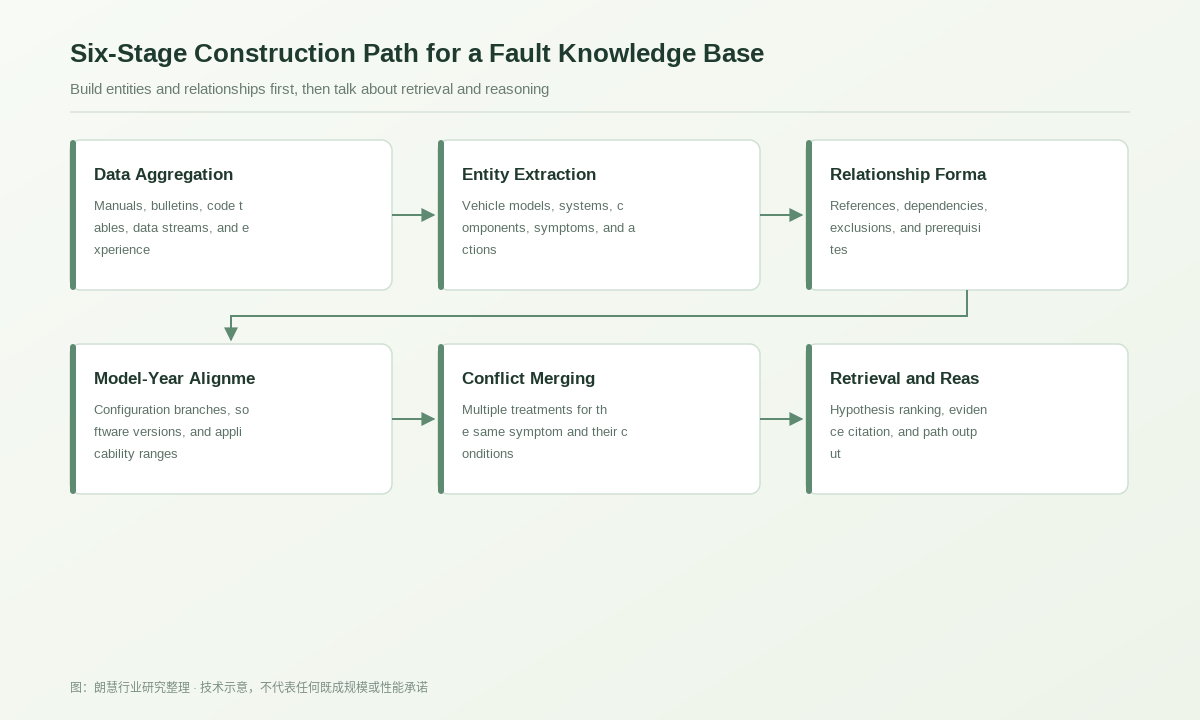
2. Fault knowledge bases: from disorganized text to a fault graph that supports reasoning
The raw form of repair knowledge is highly disorganized. Original equipment manuals contain disassembly steps and torque values; fault-code definitions and freeze-frame notes; technical bulletins and recall notices; data streams read from diagnostic tools; parts compatibility tables; and experience passed from master to apprentice in online groups. These materials differ in format, granularity, and reliability. Chopping them up and putting them into a vector database can retrieve relevant passages, but it cannot support reasoning about what to test first and what to rule out next.
A more usable approach is to establish structure first. Vehicle model, model year, system, component, fault symptom, fault code, inspection action, tools, and consumables are abstracted into entities, while references, dependencies, exclusions, and prerequisites are abstracted into relationships. For example, a fault code may point not to a single component but to several nodes along a power supply circuit; the order in which a symptom is ruled out may depend on whether the vehicle is equipped with a particular optional system. If this step is not solid, even the most sophisticated retrieval afterward is of little use.
Another benefit of structure is explainability. When the hypotheses generated by a model can be attached to specific entities and relationships, a technician can ask which piece of evidence supports a conclusion and judge whether that evidence applies to the vehicle in front of them. Conversely, if knowledge exists only as text fragments and answers must be organized by the language model itself, the system can easily sound convincing while being wrong, especially when model-year differences or exceptions are involved.
Timeliness is one of the most underestimated costs of a knowledge base. Technical bulletins are updated, parts are discontinued and replaced, and the meaning of the same fault code may change across software versions. A knowledge base needs version fields and effective dates, as well as the ability to mark which model-year range a piece of knowledge applies to. Without version management, a knowledge base accumulates large numbers of contradictory entries after just one year of use, leaving users unable to determine which information still holds.
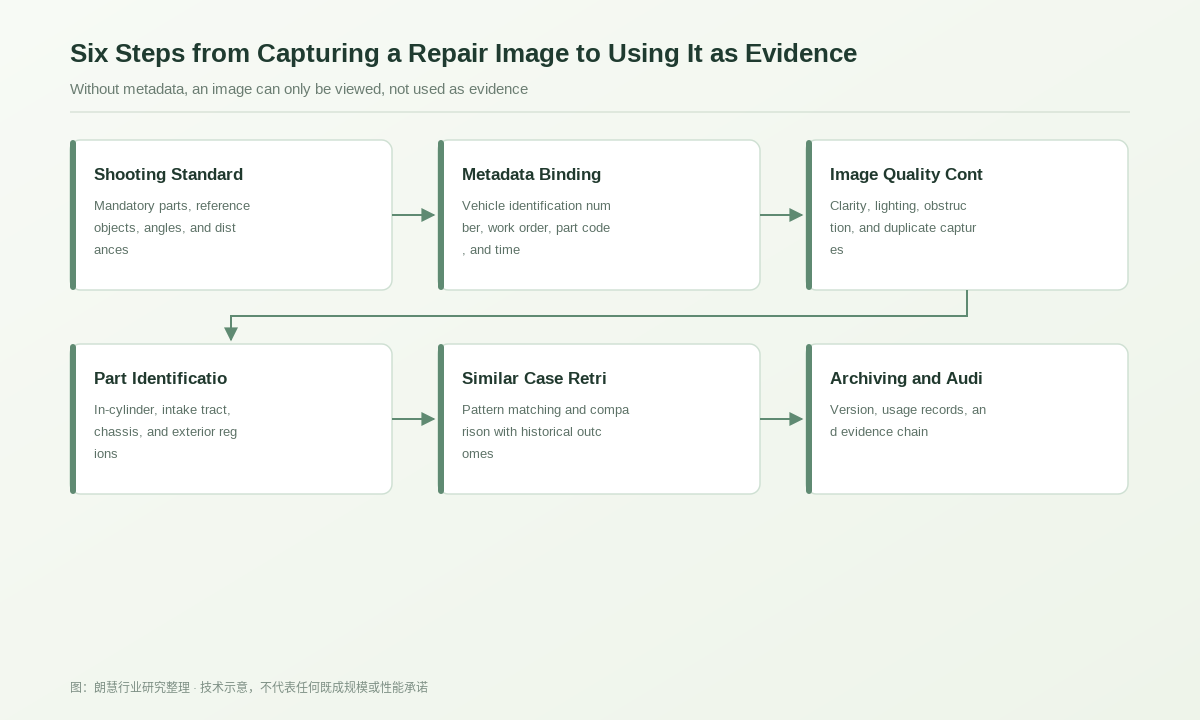
3. Repair images: for endoscopic and exterior photos, evidence comes first
Endoscopes and exterior photos have long existed in repair shops, but they have remained at the stage of being captured and sent to a technician for a look. Carbon deposits in the cylinder, abnormal wear on valve and piston crowns, contamination in the intake tract and throttle body, particulate filter blockage, and sludge in a transmission valve body are all difficult to explain in words; a single endoscopic image can say a great deal. Exterior photos serve another purpose: the extent of accident damage, the location of leaks, the pattern of uneven tire wear, and traces on paint and body panels.
The value of images lies first in evidence and only second in diagnosis. Accident assessment requires images that can be reviewed, rework disputes require photos that reconstruct the condition at the time, and the allocation of insurance and after-sales responsibility also depends on an image chain. This means images are not just model inputs; they are also business-process evidence. The engineering priority is therefore not how accurately an image is recognized, but whether the system can prove that the photo shows this vehicle, this part, and this moment.
There are almost no standards for on-site capture: insufficient light, camera shake, missing scale references, and arbitrary angles can make images of the same part look radically different depending on who took them. To make images usable, a shooting standard is needed that specifies mandatory parts to capture, reference objects, shooting distance and angle, and whether readings must be included. At the same time, the vehicle identification number, work order number, part code, capture time, and technician identifier must be bound together as metadata before images acquire value for retrieval and evidence.
Once images are combined with a knowledge base, they can support retrieval of similar cases: given an in-cylinder image and vehicle information, the system can find historical cases with similar patterns and their outcomes. The difficulty lies in annotation. Repair images lack the standardized system used in medical imaging, so part categories, pattern types, and severity grades must be defined locally, while consistency across technicians must be ensured. Without consistency, the retrieved cases are only superficially similar.
4. Work orders and parts: connecting diagnostic conclusions to execution conditions
Work orders are a repair business's real data asset, but also its dirtiest data. Symptom descriptions are filled in casually by service advisors or technicians, and terms such as noise, vibration, and lack of power have no unified definition. Inspection processes often record only the conclusion, not the process of elimination. Replaced parts and labor records are relatively standardized, but the link to fault symptoms is frequently missing. To train or evaluate a model with work orders, free text must first be converted into usable structure.
The value of parts data is that it turns diagnostic conclusions into executable actions. A fault hypothesis must ultimately resolve to a specific part: the original equipment part number, approved substitutes, compatible model years and configurations, removal and installation locations, and required special tools. One wrong compatibility relationship can mean a technician removes a part and cannot reinstall it, or reinstalls it while the problem persists. Compatibility tables are usually branched by model year and configuration, with many versions and frequent changes. Until this problem is solved, even accurate diagnosis cannot be put into practice.
The relationship among the three data types can be understood this way: the knowledge base provides hypotheses and paths for elimination, images provide on-site evidence, and work orders and parts provide outcome validation and execution conditions. Without any one of the three, the system degrades: a knowledge base alone becomes an encyclopedia, images alone become a photo album, and work orders alone become a ledger. Only after the three are connected does the full chain emerge: on this vehicle, this symptom is most likely to arise through three paths; test this item first; if the result is such and such, prepare this part.
The difficulty of connecting them lies in identifier alignment. The same vehicle may appear in different systems by license plate, vehicle identification number, work order number, or member number. The same component may be named differently in a manual, parts table, and work order. A master data set and mapping rules are required, with room for manual correction. There is no shortcut here; every field must be matched one by one. Once that is done, the cost of all subsequent analysis falls.
5. Explainability: technicians want a path, not a conclusion
Repair technicians have a lower tolerance for AI than most professions. The reason is practical: one wrong teardown costs time, may require paying for a part, and requires an explanation to the customer. They will not accept an answer like, “I think it's the water pump.” They want to know why the water pump is suspected, what to test first, and what result would rule it out. In this setting, explainability is not a compliance requirement; it is a precondition for use.
There are roughly three workable forms of explanation. The first is evidence citation, attaching manual passages, bulletin entries, and similar cases to a hypothesis, with the source text available on click. The second is path presentation, laying out inspection actions as an ordered list and stating the decision conditions and branches at each step. The third is confidence tiers, using coarse-grained labels such as highly likely, requires verification, and insufficient information rather than a seemingly precise probability. Used together, these three methods are far more useful than a single natural-language explanation.
A more dangerous issue is a plausible-looking causal chain. Models are good at generating reasoning that reads smoothly, but causation on the repair site often carries preconditions: a fault may occur only when the engine is cold, only in a particular gear, or only at a specific voltage. If those preconditions disappear from the explanation, a technician may follow it, obtain a normal test result, and thereby rule out the actual fault. The system must therefore state preconditions explicitly and, when information is insufficient, proactively identify what data is still missing.
Refusal and escalation mechanisms matter just as much. When a vehicle model or fault exceeds the knowledge coverage, the system should say that it does not know and provide a path for obtaining the information: which manual section to consult, which type of tool to use for retesting, and which level of technical support to contact. In the long run, a tool that dares to refuse is more trustworthy than one that always produces an answer, because it does not create false certainty around critical judgments.
6. Shop deployment: 4S dealerships and independent shops are not the same problem
The differences between 4S dealerships and independent repair shops are greater than people expect. A 4S dealership typically handles a relatively narrow range of models, has original manuals and dedicated diagnostic tools, follows standardized processes, and assigns clear roles to technicians. Their pain points are difficult faults and bay efficiency: one difficult vehicle occupies a bay, and every vehicle waiting behind it is affected. Independent shops deal with a wider mix of models, incomplete documentation, price sensitivity, and high technician turnover. Their first pain point is whether a vehicle can be repaired at all and whether it is worth repairing.
This difference means that one product cannot serve every market. For 4S dealerships, the tool must fit into existing diagnostic workflows, output inspection sequences and labor-time references, and help bays turn over faster. For independent shops, the tool must cover long-tail models and solve identification and judgment before talking about efficiency. The same knowledge base therefore needs different presentation and interaction designs for each setting; otherwise, neither side will be satisfied.
Deployment is also constrained by shop conditions. Many shops have unstable networks, and reliable connectivity is unavailable next to the bay. Putting all inference in the cloud can create obvious waits. A workable combination is local inference with cloud updates: local devices handle retrieval and inference for common models, while the cloud handles knowledge updates and deep analysis of difficult problems. This hybrid architecture demands strong version consistency, because outdated local knowledge can directly produce wrong recommendations.
The deployment rhythm should be to prove the system in one shop before discussing replication. The standard for success is not how many devices have been installed, but whether a stable usage habit has formed: technicians proactively open the tool when they encounter an uncertain fault, and they leave feedback after using it. Until that habit exists, expanding to more shops will only amplify the problem and push unvalidated workflows into more locations.
7. Technician adoption: the barrier is often not training
Technicians rarely reject a tool because they do not know how to use it. Three reasons are more common: one extra step, one extra account, and one extra judgment. Hands are oily on the repair site and the pace is continuous. Any action that requires switching applications or re-entering information will be abandoned. Where the tool is placed therefore matters more than how many features it has. Putting it next to the diagnostic tool or inside the work order system is far more effective than building a separate app.
Input methods must also accommodate the site. Describing a fault by voice, taking a photo, and scanning a vehicle identification number cost far less than typing. Output must accommodate the site as well: the conclusion, evidence, and next step should fit on one screen rather than requiring three levels of menu navigation. These may look like interaction details, but in practice they determine whether the tool will be used a second time.
Handling disagreement is a key part of adoption. When an AI judgment conflicts with a technician's experience, a system that insists on its own conclusion will simply be turned off; a system that silently changes its mind loses its value. A better approach is to record the disagreement: flag the technician's differing judgment, attach the final outcome, and use it as input for later knowledge correction. Disagreement is not failure; it is precisely the kind of sample the knowledge network most needs.
Performance metrics require care. Measuring shops by number of uses will produce a large volume of meaningless queries. Measuring by click-through rate will produce clickbait-style presentation. A more reasonable approach is to examine outcome metrics: first-time fix rate, rework rate, average diagnostic time, and the number of ineffective teardowns. These metrics change slowly, but they point in the right direction and will not push technicians toward going through the motions.
8. Offline deployment and multilingual support: going global doubles the engineering constraints
International expansion amplifies constraints. Network conditions vary widely among independent repair shops overseas, and bandwidth and stability in some regions are insufficient to support real-time cloud inference. Data compliance may also require repair data to remain local. Offline deployment is therefore not a bonus feature but an entry condition: without it, the system cannot get through the door.
Offline use entails a whole set of trade-offs. Models must be quantized and compressed, knowledge bases must be distributed in segments, updates must support incremental changes and rollback, and local and cloud versions must be reconcilable. After compression, model performance on long-tail faults will decline, and retrieval and rules must fill the gap rather than relying on brute force. A more realistic engineering approach is to layer capabilities: common faults are handled locally, while difficult problems go to the cloud when connectivity is available.
Multilingual support does not mean translating the interface. Terminology density is extremely high in repair work. Fault-code descriptions, component names, and removal and installation actions all have established industry formulations, and machine translation can easily confuse the throttle body with the throttle valve, or the timing belt with the timing chain. A workable path is to maintain a terminology list, turn multilingual mapping into a controlled vocabulary, and manage interface copy translation separately from terminology mapping so that one change does not affect the entire system.
Hardware selection must distinguish between usable and good. A standalone inference device has limited computing power, and being able to run does not mean the response is fast enough. The experience threshold in a shop is low: once waiting exceeds a dozen seconds or so, a technician will go back to flipping through the manual. Selection should be stress-tested against real bay scenarios rather than judged by nominal specifications and demo videos.
9. Data flywheel: three breakpoints in the loop
The long-term value of repair AI lies not in the model, but in the loop between data and knowledge. Shop usage produces diagnostic paths and outcomes; outcomes flow back to correct knowledge; updated knowledge makes the tool more useful; greater usefulness drives more usage. The loop sounds smooth, but in practice it has three breakpoints, and the flywheel cannot turn if any one of them is not connected.
The first breakpoint is the willingness to send data back. Repair data is an asset to a shop, especially difficult cases, and technicians are reluctant to contribute it for free. A workable mechanism is exchange: contribute cases in return for more complete knowledge and more accurate retrieval. The second breakpoint is outcome annotation. Many completed repairs do not record what the final problem was; they only record which parts were replaced. Without outcome labels, the returned data cannot be used to correct judgments. The third breakpoint is conflict merging. The same symptom may be handled differently at different shops, so the system must be able to express that both approaches are viable under different conditions rather than forcing them into one answer.
There is also a frequently overlooked bias: the cases that get recorded are often the vehicles that were successfully repaired. Vehicles that were not fixed, judgments that were wrong, and customers who gave up rarely enter the system. Training only on successful cases will make the system overestimate its own accuracy and produce overconfident recommendations in difficult scenarios. Failed cases must be actively sampled, even if they are obtained indirectly through follow-ups or rework records.
Models are updated every few months, so building a moat around a model is not reliable. What is genuinely difficult to replicate is the data mechanism: who is willing to provide data, how it is annotated, how conflicts are merged, and how results are validated. This mechanism takes time to build, but once it exists, changing models does not require tearing everything down.
10. Evaluation and acceptance: do not summarize everything with a single accuracy score
The most common mistake in evaluating repair AI is relying on one broad accuracy score. The difficulty distribution of fault diagnosis is extremely uneven: routine maintenance issues are almost never wrong, while intermittent electrical faults, vibration strongly tied to operating conditions, and problems requiring joint investigation across multiple systems have a much lower baseline. Combining them into one number shows neither progress nor comparability across different approaches.
A reasonable approach is layered evaluation. At the diagnostic layer, look at hypothesis hit rate and the number of test steps: whether the true cause appears among the three hypotheses provided, and how many steps are needed on average to localize it. At the business layer, look at first-time fix rate, rework rate, bay throughput, and the number of ineffective teardowns. At the knowledge layer, look at coverage, timeliness, and conflict rate: how many vehicle models and fault types are covered, how often entries are updated on average, and how many contradictory records exist for the same symptom.
The acceptance method must be reproducible. Use held-out vehicle models and fault types for blind testing, replay historical work orders, and compare different bays within the same shop. Each of the three methods has its own bias: blind testing is clean but has a small sample; replay is closer to reality but limited by the quality of historical records; bay comparison is the most realistic but takes longer. Using them in combination is more reliable than relying on one method alone and makes it easier to provide evidence when the two sides disagree.
Safety boundaries must be written into acceptance criteria. Any judgment related to braking, steering, airbags, or high-voltage systems must undergo human review and leave an audit trail, regardless of how confident the model is. This is not distrust of the model's ability; it is a requirement of accountability. If something goes wrong, it must be possible to identify who made the decision and on what basis.
11. A forward-looking assessment for the next 12 to 24 months
First, knowledge forms will become hybrid. Pure-text retrieval will move into a supporting role, while structured fault graphs combined with similar-case retrieval will become the main path. The reason is straightforward: repair scenarios require explanations that are both explainable and executable, and pure text cannot provide an inspection order. Whoever can align manuals, bulletins, work orders, and images to the same set of entities will have a more durable knowledge base.
Second, images will enter the standard work-order workflow. Endoscopic and exterior photography will move from being captured only when remembered to being mandatory under a shooting standard, with metadata binding becoming the default. This will bring both a new body of data and new annotation needs. Methods for ensuring consistency in image annotation can be transferred from the medical imaging field, but the grading system must be rebuilt for repair scenarios rather than copied directly.
Third, information accessibility will improve. Discussions around opening up repair information and the right to repair are progressing across multiple markets, and the scope of original equipment material available to independent repair shops is expanding. This is favorable for AI tools in independent shops, but it also means knowledge bases must handle sources with different origins and inconsistent standards. Conflict merging will become a core competitive capability.
Who will benefit first? My assessment is that it will be chain stores with accumulated work order data, automotive OEM after-sales operations with established original-equipment material systems, and manufacturers of diagnostic-tool hardware, all of which naturally occupy an entry point. Evaluation criteria will also shift: from whether answers are correct to how many steps were saved, how many unnecessary teardowns were avoided, and how much rework was reduced. Once that shift happens, products competing on the strength of demos will quickly lose their position.
Langhui's Engineering Capabilities Along This Path
Langhui's capabilities lie on the data side, not in automotive diagnosis itself. We design capture standards, structured annotation, quality control and consistency reporting, and data dictionaries and version records. In healthcare, our scope covers modalities such as CT, MR, PET, mammography, and ultrasound. Transferred to repair scenarios, this methodology takes the form of image shooting standards, part and pattern grading tables, consistency sampling checks for annotations, and traceable metadata and version management.
Specifically for repair knowledge bases, we can take on methods for organizing entities and relationships, annotation system design, alignment rules and conflict records across data sources, and pre-delivery consistency assessment reports. The diagnostic logic itself requires participation by industry experts; we do not replace it, nor do we claim established domain knowledge in automotive diagnosis. Compliance assessments and legal opinions are issued by qualified institutions.
If your team is building repair image datasets, structuring fault knowledge, or governing fields in work order text, you can send us the data scale, vehicle model coverage, and delivery milestones. We will provide actionable annotation standards and a quality inspection plan. Build the standard once, and subsequent batches can reuse it directly.
FAQ
Can automotive repair AI really replace senior technicians?
Not in the short term. It replaces work such as consulting references, comparing cases, and organizing inspection sequences, externalizing part of the judgment process and giving mid-level technicians a path to follow for common difficult faults. The parts that genuinely require listening to sounds on site, feeling temperatures, and judging by hand still depend on people. A more realistic goal is to free senior technicians from repetitive troubleshooting rather than to remove people from the process.
Can a general-purpose large model plus a prompt perform fault diagnosis?
It can converse, but it cannot deliver. General-purpose models lack underlying data such as vehicle model years, fault-code definitions, and parts compatibility, and when confronted with a specific vehicle line they can easily produce fluent but incorrect causal explanations. To build a usable system, at minimum you need structured fault knowledge, searchable cases, and rules and tools that constrain the output scope.
What kind of shooting standard do endoscopic and exterior photos need?
The core is three things: where to shoot, how to shoot, and how to prove it. Specify mandatory parts and shooting order, define reference objects, angles, and distances, and bind the vehicle identification number, work order number, part code, and time as metadata. Without any one of these, the image can only be viewed and cannot be used for retrieval, damage assessment, or rework disputes.
Can an AI tool still be used when the shop network is very poor?
Yes, but it must be designed with offline-first principles. A common approach is for local devices to handle retrieval and inference for common vehicle models, while the cloud handles knowledge updates and difficult-case analysis, with local and cloud versions reconcilable and rollback-capable. Models must be quantized and compressed, long-tail capabilities must be filled with retrieval and rules, and the compressed model should not be expected to answer everything.
How do you decide whether an automotive repair AI tool is worth adopting?
Do not judge by the demo. Look at three outcome metrics: first-time fix rate, number of ineffective teardowns, and average diagnostic time. Ask the supplier to replay your shop's historical work orders and agree on blind-tested fault types. At the same time, confirm whether recommendations involving safety-critical parts require mandatory human review and leave an audit trail; this determines whether responsibility can be clearly assigned if something goes wrong.
- W3C PROV-O: The PROV Ontology https://www.w3.org/TR/prov-o/
- NIST AI Risk Management Framework https://www.nist.gov/itl/ai-risk-management-framework
- Retrieval-Augmented Generation for Knowledge-Intensive NLP Tasks https://arxiv.org/abs/2005.11401
- ISO/IEC 42001:2023 Artificial intelligence management system https://www.iso.org/standard/81230.html
- U.S. FTC, Nixing the Fix: An FTC Report to Congress on Repair Restrictions https://www.ftc.gov/reports/nixing-fix-ftc-report-congress-repair-restrictions