
FORWARD DEPLOYED ENGINEER / AI DELIVERY
FDE and AI Delivery: The Bottleneck Is at the Engineering Front End—How to Build Talent and Co-Creation Methods
As models become more capable in general, the bottlenecks in enterprise adoption are increasingly concentrated at the engineering front end: requirements cannot be articulated clearly, task definitions are not verifiable, and systems are unstable in production. This article examines FDEs (forward deployed engineers), breaking down the division of labor between engineering- and domain-oriented roles, their capability models, project cadence and client co-creation methods, and discusses development paths and forward-looking assessments over the next 12 to 24 months.
Over the past two years, model capabilities have advanced faster than enterprises have been able to put them to use. There is a wide gap between demo performance and production performance: data remains inside the enterprise, tools are decade-old legacy systems, acceptance criteria are buried in appendices, and no one has clarified responsibility boundaries. None of these issues sit on the model side; they sit at the engineering front end. FDE is the role created to address this stretch. This article explains what they actually do, how the two types of roles are divided, how capabilities are evaluated, how people are managed, and which practices look impressive but accomplish little.
1. The Bottleneck Is Not in the Model, but in the Stretch from Idea to Specification
The difficulty of using AI in enterprises increasingly lies not in what the model can do. The supply of general-purpose capabilities is already sufficient; what truly blocks progress is the stretch ahead. A client has a vague idea, but is unsure whether AI can accomplish it or how it should be done. If this stretch is not worked through, the more effort goes into development, the further it drifts from the mark.
The engineering front end refers to the process of turning an idea into an executable, verifiable specification. It is necessary to clarify who currently performs the process, how long it takes, what happens when errors occur, and which steps cannot be changed; to express the goal in terms of inputs and outputs, boundaries and error tolerance; and to connect internal materials, tools, rules and workflows. None of this belongs to model training, yet if any piece is missing, the system cannot enter production.
FDEs (Forward Deployed Engineers) are responsible for this stretch. Rather than polishing a general-purpose product at headquarters, they work on-site with the business, translating vague requirements into task definitions, connecting internal materials into knowledge bases, turning rules into constraints, and finally delivering a system that runs and can be accepted. The value of this role lies not in how fast code is written, but in converting uncertainty into something executable.
2. The Six-Stage FDE Delivery Chain
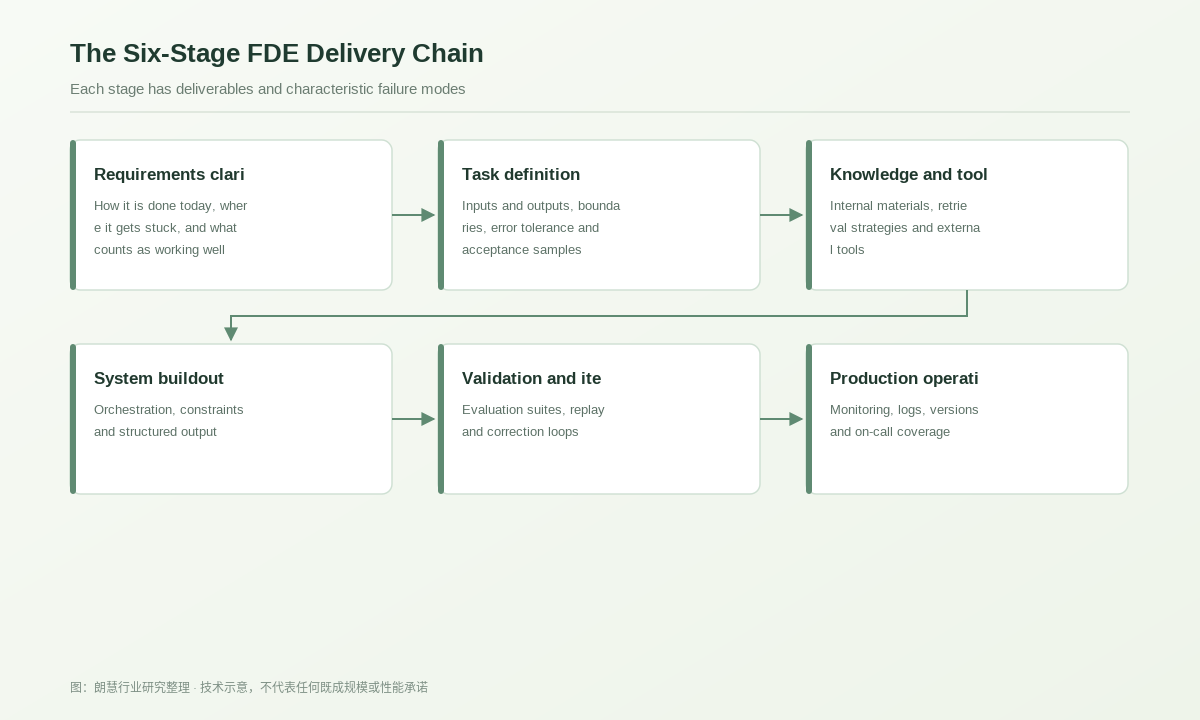
A complete delivery chain can be divided into roughly six stages: requirements clarification, task definition, knowledge and tool integration, system buildout, validation and iteration, and production operations. Each stage has clear deliverables and characteristic failure modes. The chain is mapped out not to make the process look tidy, but to identify which stage a project is stuck in when it stalls.
During requirements clarification, what the client says is often not the actual need. “We need an intelligent customer service agent” may be driven by inaccurate ticket classification that slows dispatch. The FDE's job is not simply to take the request at face value, but to ask three layers deeper: how is it done today, where does it get stuck, and what counts as working well? This step does not consume much of the total delivery time, but it determines the direction of all subsequent work. If the direction is wrong, rework costs are highest.
Task definition means writing the goal as a specification the machine can execute and a human can accept. What the inputs are, what the outputs look like, where the boundaries lie, and how much error tolerance is acceptable must all be put on paper. The most common pitfall here is writing “accurate answers” as an acceptance criterion, because it cannot be measured. A measurable formulation provides a set of samples, specifies how many of them must achieve defined results, and sets out what happens when they do not.
The remaining four stages are engineering work. They look like standard actions, but every client's constraints are different: whether data can leave its domain, whether third-party components can be installed, how long logs must be retained, and who is on duty after launch. If these constraints are not written into the plan, they will erupt on launch day. Experience shows that the larger the organization, the more important it is to surface constraints upfront rather than leave them for integration testing.
3. Two Types of FDE: How Engineering- and Domain-Oriented Roles Divide the Work
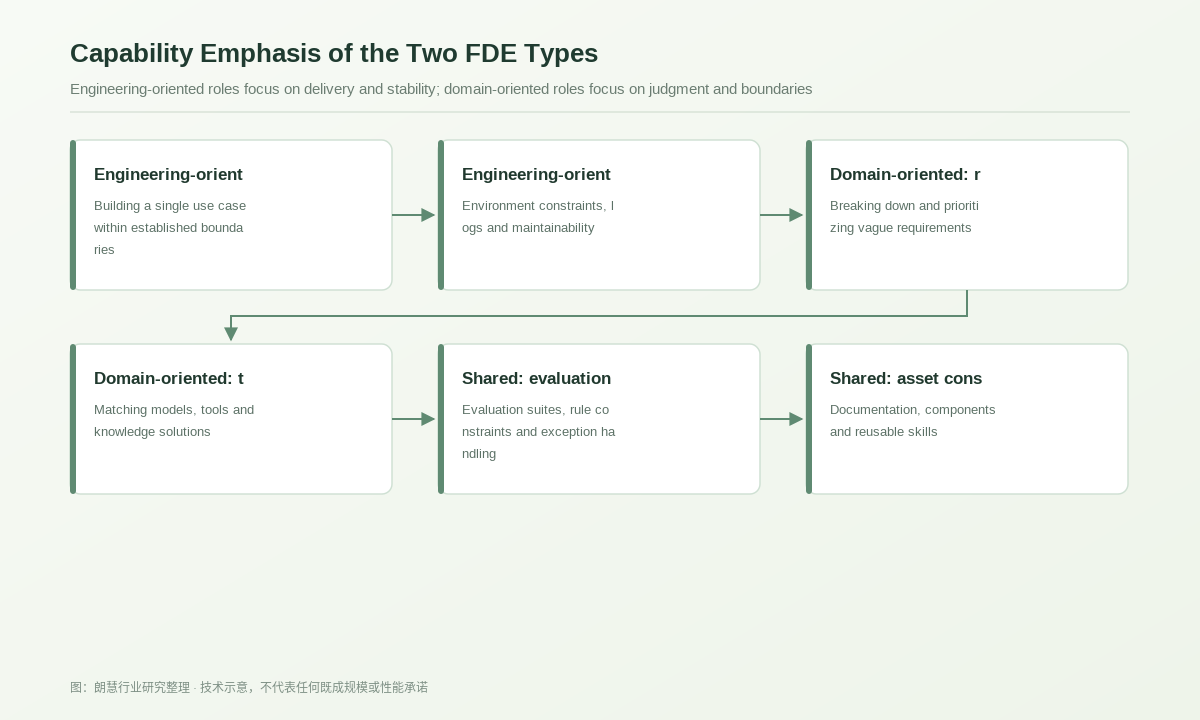
In practice, FDEs fall into roughly two categories: engineering-oriented and domain-oriented. The distinction is not about labeling people, but because their capability structures and evaluation methods differ greatly. Training them in a blended way often fails on both fronts: people with an engineering background, asked to justify requirements, tend to translate vague ideas directly into technical solutions; people with a domain background, asked to deliver independently, tend to lose control of the details.
Engineering-oriented FDEs work in relatively well-defined scenarios: the client knows what it needs, and which data the system must connect to and where it will be deployed are largely determined. Their work is development, integration, deployment and operations—building and stabilizing a single use case within established boundaries while keeping it maintainable. Compared with traditional roles, this is close to a technical presales position, except that they can now genuinely develop and deploy systems.
Domain-oriented FDEs face vague requirements: the client has only a directional idea, wants to introduce AI, but does not know where to begin. They must repeatedly work through the requirements with the client, determine what can be done, what should not be done, and which approach is most reliable, while also defining the division of labor and responsibility between humans and machines. This role is close to a solution-oriented presales position, but demands more depth: it requires both industry knowledge and an understanding of where models are applicable within that industry.
Problems most often arise at the boundary between the two roles. In team composition, every project needs at least one person accountable for business judgment and one accountable for system stability. The same person may hold both responsibilities, but at least one must be assigned. Many projects fail not because capability is lacking, but because no one is truly accountable for key judgments.
4. Capability Model: Three Questions, Three Capabilities
Whichever type of FDE is involved, delivery ultimately comes down to three questions: Is the task definition clear? Is the system stable in operation? Are the answers professionally correct? These questions correspond to three capabilities and three of the most common failures: drifting requirements, unstable production performance, and wildly incorrect answers.
The core of task-definition capability is requirements engineering. It requires translating client language into input-output specifications, identifying contradictory requirements, and making trade-offs when resources are limited. This capability is difficult to acquire through classes; it comes mainly from repeated lessons imposed by changing requirements on real projects. To assess whether someone has it, see whether they can break down a vague requirement into three verifiable subtasks within half an hour.
Reliability engineering capability comes from a clear understanding of the characteristics of large models: they perform probabilistic reasoning, so the same question may produce different outputs twice. Production systems cannot accept that kind of uncertainty, so tools, rules and structured output must constrain it within a verifiable range. Determining which steps must follow deterministic processes and which can be delegated to the model is a core craft of FDE work and the hardest part to learn quickly.
Professional correctness is judged by testing standards. The model should not simply be allowed to declare that it answered correctly; instead, a reproducible evaluation suite must be established, covering typical and boundary scenarios, and run after every change. The evaluation suite is itself an asset: it records what counts as right and wrong in the business, as well as the conditions under which clients will be dissatisfied.
5. Project Cadence: 20% Generation, 80% Validation
A common misconception is that AI projects move slowly at the beginning and quickly at the end. The reality is the opposite: it is fast to produce an initial result from the model—something demonstrable can be ready within days—but making it deliverable consumes most of the time. The gap lies mainly not in features, but in edge cases, exception handling and data quality.
A more realistic allocation of time is 20% for producing an initial version and 80% for validation, testing and correction. This ratio is not a precise statistic, but a practical reminder. If a team's allocation is reversed—chasing performance first and adding data and evaluation later—delivery quality will inevitably suffer, because optimization has no baseline and no one can tell whether a change made things better or worse.
In terms of cadence, the project should be divided into several small, verifiable segments, each with clear acceptance criteria. The first segment is usually task definition and the evaluation suite; the second is the minimum chain connecting data and tools; only the third addresses performance optimization. This order may look slow, but it actually saves time: once the evaluation suite is in place, every subsequent change can immediately be assessed for its value.
There is another cadence-related pitfall: expectations become inflated during demos. A demo uses selected scenarios, while production covers the full scenario space; the performance gap between the two must be explained in advance. If it is not, the post-launch shortfall becomes a trust issue, and once trust is lost, even excellent iterations later on become difficult to push through.
6. Co-Creation with Clients: Three Actions, No Unproductive Meetings
Co-creation does not mean holding more meetings. Truly effective co-creation involves only three actions: requirements justification, prototype walkthroughs and joint acceptance. Most other meetings can be compressed into written updates, leaving time for on-site work.
Requirements justification should begin with questions, not with a prepared solution. Prepare a checklist: who currently performs the process, how long it takes, what happens when errors occur, which steps cannot be changed, and under what circumstances it is better not to use the system at all. Client answers often overturn the initial assumptions—and that is precisely where the value lies. The output is a scope statement that both sides endorse, clearly stating what will be done and what will not.
Prototype walkthroughs should take place at the low-cost stage. Running one path through with a small portion of real data and letting the client operate it themselves is far more effective than watching a demo. During the walkthrough, focus on two things: whether the client will misuse the system, and whether the system will produce misleading results after misuse. The latter is more dangerous than the former, because errors will be amplified by the system.
Joint acceptance criteria must be established upfront. The acceptance checklist should be written at the start of the project, confirmed by both sides, and only refined—not overturned—along the way. Projects that discuss acceptance criteria only on the day of acceptance almost never finish smoothly. Beyond functionality, the checklist must define how exception scenarios are judged, what the performance floor is, and who signs off under which conditions.
7. Human-Machine Division of Labor and Responsibility Boundaries
The human-machine division of labor is not a technical issue; it is an issue of responsibility. In areas involving personal safety, funds or compliance, a specific person must be accountable for the outcome. The system may provide recommendations, but it cannot become the sole basis for judgment or a vacuum of responsibility.
Boundaries should be drawn according to consequences. Where consequences are irreversible and losses are large, humans decide, while AI handles information preparation and exception alerts only. Where consequences are reversible and losses are small, AI may execute directly, with humans conducting spot checks. This division must be written into the plan and reflected in the interface: which results are recommendations, which require confirmation before proceeding, and what must be visible at a glance.
Responsibility boundaries must also cover failure scenarios. Who detects system errors, who handles them, how quickly, and how the incident is recorded—if these are not clearly defined, blame will be shifted after something goes wrong. Logs and audit trails are not merely technical details here; they are evidence in the chain of accountability. What to log also matters: not only inputs and outputs, but also which version and which set of rules were in use at the time.
8. Consolidation: From a Single Agent to Reusable Skills
After a project is delivered, the most likely outcome is that the people leave, the assets remain, and no one knows how to use them. To keep deliverables alive, consolidation must happen throughout the project—not as documentation added at closure.
Consolidation has three levels. The first is documentation: deployment method, dependencies, configuration and common fault handling, with the standard that someone else can run the system by following it. The second is components: extracting repeatedly used capabilities into reusable modules, such as document parsing, field extraction and retrieval strategies. The third is capability abstraction: organizing independent agents into callable skills, then combining them into larger systems.
The trend from a single agent to skills and then to higher-level orchestration is already fairly clear in engineering. Its practical value is reducing redundant construction—the next project does not have to start from zero. But abstraction should be restrained; abstracting too early produces frameworks that no one uses, increasing the burden on every project. The test is simple: only extract logic after it has appeared more than once—three times or more.
Consolidation also includes people. The judgments formed during a project—which requirements should be rejected, which types of data are unreliable, and which steps must retain human involvement—are not in the documents; they are in people's heads. During handover, having the recipient run through a small project is more useful than reading ten documents. This is also the prerequisite for scaling a team: knowledge must be able to exist independently of individuals.
9. Talent Development Path: From Role Understanding to Independent Delivery
People who want to become FDEs come from varied backgrounds: backend development, implementation, industry consulting, or recent graduates. This means training cannot start with the technology stack; it must start with an understanding of the role. First establish judgment about what this role can and cannot do, then move to tools. If the order is reversed, people will study a great deal of material they will never use.
The introductory stage broadly covers six areas: role understanding and industry scenarios, basic knowledge and use of large models, tool and framework selection, judgment of when knowledge and retrieval augmentation are appropriate, end-to-end single-use-case delivery, and communication and professional conduct. Tool selection is the area most easily taught as memorizing lists; an effective approach is to make trade-offs against scenarios: how large the data volume is, how frequently it is updated, what the client's environment can install, and how much time and staffing are available. The optimal solution for the same requirement can differ completely under different constraints.
The goal of training is not to pass an exam, but to deliver independently. A practical evaluation method uses real or simulated projects for hands-on practice: provide a vague requirement, a set of dirty data and a constrained environment, and see whether the person can deliver something runnable, verifiable and handover-ready within an agreed period. Exams can test knowledge; only projects can test judgment.
The talent system must be able to accumulate knowledge. Trainees' operating processes, common mistakes and effective solutions are themselves training materials. Organizing these into cases and question banks raises the starting point for the next cohort. This is also the real value of a training and assessment platform: not issuing a certificate, but turning hands-on experience into a reusable asset.
10. Organization and Evaluation: Do Not Treat FDEs as Extra Presales Headcount
The most common mistake in evaluating FDEs is looking only at delivery volume. Delivering more does not necessarily make someone a good FDE; it may mean they have pushed away every difficult requirement. The evaluation priorities for the two role types also differ. Using the same scorecard for both will inevitably distort results.
Engineering-oriented FDEs are evaluated more on hands-on delivery: completion, system stability, documentation and reproducibility. Stability should be assessed through architecture and logs, not presentations; reproducibility is tested by whether someone else can deploy the system by following the documentation. Domain-oriented FDEs are evaluated more on judgment: industry understanding, whether technology selection is reasonable, whether the human-machine division of labor holds up, and the quality of consolidated assets. These are softer criteria, but not impossible to measure—they can be assessed through solution reviews and project retrospectives.
At the organizational level, avoid one trap: treating FDEs as an extension of presales headcount. Presales aims to advance partnerships; FDEs aim to launch systems. Their success criteria are different. If FDE evaluation is tied to early-stage advancement, they will tend to promise things they cannot deliver, leaving problems for post-launch teams. The ultimate casualties are client trust and the team's reputation.
Another organizational issue is knowledge flow. Pitfalls encountered in the field, special client constraints and effective solutions must return to headquarters; otherwise, the next project will stumble over the same problems. Fixed mechanisms are needed: retrospective meetings, case libraries and component reviews. These mechanisms do not generate direct revenue, but they determine whether the team can scale. Without knowledge-flow mechanisms, the larger the team becomes, the more repetitive work it performs.
11. Forward-Looking Assessment for the Next 12 to 24 Months
First, FDEs will evolve from specialized roles at a handful of companies into a standard component of AI delivery teams. The reason is straightforward: as model capabilities become increasingly general, the differentiating work increasingly lies in integrating them into specific business operations—and that is exactly the FDE's job. In the talent market, people with complete delivery experience will become notably scarce.
Second, divisions of labor will become more specialized. The boundary between engineering- and domain-oriented roles will become clearer, and roles dedicated to evaluation and reliability engineering may emerge in between. Evaluation will become a standalone function, because both its workload and its professional depth are increasing; attaching it to delivery is neither realistic nor sufficiently rigorous.
Third, development systems will become standardized. A training and assessment ecosystem centered on role-based standard curricula, hands-on question banks and automated grading is already emerging, linking practice, testing and evaluation. Whether such systems can stand depends on whether their hands-on tasks resemble real delivery—not on how large the question bank is or how quickly certificates are issued.
Who will benefit first? I believe it will be teams with both industry depth and engineering capability. Pure model companies will become increasingly dependent on external partners in delivery, while pure implementation companies will struggle when they need to build systems themselves. Organizations that can connect the two will win more projects over the next two years. For individuals, the most worthwhile investment is not any particular framework, but complete experience in turning vague requirements into verifiable systems—experience that does not become obsolete when models or industries change.
Langhui's Engineering Capabilities Along This Path
Langhui takes on the data-side and evaluation-side work in AI delivery: collection-specification design, structured annotation, quality control and consistency reporting, data dictionaries and version records. In healthcare, this covers CT, MR, PET, mammography, ultrasound and other modalities. In a general AI project, these capabilities correspond to data governance for knowledge bases, construction and sampling of evaluation suites, and quality reports before delivery.
We can work with delivery teams to implement task definitions: break vague requirements into verifiable data specifications, organize internal materials into searchable and traceable structures, and turn test samples into reproducible evaluation suites. System development, model fine-tuning and production operations are handled by the client or partner; we do not replace them, nor do we claim cross-industry diagnostic consulting capabilities.
If your team is working on a knowledge-base project, needs to clarify data specifications and evaluation criteria, or wants to reduce repeated rework after delivery, send us the scenario, data scale and milestones. We will provide an actionable specification checklist and quality assurance plan.
FAQ
How does an FDE differ from a solutions architect or a presales specialist?
Presales is mainly responsible for solutions and advancing the engagement; an FDE must deliver a system that runs. An engineering-oriented FDE is close to a technical presales role, but actually performs development, deployment and operations. A domain-oriented FDE is close to a solution-oriented presales role, but must turn requirements into verifiable specifications and be accountable for launch outcomes. The test is simple: can the deliverable run in the client's environment?
Why should validation take 80% of the time on an AI project?
Producing an initial version is fast; the hard part is making it stable on real data and at edge cases. Validation must cover data quality, abnormal inputs, rule conflicts and version changes, with every item tested and documented. This ratio is a practical reminder, not a precise statistic. If a team spends all its time tuning performance, problems will typically surface in a cluster after launch.
Large-model outputs are unstable—how can they be constrained in engineering practice?
The approach is to compress open-ended generation into a verifiable range. Common practices include structured output and field validation, converting critical steps into deterministic processes, using rules and tools for pre- and post-checks, and assigning confidence tiers to results to trigger human review. The goal is not to eliminate uncertainty, but to confine it to tolerable locations.
How deep does a domain-oriented FDE need to understand an industry?
At minimum, they must be able to judge whether the client's description holds up, identify which step in the workflow is the real bottleneck, and determine which steps cannot be changed. They do not need to become industry experts, but they must be able to communicate effectively with businesspeople and recognize flawed external proposals. Judgment matters more than the volume of knowledge, because it determines whether technology selection and the human-machine division of labor hold up.
If I want to transition into an FDE role, what should I build first?
Start with task definition and acceptance design, rather than learning frameworks first. Choose a real scenario, write the vague requirement as input-output specifications and evaluation samples, then build a minimal working chain. Frameworks will change; the experience of turning vague requirements into verifiable systems will not become obsolete. Practice communication as well—FDEs spend half their time aligning boundaries with clients.
- NIST AI Risk Management Framework https://www.nist.gov/itl/ai-risk-management-framework
- ReAct: Synergizing Reasoning and Acting in Language Models https://arxiv.org/abs/2210.03629
- Retrieval-Augmented Generation for Knowledge-Intensive NLP Tasks https://arxiv.org/abs/2005.11401
- ISO/IEC 42001:2023 Artificial intelligence management system https://www.iso.org/standard/81230.html
- W3C PROV-O: The PROV Ontology https://www.w3.org/TR/prov-o/