
INDUSTRY LLM / FROM BENCHMARKS TO SCENARIO METRICS
Industry LLM Deployment: What Is Actually Missing Between General Capability and Scenario Metrics
Scores on general leaderboards and the results accepted in real business settings are often not the same thing. This article breaks down the work needed to move an industry LLM from general capability to scenario metrics across evaluation-set construction, domain fine-tuning, knowledge bases and tool calling, cost and latency, on-device/cloud division of labor, and industry standards and trust requirements. It also explains which stages are likely to stall after a pilot and offers judgments for the next two years, giving project owners and data teams a reference for comparison.
When connecting a general-purpose LLM to a specific industry, the common gap is not that the model is not smart enough; it is that people do not know how to prove it is sufficient. Public leaderboards test general questions, while business settings need stable performance on a particular set of tasks. The former can be optimized for a higher score; the latter requires an evaluation set built around the actual workflow. This article explains evaluation, fine-tuning, retrieval, tools, cost, compliance, and acceptance in the order in which deployment actually happens, focusing on issues that only become clear after working on a project. Rather than debating how strong a model is, it is better to define what counts as getting it right first; model selection, fine-tuning, and launch will then go more smoothly.
1. Why General Leaderboard Scores Cannot Serve as Acceptance Criteria
Public leaderboards test general capability. Their questions are public, their criteria are consistent, and their results are reproducible—features that make them useful for horizontal comparison but unsuitable as acceptance criteria. Business settings raise a different set of questions: Can this type of document be processed correctly in one pass? Will any field be missed? If an error occurs, can people detect and correct it? Three layers separate these concerns: data distribution, workflow constraints, and the cost of errors.
A model with high scores may still be unusable in a specific workflow for very mundane reasons. Its output format may not meet the parsing requirements of downstream systems; long documents may be truncated at critical paragraphs; it may refuse questions outside its permissions; or it may invent a plausible-sounding explanation when there is no evidence. These issues rarely lower scores in general evaluations, but they directly cause rework in business operations.
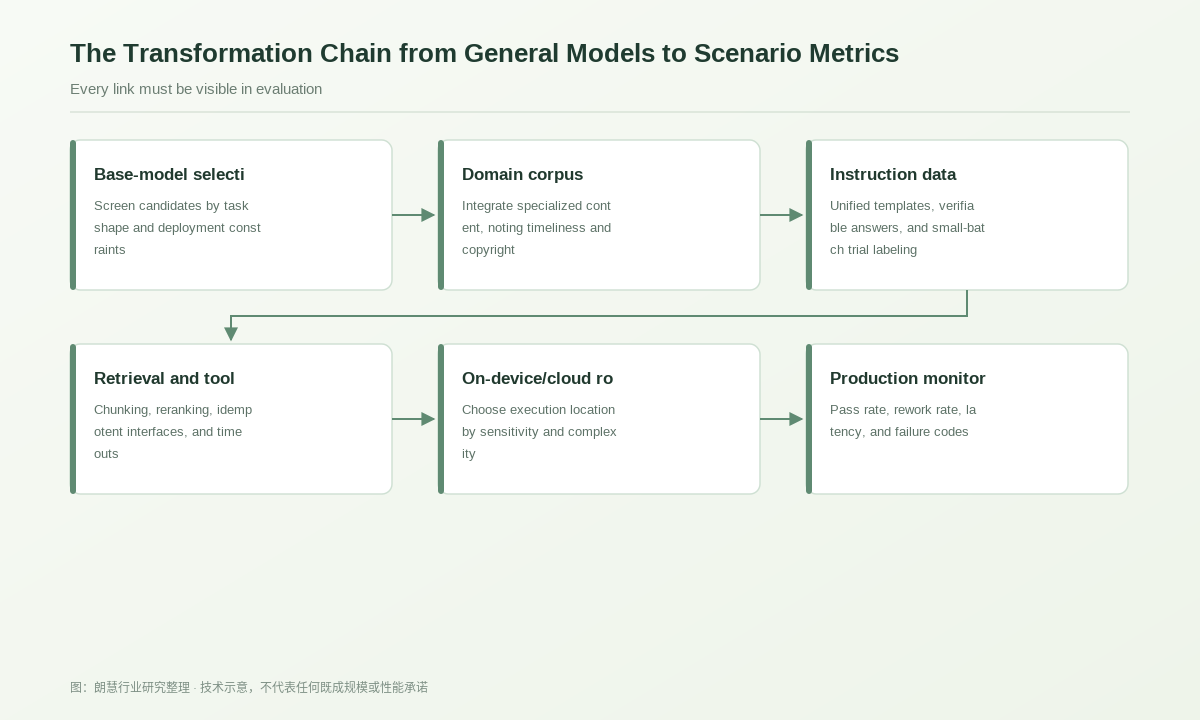
Scenario metrics must be measurable and explainable. Common ones include task completion rate, first-pass acceptance rate, manual-review rework rate, average processing time, and the distribution of return reasons. Looking at any one of them in isolation can be misleading: a high pass rate with a large manual-review workload means the model output is not trustworthy; a short processing time with a high return rate means work has simply been shifted downstream.
There is a common trap here: using leaderboard rankings for model selection and demonstrations for acceptance. Demonstrations select samples the model is good at, while acceptance must face the real distribution. A more reliable order is to define scenario metrics and the evaluation set first, and then select a model, so that selection discussions have a shared language.
| Scenario metric | Definition | Why general leaderboards cannot measure it |
|---|---|---|
| First-pass acceptance rate | Share accepted downstream without manual modification | Leaderboards do not distinguish whether manual rework is needed |
| Review rework rate | Proportion requiring return and redo after human review | Leaderboards have no review stage or accountability chain |
| Average processing time | Total time including retrieval, tool calls, and queuing | Leaderboards do not account for the engineering pipeline or concurrency |
| Return-reason distribution | Format, missing evidence, out-of-scope access, and content errors | Leaderboards show only right or wrong, not reason categories |
2. Evaluation-Set Construction: Sampling from Real Tasks
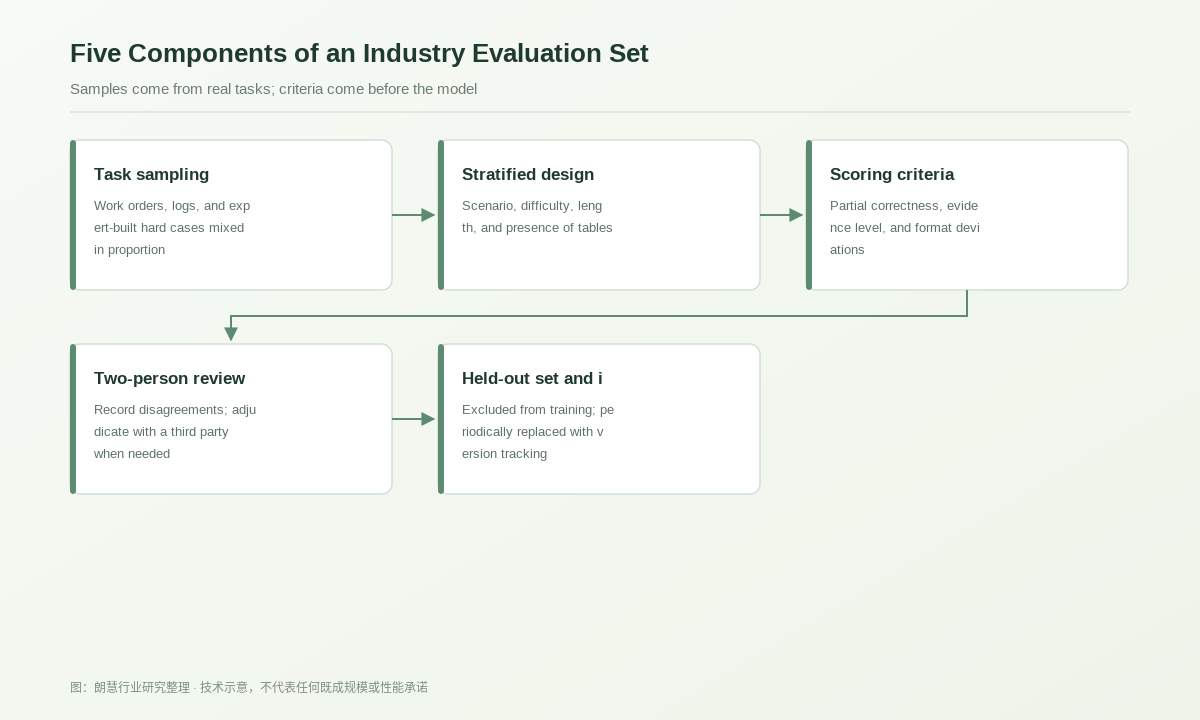
Evaluation-set samples generally come from three sources: real work orders and operation logs, difficult cases constructed by domain experts, and failed online cases fed back into the set. Each source serves a purpose: real samples ensure the distribution, expert-built cases establish the upper bound of difficulty, and failure feedback keeps evaluation from stagnating. Using only one source quickly reduces the evaluation set's ability to discriminate.
Stratification is an easy step to skip when designing an evaluation set. Samples should be stratified by scenario, difficulty, input length, and whether tables or images are present, with enough samples in each stratum so that results are not diluted by easy cases. If only easy questions are included, model scores look excellent, but performance drops immediately when complex inputs appear in production. This kind of misjudgment recurs across projects.
Labeling criteria should be written as scoring rules, not merely as “good” and “bad.” What counts as a partially correct answer, what level of evidence citation qualifies, and whether format deviations incur penalties must all be defined in advance. If scoring rules are ambiguous, two-person review turns into an argument and the decision eventually falls to the person with the higher rank, undermining the objectivity of the evaluation set.
Contamination prevention and version management matter equally. The held-out set must not participate in training, some evaluation questions should be replaced regularly, and the source and ingestion time of each sample must be recorded. For externally purchased evaluation data, confirm whether it has already appeared in public corpora; otherwise, scores will be inflated. The evaluation-set version must be registered alongside the model version, or after a few months it becomes impossible to explain where an improvement came from.
3. Domain Fine-Tuning: Data, Objectives, and the Boundary of Overfitting
In industry deployments, gains usually come from combining three things: instruction fine-tuning teaches the model task formats and expression habits, knowledge integration adds specialized content the model has not seen, and tool calling enables it to operate real systems. Continued pretraining remains valuable in a few domains with extremely rich corpora, but for most teams its return is lower than that of the first two approaches.
The quality of instruction data matters more than its quantity. For the same task, different annotators may produce completely different answer criteria; if an answer cites outdated regulations, the model will learn the error reliably. A practical approach is to define answer templates and evidence sources first, run a small trial annotation batch, and scale up once consistency meets the target.
Overfitting manifests in industry models in specific ways: memorizing answers, so a change in phrasing makes the model unable to answer; rigid formatting, so it outputs the same structure regardless of input length; and reduced generalization, so it performs well within the training distribution but fails in an adjacent subdomain. The monitoring approach is dual-track evaluation using a held-out set and real tasks; a widening gap between the two is the signal.
The order matters: build evaluation before fine-tuning. Without evaluation, changes after fine-tuning can only be judged by feel, and it is impossible to determine whether the problem lies in the data, training, or retrieval. Some teams do it in reverse—train a few versions and then examine the results—only to discover that training was not the issue and the evaluation criteria themselves were inconsistent.
4. Knowledge Bases and Retrieval: Turning “I Don’t Know” into “I Can Look It Up”
The quality of a knowledge base depends first on chunking rather than the model. Chunking by section, by clause, or by question-and-answer pair produces very different results: chunks that are too fine lose context, while chunks that are too coarse still fail to yield an answer after retrieval. Metadata matters just as much: source, effective date, applicable audience, and version determine whether retrieval results can be trusted.
Retrieval failure modes are relatively consistent: synonyms and abbreviations are not covered; IDs and model numbers are treated as ordinary words; relationships across documents cannot be found; and outdated content appears first. Targeted measures include building a synonym table, exact-matching structured fields, adding a reranking layer after retrieval, and tagging time-sensitive content with validity periods.
Answers must point back to the original text. Industry users have limited trust in “what the model says”; what they are willing to accept is “it says this here—see for yourself.” Retaining citation locations, page numbers, or clause numbers in the output is therefore part of usability, not a nice-to-have. A question-answering system without traceability is difficult to adopt in formal workflows.
A knowledge base needs an update mechanism and access controls. When a new regulation takes effect and an old version is withdrawn, the absence of a retirement process means the model may retrieve mutually contradictory content. With permissions, different roles can see different sets of materials, so filtering must happen at the retrieval layer rather than by masking the model output afterward.
5. Tool Calling and Workflow Integration: The Engineering Work Beyond the Model
Tool-calling stability depends largely on interface design rather than model capability. Parameter names must be unambiguous, required fields should be few, and return-value structures must be stable; write operations should support idempotency to prevent duplicate submissions caused by retries; and timeouts and failures should return clear codes so the model knows whether to retry, take another path, or hand the task to a person.
The division of labor between humans and machines must be defined in advance. Which steps require human confirmation, which can run automatically, and which can operate only in suggestion mode should be settled during workflow design—not enforced later through prompts. Actions involving funds, permissions, or outbound communication should default to a human-confirmation step.
Logs must be able to reconstruct a complete task: user input, retrieved content, tools called, parameters used, responses returned, delivered output, and any manual changes. Without this record, problems can only be solved by reproduction, and many problems cannot be reproduced in a real environment.
Workflow redesign is often more difficult than model redesign. Existing approval chains, system boundaries, and role responsibilities were designed around manual operations; integrating a model means redefining the stages. Most project delays occur here rather than in training. Placing workflow analysis early in the project plan is a pragmatic approach.
6. Cost and Latency: Two Hard Metrics That Determine Whether You Can Go Live
Cost should be calculated per task rather than per call. One task may include multiple retrieval rounds, several tool calls, failed retries, and human review; adding them together gives the true cost. Comparing only the price per thousand characters can lead to the wrong conclusion: a cheaper option requiring three rounds of retries may have a higher total cost.
Latency is determined by the pipeline. Retrieval, reranking, tool calling, and multi-turn generation are sequential, and each segment adds to the total; once concurrency rises, queuing time increases further. Practical optimizations include caching high-frequency results, running independent calls in parallel, summarizing long documents before close reading, and routing simple tasks to smaller models.
On-device/cloud division of labor is a common way to control cost and latency. Tasks such as formatting, field extraction, and sensitive-information detection can be handled by small on-device models, while complex reasoning and cross-document analysis are left to the cloud. Another benefit is that entire documents do not need to be uploaded, making the privacy boundary clearer. Public demonstrations have shown the viability of on-device models for specific tasks, but applicability must still be validated task by task.
Lower cost is not always better; it must be considered together with effectiveness. Pushing costs down while increasing rework simply transfers cost to reviewers. A more reasonable approach is to plot a curve of cost against pass rate, find the inflection point the business can accept, and then decide the routing strategy.
7. On-Device/Cloud Collaboration and Data De-Identification
A typical on-device/cloud workflow is as follows: the local model first identifies sensitive items and de-identifies them, the content is uploaded for cloud processing, and the result is restored locally after being returned. The value of this workflow is that the cloud sees only processed content; even if something goes wrong during transmission, what is exposed is de-identified text.
Sensitive-item detection must cover both structured fields and unstructured text. Structured content includes names, ID numbers, contact details, and account numbers; unstructured content includes personal information embedded in body text, tables in attachments, and text in images. Relying only on regular-expression matching makes it easy to miss attachments and screenshots.
Auditing must leave a trace: who sent what content where at what time, which de-identification rules were used, and whether restoration succeeded. These records are used in both internal reviews and external inspections. Access to the logs themselves must also be restricted; otherwise, no matter how good the de-identification is, the logs store the same information again.
There is a common trap here: de-identification rules are rarely maintained after launch, new business fields are not added to the rule library, and leaks appear a few months later. The rule library must be updated alongside the data dictionary, with every new field going through classification. Without this work, the security assumption behind on-device/cloud collaboration does not hold.
8. Industry Standards and Trust Requirements: Traceable, Reviewable, Auditable
Industry buyers’ requirements for models come down to three things: traceable results, reviewable processes, and auditable behavior. Traceable means every conclusion can be traced to its evidence; reviewable means another person following the same process can reach a similar conclusion; auditable means the system has kept enough process records. None of these concerns how smart the model is, but they determine whether it can enter a formal workflow.
Public risk-management frameworks and AI management-system standards can serve as self-assessment checklists. The former helps organize risk sources, affected parties, and mitigation measures; the latter emphasizes organization-level policies, responsibilities, records, and continuous improvement. Using them as checklists is more efficient than discussing from scratch what “trustworthy” means.
Highly regulated industries have additional requirements: data-retention periods, records of model-version changes, accountability boundaries for human review, and procedures for handling exceptions. These requirements are usually written into industry specifications or regulatory documents and must be checked one by one; a single generic template cannot cover every scenario.
Documentation is not formalism; it is part of the deliverable. Evaluation reports, data dictionaries, prompt versions, tool inventories, and change records will all be requested during acceptance and ongoing maintenance. Accumulating them early in the project is inexpensive; trying to fill the gaps just before acceptance is often impossible.
9. From Pilot to Scale: Organization and Acceptance Mechanisms
A pilot site should meet three conditions: high task frequency, controllable error costs, and verifiable results. High frequency ensures a sufficient sample size, controllable costs ensure problems can be absorbed, and verifiable results make it possible to judge effectiveness. Conversely, selecting a low-frequency, high-risk, difficult-to-verify scenario for a pilot reveals little regardless of whether the outcome is good or bad.
Success criteria should be written down in advance and should distinguish demonstration from acceptance. A demonstration shows whether the system can run; acceptance shows whether it is stable on the real distribution. It is recommended to agree on sample size, evaluation metrics, pass thresholds, and exit conditions before the pilot begins, avoiding post-launch debates about whether it “counts as success.”
Change management determines whether frontline users are willing to use the system. If model recommendations conflict with existing habits, users will work around them; training that explains features without explaining boundaries loses trust as soon as an anomaly occurs. A more effective approach is to use the system deeply in a few roles first, document typical problems and handling methods in a manual, and then expand gradually.
Scale-up should happen in batches, with rollback prepared. Each expansion should be accompanied by checks that metrics remain stable, and there must be the ability to switch back to manual workflows if anomalies appear. Launching everything at once without a rollback plan turns technical risk into business risk.
10. Common Failure Modes and the Order of Troubleshooting
The recommended troubleshooting order starts with the evaluation set, then data, then retrieval and tools, and only then suspects the model. Many conclusions that “the model is no good” turn out to trace back to inconsistent evaluation-set criteria, or to retrieval that never returned the correct evidence. Reversing the order wastes a great deal of time on training.
There are five common failure modes: the evaluation set deviates from the real distribution, inflating scores; knowledge-base content is outdated or poorly chunked, producing irrelevant answers; tool interfaces are unstable, causing tasks to fail midway; output formats do not meet downstream requirements, preventing automatic integration; and the lack of human confirmation points lets errors flow directly to external parties.
Each category has a corresponding low-cost validation method. Evaluation-set deviation can be found by sampling and comparing against online data; knowledge-base problems can be located through retrieval hit rates and manual review; tool problems can be assessed from the distribution of failure codes; format issues can be measured through parsing success rates; and workflow issues can be identified from return reasons in review records.
Post-incident reviews must feed failed samples back into the evaluation set, or the same problems will recur in the next model version. Feedback is not simply adding wrong answers; the failure reason and expected output must also be labeled so that the next evaluation can determine whether the issue was truly fixed.
11. Forward-Looking Judgments for the Next 12 to 24 Months
Evaluation will move from general to industry-specific. Public benchmarks will remain, but buyers will increasingly value their own private evaluation sets and may even write them into procurement and acceptance conditions. This will turn “the ability to build and maintain evaluation sets” into a standalone capability rather than an auxiliary task for algorithm teams.
The balance between on-device and cloud deployment will continue to shift. The viability of small on-device models for tasks such as formatting, extraction, and de-identification will improve, moving more stages to local devices; the cloud will handle complex reasoning and cross-document analysis. Cost structures will change accordingly, and per-task accounting will become the standard method.
Standards and trust requirements will move from advocacy to entry criteria. Traceability, reviewability, and auditation will enter acceptance checklists in the form of documents and records; industry specifications will impose more detailed requirements on model versions, data retention, and accountability for human review. Teams that establish their record-keeping systems early will find delivery much easier.
Two types of teams will benefit first: those with real-world scenario data and workflow documentation, enabling them to quickly build evaluation sets aligned with the business; and those with solid engineering pipelines, where retrieval, tools, logging, and rollback all work end to end. Projects that rely only on model capability to tell a story will stall after the pilot. The worthwhile investment over the next two years is not chasing the newest model generation, but accumulating evaluation and workflow assets.
Langhui's Engineering Capabilities Along This Path
Langhui has provided AI training data since 2016, long handling data-collection specification design, structured annotation, quality control, and consistency reports, and delivering data dictionaries and version records. On industry LLM projects, we handle evaluation-set construction and labeling-criteria design: stratified sampling of real work orders and operation logs, clear scoring rules, two-person review with disagreement records, and reproducible evaluation reports.
Our medical experience covers CT, MR, PET, mammography, ultrasound, and other modalities; this process-based quality-control methodology also applies to industry text and multimodal evaluation. We do not claim platform-level model-training capabilities, nor do we claim to hold any security certification; matters involving cross-border data transfer, privacy compliance, and legal opinions are handled by qualified organizations.
If your team is preparing an industry LLM for evaluation and acceptance, or needs to formalize labeling criteria, sampling plans, and version records into documents, send us the scenario type, task shape, and delivery milestones. We will provide an actionable evaluation-plan framework and checklist.
FAQ
Does an industry LLM always require domain fine-tuning?
Not necessarily. If the tasks mainly involve retrieval-based question answering and format conversion, knowledge integration plus prompt engineering may be enough. If there are stable requirements for output format, terminology, and refusal boundaries, instruction fine-tuning delivers clearer gains. The way to decide is to build an evaluation set, compare performance on real tasks before and after fine-tuning, and then decide whether to invest training resources.
How many samples does an evaluation set need?
There is no single number. The key is whether the strata cover the main scenarios and difficulty levels. Every important stratum needs enough samples, otherwise its conclusions cannot be trusted. Rather than pursuing a large total, pay more attention to the proportion of difficult samples, source distribution, regular item rotation, and whether the scoring criteria are sufficient to support two-person review reaching similar conclusions.
What if knowledge-base retrieval keeps returning irrelevant answers?
Check chunking and metadata first, then retrieval and reranking. Chunks that are too fine lose context, while chunks that are too coarse mix in irrelevant content. Without effective dates and applicability ranges, outdated content will rank first. Add a synonym table, exact-match identifiers, apply a reranking layer after retrieval, and tag time-sensitive content with validity periods.
Can small on-device models replace large cloud models?
In most cases, this is a division of labor rather than replacement. Tasks with clear boundaries—formatting, field extraction, and sensitive-information detection—are suitable for on-device execution; complex reasoning and cross-document analysis still require the cloud. Whether to migrate should be validated task by task using the pass-rate, latency, and cost curves, not judged solely by model parameter count.
What materials do buyers typically review during acceptance?
Usually four categories: the evaluation set and scoring criteria; the evaluation report and failed-sample analysis; the data dictionary and knowledge-base version records; and the tool inventory and change log. Some industries also require human-review records and exception-handling procedures. These materials should be accumulated from the early stages of the project; trying to fill the gaps just before acceptance is often impossible.
- Liang et al., Holistic Evaluation of Language Models (HELM) https://arxiv.org/abs/2211.09110
- Hendrycks et al., Measuring Massive Multitask Language Understanding (MMLU) https://arxiv.org/abs/2009.03300
- Lewis et al., Retrieval-Augmented Generation for Knowledge-Intensive NLP Tasks https://arxiv.org/abs/2005.11401
- Schick et al., Toolformer: Language Models Can Teach Themselves to Use Tools https://arxiv.org/abs/2302.04761
- NIST AI Risk Management Framework https://www.nist.gov/itl/ai-risk-management-framework
- ISO/IEC 42001:2023 Information technology — Artificial intelligence — Management system https://www.iso.org/standard/81230.html