
EMBODIED AI PLATFORM / REVIEW FRAMEWORK
Embodied Intelligence Industry Platform Project Review: How to Set the Technical Roadmap, Data Assets, and Support Weighting
The difficulty in reviewing an industry platform is not reading the materials, but judging assets, reuse, and operations. This article breaks the review into sections on technical roadmap balance, scenario deliverability, data assetization, team structure, indicator weights and veto items, equipment configuration, operating entity, and public-service attributes, with three common counterexamples and an outlook for the next two years for use by review experts, applicants, and industry investors.
When deciding whether an embodied intelligence industry platform should receive support, review meetings often spend the most time arguing over how many devices to buy and how the site should be configured, even though these are not the decisive issues. The difficult questions are what assets the funding ultimately becomes, whether those assets can be reused by external teams, and how the platform will sustain itself after subsidies end. This article turns those three questions into verifiable items, provides guidance on weight design and veto items, and lists several common sources of lost points for review experts, applicants, and industry investors conducting due diligence.
I. Technical Roadmap: Real Robots, Simulation, and Hybrid Balancing
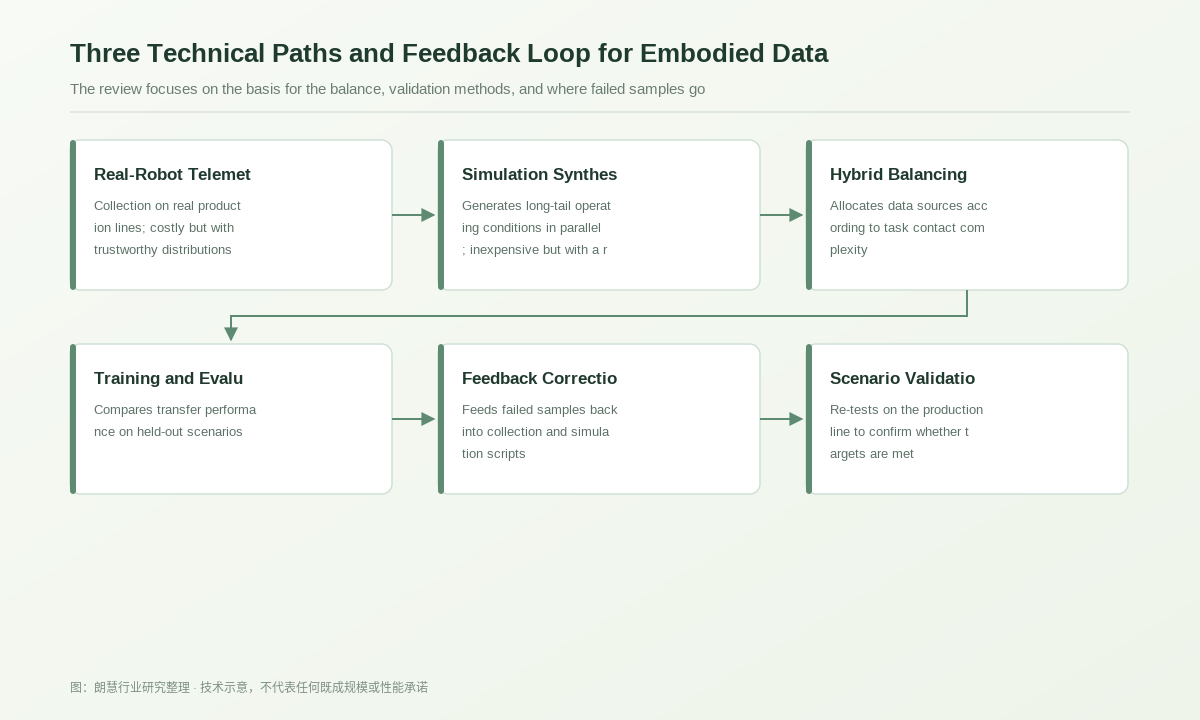
There are currently three broad sources of embodied intelligence data: real-robot telemetry, synthetic simulation data, and a hybrid of the two. Real-robot data is authentic, but collection is costly, and actions on one production line often cover only a limited set of operating conditions. Simulation data is inexpensive and can be generated in parallel, but a reality gap remains: contact mechanics, deformable objects, and sensor noise are difficult to reproduce fully. A hybrid approach uses a small amount of real-robot data to calibrate the simulation, then uses the simulation to expand long-tail operating conditions. Reviewers should not choose sides but examine whether the balance among the three approaches in the proposal has a basis, and whether that basis comes from task decomposition rather than generic industry claims.
The main basis for judgment is the task type. Contact-rich operations such as grasping, insertion, and assembly place high demands on friction and deformation modeling, making simulation transfer difficult and requiring a higher share of real-robot data. Vision- and path-centric tasks such as inspection, meter reading, and material handling can rely more heavily on simulation. If a proposal applies the same balance to all scenarios, it usually indicates that no task decomposition was performed and that construction experience from elsewhere was simply transplanted as a whole. Reviewers can ask applicants to provide the data-source balance for each task type and the comparative experiments or baselines supporting that balance; any mismatch should prompt further questions.
The data feedback mechanism also matters. Does data collected from real robots enter training? Does the trained model return to the same scenario for validation? Are failed samples recorded and used to correct collection scripts and simulation parameters? This chain should be included in the project scope. Many proposals stop after collection and training, leaving out validation and feedback. The platform then becomes a one-way data pipeline, and the more it collects, the higher the sunk cost. More commonly, validation is written up as an acceptance demonstration, with only successful clips shown, failed samples never archived, and the next collection run repeating the same mistakes.
II. Scenario Deployment: From Demo Actions to Production Takt Time
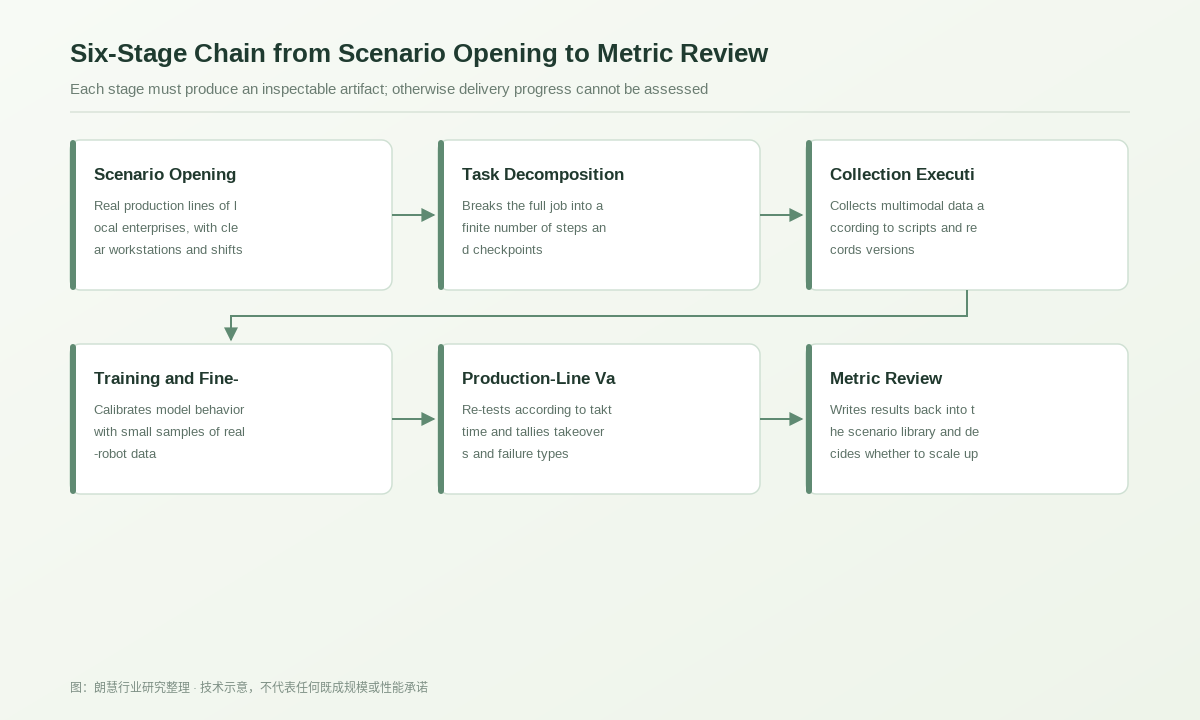
Smooth robot movements in a demo video do not mean the robot can work on a production line. Demos typically use fixed lighting, fixed bins, and a fixed rhythm, while production lines require continuous operation over several hours, tolerate variations in incoming materials, and are constrained by upstream and downstream takt time. During review, distinguish between demoable and deliverable: the former looks at whether an action is completed, while the latter looks at stable output per unit time and the frequency of human takeover. These two types of evidence are collected in completely different ways. A video is enough for the former; the latter requires continuous multi-shift run records and an exception ledger, along with a clear account of how exceptions were detected and who handled them.
A practical rule for scenario selection is to first see whether the task can be broken into a limited number of steps, and then whether a failure at each step is detectable. Decomposability means data can be collected and trained in stages, and each step can be accepted separately. Detectable failures mean takeover and recovery can be designed, so one mistake does not stop the entire line. The hardest tasks look simple, but when they fail, no one knows where the error occurred; a large amount of data is collected but cannot be attributed, and the whole system eventually reverts to manual work. Reviewers should require a failure classification table rather than a single, generalized success rate.
Structure should also be tiered. Structured scenarios, such as fixed workstations, fixed incoming materials, and fixed lighting, can be addressed first and are most likely to produce reusable data. Semi-structured scenarios, such as variable incoming materials and adjustable workstations, should be the focus for breakthroughs. Unstructured scenarios, such as open factory sites, moving personnel, and multi-machine collaboration, should first receive preparatory layout work without a delivery commitment. If a proposal writes an unstructured scenario directly as a near-term target, reviewers should require a decomposition path and validation milestones. Otherwise, funds may be spent on demonstrations that never converge, with the applicant still explaining two years later why the system has not gone live.
III. The Three Questions Reviewers Must Really Answer
Back at the review table, an embodied intelligence industry platform's materials often resemble a feasibility study report, but only three questions truly determine success or failure: what assets the funding ultimately becomes, whether those assets can be reused by external teams, and who will ensure the platform is still operating three years later. Hardware lists, exhibition-hall area, and investment composition—the items most likely to be questioned repeatedly—are actually downstream of these three questions. Review meetings have limited time. If the discussion starts with equipment models and interior-fitting standards, it often ends without addressing the real points of disagreement. Scores are then based on material completeness, leaving everyone uneasy after the review.
The first question is the nature of the assets. Robot bodies are consumables: they depreciate, become obsolete, and may be left idle as tasks change. Data, calibration parameters, scenario scripts, and evaluation benchmarks are what can accumulate into lasting assets. Reviewers should ask: on the day the project ends, will the site contain equipment that others cannot take away or use, or equipment that others can actually use? If only the former applies, the platform has functionally degenerated into a showroom with a production line. It will be difficult to sustain through its own revenue and cannot be considered public service, because no one will pay just to watch a demonstration.
The second question is the boundary of reuse. Whether the same data can support different robot bodies, tasks, and teams depends on field design, coordinate-system definitions, time synchronization, and annotation standards at collection time—not on how many robots were purchased. The third question is operational responsibility. If the materials contain only a construction plan and no operating plan, or if the operating plan has only an organizational chart and no assessment metrics, the project can basically be judged high-risk. These two items should be listed separately on the review form rather than folded into project feasibility as an afterthought, otherwise the problems will be diluted across the average score.
IV. Data Assets: Reusable, Traceable, and Deliverable
The first standard for data assets is reusability. Can the same segment of collected data support imitation learning, visual localization, and hand pose estimation at the same time? This depends on whether the original multimodal streams were retained during collection: multiple image feeds, joint angles, end-effector forces, inertial units, audio, and their temporal relationships. Retaining only processed features locks the data into one algorithmic approach; changing teams or models requires recollection. During review, ask: without recollecting data, how many task types can this dataset support? The answer largely reflects the design level.
The second standard is traceability. Every data item should be able to answer: which device, which calibration, which scenario version, who collected it, and which version of the cleaning rules it passed through. Without this metadata layer, problematic data can only be discarded as a whole batch, because there is no way to tell whether an individual sample is defective or one device's calibration has drifted. A practical approach is to assign each segment a global identifier, archive calibration files, collection-script versions, scenario configuration, and data together, and list them item by item in the delivery manifest. It is better to include a few extra columns than to leave ambiguous areas.
The third standard is deliverability. Here, delivery means whether external teams can obtain and use the data on demand, not the commercial terms. Authorization scope, de-identification rules, delivery formats, and version numbers must be clear, along with a sampling-acceptance method that lets recipients judge quality themselves. If data can only be used by the builder, it is merely an internal R&D cost and does not constitute a public-platform asset. Reviewers can test data usability by asking whether an external team can reproduce one training run without accessing the original equipment; this answer often says more about the platform than dataset size.
V. Team Structure: Four Roles—Collection, Annotation, Training, and Delivery
Teams for platform-style projects are often assembled from different parties: universities provide algorithms, companies provide equipment, and an operating company provides the site. This structure is acceptable during construction but tends to fall apart during operations because no one is accountable for the final delivery. Reviewers should check whether four roles are all covered: collection execution, with people who can remain on-site at the production line over time; annotation and quality control, with people who understand task semantics rather than merely drawing boxes; model training, with people capable of fine-tuning and evaluation; and delivery and operations, with people who take full responsibility for user issues. If any role is missing, the proposal will usually pass over it with a vague term. Such wording should prompt questions.
Collection execution is the easiest role to underestimate. It requires people who can communicate with production-line shift supervisors, identify abnormal incoming materials, and repeat work according to scripts—not students brought in temporarily. Industry-academia integration can solve staffing scale, but it needs corresponding training and in-process quality checks. Otherwise, data collected by different people from the same task will have inconsistent distributions, diluting model-training performance. Reviewers can ask for staffing sources, training duration, assessment methods, and contingency plans for staff turnover. These three items are more meaningful than simply reporting headcount and better show whether the operator has seriously calculated costs.
The team structure also needs to be assessed in terms of decision-making authority. If technology and operations are completely separated, each side will wait when a scenario changes: technology waits for operations to confirm requirements, and operations waits for technology to assess feasibility. A practical arrangement is to appoint a person accountable for scenario delivery who also oversees collection scripts and acceptance standards, so that collectors are not indifferent to usability and users are indifferent to collection. If this point is not written into the proposal, disputes will arise during implementation. If it is written in but authority is not granted, it remains a paper arrangement. Reviewers can ask whom this person reports to and whether they can veto an unreasonable collection plan.
VI. Weights and Veto Items in Review Metrics
More granularity in metric weights is not always better. With too many dimensions, reviewers' scores converge, and the result becomes a judgment of material thickness and formatting. It is advisable to narrow the review to five or six dimensions: technical-roadmap soundness, scenario deliverability, data-asset usability, team and operating capability, funding and schedule feasibility, and public-service attributes. Each dimension should have three to five verifiable factual items—such as whether there is a task-decomposition table, calibration and version records, or external-team trial records—rather than a pile of adjectives. The more factual items there are, the less disagreement there will be among reviewers, and the easier the result is to explain afterward.
Weight design should match the project stage. For construction-stage projects, technical-roadmap soundness and scenario deliverability should carry more weight. For operating-stage subsidies, operating capability and data reuse should carry more weight. Applying the same weights to all projects is like measuring different stages with one ruler. The review form can be versioned, but the version-switching rules must be announced in advance; otherwise applicants cannot prepare, and the review committee can easily get bogged down in details. Publishing the weights is itself a form of guidance that changes what applicants put in their materials; this is more effective than writing review comments after the fact.
In addition to scoring, there must be veto items. For example: no clearly defined operating entity, no data-authorization path, no decomposition plan for unstructured scenarios, or a clear mismatch between key equipment and the scenario. If any one of these applies, the project does not enter the ranking. The purpose of veto items is not to eliminate a certain number of projects, but to prevent reviewers from balancing the total score and rescuing a project that clearly does not hold up. Without veto items, review results are often uniformly average and unremarkable, with final decisions driven by relationships and material thickness. This is unfair to organizations that prepare serious proposals and encourages the next round of applications to focus on assembling impressive documents.
| Review Dimension | Weighting Orientation | Evidence Required |
|---|---|---|
| Technical-Roadmap Soundness | Medium-High | Basis for the balance among the three data sources, task-decomposition table, and baseline comparisons |
| Scenario Deliverability | High | Deliverable-scenario list, takt-time criteria, and takeover and failure-classification ledger |
| Data-Asset Usability | High | Field and coordinate-system definitions, calibration and version records, and external trial records |
| Team and Operating Capability | Medium-High | Role-division table, requirements list, in-process metrics, and assessment methods |
| Public-Service Attributes | Medium | Open-access rules, booking and billing methods, and integration plan with existing platforms |
VII. Review Criteria for Hardware Procurement and Equipment Configuration
Equipment lists are the easiest part of review materials to inflate. Hundreds of robots, several motion-capture systems, and several collection terminals may sound impressive, but the real questions are: which scenario each device serves, how many valid data items it can produce per day, and at what utilization rate it counts as idle. Aligning equipment counts with scenario-task counts is far more persuasive than broadly claiming that collection needs are met. During review, applicants can be required to list the correspondence between equipment and tasks item by item. Any device without a corresponding task should be marked with a question mark, not accepted first and justified later.
The procurement pace should also be reviewed. Buying all equipment at once means depreciation starts from day one, while scenarios often go live in several batches. Staged procurement tied to scenario launch can defer financial pressure and allow models to be adjusted based on early data quality. Reviewers can require a staged plan with trigger conditions—for example, starting the second batch only after the first batch has operated continuously for a period and the data qualification rate has reached an agreed threshold. The more specific this condition is, the fewer disputes there will be during implementation, and it will be easier to explain during audits why the arrangement was chosen.
Self-purchase and rental should also be distinguished. Computing power, motion-capture facilities, and some high-value sensors are suitable for rental or sharing, while robot bodies and collection terminals are more suitable for ownership. If a proposal buys everything, either the budget is generous or utilization rates have not been calculated. There is a pitfall here: rental arrangements must clearly define data-egress and confidentiality boundaries. Otherwise, data leaves traces on third-party equipment, complicating later authorization and external services. When reviewers see a rental arrangement, they should also ask where data processing occurs and who retains the logs.
VIII. Operating Entity and Sustained Operating Capability
The operating entity must answer three questions: who makes decisions, who bears losses, and who is accountable to users. It is common practice for a local state-owned enterprise to take the lead in establishing an operating company. The advantage is smooth resource coordination; the risk is a long decision chain and slow market response. Reviewers should check whether research functions and operating functions have been separated, and whether the operating team is assessed on metrics tied to service quality rather than only on asset preservation. If the two functions are mixed together, the slower pace of research will hold up service, while service details will crowd out R&D, leaving both sides dissatisfied.
Revenue structure should be diversified, but not every line must succeed. Equipment and facilities opened by time slot, collection and annotation services, secondary development and model fine-tuning, testing and evaluation, training and internships, and licensed data use—two or three workable lines among these are enough to be healthy. The key is to have verifiable sources of demand: have local enterprises already made specific requests, or are they still at the stage of intent? Are there engagement records, trial feedback, and repeat-purchase signs? Reviewers can ask for a demand list and communication records rather than only a framework agreement, which anyone can sign.
The operating exemption period should have clear boundaries. Giving the operating team a period of tolerance is reasonable, but process metrics should apply during the exemption as well, such as equipment uptime, data-delivery batches, and user return visits. Looking only at end-period revenue can allow early operations to lose control; looking only at process metrics may produce a team that does superficial work. The two should be used together, with exit and renewal conditions agreed in advance. The operator should know when support will stop and when it can be expanded—this is much clearer than discussing it at year-end.
- Equipment and facilities opened by time slot
- Collection and annotation services
- Secondary development and model fine-tuning
- Testing and evaluation services
- Training and internships
- Licensed data use
IX. Public-Service Attributes and Regional Industry Fit
The public nature of a public-service platform is reflected in who can use it, under what conditions, and to what extent. If the equipment is available only to a few shareholder companies, it is an enterprise-internal R&D center and should not apply for support under public-platform standards. Reviewers should examine the access rules: whether the booking mechanism is public, whether billing is transparent, whether scheduling is fair, and whether small and medium-sized enterprises can afford fragmented time slots. These rules do not need to be complex, but they must be clearly written in advance. Otherwise, operations depend entirely on personal relationships, the platform's public-service nature disappears, and there is no way to explain externally where the money went.
Regional fit should be assessed against the local industrial structure. A city focused on construction machinery, electronics manufacturing, and food processing should build collection scenarios around real workstations in those industries rather than copy generic scenarios from elsewhere. Data from production lines elsewhere often does not apply locally because incoming materials, takt time, and worker habits differ, causing clear performance drops. If a proposal's scenario list does not align with local industries, it will be difficult to find paying users later. The platform can then survive only on subsidies, and operations stop when subsidies end.
Connections with higher-level platforms should also be written clearly. Where provincial or municipal platforms already exist for scenario publishing, computing-power scheduling, and data-trading channels, the platform should integrate with them rather than build another set of systems. The consequence of duplicate construction is fragmented data, forcing companies to register repeatedly across multiple systems until no one wants to use it. Reviewers can make reuse of existing platform interfaces a hard requirement and ask for the specific fields and responsible parties for integration. A proposal that only mentions strategic cooperation without listing interfaces will usually stop at the signing ceremony; six months later, the only evidence will still be the group photos.
X. Three Common Counterexamples: Collecting Without Use, Overly Broad Scenarios, and Equipment Mismatch
The first counterexample is collection without validation. A collection site is built, equipment is purchased, and staff are hired, but nothing explains where the data goes after collection, who uses it, or how well it performs. Such projects can deliver a dataset volume during acceptance but cannot demonstrate improved model performance, making them difficult to sustain in the second year. The identification method is simple: check whether the materials name users and include usage plans, and whether trials have already occurred—not merely the number of planned service targets. Any proposal that states only the number of potential users without an actual contact list should essentially be treated as unverified.
The second counterexample is an overly broad scenario scope. Open factory sites, home services, and medical assistance are all written into the construction scope at once, with each only reaching demonstration level. Reviewers should require convergence onto two or three deliverable scenarios, with the rest treated as reserves and clear activation conditions specified. The wider the scope, the shallower the validation depth for each part. In the end, not one part can be proven externally, while limited collection staff are spread too thin and even the most basic tasks are not done solidly. The number of scenarios is not an achievement in itself; the real measure is continuous stable operation on one production line.
The third counterexample is a mismatch between equipment and tasks. Using high-precision motion capture to collect data for handling tasks with low precision requirements, or using a low-resolution camera to collect data for recognizing small components, are examples. Such errors do not appear on procurement lists; they emerge only when task indicators and equipment specifications are compared item by item. Adding a column to the review form showing which task indicator each device supports can prevent many later explanations and block one common way of padding budgets. At a more detailed level, reviewers can also ask the proposal to specify under what conditions each device will fail, avoiding the mistake of treating laboratory parameters as production-line capability.
XI. Forward-Looking Assessment for the Next 12–24 Months
Over the next one to two years, review priorities will shift from what is being built to what can be used as proof. Dataset volume will no longer be the main metric; it will be replaced by effective training gain per unit of data, cross-robot transfer success rate, and scenario-reproduction stability. Platforms that cannot provide these forms of evidence will struggle to enter the next round of support. This will create a chain reaction: collection scripts, calibration records, and evaluation benchmarks—these seemingly minor items—will become core sections of application materials. If they are not written clearly, it means they have not been accumulated in routine work.
The second change is that the balance between simulation and real-robot data will become more explicit. As simulators improve in modeling contact and deformable objects, the demand for real-robot data in some tasks will decline, while investment in calibration and validation will increase because assessing the reality gap itself requires real-robot data as an anchor. A simulation-to-reality gap assessment should appear as a review item, rather than simply asking how many simulation platforms were purchased and how many parallel environments they can run. Teams that can quantify the gap for specific tasks have usually already made their collection processes run smoothly.
The third change is that regional platforms will move toward specialization. Computing power, collection, evaluation, and trading will not be built in full by every city; regional division of labor and collaboration will be more likely, with each platform serving different parts of the chain. Whoever first makes one type of capability ready for external service has the chance to become a regional node. For applicants, it is better to go deep on one segment than to pursue breadth, while clearly defining interfaces with other nodes. For reviewers, projects with a clear division-of-labor position are easier to accept than projects that try to do everything, and they are also more likely to show results within two years.
Langhui's Engineering Capabilities Along This Path
Langhui's work on the data side focuses mainly on collection standards and delivery quality: from scenario-task decomposition and field and coordinate-system definitions to collection scripts, calibration records, version numbering, and acceptance checklists, we create a reproducible set of documents so that data remains usable after teams or models change. This work may look tedious, but it is precisely what is most easily overlooked and hardest to repair after the fact in platform reviews.
For annotation and quality control, we provide structured annotation, quality-control sampling, and consistency reports, producing defect classifications, rework records, and batch statistics for project acceptance and subsequent re-inspection. In medical imaging, our scope covers CT, MR, PET, as well as mammography, ultrasound, and other modalities. For multimodal data such as video, point clouds, and time-series sensor data, we can take responsibility for part of collection-standard design, metadata dictionaries, and delivery-format specifications.
We should state our boundaries: we do not claim compliance certifications such as HIPAA, nor do we list endoscopy, whole-slide pathology images, or clinical-record text processing as platform capabilities. For review criteria, metric weights, and acceptance standards on specific projects, we typically participate as advisors, helping translate technical descriptions into verifiable items rather than making judgments on behalf of the competent authority.
FAQ
When reviewing an embodied intelligence industry platform, why can reviewers look only at investment scale and equipment counts?
Investment scale reflects inputs, not assets. Equipment depreciates and facilities may sit idle; what remains usable over the long term is data, calibration records, scenario scripts, and evaluation benchmarks. Reviewers should ask what reusable assets remain when the project ends and whether external teams have actually used them. These two points say more than the length of an equipment list.
How should reviewers distinguish between a scenario that is demoable and one that is deliverable?
Demoability is about whether a single action is completed, usually filmed under fixed lighting and fixed incoming materials. Deliverability is about stable output across multiple shifts, the frequency of human takeover, and the distribution of failure types. Asking applicants for continuous run records and an exception ledger rather than a single edited video makes the distinction clear.
What makes data assets reusable?
At least three conditions should be met: original multimodal streams are retained rather than only processed features; each data item can be traced to the device, calibration, scenario version, and cleaning rules; and an external team can reproduce one training run without accessing the original equipment. Only when all three are met does the data have a basis for use across tasks and teams.
Who should determine the weights for review metrics, and should they be published?
Weights should be jointly drafted by the review organizer together with technical and operational stakeholders, with separate versions for different project stages and different emphases for construction and operations. The rules should be published in advance so applicants know what to include. If weights are not published, scoring tends to revert to material thickness and familiarity.
If no company uses the platform after it is built, where does the problem usually lie?
There are three common causes: access rules are opaque and small and medium-sized enterprises cannot book time slots; scenarios do not fit local industries and the collected data cannot be used; or the platform has equipment but no services, so companies cannot process the data even after receiving it. Defining access rules, scenario lists, and service content during the review stage is more effective than trying to remedy the problem afterward.
- Open X-Embodiment: Robotic Learning Datasets and RT-X Models https://arxiv.org/abs/2310.08864
- RT-1: Robotics Transformer for Real-World Control at Scale https://arxiv.org/abs/2212.06817
- DROID: A Large-Scale In-The-Wild Robot Manipulation Dataset https://arxiv.org/abs/2403.12945
- NIST AI Risk Management Framework https://www.nist.gov/itl/ai-risk-management-framework
- ISO/IEC 42001:2023 Artificial intelligence management system https://www.iso.org/standard/81230.html