
HUMANOID PRODUCTIZATION / BODY, DATA, SCENARIO
Humanoid Robot Productization: The Triple Constraints of Body, Data and Scenario, and the Division of Labor Between Robot Makers and Solution Providers
Humanoid robot prototypes are no longer rare; the hard part is productization. This article groups the constraints into three areas — body, data and scenario — and discusses them one by one: the trade-offs among joints, dexterous hands and batteries; data supply from teleoperation, motion capture and human video; different acceptance standards for industrial and commercial service scenarios; how robot makers and solution providers should divide the labor; and a forward-looking judgment spanning 12 to 24 months.
There have already been many public demonstrations of humanoid robots, but going from prototype to product means a complete change in evaluation criteria. This article does not discuss who is smarter; it lays out the constraints of productization: the body determines the physical ceiling, data determines the intelligence ceiling, and the scenario determines the commercial ceiling, and the three squeeze each other. The article discusses the trade-offs among joints, dexterous hands and batteries; what teleoperation, motion capture and human video each contribute; why industrial and commercial service scenarios have two different sets of acceptance standards; and at what layer the division of labor between robot makers and solution providers should be written down.
1. Productization Is Not About Building a Walking Prototype
There have already been many public demonstrations of humanoid robots: walking, climbing stairs, carrying objects and conversing with people. But going from prototype to product means a completely new set of evaluation criteria — whether continuous operation is stable, whether faults can be localized, whether spare parts are available, whether the software can be upgraded, and whether consistency holds across production batches. A demonstration only cares whether something can be done once; a product must be able to do it every day, and without the customer stopping production.
The thresholds of productization can be grouped into three areas: body, data and scenario. The body determines the physical ceiling, including payload, accuracy, endurance and lifespan; data determines the intelligence ceiling, including how many tasks can be learned and how far the model can transfer; the scenario determines the commercial ceiling, including who is willing to pay for the outcome and what the acceptance criteria are. The three squeeze each other, and changing one often requires changing the other two — this is the most easily underestimated cost of productization.
This is also why the industry has two types of companies at the same time: robot makers that build the whole machine, and solution providers that build the algorithms and integration. The former bears the risks of hardware, manufacturing and consistency; the latter bears the risks of scenario adaptation and delivery. Whether the division of labor is clear directly determines whether a project can be accepted within a reasonable timeline, and who will diagnose the problem when something goes wrong.
2. The Body: Three Hard Constraints — Joints, Dexterous Hands and Batteries
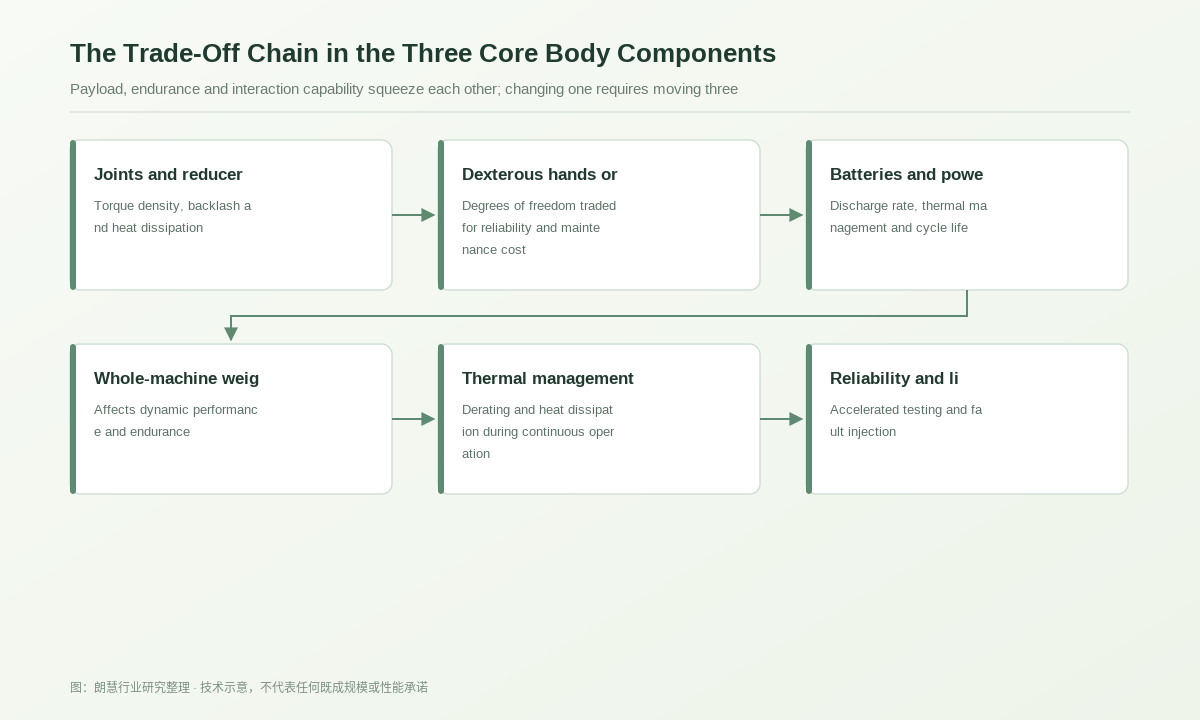
Joints are the most expensive and most difficult part of the body. They must simultaneously satisfy torque density, response bandwidth, backlash, heat dissipation and lifespan. A humanoid structure requires joints to deliver sufficient torque within a limited volume; high torque often means high heat generation, and during continuous operation the temperature rise causes torque to drop and accuracy to drift, to the point where derating may be necessary. A common engineering practice is to rate the joint a level lower and trade thermal design and control strategies for stability, rather than putting peak figures in the specification sheet.
Dexterous hands are another watershed. Multi-finger, high-degree-of-freedom hands look good in demonstrations, but in industrial scenarios, reliability and maintenance cost often matter more than degrees of freedom. Gripper-type end effectors are more mature in terms of repeatability, lifespan and replaceability. Dexterous hands suit occasions requiring fine manipulation or human-robot interaction, but at the cost of sensors, control and calibration. When selecting a design, first ask how many degrees of freedom the task requires, rather than chasing anthropomorphism.
Batteries and power management are often underestimated. Bipedal walking has large power fluctuations and high instantaneous current, so batteries must be judged not only by capacity but also by discharge rate, thermal management and cycle life. Endurance figures differ greatly between the lab and the field, and are affected by payload, terrain and start-stop frequency. A more prudent approach is to provide an endurance range under typical operating conditions and design for quick-swapping or on-line recharging, rather than quoting a single idealized number in marketing.
The lifespan of structural parts must also be factored into productization. Cable fatigue under repeated bending, reducer wear, and fasteners loosening under vibration are inconspicuous at the prototype stage and only emerge after months of continuous operation. Solving these problems at the design stage is far cheaper than repairing them in the field, and makes it much easier to turn the machine into a repeatable product.
3. Data: Three Tiers of Supply — Teleoperation, Motion Capture and Human Video
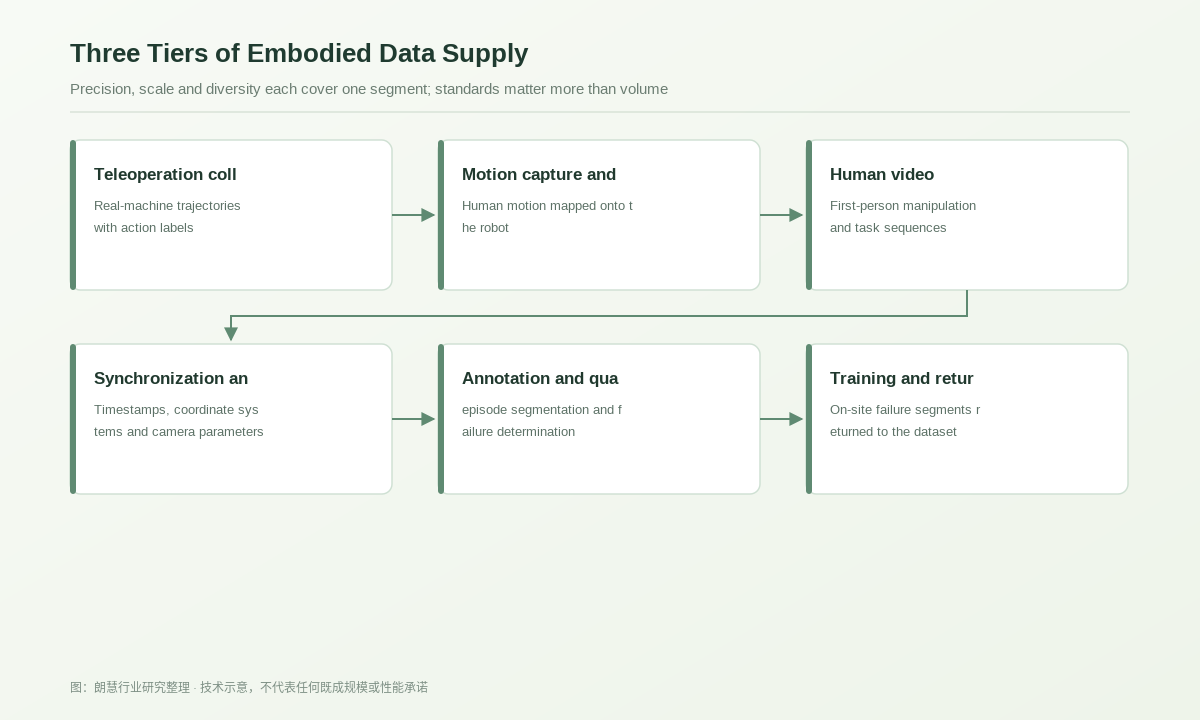
Embodied data comes roughly from three tiers. Teleoperation is closest to the real machine: the operator controls the robot through a master-slave device or motion-capture equipment, and the collected data consists of real trajectories with action labels. This is the highest-quality data, but collection speed is limited by human and equipment throughput, and the cost is high. This type of data is the mainstay of the post-training stage, because it corresponds directly to the dynamics and workspace of the target robot.
Motion capture can collect human motion without occupying the robot, and then map it onto the robot through retargeting, making it more efficient and suitable for bulk collection of motion priors. However, differences in body shape and degrees of freedom introduce errors during mapping, especially around the hands and waist. Human video is the largest tier: first-person footage contains a wealth of everyday manipulation, making it suitable for learning task sequences and object priors, but it lacks precise motion and force information and usually requires pose estimation for weak supervision.
Collection standards matter more than collection volume. Whether multiple cameras are synchronized, whether timestamps are unified, whether calibration varies with the scene, whether operators are consistent, and whether failure segments are retained — these determine whether the data is usable. It is especially important to keep failure samples, since most of the value of a real system comes from knowing when it will fail. A dataset containing only successful trajectories will produce a policy that lacks a sense of boundaries in the field.
For public data, one can look to the collection paradigms of efforts such as ALOHA, DROID and DexCap: master-slave teleoperation, cross-scenario mobile collection and portable motion capture, each with its own applicability limits. Copying their equipment wholesale may not be appropriate, but their annotation fields and quality-control approaches are worth borrowing, and can save a lot of detours.
4. Scenarios: Industrial Heavy-Duty and Commercial Service Have Two Different Sets of Acceptance Criteria
The acceptance criteria in industrial scenarios are cycle time, yield, availability and safety. Customers care about output per unit of time, how many hours the system can run continuously without stopping, and how quickly it recovers from a fault. In this setting, the advantage of a humanoid structure is not that it looks human, but that it can enter workspaces designed for people — existing station heights, aisle widths and rack positions need no modification, which is the fundamental reason many customers are willing to give it a try.
Commercial service scenarios have different standards. Tasks such as guiding, explaining and receiving guests have low precision requirements but high demands on interaction naturalness, stability, noise and appearance. Customers care about the visitor experience and operating costs, not repeatability. Transplanting industrial parameters directly into service scenarios produces products that are both expensive and hard to use, and the reverse is equally true.
A third category is hazardous and special environments, where the criterion is that people do not have to go there. These scenarios demand the highest reliability and protection ratings and the lowest level of interaction; they often require customization, with small volumes but high value density. The differences among the three types of scenario point to one conclusion: a product matrix is not the same machine in a different shell, but rather working backward from requirements to define body parameters, data strategy and delivery approach.
Scenario selection also has a practical constraint: the customer's operations and maintenance capability. Industrial customers usually have equipment maintenance teams and can accept scheduled servicing and spare-part replacement; commercial customers often do not, and can only rely on the vendor's remote support. Selling the same machine to these two types of customer means completely different after-sales models, and this must be thought through at the pricing-model and product-definition stage.
| Scenario | Core Metrics | Body Priorities | Data Priorities |
|---|---|---|---|
| Industrial manipulation | Cycle time, yield, availability | Payload, repeatability, heat dissipation | Fixed stations, centralized collection |
| Commercial service | Experience, stability, noise | Interaction, appearance, low maintenance | Open inputs, sample coverage |
| Hazardous and special | Reliability, protection rating | Protection, redundancy, remote operability | Custom operating conditions, small volumes, high value |
| Research and education | Programmability, safety | Lightweight design, limits and emergency stop | Reproducible example data |
5. How the Three Constraints Squeeze Each Other
Increasing payload means enlarging joints and structural parts, which raises the machine's weight and lowers endurance; increasing endurance means adding batteries, which raises weight again and degrades dynamic performance. This is the most direct set of contradictions. The usual resolution is a scenario-based trade-off: industrial heavy-duty applications accept shorter endurance and compensate with battery swapping or rail-based power supply; service scenarios accept lower payload in exchange for longer run times and lower noise.
Pressure on the data side comes from scenario differences. Objects and workflows in industrial tasks are relatively fixed, so data can be collected centrally and coverage is easy to scale up; inputs in service scenarios are almost open-ended, coverage is never sufficient, and one can only rely on stronger generalization and more conservative behavioral policies. For a single model architecture to serve both types of scenario, the action representation and safety policy must be layered, otherwise neither side will be good enough.
Pressure on the scenario side comes back to cost and maintenance. Customers will not pay a long-term premium for generality; they will pay for 'solving my problem'. This means productization must converge: make the limited set of capabilities rock-solid, and explicitly exclude what the system is not good at. Daring to list unsuitable scenarios in the product documentation makes it easier to pass acceptance than claiming the machine can do everything, and it builds reputation faster.
The three constraints also determine the iteration cadence. Change the body once, and calibration, data and policies must be revalidated; change the batch of data, and the model's failure modes change; change the scenario, and the acceptance metrics must be rewritten. The efficiency of a productization team depends largely on whether it can decouple these three types of change so that they do not have to happen at the same time.
6. Robot Makers and Solution Providers: Who Owns Which Layer
A robot maker's core assets are mechanical, electronic, joint and structural design, manufacturing processes, and the reliability and consistency of the complete machine. A solution provider's core assets are scenario understanding, algorithm adaptation, system integration and delivery capability. The area where the two overlap is motion control and basic perception — this is where friction is most likely and where boundaries need to be drawn up front.
A relatively healthy division of labor is: the robot maker provides stable hardware interfaces, the real-time control layer, safety functions and development documentation; the solution provider handles task orchestration, perception fusion, navigation and interaction at the application layer, and takes on on-site commissioning and acceptance. The more standardized the interfaces, the lower the solution provider's reuse cost and the easier it is for the robot maker to scale shipments — a win-win for both sides.
A common failure mode in practice is that both sides want to do the full stack. The robot maker builds its own algorithms, and the solution provider modifies its own hardware; neither side goes deep enough, and the project timeline stretches. Another failure mode is unclear interfaces: the solution provider cannot access low-level state or real-time control authority, and can only patch around the edges, producing a system that responds slowly and is hard to diagnose. Writing the division of labor into the technical agreement is far more useful than writing it into a shared vision.
For solution providers, it is also worth thinking through where their irreplaceability lies. If the work is simply connecting open-source models to someone else's robot, the value can easily be compressed; the real moat lies in accumulating scenario data, standardizing delivery processes, and understanding the customer's process. All three take time and are not easy to replicate.
- Robot maker: joints and structure, power supply and heat dissipation, real-time control, safety limits, whole-machine consistency and spare parts
- Solution provider: task orchestration, perception fusion, navigation and interaction, on-site commissioning, acceptance and training
- Joint agreement: state and command interfaces, time synchronization, fault-code definitions, software upgrade and rollback mechanisms
- Likely points of dispute: motion-control parameters, accountability for anomalies, data ownership and subsequent model updates
7. Controllers and Compute: The Real Boundaries of On-Device Inference
Compute on a humanoid robot is limited. The whole-machine power budget must be divided among joints, computation, sensing and heat dissipation, leaving only a small portion for inference. This means large models must be quantized, distilled or pruned, or part of the computation must be offloaded to edge servers. Offloading to the edge introduces communication latency and the risk of disconnection, which is especially noticeable in mobile scenarios: as soon as the network jitters, motion stutters.
The value of an on-device controller lies in determinism. The real-time control loop requires a fixed cycle and must not be preempted by inference tasks; perception and planning can be asynchronous, but worst-case latency must be kept under control. A common engineering approach is to divide the system into hard real-time, soft real-time and non-real-time layers with different scheduling strategies, rather than running everything in a single inference framework.
There is also a practical issue: the chip and toolchain ecosystem. Selection is not just about compute; one must also consider operator support, quantization precision loss, driver stability and supply lead time. Many teams get things running on a development board at the prototype stage, only to discover during mass production that certain operators have no efficient implementation and the model architecture must be changed. The earlier such issues surface the better, and ideally there should be an end-to-end stress test before the design is frozen.
Beyond compute, there is power consumption and heat dissipation. A high-compute module running for long periods inside a sealed body will throttle, delivering less than its rated performance. Integrating thermal design into the whole-machine plan is more reliable than adding fans or throttling later, and better matches a humanoid robot's requirements for appearance and noise.
8. Atomic Skills and Task Orchestration: Build Reuse at the Skill Level
The difficulty of cross-scenario reuse lies in the enormous variation among tasks. A pragmatic approach is to stop having the model learn complete tasks directly, and instead learn a limited set of atomic skills: grasping, placing, locating, pressing, rotating and inserting. Complete tasks are composed of these skills in sequence, combined with task-level planning and verification. The number of skills stays manageable, data collection and validation converge more easily, and the team can state the success rate of each skill.
The advantage of this approach is low transfer cost. Change the workstation, and what usually changes is only the combination order and parameters of the skills, not the entire model. The drawback is that the transitions between skills are prone to problems: pose errors after grasping carry over into placement, and detecting placement failure must be designed separately. The skill layer therefore needs unified interfaces and explicit pre- and post-conditions, and cannot rely on parameter tuning alone.
The orchestration layer can use rules or state machines, or a language model for planning. Rules are predictable and easy to debug; models can handle unseen combinations. A prudent approach is to have the model generate plans while rules provide validation and fallback, so that the system can return to a known safe path when something goes wrong. Purely model-driven orchestration is the hardest to diagnose when it fails, and the hardest to explain to the customer.
Building the skill library calls for restraint. Too many skills cause combinatorial explosion and raise validation costs; too few skills leave tasks uncovered and customers will find the system hard to use. The usual approach is to start with the high-frequency motions of the target scenario, cover the main workflow, handle the rest through customization, and gradually consolidate them into general-purpose skills.
9. Reliability and Safety: From Functional Safety to On-Site Operations
Because humanoid robots share space with people, safety requirements are more complex than for traditional industrial robots. Industrial robots have fences and safety zones; humanoid robots must walk in open spaces and require person detection, speed limits, force limits and emergency stop. The relevant standards framework can draw on the ideas of the ISO 10218 series and ISO/TS 15066, but the dynamic balance risks introduced by humanoid structures are still evolving in terms of standard coverage and cannot simply be applied as-is.
Reliability must come from design rather than testing. Joint lifespan, cable bend cycles, fastener locking, and protection against dust and moisture are inconspicuous at the prototype stage and only emerge after months of continuous operation. Productization teams typically run accelerated life tests and fault injection to resolve problems at the design stage. Testing can only prove that a problem exists; it cannot substitute for design margin.
On-site operations and maintenance is part of productization. Faults must be diagnosable remotely, logs must be transmitted back, and spare parts must be replaceable quickly. Humanoid robots are structurally complex and costly to disassemble on site; modular design can significantly lower the maintenance barrier. What customers really care about is not a zero failure rate, but how long recovery takes after a failure, and whether production must stop during recovery.
Safety design also has an organizational question: who has the authority to stop the machine. The on-site operator, the customer's safety officer and the vendor's remote engineer must have their permissions agreed in advance. Without such an agreement, the parties wait on each other when an incident occurs, making the risk greater. Writing permissions and procedures into the delivery documentation is the least conspicuous but most necessary page in productization.
10. Delivery and Acceptance: Write Maintainability into the Checklist
Delivery is not simply shipping the machine to the site. A complete delivery includes site survey, task analysis, data collection, model adaptation, trial operation, training and acceptance. Each item takes time, and compressing any one of them comes back later as rework. A pragmatic schedule lists trial operation separately, allowing parameters to be adjusted and data supplemented during the trial, rather than counting it as part of the delivery timeline.
Acceptance metrics must be measurable. Cycle time, success rate, continuous operating hours, anomaly recovery time and manual intervention frequency can all be quantified; descriptions such as level of intelligence or naturalness cannot be accepted. It is advisable to define the metrics, measurement methods and sample sizes clearly early in the project, to avoid conflicting interpretations at acceptance and to prevent a demonstration from being treated as acceptance evidence.
Maintainability should be a separate threshold. Whether the software can be upgraded remotely, whether the model can be hot-updated, whether adding tasks requires downtime, and how long spare-part lead times are — these determine the customer's long-term cost of use. Many projects pass acceptance and are retired six months later because maintenance costs are too high; the problem lies in this layer not being agreed, not in the machine itself being unusable.
Data return flow must also be written into the delivery. Failure segments generated on site are the most valuable assets, and delivery should specify who can use them, how they are anonymized, and how often they flow back. If this is not written down clearly, the project ends when it is delivered, the next order starts from zero, and productization becomes impossible to discuss.
11. A Forward-Looking View of the Next 12 to 24 Months
First, product matrices will continue to converge. Whole-machine vendors will compress their model lines into a handful of payload and form-factor tiers, covering differentiated needs through configurations rather than new models. Customization will retreat to the appearance and interaction layers, and body parameters will be standardized as far as possible; otherwise manufacturing and spare-part costs cannot be brought down and delivery timelines cannot be stabilized.
Second, data collection will move from project-based to routine. Collection standards for teleoperation and motion capture will gradually converge, weak-supervision methods for human video will mature, and the reuse rate of cross-platform datasets will rise. The first to benefit will be teams with established collection workflows, annotation quality control, and the ability to reuse data across multiple projects — not the teams with the largest single collection runs.
Third, the value of solution providers will rise. As robot bodies gradually become homogeneous, scenario adaptation, system integration and delivery capability become the sources of differentiation. Fourth, safety and evaluation will move upstream: customers will demand reproducible test reports rather than on-site demonstrations. For teams preparing to enter this field, the best investments over the next two years are interface standardization, data pipelines and maintainability design — not building yet another shell that looks more human.
Langhui's Engineering Capabilities Along This Path
Langhui Technology's embodied data team takes on the collection and annotation segment: synchronization of multi-camera video with robot state, timestamp alignment verification, calibration records, episode segmentation and success/failure determination, delivering data dictionaries, batch manifests and version records, so that the same batch of data can be reused for policy training, world-model training and anomaly detection.
What we do is process and quality control: collection standards design, unified annotation conventions, consistency spot-checks and issue traceability, including the organization and retargeting checks of teleoperation and motion-capture data. The whole-machine body, joints, controllers and mass production are outside our scope, and we do not claim whole-machine delivery capability.
If your team is building a manipulation data pipeline for humanoid robots, or needs to turn on-site failure segments into usable training sets, send us the scenario, collection equipment and degrees of freedom of the robot; we will first provide the annotation conventions and quality-control plan, before discussing scale.
FAQ
Which link in humanoid robot productization is the hardest?
The difficulty lies in the three constraints of body, data and scenario squeezing each other, not in any single technology. Raising payload pushes up weight and compresses endurance; changing scenario overturns the data and acceptance criteria; changing the body once means redoing calibration and validation. The core work of productization is to decouple these three types of change and to make the limited capabilities rock-solid, rather than lengthening the parameter sheet.
Is a dexterous hand a necessary condition for productization?
No. Most industrial tasks can be completed with a two- or three-finger gripper, with more controllable lifespan, maintenance and cost. Dexterous hands suit fine manipulation or human-robot interaction scenarios, but at the cost of sensors, control and calibration. Selection should start by defining how many degrees of freedom the task requires, and then deciding the end-effector form, rather than starting from anthropomorphism.
How should teleoperation data and human video data be mixed?
There is no universal ratio. Teleoperation data carries precise action labels and suits post-training and fine-tuning for the target scenario; human video is voluminous and suits pretraining to learn task sequences and object priors, but lacks force information. A common practice is to use video as the base, motion capture to add scale, and teleoperation to align with the robot, then adjust the three proportions according to the task's precision requirements.
How should the boundary between robot makers and solution providers be drawn?
The robot maker is responsible for joint structure, power supply and heat dissipation, real-time control, safety limits and whole-machine consistency; the solution provider is responsible for task orchestration, perception fusion, navigation and interaction, on-site commissioning and acceptance. The area with the greatest overlap is motion control, and it is advisable to write into the technical agreement: who provides the state and command interfaces, who defines the fault codes, who is responsible for upgrade rollback, and who bears responsibility for anomalies.
Does a humanoid robot entering a factory require production line modification?
Usually no major modification is needed — this is precisely one of the selling points of the humanoid form. Existing station heights, aisle widths and rack positions are mostly designed for people, and a humanoid robot can enter directly. However, floor flatness, clear passage width, charging locations and safety distances must still be assessed, and guardrails or speed-limited zones added where necessary; zero modification cannot be assumed.
- GR00T N1: An Open Foundation Model for Generalist Humanoid Robots https://arxiv.org/abs/2503.14734
- Learning Fine-Grained Bimanual Manipulation with Low-Cost Hardware (ACT / ALOHA) https://arxiv.org/abs/2304.13705
- DROID: A Large-Scale In-The-Wild Robot Manipulation Dataset https://arxiv.org/abs/2403.12945
- DexCap: Scalable and Portable Mocap Data Collection System for Dexterous Manipulation https://arxiv.org/abs/2403.07788
- ISO 10218-1:2011 Robots and robotic devices — Safety requirements for industrial robots — Part 1: Robots https://www.iso.org/standard/51330.html
- ISO/TS 15066:2016 Robots and robotic devices — Collaborative robots https://www.iso.org/standard/62996.html