
VLA & WORLD MODELS / EMBODIED AI GAP ANALYSIS
VLA and World Models: The Real Gaps in Long-Horizon Tasks, Generalization, and Data Scale
Embodied AI demos are no longer hard; the hard part is delivering a policy as a system that can run continuously. This article starts from VLA's associative learning and causal misalignment, discusses what world models can and cannot fill in, then breaks down long-horizon tasks, generalization, data mix, action representation, and evaluation benchmarks one by one, and offers a forward-looking judgment for the next 12 to 24 months for algorithm leads and project decision-makers.
Over the past two years, public demos in embodied AI have improved quickly, but few teams have turned those demos into deliverable systems. The gap is not in any single model, but in four areas: task length, environment variation, data coverage, and observability. This article first clarifies the capability boundaries of VLA, then discusses the predictive ability world models can add, and finally turns to data mix, action representation, evaluation, and engineering deployment. It does not rank technical routes; it discusses division of labor and costs, as well as which metrics deserve to be included on an acceptance checklist.
1. What Lies Between Demo Videos and a Deliverable System
At trade shows and in short videos, a robotic arm completing tasks looks like it is already no problem: grabbing a cup, folding clothes, placing parts into a bin, moving smoothly like a human. But once the same policy is moved to a production line, the problems immediately change into several other categories: whether the cycle time is sufficient, what the lower bound of success rate is, how to recover after an error, and what the system will do when it encounters an unseen input. A demo can choose the best run; delivery requires that even the worst run does not cause an accident.
The gap can be broken down into four items: task length, environment variation, data coverage, and observability. Demo tasks usually last a dozen seconds, involve a single object, and take place at a fixed station; real tasks often run for minutes and dozens of steps, with both objects and operating conditions changing. In a long sequence, model errors accumulate. If the trajectory is off by two or three centimeters at the start, after a dozen steps the system may grasp empty air, and it is difficult to determine at which step the deviation began.
A more common situation is that teams conflate model capability with system capability. A policy that can run through a task only solves the mapping from perception to action; it also needs task scheduling, fixture coordination, safety speed limits, exception fallback, logging, and replay. If any one of these is missing, the first on-site anomaly will bring the entire system to a halt. This is also why many teams produce polished demos but repeatedly delay deployment.
2. The Capability Boundaries of VLA: The Ceiling Created by Associative Learning
The basic approach of vision-language-action models (VLA) is to encode images and language instructions, then directly regress actions, training by imitating a large number of examples. This approach is indeed effective for open vocabulary and instruction understanding, and public work such as RT-2 and OpenVLA has demonstrated the possibility of cross-task transfer. But what it learns is the association of “seeing this kind of image and hearing this sentence usually corresponds to this action,” not the causality of “if I take this action, how will the world change.”
Reversing the direction of causality has two observable consequences. First, the model lacks an internal representation of the state changes caused by its actions; once the image falls outside the training distribution, outputs begin to drift, and the drift has no sense of direction. Second, when faced with situations that require trade-offs, such as whether to push an obstacle aside first or grasp it first, the model has no intermediate quantity it can reason about, so it can only choose one option based on similarity, with no way to explain the choice afterward.
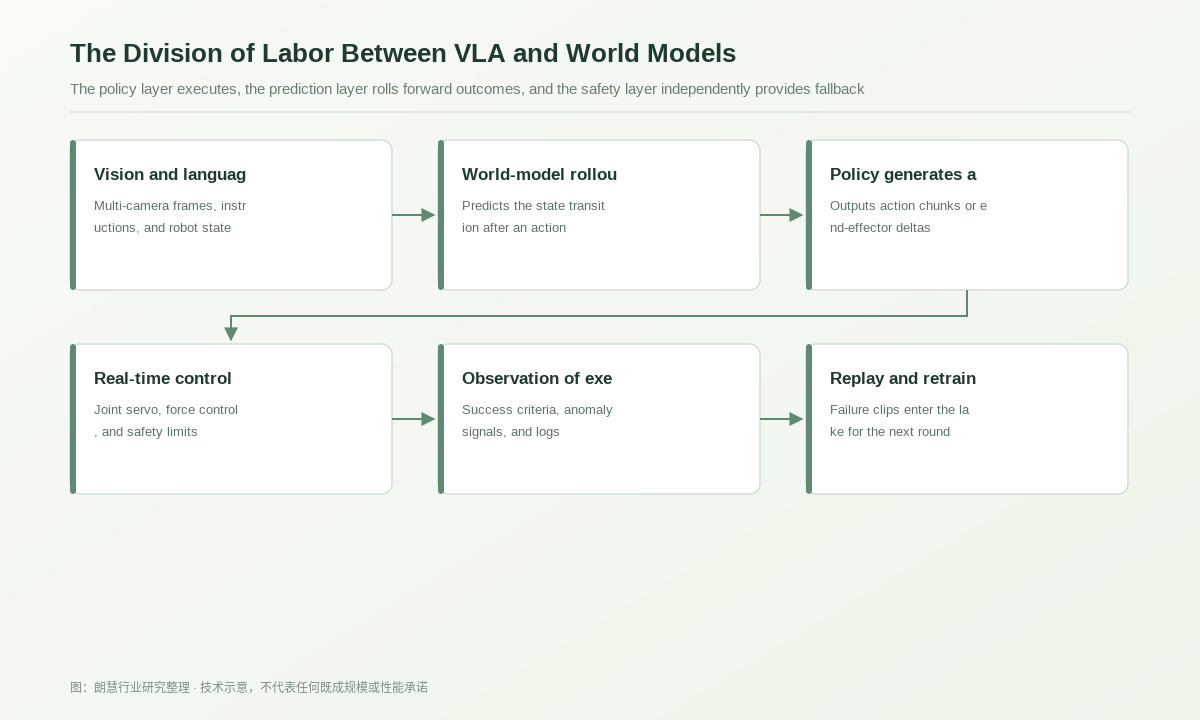
This does not mean VLA is unworkable; it means VLA is one layer of policy and needs other modules to supply predictive ability. Treating VLA as a complete embodied AI solution will repeatedly run into walls on long-horizon tasks and out-of-distribution scenarios. Treating it as an executable decision layer, combined with prediction and verification modules, is closer to engineering reality. This division of labor will become clearer over the next two years and will also be reflected in team organizational structures.
One point that is often overlooked: VLA's language-understanding ability is frequently overestimated. A model being able to repeat an instruction does not mean it has placed the instruction at the correct spatial position. Phrases such as “the one on the left” or “a little higher” in an instruction must be aligned with the camera and the robot's coordinate system in a real scene. If this step is not done well, even the most precise subsequent actions have no meaning.
3. What World Models Add Is Prediction, Not Policy
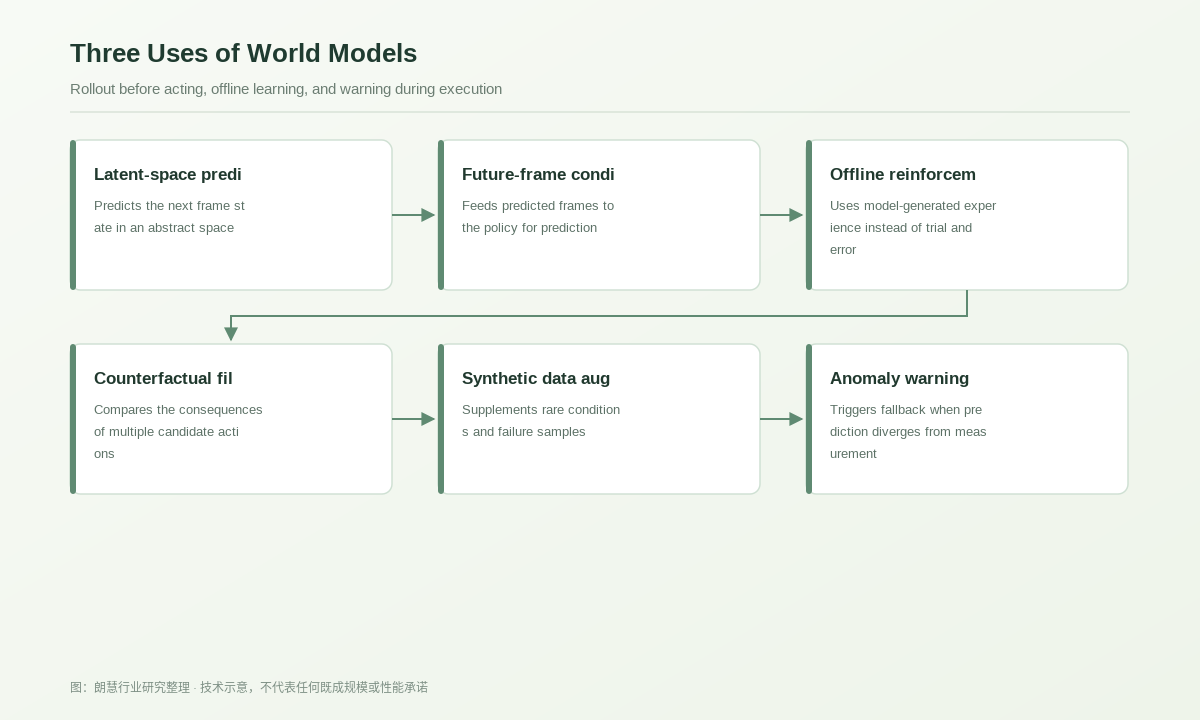
The definition of a world model is straightforward: given the current state and the action to be executed, predict how the state will transition. Applied to video, this means replacing the state with a sequence of frames and predicting the next frame. The mainstream approach performs diffusion prediction in latent space, avoiding the high cost of pixel-by-pixel generation and staying closer to the way humans abstract the world. The Dreamer series demonstrated that this path is viable for control tasks, while work such as Genie pushed it toward interactive generation.
Its purpose is not to output actions directly, but to provide three kinds of support: candidate rollout before an action, synthetic experience during training, and anomaly warning during execution. Feeding predicted future frames to the policy, allowing it to see the consequences of its own actions before deciding on the next step, is an early and direct use. A more advanced use is moving rollout offline to perform model-based reinforcement learning, using the model's imagination to replace part of the real-robot trial-and-error.
The boundaries are equally clear. Prediction error grows with the number of rollout steps, and long rollouts quickly diverge. Contact-rich tasks such as insertion, tightening, and folding flexible objects are sensitive to physical details that purely visual prediction cannot cover, including force and deformation. Training a world model itself also requires large amounts of video and compute, which small teams can hardly bear on their own. It is an enhancement, not a replacement.
When choosing, first ask one question: is my failure mode caused by insufficient predictive ability? If failures mainly come from inaccurate calibration, fixture slippage, or inadequate cycle time, introducing a world model will not solve the problem and will only add another model to maintain. This investment only pays off when you genuinely need the ability to evaluate multiple candidates before acting.
4. Long-Horizon Tasks: Error Accumulation, Hierarchy, and Recovery
The difficulty of long-horizon tasks lies not in single-step accuracy, but in the compounding of errors. A small deviation at each step changes the input distribution for the next step, so the model continues making decisions on a shifted image and the deviation is amplified. The engineering response is not to make the model larger, but to divide the task into segments: coarse localization, grasping, transport, and placement each have clear success criteria, with resettable checkpoints between segments.
Hierarchy is a common structure: the upper level handles task planning and skill selection, while the lower level handles concrete action generation. The upper level can use a language model or a finite-state machine; the lower level can use a VLA or a policy trained for a single skill. The benefit of hierarchy is that failures can be localized, making it possible to distinguish a wrong skill selection from inadequate skill execution. The drawback is that the interfaces must be designed carefully; the upper-level goal description must be understandable by the lower level, otherwise errors will be amplified at the interface.
Recovery capability deserves more investment than success rate. What happens when a grasp fails in a real scene, when an object is knocked over, or when a person suddenly enters the workspace? These branches determine whether the system can run continuously. A practical approach is to define detection signals and fallback actions for each type of anomaly and include them in the acceptance checklist. A system that tests only the success path will expose its problems at the first anomaly.
One more point is often overlooked: long-horizon tasks should be evaluated segment by segment, not only end to end. A low end-to-end success rate may mean one segment is particularly bad, or that transitions between segments are unstable. Recording success rates and time costs for each segment separately gives improvement a direction; otherwise, the only option is to add data blindly.
5. Generalization: Four Kinds of Variation, Four Kinds of Cost
Generalization is not a single dimension. Object variation includes new shapes and materials; position variation includes workstation height and placement posture; appearance variation includes lighting, background, and occlusion; instruction variation includes synonymous expressions and compound goals. These four types of variation place completely different pressures on a model. Object variation tests geometric and physical understanding; position variation tests coordinate systems and calibration; appearance variation tests visual robustness; instruction variation tests the alignment of language and space.
There is also a commonly overlooked dimension: embodiment variation. The same policy moved to machines with different degrees of freedom, different link lengths, and different grippers will no longer have a matching action space. Public cross-embodiment datasets attempt to alleviate this problem, but true transfer still requires alignment design for the action space, such as unifying it to the end-effector pose space or training a redirection layer; you cannot expect the model to learn this on its own.
Judging whether generalization is sufficient cannot rely only on average success rate. You need to look at the decline on out-of-distribution samples, as well as whether failures occur gradually or stop immediately. The latter is far safer than the former. During acceptance, it is recommended to prepare a separate set of out-of-distribution scenarios. The number does not need to be large, but it should cover the four types of variation above, serving as an internal quality threshold rather than waiting for the customer's site to discover the issue.
The corresponding action on the data side is layered collection: routine operating conditions ensure density, while edge conditions ensure coverage. Many teams spend their entire budget repeatedly collecting the same placement configuration, resulting in attractive average metrics but high variance. A small number of targeted edge samples often improve on-site performance more than doubling the number of routine samples.
6. Data Mix: Real Robots, Simulation, and Human Video Each Cover a Segment
The scarcity of embodied data is structural. Internet text and images can be crawled, but robot manipulation data can only be collected. Real-robot data is high quality but expensive, since one trajectory requires people, machines, and the site to be present at the same time; simulation data is cheap and parallelizable, but has a reality gap; human video is abundant and contains rich manipulation priors, but lacks action labels and force information. The relationship among the three is not substitution but division of labor.
A relatively realistic mix is phased: use large-scale human video and simulation data as the foundation during pretraining to learn priors about objects, scenes, and actions; use cross-embodiment real-robot data during mid-training to align the action space; and use real-robot data from the target scenario during post-training for fine-tuning. There is no universal answer for the mix across the three stages; it depends on the task's accuracy requirements and available collection capability, but the overall order is relatively stable.
Data quality affects results more than quantity. For the same trajectory, whether timestamps are aligned, whether calibration is accurate, and whether language annotations are consistent determine whether the data can be used effectively. Many teams collect tens of thousands of trajectories only to discover that the camera and robot are not time-synchronized, so the entire batch can only be downgraded for use. This kind of problem can be avoided with one day of attention to collection specifications; no amount of a month-long rework can fully make up for it.
The value of public datasets is that they eliminate part of the cold start. Open X-Embodiment aggregates manipulation data across institutions and embodiments, and DROID provides a cross-scenario real-robot collection paradigm. They can help you validate a workflow quickly, but they can hardly cover your workstation directly. Treating public data as a baseline and self-collected data as the source of differentiation is more practical than pursuing data volume.
| Data type | Advantages | Limitations | Applicable stage |
|---|---|---|---|
| Real-robot teleoperation | Includes action labels; highest quality | Slow collection; depends on people and equipment | Mid-training, post-training |
| Synthetic simulation data | Parallelizable, annotatable, low cost | Rendering and contact gaps | Pretraining, supplementing rare conditions |
| Human video | Large scale; rich manipulation priors | Lacks action and force information | Pretraining, task sequencing |
| Public cross-embodiment data | Eliminates cold start; relatively uniform format | Large workstation and embodiment differences | Baseline validation, action-space alignment |
7. Action Representation: The Tradeoffs Behind Four Choices
Action representation determines what the model outputs and whether it can be reused across embodiments. There are four common choices: joint positions or velocities, end-effector pose deltas, discretized action tokens, and action chunks with generative decoding. Joint space is intuitive but tightly bound to the embodiment; end-effector pose is closer to task semantics but requires inverse kinematics and collision handling; discrete tokens make it easier to share architectures with language models, but precision is affected by quantization; action chunks with diffusion or flow matching can model multimodal distributions but incur higher inference cost.
The choice depends on control frequency and precision requirements. High-frequency force-control tasks require short action chunks and low-latency inference; grasp-and-place tasks can use longer action chunks in exchange for stability. Hybrid approaches are also common: coarse actions use generative decoding, while end-effector fine-tuning uses an analytical controller. The key is to clarify the division of responsibilities and not let a generative model handle the precise localization it is not good at.
There is also an engineering detail: action representation must be consistent with the data collection method. Human motions captured with motion capture produce joint angles, while teleoperation produces end-effector poses. Training on both mixed in a single dataset requires first unifying them into the same space. If this step is forgotten, the model will learn contradictory mappings, appearing as noticeably worse performance on certain batches, while the root cause remains difficult to identify during troubleshooting.
There is also a low-cost way to evaluate action representations: train a small model with each representation on the same batch of tasks, then compare convergence speed and failure types. Failure types are more informative than success rate. If failures concentrate on “arriving at the correct position but with inaccurate orientation,” this indicates that the representation or decoding method is a poor fit, not that the data is insufficient.
8. Evaluation: Why Simulation Leaderboards Do Not Match Real-Robot Performance
The value of simulation benchmarks is reproducibility, parallelism, and low cost. Work such as LIBERO, SimplerEnv, and BEHAVIOR provides a common language that lets different methods be compared under similar conditions. But there are gaps between simulation and reality in rendering, contact models, and sensor noise, so leaderboard rankings cannot be directly converted into on-site success rates. Treating a leaderboard as a single metric easily produces policies that are good at taking tests.
The difficulty of real-robot evaluation is irreproducibility. The same policy can produce different results on different tables and under different lighting, while the sample size remains limited. A feasible compromise is to standardize scenarios and repeat trials: fix the object set, the initial pose distribution, and the scoring rules; repeat each task enough times and report the range of variation. This at least allows relative comparisons instead of drawing conclusions from a single demo.
Evaluation should also include non-functional metrics: single-inference latency, continuous operating duration, anomaly recovery time, and manual intervention frequency. These metrics do not appear in papers, but they determine whether customers will keep using the system. If an acceptance sheet contains only success rate and none of these, problems after launch will emerge in another way and are often harder to handle.
A final reminder: the evaluation set must be updated regularly. After the model and data have gone through several iterations, the original test set may have leaked into the training process, inflating metrics. Keep a held-out set that does not participate in tuning. It does not need to be large, but it should remain frozen long-term; it reflects the true level better than any leaderboard.
- Task-level metrics: segment success rate, end-to-end success rate, average completion time
- Robustment metrics: decline on out-of-distribution samples, safe stopping on failure
- Engineering metrics: inference latency, continuous operating duration, anomaly recovery time, manual intervention frequency
- Data metrics: annotation consistency rate, time synchronization error, batch traceability
9. Engineering Deployment: Latency, Frequency, and Safety Boundaries
VLA's inference cost determines the upper bound of control frequency. If a large model cannot run on the edge device, the options are to lower the frequency, add an edge server, or use a distilled smaller model. Lowering frequency makes the system slow to respond to sudden changes; adding an edge server introduces network jitter; distillation loses some generalization. Each path has costs. Before choosing, measure round-trip latency under the worst case rather than relying only on the average.
Safety boundaries must be independent of the model. Travel limits, speed limits, torque caps, emergency stops, and personnel-entry detection should be guaranteed by an independent control layer, not by a policy learning not to hit people. When the model fails, the safety layer must be able to bring the system to a safe state rather than waiting for the model to recover on its own. This is a basic functional-safety requirement and the part most likely to be questioned during on-site acceptance.
Observability is often left to the end. Logs should record input images, instructions, actions, execution results, and manual interventions, and ideally support replay. Without replay, on-site problems can only be guessed at; with replay, the same data can be analyzed repeatedly and can also be turned directly into training samples for the next round. Designing logging into the first version saves far more effort and money than adding it afterward.
The deployment form should also be decided in advance. Whether inference runs entirely on the device or combines a local edge layer with cloud training determines the subsequent operations model. Cloud training is easy to centralize, but sending data off-site involves compliance and network costs; fully local deployment is simpler, but model updates depend on the site. This choice should be made when the project starts; changing it midway affects the entire architecture.
10. The Data Flywheel: From the Project Site Back to the Training Set
The real moat is not any single model, but the speed of data return flow. Every deployment produces failure samples, which are the scarce resources closest to the target distribution. Teams need to design a path from the site to the training set: filtering, anonymization, annotation, ingestion, and version management, each step with an owner and a deadline, rather than relying on ad hoc coordination.
The difficulty of return flow is people. Site engineers care about whether today's run works and will not proactively organize failure clips; algorithm teams care about metrics and do not want to process dirty data. An effective approach is to make the return flow part of the process, for example, exporting anomaly clips on a fixed weekly schedule, having a dedicated role perform initial screening, and including annotation work in the project schedule rather than treating it as extra contribution.
Data assets must be reusable. The same collected data may be used simultaneously for policy training, world-model training, and anomaly detection. Therefore, metadata at collection time must be complete: equipment model, calibration parameters, scene description, operator habits, and task objectives. Data without metadata cannot be used in another project and becomes a one-time consumable.
There is also the compliance layer. On-site footage may contain faces, badges, and production-line markings, so anonymization and authorization confirmation are required before return flow. Many teams leave this to the end, leaving data stacked on hard drives and afraid to use it. Writing anonymization rules into the collection process makes the data usable from day one, which is far cheaper than remediation afterward.
11. Forward-Looking Judgment for the Next 12 to 24 Months
First, the division of labor will become clearer. The three-layer structure of VLA as the policy layer, world models as the prediction layer, and traditional control as the safety layer will move from a research concept to an engineering default. Claims that one model solves everything will become rarer, because customers are no longer willing to pay for concepts; they will demand clarity on what each layer is responsible for and who provides the fallback when failure occurs.
Second, data supply will shift from self-collection to protocolization. Combinations of cross-embodiment datasets, human video, and synthetic simulation will become more common, and standards for data formats and temporal alignment will gradually unify. The first beneficiaries will not be teams with the most compute, but teams with collection specifications, annotation quality control, and the ability to reuse data across multiple projects.
Third, evaluation will shift from leaderboards to task-level acceptance. Customers will require enough runs in their own scenarios and failure-type reports rather than paper numbers. Fourth, cost pressure will push models toward edge deployment and distillation, making inference latency the first threshold for selection. For teams preparing to enter this field, the most worthwhile investment over the next two years is not a larger model, but a reusable data pipeline and a verifiable evaluation process.
Langhui's Engineering Capabilities Along This Path
Langhui Technology's embodied data team handles the collection and annotation stage: synchronizing multi-camera video and robot state, checking timestamp alignment, recording calibration, performing episode segmentation and success/failure determination, and delivering data dictionaries, batch manifests, and version records so the same batch of data can be used simultaneously for policy training, world-model training, and anomaly detection.
What we can do is process and quality control: designing collection specifications, unifying annotation standards, conducting consistency sampling checks, and tracing issues. Complete robots, joints, and controllers are outside our scope, and we do not claim to have mass-production or complete-system delivery capability.
If your team is building a manipulation data pipeline, or needs to turn on-site failure clips into a usable training set, send us the modalities, collection equipment, and task types. We will first provide annotation standards and a quality-control plan before discussing scale.
FAQ
Are VLA and world models substitutes for each other?
No. VLA is an executable policy that takes images and instructions as input and outputs actions; a world model predicts state transitions and does not directly output actions. They operate on different dimensions, so comparing which is better is meaningless. The more common engineering combination is to use the world model's predictions as an additional condition for the policy, or to use it to generate experience offline and then execute with VLA.
Do long-horizon tasks have to be hierarchical?
In most cases, yes. End-to-end models accumulate errors significantly after a dozen steps, making failures difficult to localize. Hierarchy divides the task into segments with clear success criteria and sets checkpoints between segments, allowing fallback when an error occurs instead of restarting the entire sequence. The cost is higher interface-design complexity: the upper-level goals must be accurately understood by the lower level, otherwise errors will be amplified at the interface.
Can simulation data replace real-robot data?
Not completely. Simulation is suitable for pretraining and supplementing rare conditions because it is low-cost, parallelizable, and automatically annotatable. But there are gaps in rendering, contact models, and sensor noise compared with reality, and transfer loss on fine manipulation is significant. A practical approach is simulation for the foundation, real-robot data for alignment, and target-scenario data for fine-tuning. Each of the three serves a different purpose, with the proportions adjusted to the task's accuracy requirements.
Should action representation use joint space or end-effector pose?
It depends on whether cross-embodiment reuse is needed. Joint space is tightly bound to the embodiment and requires retraining when the machine changes; end-effector pose is closer to task semantics and transfers well, but requires inverse kinematics and collision handling. Many teams use a hybrid approach: coarse actions go through generative decoding, while end-effector fine-tuning is delegated to an analytical controller. Whichever is chosen must remain consistent with the data collection method.
How do you determine whether an embodied model is ready for delivery?
Look at four things: whether segment success rate and end-to-end success rate are stable, how much performance declines on out-of-distribution scenarios, whether the system can stop safely on failure and provide readable anomaly signals, and whether continuous operation and anomaly recovery can be measured. Add inference latency and manual intervention frequency. An evaluation based only on average success rate cannot support a delivery decision.
- Open X-Embodiment: Robotic Learning Datasets and RT-X Models https://arxiv.org/abs/2310.08864
- RT-2: Vision-Language-Action Models Transfer Web Knowledge to Robotic Control https://arxiv.org/abs/2307.15818
- π0: A Vision-Language-Action Flow Model for General Robot Control https://arxiv.org/abs/2410.24164
- OpenVLA: An Open-Source Vision-Language-Action Model https://arxiv.org/abs/2406.09246
- Mastering Diverse Domains through World Models (DreamerV3) https://arxiv.org/abs/2301.04104
- Genie: Generative Interactive Environments https://arxiv.org/abs/2402.15391