
ARCHIVE MIGRATION / RECORDS AND BUSINESS SYSTEMS
Structured Migration of Existing Expropriation Archives: Scanning and Recognition, Cataloging Rules, and the Dual-Set System
Existing expropriation archives, moving from paper files and scattered electronic documents to searchable, verifiable, and access-tiered structured assets, present their greatest challenge not in scanning equipment but in catalog systems, cataloging granularity, and quality-control rules. This article breaks down seven stages—inventorying and ledger building, scanning and OCR, cataloging, the dual-set system, security classification, sampling and rework, and on-site verification records—and offers an outlook for the next 12 to 24 months.
The most common failure in existing-archive migration is not that the scans are unclear, but that after scanning, the documents still cannot be found. Files are loaded into the system by cabinet number, with searchable fields limited to filename and upload time. Business staff who want to search by ID number, parcel number, or village group can only click through the directory layer by layer. The real workload comes before scanning: first define the catalog system and cataloging granularity, then set image standards and OCR strategy, and only afterward proceed to batch processing, quality inspection, and ingestion. This article follows that sequence, explaining the criteria, failure conditions, and rework costs at each stage, as well as how to implement the dual-set system, security classification, and on-site verification records in the system.
I. Most Existing-Archive Migration Failures Happen Before Scanning
Understanding archive digitization as simply buying equipment and hiring people to scan is the most common starting point for such projects. Six months later, hundreds of thousands of pages of images have piled up in the system, while search still depends on a directory tree. Business staff cannot find what they need and can only call former colleagues to ask. The problem is not the scanner, but that three questions were never answered before work began: by what entities should the archives be organized, at what granularity should each document be cataloged, and after migration, who will search for what under which conditions.
Expropriation archives are inherently cross-cutting across multiple entities. Under one project sit project approval documents, red-line maps, hearing materials, and compensation plans; under one household are property determinations, population information, compensation agreements, and payment vouchers. The same material may belong to a particular project, a particular household, and a particular parcel. If the catalog is organized only by physical cabinet and year, these cross-cutting relationships are lost the moment migration begins, and can afterward only be reconstructed from memory.
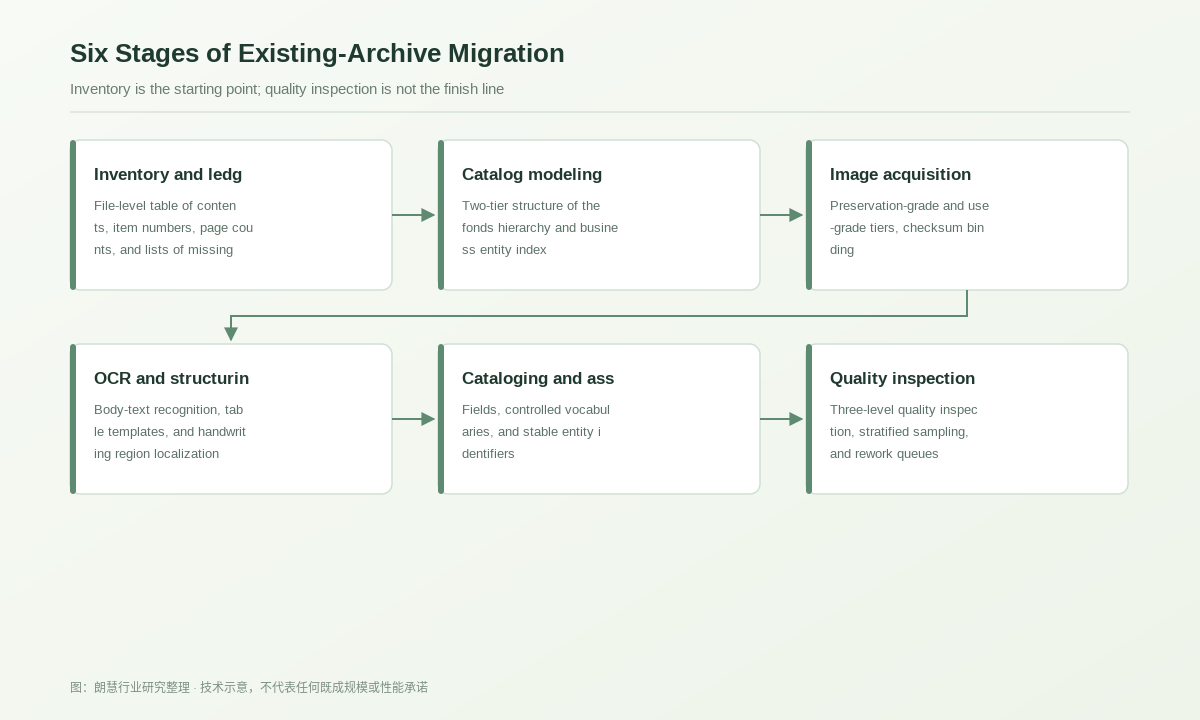
So the first step is inventory and modeling, not scanning. The inventory must produce a file-level table of contents, item numbers, page counts, and a list of missing and damaged pages; the modeling must define the business entities and their ownership relationships with documents, and identify which fields serve as search keys. Search keys are not decided on a whim. They are inferred from real questions: who usually searches, what information do they bring with them, and what happens when they cannot find it.
An even more common situation is this: the organization already has a business system, and archives are merely attachments hanging under projects. In that case, the migration goal is not to build a separate archive repository, but to make archives attributes of business entities—viewed, cited, and traced on the same page. If the goal is set wrong, every subsequent field design will follow it.
II. Catalog System: Define Business Entities First, Then Hierarchy
The catalog system determines the ceiling of searchability. A common approach is to carry over the paper-era classification scheme, arranging items by year, retention period, department, and file number. This system is sufficient for custody and transfer, but insufficient for business queries, because what business staff have in mind is not file numbers, but project names, village groups, household heads, and parcels.
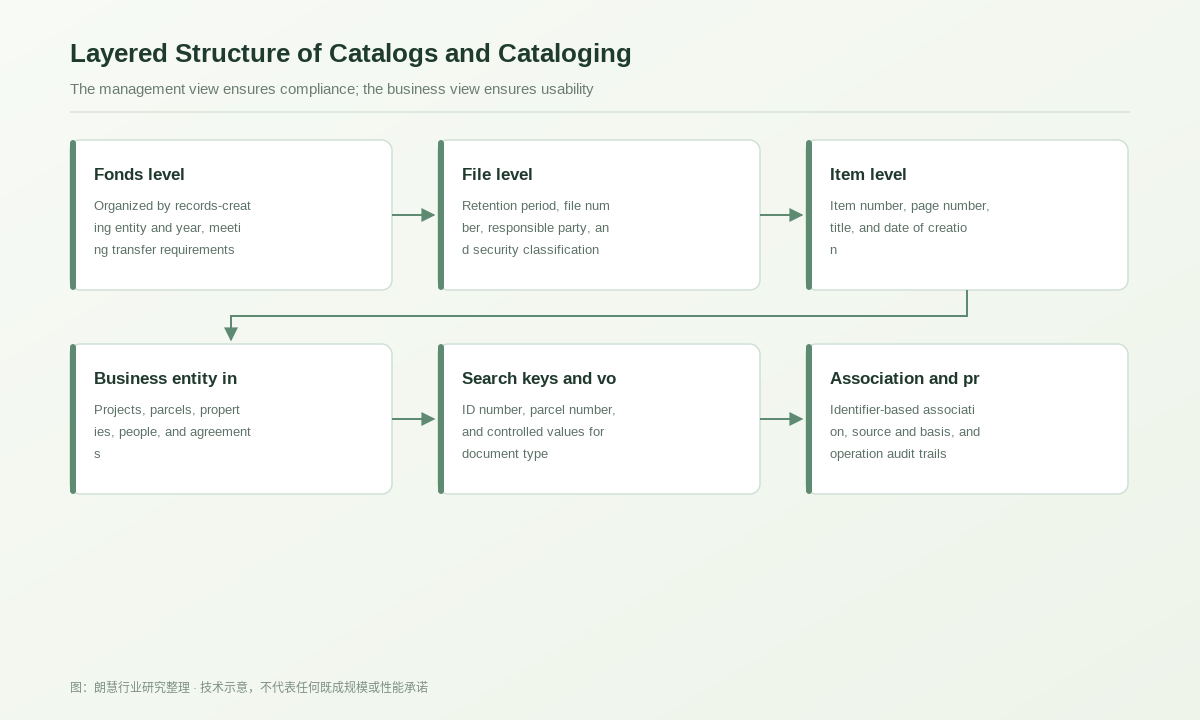
A more reliable approach is a two-tier catalog: one layer is the archival-management view—fonds, catalog, file, item—meeting requirements for filing, transfer, and audit; the other is the business-side entity index, reassembling documents around entities such as projects, parcels, properties, people, and agreements. The two layers are linked by stable identifiers, not by guessing based on similar filenames.
The hierarchy should not be too deep. Once a catalog exceeds four levels, front-line staff begin creating folders on a whim during data entry, and eventually the same type of material is scattered across a dozen or more paths. In practice, the management tier should follow the standards, while the business tier should be kept within two levels; remaining relationships should be handled through fields and tags rather than by creating more folders.
Identifiers must follow rules, and those rules must be finalized once before migration begins. Project numbers, parcel numbers, property numbers, and item numbers should each remain independent and must not be nested within one another. Once a rule is launched and then changed, the cost of renumbering historical data is extremely high, and existing reference relationships are disrupted.
III. Scanning and OCR: Image Quality Is the Foundation for Every Later Stage
Scanning is the stage most prone to price pressure and most likely to plant hidden landmines. Judging whether an image is usable does not mean looking at resolution figures, but four things: whether the text is legible, whether the page is complete, whether skew and distortion are within acceptable limits, and whether the color mode matches the original. Red seals on color approval documents, handwriting in signed approvals, and pale carbon copies are the first information lost to low-quality scans.
Engineering practice typically grades images by purpose: preservation-grade images for long-term storage follow industry archive standards, retaining original color and full page margins; use-grade images for daily reference and OCR may be compressed, denoised, and deskewed, but must not be cropped to remove seals or margin annotations. Both sets of images are generated from the same source, with filenames bound to checksums, so that later there is no ambiguity about which version is the original.
OCR is not a cure-all. Recognition rates for printed text and formally structured official documents are usually acceptable, but drop significantly for handwritten approvals, carbon copies, areas obscured by stamps, and vertically set traditional Chinese characters. A practical approach is layered processing: printed body text goes through automated recognition; tables use layout analysis plus templates; handwriting and seal areas are only located and manually transcribed, without forced recognition. Clearly flagging unrecognizable sections is safer than returning a plausible-looking result full of wrong characters.
Recognition results must retain confidence scores and source coordinates. Low-confidence fields enter a manual review queue, with the original image on the left and the text box on the right; once edited, the result is written back immediately. OCR output without coordinates and confidence scores is nearly impossible to locate errors for during quality inspection—the entire page has to be reviewed again.
IV. Cataloging Rules: Fields, Granularity, and Controlled Vocabularies
Cataloging rules must resolve three things: at what level to catalog, what to enter in each field, and which values must come from a vocabulary list. If these three are not clearly specified, ten people cataloging the same project will produce ten different results, and the statistical basis will become a mess.
Granularity is set by purpose. File-level cataloging for search must include at least title, responsible party, date of creation, document type, associated entity, page count, and security classification; for business processing, key business fields must also be added, such as compensation plan number, area, and determination conclusion. More fields are not always better: each additional mandatory field raises data-entry costs, and the rates of omitted and arbitrary entries rise along with it.
Controlled vocabularies are the key to comparability. Fields such as document type, subject matter, administrative division, building structure, and compensation method must use fixed vocabularies and cannot be freely typed. Free entry results in the same thing appearing in five or six different forms, and searchers can only try them one by one. Vocabularies need to be maintained: new entries go through application and review, not added by whoever wants to add them.
Another commonly overlooked field: source and basis. Which file was this material extracted from, which rule establishes that it belongs to this entity, and who entered it and when? This information matters more than the body text when disputes arise, and it is also the foundation for later audit tracing.
V. The Dual-Set System: Paper and Electronic Do Not Simply Coexist
The intent of the dual-set system is for the paper and electronic media to take on different responsibilities, not merely to store the same thing twice. Paper originals carry evidentiary force and proof of authenticity; electronic copies support search, sharing, and business workflow. The relationship between the two must be written clearly into policy, or when a dispute arises, no one can say which set governs.
Which materials must retain paper originals is usually determined by regulations and the nature of the business: agreements involving signatures and seals, determination materials that must be submitted as evidence, and files with special bindings or attachments. Which can be kept only in electronic form depends on scanning quality, metadata completeness, and long-term readability. The standard is not convenience, but whether you can prove authenticity when something goes wrong.
The electronic set must solve for long-term readability. Common practice is to preserve documents in open or standardized layout formats, paired with periodic format migration and integrity checks; checksums and operation logs are also preserved to prove that a file has not been replaced since it entered the repository. Simply piling JPEGs on a shared drive is not a dual-set system—it cannot even guarantee basic integrity.
The two sets must match. The file number, item number, and page number of the paper file must correspond one-to-one with the directory structure, filenames, and metadata of the electronic files: any paper volume picked at random can be located to the corresponding electronic file in the system, and vice versa. A dual-set system that does not match is, in practice, two unrelated collections of material.
VI. Security Classification and Access: Security Levels, Roles, and Audit Trails
Archive security classification cannot be a single security label. Expropriation archives contain policy documents that can be proactively disclosed, sensitive materials involving personal identity, household population, and compensation amounts, and restricted-use materials involving third-party appraisals and surveying results. Classification must be based on content and consequences, not applied uniformly to an entire file.
In the system, classification must become executable rules: which roles can view the catalog, which can view full text, which can only view de-identified summaries, which require secondary approval, whether downloads are watermarked, and whether exports leave a record. Roles are defined by position, not by person; when personnel change positions, the role is changed rather than the permission list.
Audit trails must be detailed enough to reconstruct events. Who accessed which file, from which address, at what time, and performed what action must all be recorded, and the logs themselves must be tamper-proof. A single login log is not enough; what really needs reconstruction is how a sensitive material was disseminated, and within what scope.
Permission design must also account for field scenarios. Mobile photo capture and on-site verification signatures often occur under conditions of weak networks, shared devices, and temporary personnel. These entry points require separate permission and time-limit controls—for example, temporary authorizations that expire automatically, device binding, and encrypted offline storage of data—rather than simply reusing the office permission model.
VII. Quality Inspection and Sampling: Sampling, Error Classification, and Rework
Quality inspection is not a matter of flipping through a few pages at the end to see whether they are clear. Effective quality inspection operates on three levels: the image layer checks completeness, clarity, skew, and duplication; the data layer checks missing fields, out-of-vocabulary entries, format errors, and whether entity associations are correct; the business layer checks whether key materials are complete and whether the logic is self-consistent—for example, a compensation agreement with no determination conclusion.
Sampling must be stratified by batch and risk, not determined by drawing lots. The first several batches from new suppliers, new scanning equipment, or new data-entry staff should be fully inspected, shifting to sampling once stable; items involving sensitive information, key conclusions, or disputed materials get higher sampling ratios. The sampling ratio must be written into the work specifications—if it is not, inspection becomes a matter of mood.
Errors must be classified, or rework has no direction. Common categories are: auto-correctable, such as orientation and naming; requiring manual transcription, such as missing fields and wrong associations; requiring verification against the original, such as missing pages, blurriness, and unclear signatures or seals; and requiring business confirmation, such as a determination conclusion contradicting the materials. Different categories enter different queues with different responsible parties.
Rework must be fully documented. The sampling results, error rates, rework volumes, and re-inspection results of each batch must be archived to form a trend. Watching trends is more useful than watching a single pass rate: if a type of error recurs, it indicates a problem with the rules or training, not with any individual.
VIII. Digitized Records of On-Site Verification: Location, Time, Images, and Signatures
Expropriation, demolition, and resettlement operations cannot do without on-site verification: current condition of properties, inventory of ancillary structures, population determination, and vacating progress. These records used to be made on paper forms with photos, then transcribed back at the office—making it easy for times not to match, photos not to be found for the right household, and signers to be unclear.
Digitization's key is binding four types of information together: location, time, images, and responsible person. Photos automatically carry geolocation and timestamps, are directly linked to business entities, and on-site signatures are completed on tablets and sent back, forming an unbroken chain of records. There is no need to transcribe back at the office; verification results enter the business system directly.
On-site records must also support review. Photos of the same property at different stages must be comparable by time to determine whether new structures were added or vacating was completed; results of a given verification round must be trackable by personnel and by location. These capabilities depend on the data structure, not on the photos themselves.
Weak networks and offline conditions are the norm. Field data collection must first write to local encrypted storage, then automatically upload and verify completeness once connected; in case of conflicts, the server record prevails while the local original is retained. Without offline capability, a product will be abandoned within days on a real worksite.
IX. Integration with Business Systems: Enter Once, Reuse Everywhere
Many organizations historically built their archive systems and business systems separately. The goal of integration is not to synchronize data between the two, but to ensure that each fact has a single point of entry and is referenced elsewhere. Without this, you end up with two sets of household registration data and two sets of area figures in different systems, and no one can say which set is correct.
A workable boundary is: the business system owns process data and state transitions, the archive system owns original evidence and long-term preservation. Conclusions generated during business processing are written back to the archive's cataloging fields; original materials are attached in reverse to business entities for reference. The two sides are linked by unified entity identifiers, without full field-level replication.
Search must work across systems. The most frequently requested capability from business staff is to enter an ID number or name and see that person's materials across all projects. This requires a unified search entry point with permission filtering, rather than asking users to first select a project and then search for a person. Search result ordering, match reasons, and accessible scope must be clearly displayed, so that content the user is not authorized to see is not leaked in summary form.
Interfaces need failure handling. Batch synchronization failures, misaligned field mappings, and duplicate pushes happen every day in real environments. Retry, reconciliation, alerting, and manual compensation entry points must exist; you cannot assume an interface will always succeed.
X. Organizing Migration Projects: Acceptance and Rework Control
Migrating existing archives is a long-cycle, low-margin-for-error endeavor. A more stable way to organize the work is to proceed in batches: first complete one full project as a model, running the catalog, fields, image standards, and quality rules end to end, then replicate this to other batches. The model batch has the lowest rework cost and exposes the fullest range of problems.
Acceptance criteria must be set upfront. Image pass rates, field completeness rates, entity association accuracy, sampling error rates, and search hit performance must be defined before work begins and calibrated against the model batch. Accepting based only on how many pages were scanned is equivalent to having no acceptance at all.
Personnel are the biggest variable. Scanning, data entry, and quality inspection are often performed by outsourced or temporary staff with high turnover. The way to reduce risk is not to add people, but to build rules into the tools: mandatory-field validation, vocabulary dropdowns, batch deskewing, error prompts—so that even novices are less likely to make basic mistakes. At the same time, common errors should be turned into training material to shorten the onboarding time.
Finally, there must be a list of outstanding issues. Migration can never be 100% perfect; it must be clear which issues can be deferred, who is responsible, and when they will be addressed, and which must stop and be verified against the originals. Without this list, issues become ownerless matters after acceptance.
XI. Outlook for the Next 12 to 24 Months
First, acceptance criteria for archive migration will shift from page counts to usability. As business systems become broadly connected, buyers will increasingly care about search hit rates, field completeness, and the accuracy of cross-system associations, rather than total pages scanned. This will push contractors to invest more upfront work in catalog modeling and cataloging rules.
Second, OCR will shift from general-purpose recognition to layout understanding plus field extraction. Large models are improving in table structure reconstruction, assisted recognition of handwritten documents, and cross-page classification of materials, but manual review will still be needed as a safety net in the short term. What truly creates separation is not the model, but whether you have high-quality annotated samples and reproducible evaluation sets.
Third, the dual-set system will continue to exist, but the electronic set's weight will rise. As standards for electronic signatures and single-set electronic archiving gradually take hold, more and more business materials will be natively archived in electronic form, with paper originals retained only where required. This raises the bar for metadata quality and long-term readability.
Who benefits first? My judgment: organizations that treat their catalog system and cataloging rules as assets. Once the rules are stable, switching systems, switching vendors, or onboarding new business becomes mere adaptation work; if the rules were never built properly, every system change means starting over. For contractors, teams that can connect data across archives, business operations, and the field will go further than teams that only know how to process scans.
Langhui's Engineering Capabilities Along This Path
Langhui takes on the data-side work in projects of this type: collection specification design, structured data entry, quality control and consistency reporting, and data dictionaries and version records. In archive migration, this corresponds to organizing catalog and cataloging rules, designing sampling schemes for scanned-document quality inspection, field mapping and association validation, and traceable records throughout the migration process.
We can work with business systems on data interface specification design, aligning archive entities, business entities, and search keys; we can also take on the design of collection specifications and annotation standards for on-site verification records. Archive repository deployment, scanning production lines, and long-term preservation systems are handled by the client or partners; we do not replace them, nor do we claim statutory qualifications for archive custody.
Our capability boundaries in healthcare are equally clear: image annotation covers CT, MR, PET, mammography, ultrasound, and other modalities; we do not claim HIPAA certification, and we do not claim endoscopy, pathology whole-slide imaging, or clinical-record NLP as platform capabilities. If your organization is undertaking an existing-archive migration, or needs to sort out cataloging fields and quality-inspection criteria, send us the archive types, approximate volume, and search scenarios, and we will provide an actionable specification list.
FAQ
For digitizing existing archives, is a higher scanning resolution always better?
No. Resolution only needs to be sufficient; what matters is that text is legible, pages are complete, and color matches the original. Preservation-grade images follow industry standards and retain page margins and seals; use-grade images may be compressed and deskewed, but key information must not be cropped out. Blindly increasing resolution doubles storage and transmission costs without solving the search problem.
For the paper and electronic dual-set system, must both sets always be kept?
It depends on the nature of the business and regulatory requirements. Originals involving signatures and seals, or that must be submitted as evidence, generally must retain paper copies; materials with high scan quality, complete metadata, and long-term readability can be kept only in electronic form. The precondition is that the electronic set has checksums and operation logs and can prove it has not been replaced—otherwise the dual-set system is merely two unrelated collections of material.
Once scanned documents have undergone OCR, can they be fully text-searched?
That only makes them preliminarily usable. Recognition rates for printed text are good, but drop noticeably for handwritten approvals, areas obscured by stamps, carbon copies, and vertically set traditional Chinese characters. True searchability also requires layout analysis, field extraction, confidence scoring, and manual review. Ideally, search results can be located to coordinates on the original image; otherwise, users who see wrong characters have no way to verify the basis.
How is archive security classification determined, and how does it relate to business-system permissions?
Classification is based on content and consequences, not applied uniformly to an entire file. Public policies, personal sensitive information, and third-party deliverables should fall into different levels. In the system, this must become rules: whether a role can view the catalog or full text, whether de-identification is applied, whether secondary approval is required, and whether downloads are watermarked. Roles are defined by position; when personnel change positions, the role changes, not the permission list.
How long does existing-archive migration generally take, and how do you control rework?
It depends on the volume of files and baseline conditions; proceeding in batches is generally more stable. First complete one full project as a model, running the catalog, fields, image standards, and quality rules end to end, then replicate this to other batches. Rework control depends on three things: acceptance metrics set upfront and calibrated against the model, error classification into different queues, and archiving each batch's sampling results to watch trends.
- ISO 15489-1:2016 Information and documentation — Records management — Part 1: Concepts and principles https://www.iso.org/standard/62542.html
- ISO 14721:2012 Space data and information transfer systems — Open archival information system (OAIS) — Reference model https://www.iso.org/standard/57284.html
- ISO 19005-1:2005 Document management — Electronic document file format for long-term preservation (PDF/A-1) https://www.iso.org/standard/38920.html
- W3C PROV-O: The PROV Ontology https://www.w3.org/TR/prov-o/
- U.S. National Archives — Digitization Guidance and Best Practices https://www.archives.gov/preservation/digital