
INVESTMENT SYSTEM / PROCESS DESIGN
Process Design for Investment and Financing Systems: How the Project Database, Investment Decisions, Fund Disbursement and Post-Investment Alerts Fit Together
Investment and financing systems commonly fail not because they lack features, but because definitions are not aligned, processes break down midway, and no one owns the alerts. This article breaks down the design essentials into nine stages: project database admission, due diligence and review, investment decision voting, fund disbursement, post-investment management, risk alerts, state-owned asset supervision reporting, permission controls and audit trails, and acceptance testing and rollout. Each stage identifies where decisions should be made, highlights common pitfalls, and offers a judgment on what will matter over the next 12 to 24 months.
After an investment and financing system goes live, feedback from business teams often centers on questions such as “can this report be generated automatically?” and “why does this figure differ from the financial statements?” Behind these surface-level issues lies the same problem: the three ledgers for assets, financing and funds are not aligned, and key judgments within the processes are not being recorded. This article does not discuss feature lists. It focuses on how processes connect, where decision points fall in each stage, which designs look complete but cannot withstand scrutiny, and what to test during acceptance.
I. Define the Data Definitions Before Discussing Features: Asset, Financing and Fund Ledgers
A common complaint after an investment and financing system goes live is “the data is wrong.” Investigation usually reveals that the system did not calculate incorrectly, but that three departments are keeping separate books. The asset department records physical assets, the investment and financing department records financing arrangements, and finance records vouchers. The three ledgers differ in granularity and timing. The system’s first task is not to add features, but to align these three types of ledgers to the same set of master data and the same timing definitions.
Each ledger has a distinct role. The asset ledger answers “what do we have, what is it worth, and can it be used for financing?” The financing ledger answers “how much has been raised, through what means, and when is repayment due?” The fund ledger answers “has the money arrived, who was paid, and what is the voucher?” They are connected through asset numbers and project numbers. If any link is missing, summary reports can only be assembled manually, and every attempt risks an error.
Alignment must be expressed in concrete fields, not merely stated in policy. For example, is the “financing balance” calculated as principal minus repaid principal, or as the balance on the reconciliation statement? Is the “occupancy rate” based on area or room count? Are “projects under construction” recognized at project approval or at construction start? If these questions are not clarified during requirements, making changes after development will require rebuilding reports and re-entering historical data.
II. The Project Database: Admission and Tiering from Lead to Entry
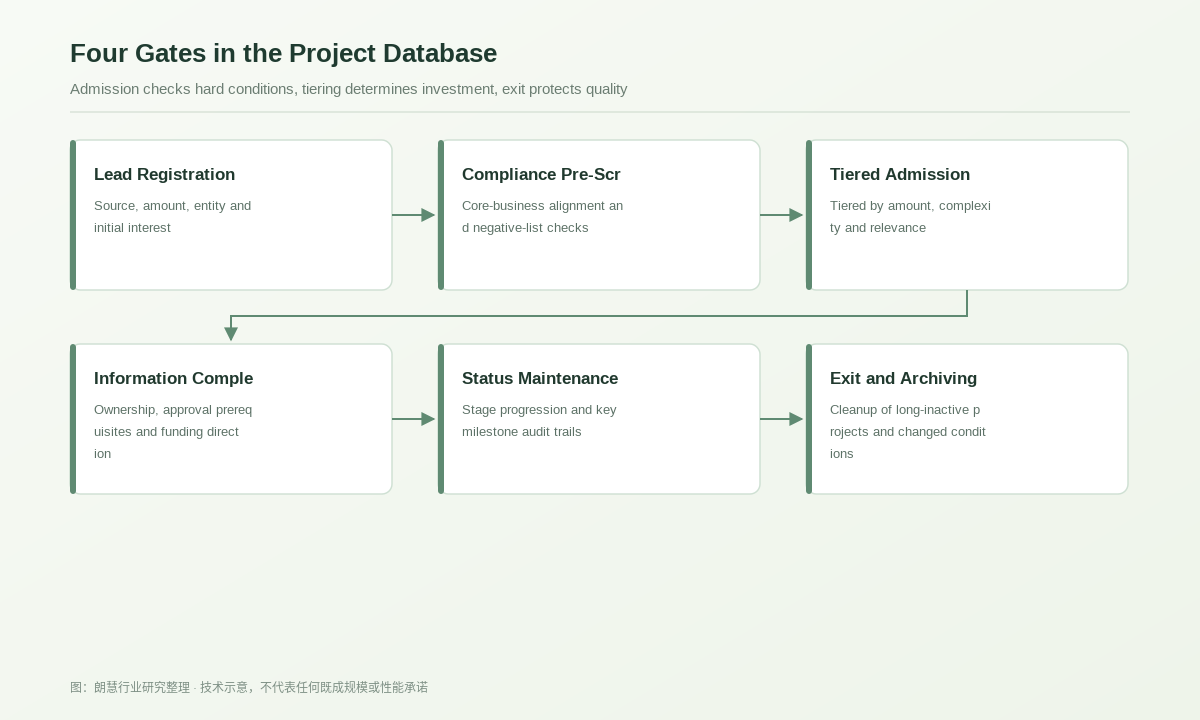
The project database is more than a list of projects; it is a gate. Its purpose is to screen opportunities before resources are committed, keeping out obviously non-compliant projects and those whose economics clearly do not work, while prioritizing projects worth deeper review. Without this gate, the database eventually becomes a form anyone can fill out. Once completed, no one checks it, and later reporting requires determining which entries are genuine.
Admission criteria should be few but strict. Common criteria include alignment with the organization’s core responsibilities and main business, absence from the negative list, substantially complete ownership or approval prerequisites, and a clear direction for funding sources. Too many criteria degrade into a formality review; too few amount to having none. A practical approach is to divide them into “mandatory” and “bonus” criteria. Mandatory criteria function as vetoes, while bonus criteria are used for ranking.
Tiering determines how much due diligence effort a project will receive. Projects are usually tiered by amount, risk complexity and strategic relevance. Large or cross-sector projects follow the full process, while smaller standardized projects follow a simplified one. Tiering standards should be public; otherwise business teams may perceive the process as opaque. There must also be an exit mechanism: projects that remain inactive for long periods, experience changes in prerequisite conditions, or repeatedly fail review should be removed. Otherwise the database will keep growing while losing credibility.
III. Due Diligence and Review: Turning a Materials Checklist into a Verifiable Data Structure
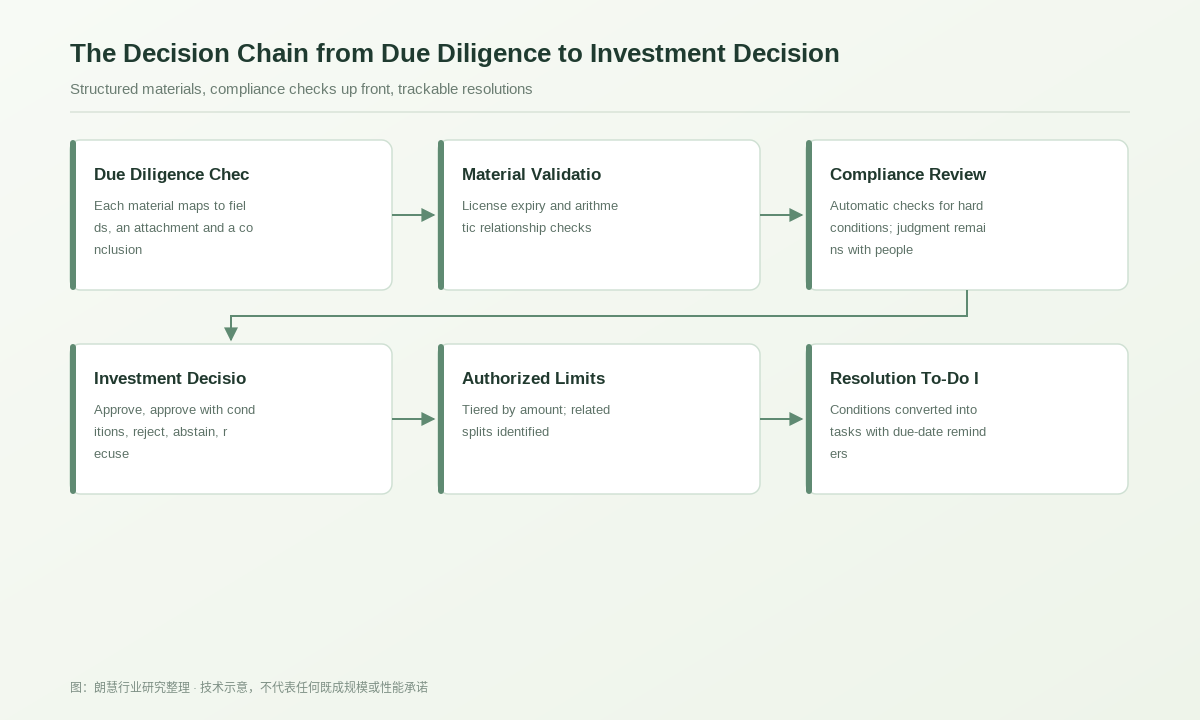
The main source of waste during due diligence is not insufficient depth, but repeatedly requesting and returning the same materials. This usually happens because the checklist is distributed as a document, fields are not structured, submissions arrive as scanned files in various formats and self-made spreadsheets, and reviewers must compare them manually. When the checklist is built as a structured form in the system, the return rate falls noticeably and review time is shortened.
The key to structuring is defining “one material = a set of fields + one attachment + one conclusion.” Fields support validation, such as license expiry dates, whether ownership percentages total one, and the arithmetic relationships among financial data. Attachments provide evidence. Conclusions capture the reviewer’s judgment. Keeping the three separate allows reviewers to see both the conclusion and the supporting basis, rather than guessing from a pile of scans.
Review should distinguish between “compliance review” and “value review.” Compliance review checks whether hard conditions are met; it can be standardized and moved into the system for automatic validation. Value review considers return estimates, exit paths and synergies, which require human judgment; the system only provides structured comparisons and scenario calculations. Mixing both types of issues in one meeting usually means compliance issues consume all the available time, leaving no time to discuss value before the meeting ends.
IV. The Investment Decision Process: Agenda, Voting, Recusal and Authorized Limits
The key requirement for designing an investment decision process is traceability, not having many steps. A decision meeting should be able to answer: who proposed the agenda item, when the materials were complete, who attended, how each person voted, what the basis was, and whether the resolution had conditions. If these elements do not correspond to fields in the system, the only evidence available afterward is the meeting minutes, which are often incomplete and leave responsibility unclear.
Voting must distinguish several outcomes: approve, approve with conditions, reject, abstain, and recuse. Recusal is especially easy to overlook. Related parties and individuals with conflicts of interest should recuse themselves; the system must support registration and reminders rather than relying on self-discipline. Authorized limits are another dimension: different amount ranges correspond to decision-making bodies at different levels. Exceeding a limit must be escalated and cannot be avoided by splitting a transaction into multiple payments. If the system can identify related transactions split over a short period, it will save substantial post hoc checks.
A resolution is not the end of the process, but the beginning of execution. Conditions attached to a resolution must be converted into to-do items, assigned to specific owners, and tracked with due-date reminders. A common failure occurs when a resolution is approved but no one follows up on its conditions. Six months later, the team discovers that a key prerequisite was never implemented, and the project has advanced to a stage that is difficult to reverse. The root cause lies not in execution, but in failing to break the resolution into trackable tasks.
V. Fund Disbursement: Planning, Payment, Accounts and Reconciliation
Disbursement risks concentrate in two areas: “off-plan payments” and “wrong accounts.” Off-plan payments occur when a payment is made without being included in the annual or quarterly funding plan. A wrong account occurs when the receiving account does not match the entity using the funds. The former is controlled through a strong link between planning and disbursement; the latter is controlled through account whitelisting and change approval. If both controls are in place, the probability of problems drops by an order of magnitude.
The disbursement process generally has four steps: funding request, review, payment instruction, and confirmation of receipt. The system must ensure that each step has a corresponding voucher, and that the amount, account and purpose of the payment instruction match the request. Manual steps may remain where business judgment is genuinely required, but changes must be logged, including what was changed, who changed it, and the basis for the change.
Reconciliation is both a finishing step and a validation step. Bank statements are imported and automatically matched against payment records in the system, with unmatched items held for manual processing. If this step is done rigorously, the subsequent fund ledger and regulatory reports do not require secondary processing. Many organizations do not lack reconciliation; they reconcile outside the system and never write the results back. As a result, system balances remain slightly different from reality for long periods, and the discrepancy keeps accumulating.
VI. Post-Investment Management: Equity Ledger, Dividends, Exit and Impairment
Post-investment management can easily become “quarterly form filling.” Filling in forms is not inherently wrong, but if the content never enters analysis and alerting, it only adds workload. Effective post-investment management must at least answer three questions: how is the investee performing now, what is our equity interest worth, and what should be done next? These correspond to three data sets. If one is missing, the judgment remains unsupported.
The equity ledger must stay synchronized with business registration information and internal resolutions. Ownership percentage, paid-in capital, board seats and special rights arrangements are all essential. Dividends should be traceable to the resolution and the receipt of funds. Exit records should capture the method, how consideration was determined, and the final result. These records are not only for reporting; they are also the basis for future disposal decisions and cannot be reconstructed after the fact.
Impairment is sensitive, but it still requires a process. There must be a regular valuation mechanism. Valuation methods, key assumptions and parameter sources must be archived, and changes in valuation results must be explainable. Without such a mechanism, book value can diverge from reality for long periods, only for the organization to discover when disposal becomes necessary that the figures can no longer be justified. For valuation, the process matters more than the conclusion because the conclusion will change.
VII. Risk Indicators and Alerts: Thresholds, Triggers and Accountability
The value of an alerting system does not come from having many indicators, but from ensuring that someone owns every alert. A common design mistake is to list dozens of indicators and pop up hundreds of reminders each day until everyone stops looking. A more effective approach is to begin with a small number of indicators directly related to fund safety, get the response process working smoothly, and then add indicators gradually. Adding indicators is easy; getting people to respond is hard.
Indicators fall into three broad categories: debt-service, operational, and compliance indicators. Debt-service indicators cover maturity distribution, coverage ratios and liquidity. Operational indicators track trends in revenue, gross margin and cash flow. Compliance indicators cover license expiry dates, litigation, guarantee payments and similar factors. Thresholds should not be one-size-fits-all. They should be tiered by project and adjusted dynamically once enough historical data has accumulated, rather than pursuing precision from the start.
Every alert needs a clearly designated response owner, a deadline, and an escalation path: if it is not handled within the specified time, it is automatically reported to the next level. Alert closures must also be logged, stating what measures were taken and what effect they had. A system that records only “handled” is effectively equivalent to having no alerts, because it can neither support postmortems nor accumulate judgment experience.
VIII. State-Owned Asset Supervision Reporting: Definitional Differences and One Source per Data Point
The pain point in regulatory reporting is usually not an inability to fill out forms, but that the same set of figures does not reconcile across reports. This happens because reports differ in statistical scope, timing and consolidation rules, while the system does not make those differences explicit. The solution is to establish “one source per data point”: each indicator has a unique data source and calculation rule, and reports only combine figures rather than recalculating them.
Definitional differences require a mapping table. For example, should investment amount be based on the signed amount, the amount received, or the completed amount? Should liabilities use the parent-company basis or the consolidated basis? Do projects under construction include those that have been suspended? These differences are themselves reasonable; the problem is that they are not documented. The mapping table must be maintained alongside the reports and traceable to specific fields, rather than simply saying “as required by the regulator.”
Reporting timing also matters. Monthly, quarterly and annual reports have different deadlines. The system must be able to generate snapshots at different points in time instead of rerunning the current data each time. Otherwise historical reports will “change” over time, making them difficult to explain during audits and hard to identify which version was submitted at the time.
IX. Permissions and Audit Trails: Data Isolation and Audit Traceability
Investment and financing data is more sensitive than general business data, so permissions should follow the principle of least necessary access. The asset department can view assets but not financing details. The investment and financing department can view assets and financing but cannot modify original asset records. Finance can view fund transactions. A cross-visible but non-editable relationship is naturally expressed through two dimensions: role and data scope, which also makes later adjustments easier.
Audit trails must cover both reads and writes. Recording before-and-after values for write operations is straightforward, but read operations, especially exports and bulk queries, are often overlooked. In investment and financing scenarios, the system must log who exported how many project records and when. Export permissions should be configured separately, with a limit on the number of records per export; requests exceeding the limit must go through approval. This rule is more effective than assigning blame afterward.
Audit traceability must answer, “Where did this data come from?” Whether it was synchronized from a business system, entered manually, or imported from an external source, the source marker must travel with the data. Without a source marker, any data error requires a full-table investigation that is time-consuming and prone to omissions. Source markers are not expensive to maintain, but they are the starting point for all data quality work.
X. Acceptance and Rollout: How to Get Business Teams to Actually Use the System
Investment and financing systems rarely fail because they lack features; more often, they fail because business teams do not use them. There are usually three reasons: data must be entered twice, users cannot find what they need, and nobody reviews what is entered. All three problems must be resolved during design and rollout. Issuing a mandate to use the system will not solve them, because business teams face their own performance pressures and are unwilling to perform work that produces no value.
Double entry is resolved through integration: data that can be retrieved automatically should not be entered again by business users. “Cannot find it” is resolved through search and view design, so that each role opens the system to the batch of projects they care about. “Nobody reviews it” is resolved through feedback mechanisms: data entered by business users must have some effect somewhere, even if only an automatic summary. That is better than entering data that disappears without a trace.
Acceptance should cover one real end-to-end business process rather than checking off individual features one by one. Select a project currently in progress and follow it from database entry, due diligence, review, investment decision and fund disbursement through to post-investment management. Check whether the records in the system are complete, the reports reconcile, and permissions match expectations. Once this chain works, other projects can largely replicate it. If it does not, no amount of additional features can bring the system live.
XI. A Forward-Looking View for the Next 12 to 24 Months
First, investment and financing systems will evolve from “record-keeping tools” into “decision-support tools.” In the past, systems mainly handled ledgers and reports. Going forward, they will be asked to perform scenario calculations: cost and maturity distributions under different financing structures, cash flows under different exit timing, and repayment capacity under stress scenarios. These calculations are not inherently complex. The challenge is to state assumptions clearly, make results reproducible, and compare alternatives using the same definitions.
Second, regulatory reporting will become more automated. As data interfaces and statistical standards are gradually unified, the proportion of manually completed forms will decline, replaced by the maintenance of extraction and validation rules. System requirements will shift from “able to export” to “able to explain.” Every reported figure must have a clear source and calculation method, and any change in definitions must allow the impact range to be traced backward.
Third, risk alerts will move closer to cash flow. In the past, alerts were mostly based on financial statements and were clearly lagging. In the future, more high-frequency data sources will be connected, including bank statements, bills and performance progress, moving alerting points earlier. This creates a new issue: more data also means more false positives. Reducing false positives depends on whether threshold design and response feedback create a learning cycle. For users, the most valuable step right now is not to replace the system, but to unify asset numbers, project numbers and indicator definitions. They are the foundation for everything that follows.
Langhui's Engineering Capabilities Along This Path
Langhui Technology focuses on process mapping and data governance for systems of this type: asset and project coding systems, field dictionaries, state machines and permission matrices, approval and audit-trail designs, indicator definitions and report-definition mapping tables, and end-to-end acceptance sampling plans. Our approach is to establish master data and definitions first, then decide which stages should use automatic validation and which should retain human judgment. Most disagreements in process design arise from definitions, not features.
It is important to clarify our boundaries: we do not claim professional qualifications in asset valuation, auditing or legal due diligence. Stages involving valuation, financial audits and legal opinions are handled by appropriately qualified organizations. In the healthcare domain, our annotation capabilities cover CT, MR, PET, mammography, ultrasound and other modalities. This is structured processing of imaging data and is not the same type of work as investment and financing business systems; we do not describe the two together.
If your organization is mapping its investment and financing processes, or already has a system but reports never reconcile and alerts go unanswered, you can send us your existing process diagrams, indicator lists and report formats. We will first provide recommendations for aligning definitions and fields, then discuss how to proceed.
FAQ
What is the relationship between investment and financing systems, asset management systems and financial systems? Should they be combined into one?
The three are related but have different responsibilities: asset management handles physical assets and ownership, finance handles vouchers and accounting, and investment and financing handles financing arrangements and post-investment management. Combining them into one system is feasible for organizations with modest data volumes, but once scale increases, differences in permissions and operating cycles often make the combined system difficult to maintain. The more common approach is to build separate systems, connect them through unified asset numbers and project numbers, and aggregate at the reporting layer. The key requirement is that there can be only one copy of master data.
After a project database is established, why are business departments still unwilling to enter data into it?
There are three common reasons: no feedback after entering data, duplicate entry, and unclear standards. The solution should address the cause: make the entered data genuinely used in reviews or reports; do not require manual entry for data that can be retrieved automatically; and publish admission and tiering standards so business teams know which projects are worth submitting. Relying solely on performance targets to mandate data entry usually produces poor data quality.
How should authorized investment decision limits be implemented in a system?
First, organize amount ranges and decision-making levels into an authorization table that serves as a basic system configuration. When an application is submitted, the required level is matched automatically based on the amount. Applications exceeding a limit cannot be submitted and must be escalated. At the same time, configure rules for identifying related transactions to prevent a project from being split into multiple applications to bypass levels. Any change to the authorization table must have an approval record and cannot be changed casually by an administrator.
How many risk alert indicators should be configured at the beginning?
Start with a small number of indicators directly related to fund safety, get the trigger, assignment, response and closure process working smoothly, and then expand gradually. Having too many indicators with no one to handle them is worse than having few indicators, because it encourages users to develop the habit of ignoring alerts. Thresholds can initially be set to experience-based values tiered by project and calibrated after enough historical data has accumulated.
What should be done when regulatory reporting definitions differ from internal management definitions?
Differences are normal; the key is to make them explicit. Define a unique data source and calculation rule for every reported indicator, create a mapping table between internal definitions and reporting definitions, document the reasons for differences, and generate snapshots of reports at different points in time for archiving. This approach satisfies reporting requirements while also allowing each figure to be explained clearly during an audit.
- ISO 31000:2018 Risk management — Guidelines https://www.iso.org/standard/65694.html
- COSO — Enterprise Risk Management https://www.coso.org/
- OECD Principles of Corporate Governance https://www.oecd.org/corporate/principles-corporate-governance/
- State-owned Assets Supervision and Administration Commission of the State Council http://www.sasac.gov.cn/
- NIST SP 800-53 Rev. 5 Security and Privacy Controls https://csrc.nist.gov/pubs/sp/800/53/r5/upd1/final