
LAND ACQUISITION & RELOCATION SYSTEM / GOV DIGITAL
Functional Architecture of Land Acquisition and Relocation Systems: Policy Basis, Compensation Calculation, and Audit Trails
The difficulty of land acquisition and relocation systems lies not in forms, but in the fact that every figure must have a basis. This article breaks down the functional architecture at six levels: policy basis library, ownership and housing surveys, compensation calculation rule engine, agreements and evidence chain, public disclosure and archives, supervision and audit. It also discusses common failure points such as joint review, special attachments, and risk assessment, as well as the direction of evolution over the next two years, providing a reference for system construction and vendor selection, and also serving as a discussion draft for requirements checklists.
On the surface, land acquisition and relocation business is about filling out forms, calculating compensation, signing agreements, and making payments. The real difficulty is that every figure must have a basis. Where compensation standards come from, how area is determined, how many people qualify for resettlement, and why one household received more compensation than its neighbor—if any of these questions cannot be answered, the project will stall during audit or petition handling. This article breaks down how such systems should be built by functional level, and also explains which steps are most likely to become empty formalities. Whether a system is good is not measured by how many features it has, but by whether it can still clearly explain a compensation payment three years later. The article ends with four common failure points and an outlook on evolution over the next two years.
I. The difficulty of such systems lies not in forms, but in the basis
The surface of land acquisition and relocation business is simple: register information, calculate compensation, sign agreements, and make payments. But what truly determines whether a project can be brought to a smooth conclusion is the basis behind every figure. Where compensation standards come from, how area is determined, how many people qualify for resettlement, why one household received more compensation than its neighbor—if any of these questions cannot be answered, the project will stop during audit or petition handling.
Policy documents cannot cover every real-world situation. A house courtyard may contain a pavilion, fish pond, well, or wall for which the document provides no compensation item; relocating a grave involves relatives, rituals, and timing, and the amount specified by the document is often lower than the actual expenditure. These are not edge cases; they occur frequently in grassroots projects.
In earlier years, the workaround was to hold meetings, issue meeting minutes, and fill in the parts that lacked a basis. That path is narrowing now: meeting minutes cannot substitute for policy basis, and local standards for supplementary compensation are being tightened. If money is paid without institutional backing, it cannot be justified during audit and may be overturned after a change in leadership.
So the first task in building such a system is not to design the interface, but to structure the basis: policy clauses, applicable conditions, approval paths, and methods of leaving an audit trail. The interface can come later; if the basis structure is designed incorrectly from the start, every subsequent module will require rework, and the cost of that rework will grow as data volume increases.
II. Functional architecture overview: six levels and three main threads
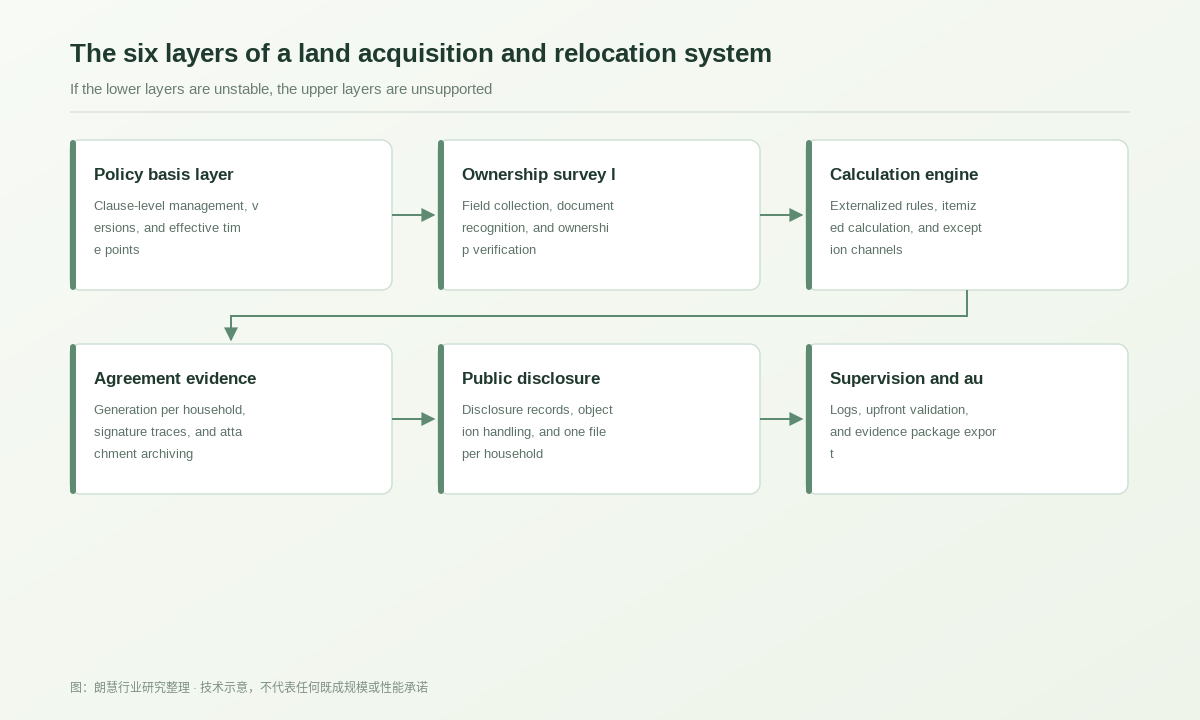
A complete system is broadly divided into six layers: policy basis, ownership and surveys, calculation engine, agreements and evidence, public disclosure and archives, and supervision and audit. These six layers are not a parallel feature menu but are interdependent. The calculation engine depends on the basis library and survey data; agreements depend on calculation results; audit depends on the traces left at every preceding layer. Remove any one layer, and the layers above it are left unsupported.
Three main threads run through all modules: people, property, and money. People refers to households and household members, resettlement eligibility, and social security coordination; property refers to land, houses, ancillary structures, and resettlement housing; money refers to compensation calculation, fund applications, disbursement, and ledgers. Every function can be located along these three threads; a function that cannot is usually something the requester thought of adding on the spot.
The architecture principles can be summarized in four phrases: traceable basis, reproducible calculations, queryable status, and recorded operations. These four are not technical indicators but business requirements. They determine that the data model must include versions, sources, and operators, rather than merely storing a final results table. Many systems become difficult to use after launch, and the root cause lies here.
A common mistake is to build the data entry interface first and add the rule engine later. The result is that calculation rules are scattered across code, spreadsheets, and one person's experience; whenever a policy changes, the program must be modified and retested, and historical data cannot be recalculated under the new criteria. The later you externalize the rules, the higher the cost, because what needs to change is not only code but also established operating habits.
III. Policy basis library: turning documents, clauses, and applicable conditions into structure
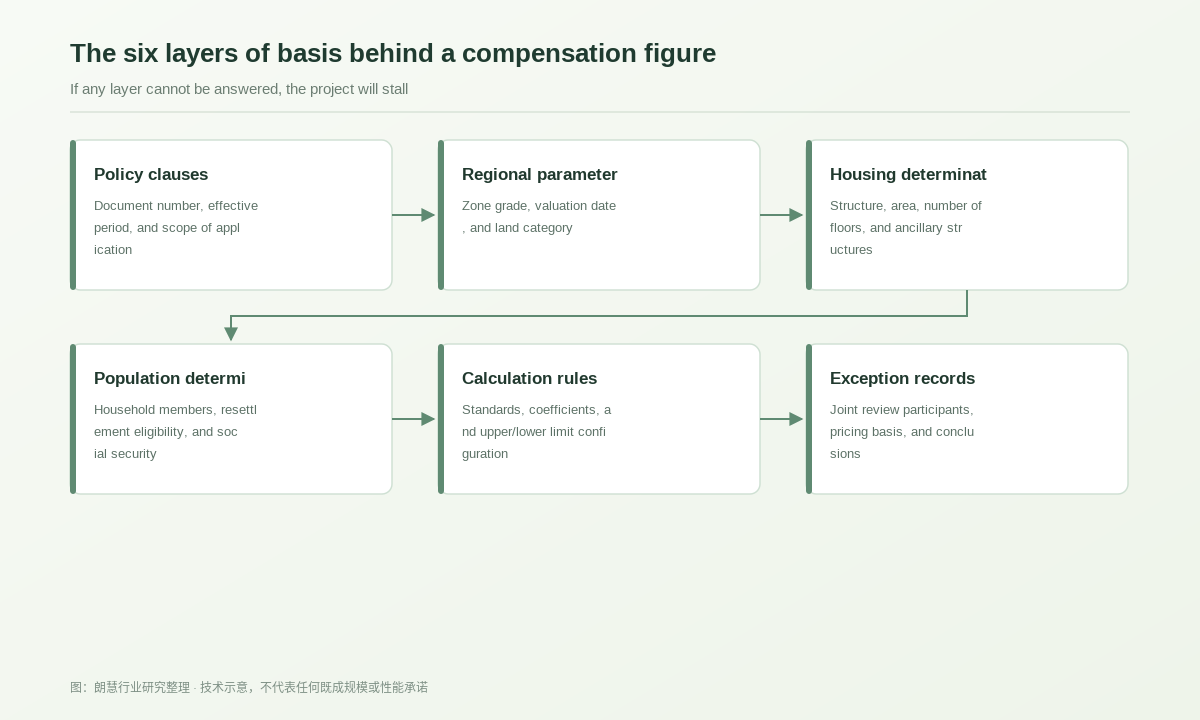
The basis library is not a network drive. Each record must be broken down to the clause level: document number, issuing authority, effective date, expiration date, applicable region, applicable subjects, calculation criteria, and relationships with other documents. Only at this level can the system answer “why does this clause apply to this household” instead of merely returning a total amount.
Version management is core. The same matter may be covered by provincial, municipal, and county-level documents, and these may be revised. The system must retrieve the version in effect at the project's point in time, rather than always using the latest version; historical projects are not retrospectively rewritten, and the basis applicable at the time is preserved. This point often becomes critical during audit, because what auditors examine is not how you calculate today, but how the calculation was performed at the time.
References must be bidirectional. From a calculation result, one should be able to trace back to the specific clause; from a clause, one should also be able to see which households it applied to. One-way references are only good for display; bidirectional references enable impact analysis: after a standard is revised, which ongoing projects require recalculation and which signed agreements need supplementary explanations becomes immediately apparent.
Updates must follow a process. After a new document is issued, who enters it, who reviews it, when it takes effect, and when the old document is retired must all have clear actions and records. A more common situation is that a document has been in effect for six months while the system still runs the old version; the front line follows the document while the system calculates according to the old standard. With two sets of criteria in place simultaneously, no one dares to trust the system's figures.
IV. Ownership and housing surveys: field collection is easy, ownership verification is hard
The first principle of field collection is to minimize manual entry. Use a mobile mini-program to photograph and recognize ID cards and property certificates, use location services to populate addresses, and leave error-prone fields such as 18-character ID numbers and doorplate numbers to recognition, while humans only confirm and supplement. Once this step is complete, registration efficiency improves noticeably, and the longstanding problems of illegible handwriting and inconsistent address formats are resolved as a side benefit.
But recognition is only the entry point; ownership must be verified. Whether land is state-owned or collectively owned, whether the property certificate number is authentic, whether all co-owners are accounted for, and whether there are seizures or mortgages—these details determine the compensation recipient and distribution method and cannot be established from a single photo. Recognition solves entry speed; verification solves who receives the compensation. The two must not be conflated.
Housing attributes must be broken down in detail: structure, number of floors, gross floor area, site area, ancillary structures, degree of renovation, and actual use. Each item corresponds to a line item in the calculation. Measurements must retain images and measurement records; drone aerial surveys can improve efficiency, but area determination still requires on-site verification, especially for additions, alterations, and structures within courtyards.
Data quality must be addressed upfront. Maintain one file per household, and flag duplicate households, split households, vacant registrations, and duplicate ID numbers at the entry stage. Discovering that the same house has been registered twice only at the calculation stage makes the cost of handling it an order of magnitude higher, because by then the agreement may already be signed and the money may already have been paid.
V. Compensation calculation rule engine: standards, coefficients, and exceptions
The engine's inputs are housing attributes, land nature, regional grade, resettlement population, and valuation date; its outputs are itemized compensation and the total. Inputs must come from verified data and must not be freely altered by users in a manual calculation interface, otherwise calculations lose reproducibility and two people working on the same household will get two different results.
Rules must be externalized as configurable expressions rather than hard-coded. Standards, coefficients, upper and lower limits, and regional variations all belong in the configuration layer; when policy changes, adjust the configuration, run approval, and record a new version without modifying the program. This is the watershed for whether such systems can remain in use for a full five years, and it is also a simple test of whether a supplier understands the business.
Exceptions must have a designed channel. Attachments not covered by documents, legacy ownership issues, and households in special hardship require joint review or collective decision-making, with participants, discussion points, pricing basis, and conclusions recorded together in the system. Exceptions themselves are not frightening; the frightening part is having no record, because what auditors usually ask is not “why was compensation paid” but “on what grounds was it paid.”
Results must be reviewable. Itemized breakdowns, clause-by-clause comparison, and explainable differences are basic requirements of the calculation module. Decimal errors and mixing of calculation criteria in manual work are very costly in this type of business; the main value of automatic calculation is not speed, but that the same inputs always produce the same outputs and, when a problem occurs, it can be traced to a specific rule.
VI. Agreement generation and evidence chain: making every signature traceable
Agreements are generated by the system per household, with fields drawn directly from survey data and calculation results to avoid manual copying. Templates must be separated by land nature, resettlement method, and compensation type; one template must not be applied to all scenarios. The amounts, areas, and population figures in the agreement must share the same source as the system data, and any manual change must leave a trace and explain the reason.
The signing step must record the signatory, time, location, and agreement version. For paper signatures, scan or photograph and upload the document and bind it to the household's file; for electronic signatures, retain evidence of the signing process. Signing without archiving is tantamount to not signing, because two years later no one can say which cabinet that piece of paper is in.
The evidence chain is organized per household: identity documents, ownership certificates, measurement images, valuation reports, public disclosure photos, original agreements, and payment vouchers. Missing items must be flagged; do not wait until audit to discover that a key document is absent. The completeness of the evidence chain matters far more than the polish of any individual document.
Change management must be designed separately. Supplemental agreements, corrections, and revocations must not overwrite original records; old and new versions must coexist. Many disputes arise not because compensation was too low, but because it cannot be clarified which version is finally effective; if the system retains only the result of the last modification, it shifts the burden of explanation onto the handling officer.
VII. Public disclosure and archives: making status externally verifiable
Public disclosure is the vehicle of procedural justice. The compensation plan, valuation results, resettlement population, and signing progress—what is disclosed, where, for how long, and how objections are raised—must all be recorded in the system, rather than considered complete once a paper is pasted on a wall and photographed. The disclosure record itself is also evidence.
Objection handling must include three actions—registration, response, and review—with the handler and time limit recorded. An objection does not necessarily have to be upheld, but it must receive a response. An objection without a response record often ends up as a petition case, and once a petition is filed, every procedural flaw that preceded it will be re-examined.
Archives are organized one file per household, with paper and electronic records corresponding to each other; historical paper archives are imported in batches through scanning and indexed. Index fields must be sufficient: name, ID number, project, village/group, and agreement number—missing any one of them turns searching into rummaging through boxes. The value of archive digitization lies in being searchable, not in how sharp the scans are.
Permissions must be tiered. Villages and groups, townships, project command posts, and audit departments see different content, and sensitive fields are masked. Data sharing is a good thing, but not everyone needs to see everything; if permissions are designed too coarsely, front-line staff will bypass the system using screenshots and spreadsheets, and the data will scatter back into individuals' hands.
VIII. Funds and disbursement: dedicated accounts, ledgers, and time points
The management requirement for compensation funds is a dedicated account, dedicated ledger, dedicated management, and dedicated use. The system must record every fund application, review, disbursement, and receipt, along with the corresponding household and agreement, so that funds and business share the same source rather than two separate ledgers each keeping their own records. Once two ledgers run in parallel for too long, the discrepancies can never be reconciled.
Process timing is critical. Relocating households are waiting for money; the longer the internal approval chain, the more likely something will go wrong at a node. The system's value is to compress internal circulation time, not to add approval steps. It should be possible to see at a glance whose hands each payment is in and how long it has been there—far more useful than post-hoc statistics on average duration.
The ledger must support multiple disbursements, batched receipts, and withholding. Budgets are aggregated by project and area, while actual expenditures are itemized by household; the two must reconcile. When they do not, it must be possible to locate the specific household and payment. Reconciliation capability is the core of the fund module, not an incidental reporting feature.
Fund data should not be maintained separately. A separately maintained ledger will inevitably diverge from business data, and eventually no one knows which figure is true. Generating the fund ledger from business documents as the source is a maintainable long-term approach, at the cost of designing those documents clearly upfront.
IX. Audit trails: turning after-the-fact explanation into process-based proof
Auditors focus on very specific issues: duplicate relocation, duplicate resettlement, over-standard compensation, diversion of funds, and procedural omissions. In the system, all of these can be mapped to specific fields and records—provided those fields were designed at the outset. Trying to add them afterward often cannot be done.
Traces must be complete: operation logs, before-and-after values of data changes, approval opinions, attachment versions, and access records. Recording only “who changed it” is insufficient; it is also necessary to record “what it was before the change,” otherwise it is impossible to judge whether the change was reasonable. Keeping logs in the database is not enough; they must be understandable to non-technical personnel.
More effective is upfront risk control. Perform rule validation at the entry stage: duplicate ID numbers, multiple compensations for the same house, a mismatch between the resettlement population and resettlement housing area, and compensation amounts exceeding the standard cap. Intercepting problems at entry is far cheaper than auditing them afterward, and it will not make front-line staff feel that the system is merely another hassle.
Audit views should be organized according to auditors' habits: spot checks by project, by household, by amount range, and by anomaly type, with one-click export of evidence packages. The system should not require auditors to learn a new set of operations; it should organize data along their inspection paths, otherwise no one will use even the most complete trails.
X. Four failure points in implementation
The first is that the joint review system operates outside the system. Supplementary standards decided in meetings do not enter the system; calculations still follow the old standard, the difference is made up offline, and it cannot be explained afterward. The institution must be embedded in the process, rather than opening another door outside it; otherwise what the system records and what is actually executed are two different things, and the audit trail loses its meaning.
The second is that standards for special attachments are severely detached from reality. For expenses such as grave relocation and courtyard structures, the document standard is often lower than actual costs, so the front line can only negotiate privately, distorting the data. A reasonable approach is to set tiered standards plus an exception channel, and record actual expenditure and its basis in the system rather than pretending it does not exist.
The third is that risk assessment becomes a formality. The report is issued by a third party, but the third party is not involved in the project; the assessment conclusions are disconnected from reality, the report says everything is normal, and risks still materialize. Risk assessment must be bound to project milestones and responsible parties, and its conclusions must be able to influence implementation cadence rather than being a perfunctory document.
The fourth is that standards go unchanged for years. Compensation standards remain static for years, becoming disconnected from local economic conditions; execution documents do not even state the document number, damaging credibility. Whether standards should be adjusted is a policy question, but at minimum the system must be able to record “which version was used,” so every adjustment is grounded in a basis rather than conveyed orally.
XI. Forward outlook for the next 12 to 24 months
First, the policy basis library will evolve from document management into a clause-level knowledge base and integrate with the calculation engine. When one standard changes, the system can automatically list affected ongoing projects and signed agreements—something most systems cannot do today. The ability to do so and the inability to do so will create a clear divide at the next policy adjustment.
Second, mobile data collection combined with drone aerial survey modeling will become standard configuration, and “see it and you can demolish it” will spread from demonstrations in individual regions to general adoption. The real threshold lies not in aerial survey equipment but in area determination rules and on-site verification processes, which must be designed jointly by business departments and the system; technology providers alone cannot push it forward.
Third, data interfaces for audit and disciplinary inspection will become more standardized, and systems will need to export verifiable evidence packages on demand rather than assembling spreadsheets on the fly. The completeness of data traces will gradually become a hard acceptance criterion for such systems, and its weight will rise relative to feature count.
Who benefits first? The teams that externalize rules and structure their basis. Systems that only provide process forms with calculations hard-coded into the code will be replaced at the next policy adjustment, because the cost of modification exceeds rebuilding. For users, the most worthwhile question when choosing a system is not how many features it has, but: when the next policy comes out, how long will it take you to change?
Langhui's Engineering Capabilities Along This Path
In this type of business, Langhui Technology is responsible for the data and rules side: designing collection standards, structured data entry, data dictionaries and version records, and archive digitization with quality control. In the land acquisition and relocation scenario, this means organizing policy clauses into searchable structures, turning housing and population data into verifiable one-file-per-household records, and turning calculation results into itemized records that can be reviewed.
We can help sort out rules and acceptance criteria: write calculation logic scattered across documents and experience into configurable rule descriptions, organize disputed scenarios into reasoned handling records, and turn archives and evidence chains into checklists that can be spot-checked. System development, hardware deployment, and operations are led by the client or partner; we do not replace them, nor do we issue legal opinions on the policy applicability of specific projects.
If your team is sorting out data standards for land acquisition and relocation, needs to structure historical archives, or wants to assess the degree of rule externalization in an existing system, you can send us the business scope, data scale, and existing materials, and we will provide an actionable checklist and quality inspection plan.
FAQ
What is the difference between a land acquisition and relocation system and ordinary project management software?
Ordinary project management software manages tasks, schedules, and documents; a land acquisition and relocation system manages basis, calculation, and evidence. It must be able to answer which policy each figure comes from, why a particular standard applies to each household, and who made each modification and when. Without these three capabilities, it is merely a data entry tool.
After compensation standards are adjusted, what happens to data from historical projects?
Historical projects are not retrospectively rewritten; the standard version and calculation process in effect at the time are preserved, which is a basic audit requirement. New standards only take effect for new projects or new milestones after the adjustment; if recalculation under the new criteria is required, a comparison result should be generated rather than overwriting the original data, and the reason for the difference should be explained.
How should attachments not covered by policy documents be handled?
Run two parallel paths: tiered standards and an exception channel. Common structures should be classified into existing items wherever possible; where there is genuinely no basis, go through joint review or collective decision-making and enter the participants, pricing basis, discussion points, and conclusions into the system. The key is not how much is paid, but whether the payment can be clearly explained.
Can the system directly use areas from drone aerial surveys as compensation areas?
Aerial surveys are suitable for preliminary assessment, progress management, and identification of suspected illegal construction, but they cannot directly replace compensation area determination. Compensation area involves ownership, structure, number of floors, and on-site verification, and generally requires measurement records and confirmation by the rights holder. Treating aerial survey results as the direct basis for compensation area can be difficult to defend in disputes.
What materials do auditors generally require the system to provide?
These typically include the complete evidence chain for one file per household, the itemized basis for compensation calculations, the correspondence between agreements and payment records, operation logs and data change records, and explanations of how anomalous households were handled. Being able to export these materials by project, by household, and by amount range is far more reliable than assembling spreadsheets on the spot.
- National Laws and Regulations Database https://flk.npc.gov.cn/
- State Council Policy Document Library https://www.gov.cn/zhengce/
- Ministry of Natural Resources https://www.mnr.gov.cn/
- Ministry of Finance https://www.mof.gov.cn/
- W3C PROV-O: The PROV Ontology https://www.w3.org/TR/prov-o/
- National Public Service Platform for Standards Information https://openstd.samr.gov.cn/