
VOICE HARDWARE / ENTRY · EDGE · PRIVACY
AI Recording Hardware Product Logic: Voice Entry Point, Edge-Cloud Collaboration, Meeting Minutes, and Privacy Tradeoffs
The competitive focus of recording hardware is shifting from 'clear recording' to 'usable immediately after recording.' This article examines how voice-entry data capture is positioned, how edge and cloud responsibilities are divided, the credibility of multi-speaker transcription and minutes generation, and the mutually restrictive relationship between privacy design and battery life/form factor. It provides a reproducible evaluation framework and considers how edge-side capabilities, product form, and privacy requirements are likely to change over the next 12 to 24 months, offering guidance for both product-development and procurement teams.
Recording hardware may look like a niche business, but in practice it packs voice processing, chips, cloud services, and compliance into a device weighing just a few dozen grams. Buyers do not care about the microphone model; they care whether they can get usable minutes right after a meeting. Makers, meanwhile, must repeatedly balance battery life, audio capture, computing power, and privacy. Following the product chain from the voice entry point to edge-cloud division of labor, then transcription, minutes, privacy, form factor, and evaluation, this article tries to make the conditions and failure boundaries of each tradeoff clear before offering a view of the next two years. It does not compare specific brands, focusing instead on mechanisms and tradeoffs.
1. Why Recording Hardware Became a Voice Entry Point
Traditional voice recorders were archival tools. The deliverable was an audio file, and both listening and organization were left to the user. Today, the selling point of these devices is obtaining a transcript, decision list, and action items within minutes after a meeting. The product definition changes accordingly: recording is only an act of data capture, while 'usable as soon as recording ends' becomes the real deliverable.
Entry-point value first comes from location. A phone microphone is not bad, but it occupies a device, and long recordings can interfere with calls, navigation, and shooting. A device clipped to a collar, worn on the chest, or attached near the ear can stay closer to the mouth, producing a better signal-to-noise ratio without interrupting the user's hands-on work. The advantage of placement often exceeds that of adding one more microphone.
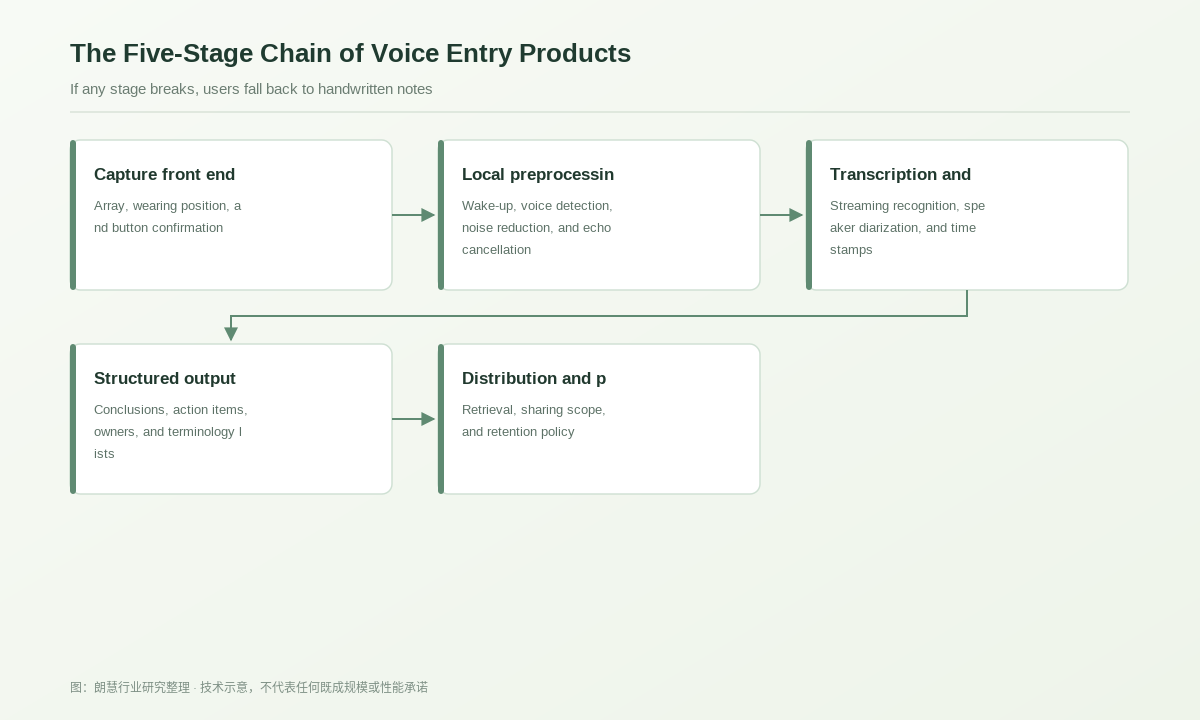
But an entry point is not the same as a product. If any one of the five stages—capture, transcription, structuring, retrieval, or permissions—is broken, users will fall back to handwritten notes. Common failure points are very concrete: transcription too inaccurate to read, minutes without clear owners, recordings left in unknown locations, and shared files that cannot be recalled. Each failure consumes trust once.
A simple test of whether a product works is whether users willingly open the result after a meeting. If they do, the chain works; if they do not, some link is still causing trouble. No matter how impressive the hardware specifications are, they cannot compensate for a broken link.
2. Edge-Cloud Collaboration: Which Computing Must Stay On-Device
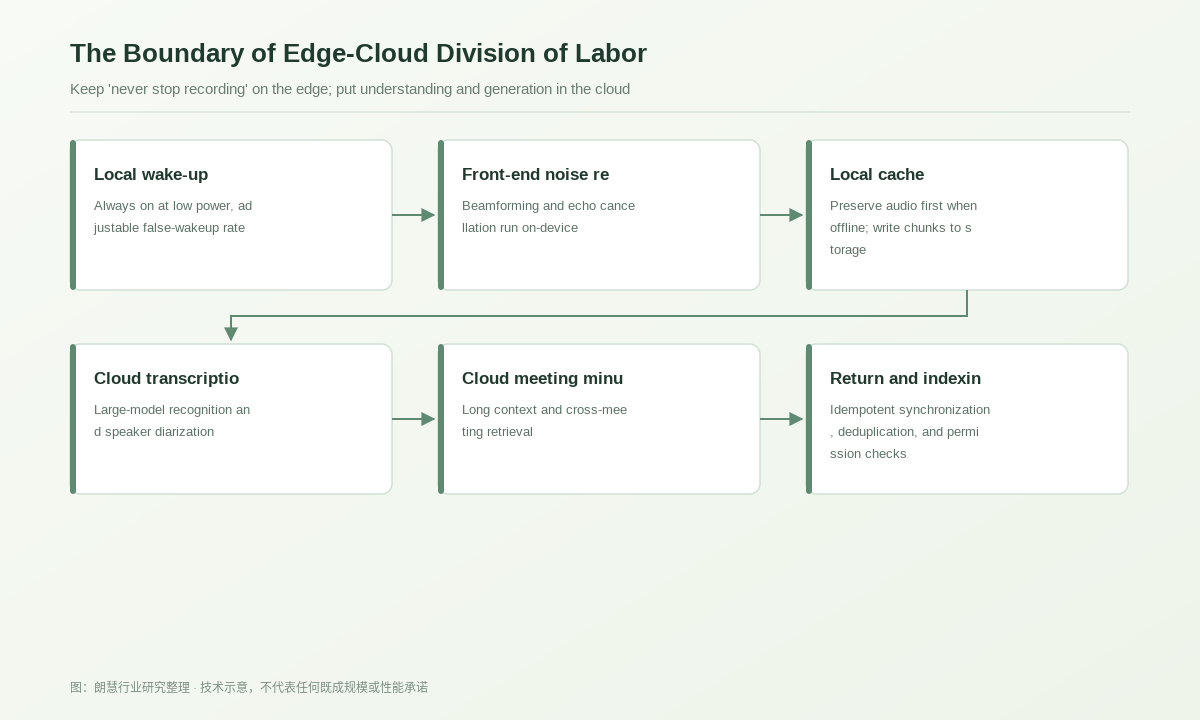
The on-device side handles everything related to 'always recording': button confirmation, wake-up, voice activity detection, echo cancellation, noise reduction, and writing chunks to storage. These operations require low latency and low power consumption and must continue working when the network is down. Moving them to the cloud would undermine both battery life and stability.
The cloud handles heavy computation: large-model transcription, speaker diarization, terminology enhancement, long-context meeting minutes, and cross-meeting retrieval. Models iterate too quickly for on-device firmware to keep up, and the computing demands exceed the thermal capacity of small wearables. A more realistic division is to keep capture and preprocessing on-device, while placing understanding and generation in the cloud.
The principle for dividing responsibilities is not 'keep everything local if possible,' but three questions: Must raw audio leave the device? Does upload occur in real time or after the meeting? After a failure, how can the process retry without duplicate ingestion or double-billing service quota? Once these three points are written down, the architecture will not be repeatedly overturned halfway through.
A common counterexample is uploading everything in real time. On a weak network, even the recording itself can freeze, and users lose the original material, which cannot be re-recorded later. A more reliable approach is to secure the audio locally first, then upload based on network conditions, putting 'no loss' ahead of 'speed.' Another easily overlooked boundary is that model upgrades should not force firmware upgrades. Keeping transcription and minutes in the cloud, while the device maintains only stable capture and transmission protocols, gives the product a significantly longer life than baking models into firmware.
3. Voice Front End: Microphone Count Does Not Determine Capture Distance
The value of dual or multi-microphone arrays lies in beamforming and noise suppression, not in the number of microphones itself. Beam width and low-frequency directivity are limited by array aperture. The smaller the body, the closer the two microphones are, and the poorer the low-frequency spatial selectivity becomes. A bean-shaped device can be worn stably, but it is difficult to achieve the directivity of a desktop array.
The nominal five-meter capture range is conditional: a quiet room, speaking from the front, no obstruction, and low reverberation. In a long-table conference room, reverberation and multiple far-field speakers lower the signal-to-noise ratio. Steady background noise in a café can be reduced, but non-steady interference such as neighboring voices, clinking tableware, and background music is much harder to eliminate cleanly.
The wearing method can also introduce new noise sources. Collar friction, zipper impacts, scarf obstruction, and table resonance all leave traces in the low-frequency band. The front end needs high-pass filtering, wind-noise detection, transient suppression, and compensation for mounting conditions such as being 'pressed against clothing,' rather than simply increasing noise reduction strength.
Verification is straightforward: ask suppliers to provide raw recordings under different distances, angles, and noise types, then independently retest in a small quiet conference room, an open office area, and a café. A single edited demo clip cannot reveal the quality of the front end. Comparing two or three devices horizontally with the same script, room, and distance will make differences clear; comparing across different rooms will often produce unreliable conclusions.
4. Transcription Quality: The Difficulties Are Multiple Speakers, Accents, and Overlapping Speech
Transcribing single-speaker, near-field Mandarin is already fairly mature, and publicly available end-to-end models perform consistently on common test sets. The real challenges are far-field, multiple speakers, overlapping speech, accents, mixed Chinese-English speech, and specialized terminology. When these conditions stack, error rates rise significantly. In a quiet near-field environment, errors mostly involve proper nouns and names; in far-field conditions, even common words may be lost.
Speaker diarization relies on voiceprint embeddings and clustering. When the number of speakers is unknown, a threshold set too high can merge two people into one, while a threshold set too low can split one person into two. Interjections, laughter, and coughing can also contaminate segmentation. Having users correct labels once after a meeting is low-cost, but the product must provide this interface.
Evaluation cannot rely on a single accuracy score. Reporting word error rate, speaker confusion rate, and timestamp deviation separately by scenario is what makes the results meaningful. Terminology lists and hot-word injection have a major impact on industry meetings. Products should let users maintain their own word lists and share them across teams.
In engineering practice, retaining confidence scores and timestamps for each segment, and flagging low-confidence segments for human review, is more honest than letting the model guess. When users can quickly locate what needs correction, trust will not be exhausted by a single error.
5. Meeting Minutes and Structured Output: From Transcript to Actionable Items
Minutes are not a compressed transcript. They extract four types of information: conclusions, action items, owners, and deadlines. An 'action item' without an owner or deadline is essentially still a summary, and users still have to break it down themselves later. These four types of information are often scattered across a recording, so the model needs to align them across segments rather than summarize segment by segment.
Generative models make things up, and this is a problem the product must confront directly. A workable constraint is to attach timestamps to each conclusion so that clicking it returns to the original statement, and to separately label what was 'explicitly said in the meeting' from what the model 'inferred.' Without traceability, minutes can only be used as drafts. Timestamps should ideally be precise to the sentence; minute-level granularity forces users to drag the progress bar back and forth.
Templates must be configurable. Weekly meetings care about progress and blockers, user interviews care about original quotes and topics, and shift handovers care about exceptions and responses. Stable fields matter more than elegant prose, so products should allow enterprises to define fields, required fields, and output formats. A few templates can cover most meetings; too many only increase selection overhead.
Human review is not failure; it is part of the design. Feeding user-edited versions back as preference data helps the next version of minutes better match a team's expression habits. Products that offer no way to edit are usually abandoned after a few weeks. A review interface should place the original statement, transcript, and minutes side by side so corrections can be made quickly.
6. Privacy Design: Data Minimization, Encryption, and Authorization
Data minimization must be implemented in hardware: record only when a button is pressed, avoid always-on defaults, provide an indicator that cannot be disabled during recording, include a physical mute switch, and allow retention of only relevant segments rather than a full day of audio. Indicators and physical switches are not decoration; they determine whether people nearby are informed. In multi-person meetings, the duty to inform usually falls on the organizer, and the device can only make the right tools available.
Encryption must cover transmission, storage, and key management. Transmission should use standard encrypted channels; stored data should be encrypted with keys managed separately from the data; and devices should be bound to accounts, with remote wipe available after loss. Deletion needs a clear deadline and verifiable result, not merely a claim that it 'supports deletion.'
Authorization becomes more complex in multi-person and enterprise settings. Advance notice, reminders posted in the conference room, unified administrator policies, and project-based retention periods and export permissions are product features, not legal addenda. Cross-border cases also require handling data-transfer paths and the rules of the recipient's jurisdiction.
Compliance frameworks provide process requirements, not product certification. GDPR, the NIST Privacy Framework, and ISO 27001 all address risk assessment, records, access control, and continuous improvement. Products must write 'who can listen, how long data is retained, and whether it is used for training' into the settings page so users can see it.
- Before capture: clearly define indicators and notification methods, distinguishing personal use from multi-person meetings.
- During capture: physical mute, visible status lights, and recording only the necessary segments.
- After capture: encrypted storage, tiered permissions, time-limited deletion, and export auditing.
7. Battery Life and Form Factor: Tradeoffs Among Bean, Pen, Card, and Earbud Designs
Form factor determines three things at once: microphone spacing, battery volume, and heat-dissipation area, all of which compete for space. A smaller body is stable to wear and less obtrusive, but both battery capacity and array aperture are constrained. A larger body improves battery life and directivity, but reduces willingness to wear it. Choosing a form factor is essentially choosing a scenario; there is no universal solution.
Bean-shaped devices suit personal near-field use when clipped to a collar, keeping the source distance stable. Pen-shaped and card-shaped devices can accommodate larger batteries and longer arrays and work well on a desk, but they depend on the user's placement habits. Earbuds are a natural entry point, at the cost of two-ear power draw, a stop-on-removal logic, and competition with calling functions.
Battery life should be designed around 'sessions,' not advertised in 'hours.' One meeting may last two hours, or a device may be used intermittently throughout a day; charging halfway means interrupting the recording. Supporting record-while-charging, battery swaps, and automatic local storage before low battery is more practical than simply increasing battery capacity.
Thermal design is often overlooked. Continuous transcription, real-time uploads, and charging stack together; once temperature rises, the chip throttles and transcription latency increases, which users perceive as 'getting slower the more they use it.' Moving heavy computation to the cloud while the device handles only the front end and caching is a common way to control heat.
| Form factor | Main advantages | Main constraints | Better-suited scenarios |
|---|---|---|---|
| Bean-shaped / clip-on | Stable to wear, close to the sound source | Limited battery and array aperture | Personal interviews, on-the-go recording |
| Pen-shaped / card-shaped | Ample battery and array space | Depends on placement, easily obstructed | Desk meetings, long recordings |
| Ear-side / earbud | Natural entry point, hands-free | Power draw, two-ear synchronization, and call contention | Mobile work, hybrid meetings |
| Desktop array | Better directivity and far-field performance | Low portability, requires external power | Fixed conference rooms, training scenarios |
8. Offline and Weak Networks: What the Product Can Still Do When Disconnected
When the network is down, the first goal is 'do not lose the audio,' not 'keep producing minutes.' A local circular buffer combined with voice activity detection writes valid segments to storage in chunks, which are uploaded in order after the network recovers. This design is more realistic and more power-efficient than running a large model on-device.
Lightweight models can run on-device: wake words, command words, keyword detection, and simple punctuation. Quantized small models can fit into wearable memory, but long-form summarization and speaker diarization should still be handled by the cloud. Clearly telling users the capability boundary is more credible than pretending to do everything. The larger the on-device model, the more noticeable the heat and power draw; battery life often fails before the experience does.
The synchronization protocol must prevent duplicates and out-of-order delivery. Chunks carry unique identifiers and sequence numbers, and the server ingests them idempotently. Device clocks are periodically calibrated against the server, and interrupted transfers record their offsets. Otherwise, one weak-network episode can create duplicate records, making the user's cleanup work more expensive than recording again.
The interface should clearly show status: recorded but not uploaded, uploading, transcribed, and pending review. Seeing 'the audio is local, waiting for the network' reassures users; seeing only a spinning icon makes them suspect the data is lost. Status visibility is itself a privacy design, because it tells users what the device is doing.
9. Evaluation and Acceptance: A Reproducible Test Protocol
Testing should start with a scenario matrix: a quiet small conference room, an open office area, a café, a vehicle cabin, and outdoor wind noise. Distance should include near-field, mid-range, and far-field levels, with speakers positioned front, side, and rear. The same scripted speech should be recorded in every cell for the results to be comparable. The matrix does not need to cover every combination; five or six representative combinations are enough to reveal differences.
Metrics should include at least: word error rate, speaker confusion rate, timestamp deviation, first-token latency, full-segment processing latency, continuous recording duration, frame drops, and interruption count. Reporting only a single 'recognition accuracy' makes it impossible to judge how the product performs in real meetings.
Methodologically, scripted speech and real meeting recordings should both be used. Scripted speech makes issues reproducible and easier to localize, while real recordings expose overlap, accents, and spontaneous interruptions. Evaluation records should clearly state the firmware version, model version, microphone gain, and room conditions; without any one of these, the results cannot be recalculated.
Acceptance criteria should state failure conditions. For example, 'in a reverberant long-table conference room, the proportion of far-field transcripts requiring human review will increase.' Making boundaries explicit saves more effort than repeatedly explaining them after delivery. Test audio and scripts should be archived together so they can still be matched to the right versions during retesting six months later.
| Metric | Measurement method | Common pitfalls |
|---|---|---|
| Word error rate | Standard-text comparison by scenario | Testing only quiet near-field conditions, hiding far-field problems |
| Speaker confusion rate | Compare after manually annotating speakers | Threshold not adjusted when the number of speakers changes |
| Latency | Time first-token and full-segment latency separately | Testing only cloud processing, not on-device queueing |
| Battery life and heat | Continuous recording under charging conditions | Laboratory room temperature, ignoring summer heat and fast charging |
10. Cost Structure: Hardware Revenue and Ongoing Service Costs
The cost structure of these products differs from that of traditional voice recorders. Hardware generates one-time revenue, while transcription, storage, and model calls are ongoing costs that grow with usage duration and the number of meetings. The more units sold, the larger the cloud bill; this must be calculated before choosing a pricing model. The higher the usage frequency, the larger the service-cost share, and the harder it becomes for hardware profit to cover it.
The main cost-control levers are on the front end: on-device voice activity detection reduces ineffective uploads by keeping silence out of the cloud; tiered models let short meetings use lightweight paths; caching and deduplication avoid repeated processing; and long context is enabled on demand rather than by default. These changes are inconspicuous, but they directly determine gross margin.
A common disagreement in business models is 'trade data for free service.' Individual users may accept it, but enterprise users generally do not accept meeting content being used for training. Products need explicit switches and written explanations of data processing, with legal and compliance teams responsible for reviewing this part.
When evaluating procurement, buyers should consider the device, subscription, operations, and migration together. Comparing only the device purchase price can underestimate long-term spending; looking only at service fees, conversely, ignores device replacement and spare-parts costs.
11. Forward-Looking Assessment for the Next 12 to 24 Months
On-device speech recognition will continue to move down the stack. Quantized models combined with dedicated acceleration units will let mid-range wearables produce readable transcripts offline, while the cloud shifts toward long context, cross-meeting retrieval, and team knowledge bases. The edge-cloud division will become clearer than it is today, and the cost pressure on pure-cloud solutions will become more obvious.
Form factors will expand into earbuds, glasses, and badges, with recording gradually becoming a system-level capability rather than a standalone device. The opportunity for dedicated hardware lies in three points: long-duration stable wearability and clear indicators—capabilities that phones and earbuds still handle poorly in the short term.
Privacy will move from declarations to verifiable claims. Procurement teams will ask what proportion is processed locally, how long audio is retained, whether it is used for training, and how deletion can be proven. Products that can provide audit records and settings-page evidence will gain an advantage in enterprise markets; products that merely display compliance labels will be challenged relentlessly.
Evaluation will also become standardized. Third-party far-field transcription evaluations, scenario-based benchmarks, and public test audio will gradually emerge, and buyers will no longer rely only on specification sheets. The first beneficiaries will be teams that already have scenario resources and can formalize evaluation and delivery processes. Teams that build only white-label hardware and acquire customers through cloud subsidies will be weighed down by ongoing service costs. For procurement teams, requiring suppliers to provide raw test audio will be more useful than reading a specification sheet.
Langhui's Engineering Capabilities Along This Path
Langhui has been working on AI training data since 2016. Medical-imaging annotation covers CT, MR, PET, mammography, ultrasound, and other modalities, with long-term delivery of collection-specification design, structured annotation, quality control and consistency reports, data dictionaries, and version records. This workflow also applies to scenario stratification, transcription proofreading, and sampling inspection for speech data.
We do not make recording hardware, do not provide cloud transcription services, and do not claim certifications such as HIPAA. What we can take on is evaluation-set design, annotation guidelines, quality-inspection reports, and privacy-process reviews: turning scenario matrices, metric definitions, and review ratios into executable documents, with legal opinions issued by qualified institutions.
If your team is evaluating recording hardware or building a speech-data pipeline, send us your use cases, language types, and delivery milestones, and we will provide a framework for the test protocol and acceptance checklist. Establishing the specifications first means you will not have to start over when changing devices or models later.
FAQ
How is AI recording hardware different from phone recording?
The difference lies mainly in capture location and subsequent processing. A phone occupies a device, and long recordings can interfere with calls and navigation; a collar-mounted or ear-side device can stay close to the mouth, providing a better signal-to-noise ratio. More importantly, it matters whether transcription, speaker diarization, and meeting minutes are connected end to end. Simply recording audio has limited value.
Why can't the back row hear clearly even with a nominal five-meter capture range?
Five meters is usually a test value under quiet indoor, front-facing, unobstructed conditions. Reverberation in a long-table conference room, multiple people speaking at once, and noise from air conditioning and projectors all lower the signal-to-noise ratio. Far-field transcription also requires beam directionality and noise reduction to work together; judging only by capture distance easily overestimates real-world performance.
When meeting recordings are uploaded to the cloud, how should enterprises assess the risk?
First examine four things: whether raw audio must be uploaded, where the data is stored, how long it is retained, and whether it is used for model training. Then confirm encryption for transmission and storage, account-device binding, and whether deletion is verifiable. For cross-border cases, legal counsel should assess each case based on the data-transfer path; the vendor's compliance statement alone is not enough.
How does the accuracy of real-time transcription differ from post-meeting transcription?
Real-time transcription is limited by streaming decoding and on-device computing, so it usually delivers usable results first and adds punctuation and terminology later. Post-meeting transcription can use longer context and larger models, making correction and speaker diarization more stable. The two are not substitutes; a common approach is to show progress in real time and produce the formal version after the meeting.
Can recording hardware still be used without a network?
It can still record, but transcription capability depends on the on-device model. A reliable design uses local chunked caching, voice activity detection, preservation of audio while offline, and idempotent ingestion after reconnection. Wake-up, keywords, and simple punctuation can run on-device, while long-form minutes and multi-speaker diarization should still be placed in the cloud.
- Radford et al., Robust Speech Recognition via Large-Scale Weak Supervision (Whisper) https://arxiv.org/abs/2212.04356
- Baevski et al., wav2vec 2.0: A Framework for Self-Supervised Learning of Speech Representations https://arxiv.org/abs/2006.11477
- NIST Privacy Framework: A Tool for Improving Privacy through Enterprise Risk Management https://www.nist.gov/privacy-framework
- Regulation (EU) 2016/679 (General Data Protection Regulation) https://eur-lex.europa.eu/eli/reg/2016/679/oj
- ITU-T P.800: Methods for Subjective Determination of Transmission Quality https://www.itu.int/rec/T-REC-P.800/en
- ISO/IEC 27001: Information security, cybersecurity and privacy protection — Information security management systems https://www.iso.org/standard/27001