
REDOLOGY IP / CULTURAL DATA ASSETS
Commercializing Redology IP: Cultural Data Assets, Edition Digitization, and Licensing Structures
The text of Dream of the Red Chamber is in the public domain. The value of Redology IP lies not in the story itself, but in editions, courses, academic endorsement, and organizational capability. This article breaks down asset inventory, edition and text digitization, licensing structures and revenue return, content production including short dramas, exhibitions and courses, text annotation and subscription distribution, and discusses the compliance boundaries for nonprofit commercialization and an outlook for the next 12 to 24 months.
The challenge in commercializing Redology IP is not whether there is a story, but whether public texts can be turned into licensible, priceable, and traceable assets. Cao Xueqin and Dream of the Red Chamber have long been in the public domain, and anyone can tell or perform the story; what is truly scarce is critically edited editions, complete course packages, systematic instruction, credible academic endorsement, and the organizational capability to deliver this content reliably. This article breaks down six issues: asset inventory, edition and text digitization, licensing structures, content production, data annotation, and operational sustainability. It also explains which practices may look lively but fail to recover their costs.
I. The distinctive nature of Redology IP: the mismatch between public texts and scarce assets
The text of Dream of the Red Chamber has long been in the public domain, and its characters, plot, and prophetic verses may be used freely. This means that telling the story itself is not a barrier; any institution or instructor can offer courses, make short videos, or organize exhibitions. The starting point of commercialization is not claiming ownership of the story, but identifying what others cannot reproduce in the short term.
Scarcity usually comes from four areas: editions and textual collation, which edition to use and how to handle variants; academic endorsement, who teaches and at what level of depth; course systems, not a single lecture, but a complete, deliverable teaching design; and organizational capability, whether experts, venues, school channels, filing, and licensing can all be put in place at the same time. The first three determine the quality of the content; the fourth determines whether it can scale.
There is a common misjudgment here: treating cultural influence directly as commercial value. Public cultural brands may be highly recognized, but attention is scattered, willingness to pay is low, and alternatives are abundant. Scenarios that can actually generate revenue are usually specific: the requirement for whole-book reading before the gaokao, teacher-training hours and teaching-research needs, construction of school cultural spaces, and study tours and parent-child experiences. Discussing IP monetization without a specific scenario usually ends up as selling books and cultural products.
Another easily overlooked constraint is that the more public a cultural subject is, the higher public expectations become. Poor adaptation, inaccurate scholarship, or skewed values can quickly escalate into public-opinion crises. This means commercialization cannot run on traffic logic alone; content review and academic gatekeeping must be built in from the start, and their costs must be included in the model.
II. Asset inventory: turn what you have into a licensable list
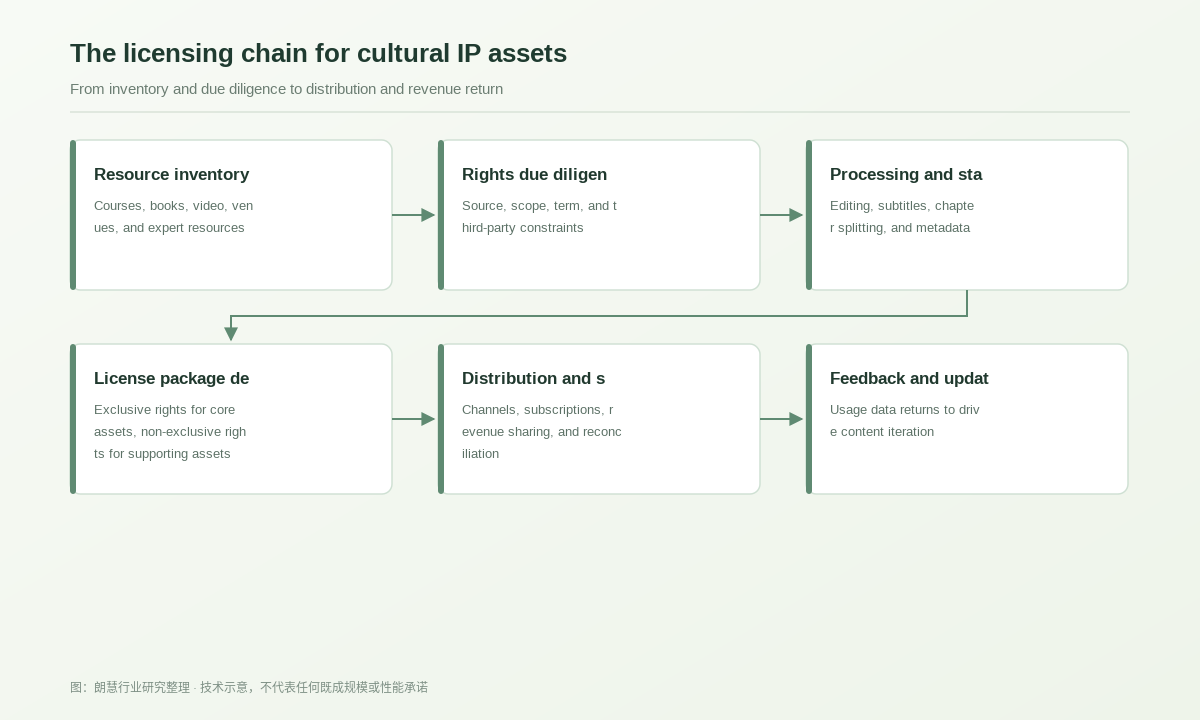
The first step in IP operations is not shooting a short drama, but taking stock of assets. Inventory granularity should reach the level at which each item can be licensed separately: how many lectures a course has, the length of each lecture, who the lead instructor is, and the status of recording; whether lecture notes and courseware are complete; the edition, printing, and scope of licensable rights of a book; the sources of images and video material; venues and event brands; and which scenarios experts can attend and under what constraints.
For each item, clearly document four things: the source of rights, whether they are owned, assigned, works made in the course of employment, or jointly produced; the scope of rights, including reproduction, distribution, communication through information networks, adaptation, and translation; term and territory; and existing constraints, such as whether the rights are already exclusively licensed or involve third-party likenesses or music. Assets that do not clearly satisfy these four requirements cannot enter the commercialization inventory.
The inventory should also distinguish between items ready to go online and items requiring processing. Recordings of lectures from three years ago are often unusable as-is: audio and video may be out of sync, whiteboard writing may be illegible, examples may be outdated, and licenses may have expired. Turning them into saleable content requires re-editing, reshooting, adding subtitles, and splitting chapters. This workload is often underestimated and is also the easiest part of the budget to miss.
The list should be versioned. Assets increase and licensing terms change; if the list is a static spreadsheet, no one will trust it three months later. A workable approach is to maintain a register with status and version records, so it is possible to see who changed what and when. It can then be exported directly for external due diligence rather than assembled on the spot.
III. Digitizing editions and texts: variants, collation, and traceability
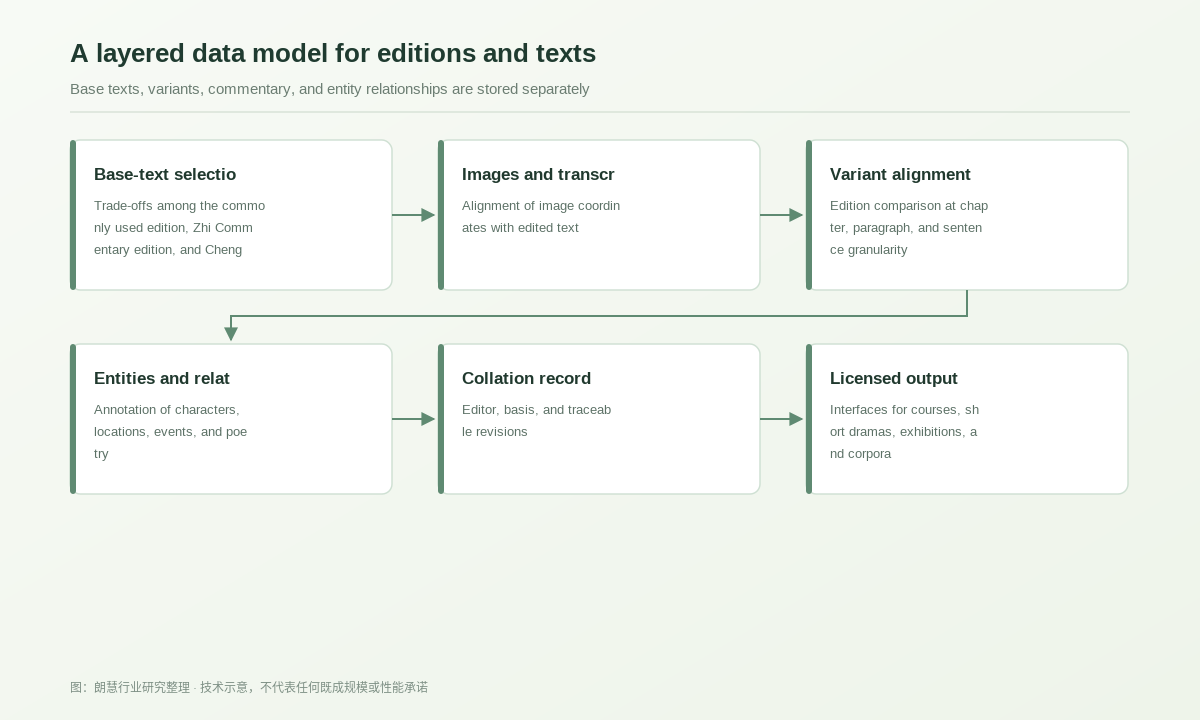
The difficulty of digitizing classical novels is not scanning, but choosing the edition. The commonly used edition, the Zhi Commentary edition, and the Cheng A and Cheng B editions differ in chapter titles, text, and commentary. Teaching scenarios are especially sensitive to editions: which edition is used for textbook excerpts, which edited text is used as the basis for notes, and which passage is quoted in an exam all affect whether content can enter schools.
A workable approach is to establish a data structure for edition comparison: use the chapter as the unit, paragraphs or sentences as the granularity, and record variants, commentary locations, and editor notes across editions. Every passage should be able to answer three questions: which base text it comes from, who edited it, and how it differs from other editions. This supports both instructional explanation and subsequent adaptation licensing.
Digitization is not only about storing text; it also requires storing structure. If chapter titles, paragraphs, characters, locations, events, poems, lyrics, and songs can be represented as tagged entities and relationships, subsequent retrieval, knowledge-graph construction, and episode outlines for short dramas will be much easier. Conversely, if everything is stored only as scans or Word documents, the value stops at reading.
Images and text should be managed separately but cross-referenced. Scans of ancient books and images of commentary belong to image assets, while edited text belongs to text assets; the two are linked by page numbers and coordinates. This satisfies both the traceability of original sources required for academic citation and the need for clean text in instructional products.
IV. Copyright and licensing structures: exclusivity, sublicensing, and revenue return
In commercializing cultural assets, the licensing structure matters more than the content. Three common approaches each have trade-offs: exclusive licensing can protect the recovery of investment but binds the partner tightly; non-exclusive licensing is flexible but allows the same content to be undercut by multiple parties; joint investment and equity participation create deeper ties but slow decisions and make exits difficult. For organizations with a nonprofit background, restrictions on legal-entity qualification must also be considered.
A more realistic structure is tiered licensing: core assets, such as complete courses and a critically edited text database, receive exclusive or sole licensing; supporting assets, such as books, cultural products, and one-off lectures, remain non-exclusive. Licensing scope should be divided by type of right, medium, territory, and term, so that a single agreement does not sell off every possibility at once.
The revenue-return mechanism must be clearly documented. Academic institutions that commercialize usually need a compliant channel: a commercial entity obtains a license and operates, and returns an agreed share of revenue to a foundation or academic-support project under the agreed terms. This chain must leave an audit trail; otherwise it will not pass annual inspections and it will be impossible to explain where the funds went.
Licensing must also govern downstream use. Sublicensing, distribution, platform consignment, and secondary editing each create new chains of rights. The licensing agreement should specify conditions for re-licensing, content-review rights, takedown mechanisms, and breach handling. It is not enough to clarify these at signing; there must also be enforceable monitoring, otherwise exclusivity quickly becomes de facto shared use by multiple parties.
V. Content production, part one: courses and teacher training
Among Redology-related content formats, courses are relatively easier to turn into stable revenue. The reason is straightforward: the target audience is clearly defined, language teachers and high-school students; the demand is firm, whole-book reading enters classrooms and appears as scored content in exams; and delivery can be standardized, teaching hours, lecture notes, assignments, and assessments can all be defined.
The key to productizing a course is decomposition. A two-hour lecture should be split into several units of 15 to 25 minutes, each with a clear objective, core question, textual basis, suggested classroom activities, and further reading. Content that cannot be decomposed usually indicates that it remains the instructor's personal performance and has not become a replicable teaching product.
Teacher training is another line. Its value lies not in the course itself, but in certification and the teaching-research network: completion certificates, teaching-hour records, selection of demonstration lessons, and regional teaching-research communities. These mechanisms turn one training session into an ongoing relationship and provide a source of feedback for content iteration. Without a teaching-research network, training is difficult to fill in its second year.
Courses must also be adapted to different channels. Public-interest courses entering schools, thematic courses for regional teaching research, and online subscription courses differ in duration, depth, and compliance requirements. Using one set of content for every channel usually satisfies no one. Product lines should be designed separately, while sharing a common text and material library at the base level.
VI. Content production, part two: short dramas, exhibitions, and study tours
Short dramas are a high-profile direction in recent years and also the easiest direction in which to lose money. The difficulty of adapting classical literary works lies in pacing and cost: the original has many characters and dense storylines, while short dramas require strong conflict and fast pacing. A careless adaptation can become another story told under the original character names, alienating readers of the original while failing to retain new viewers.
A more practical division of labor is for short dramas to handle customer acquisition and topic awareness, but not to carry the main revenue; courses and training to carry revenue; and exhibitions and study tours to carry experience and value-added consumption. All three should share the same text and image assets, avoiding repeated research for every project and conflicting interpretations of the same plot across different products.
The difficulty of exhibitions lies in spatial storytelling. Redology offers many threads: changes in editions, character relationships, food and daily life, garden spaces, and the culture of commentary. A single exhibition cannot cover everything; it must select a main line and present it in layers through objects, images, and interactive installations. Digital exhibitions are updatable, replicable, and remote-accessible, but lack the on-site presence created by physical objects.
The difficulty of study tours lies in safety and qualifications. Minors, venues, transportation, meals, and insurance are involved; a problem in any one area can escalate into a public-opinion crisis. When designing the product, safety margins and exit mechanisms must be included in the cost, and relevant operating qualifications should be obtained in advance rather than after an order is received.
VII. Data annotation: turning text assets into trainable corpora
Intelligent processing of cultural content cannot avoid annotation. Characters, locations, events, time, poetry, commentary, and variants must be structured as labeled data if they are to be used for retrieval, question answering, recommendation, or assisted creation, rather than left in explanatory videos and lecture notes.
Annotating Redology texts has several special requirements. First, character appellations are complex: one person may have a given name, style name, nickname, and an epithet used by others, making coreference resolution harder than in ordinary text. Second, edition differences mean that a passage may have multiple texts, so annotations must be tied to the base text. Third, the relationship between commentary and the main text must be distinguished; Zhi commentary is interleaved with the main text, and mixing them would contaminate the corpus.
The annotation specification must clearly define boundaries: what counts as an event, how to handle references in dialogue, whether poetry should be a separate category, how to mark variants, and how to mark uncertain cases. Without clear specifications, ten annotators will produce ten standards; the model will ultimately learn noise, and the cost of rework will far exceed the cost of writing the rules carefully from the start.
Quality control relies on sampling and consistency. Double annotation with adjudication, batch sampling, and calculation of inter-annotator agreement are all standard practices. More importantly, annotation versions and specification versions should be retained so that when model performance changes, it is possible to tell whether the problem lies in the data or in training. Otherwise, every round of tuning becomes a matter of luck.
VIII. Membership subscriptions and distribution: who holds pricing power
The core of a subscription model is not locking content behind a paywall, but continuing to provide updates and added value. Classical literature has strong one-time-consumption characteristics: users read once and leave. Renewal requires new courses, new interpretations, new materials, and new services, or the content must be embedded in the user's workflow, such as lesson preparation, question writing, and teaching research.
Pricing power depends on substitutability. If content can be freely copied, price is determined by the lowest market price. A workable moat consists of exclusive editions and collation results, a coherent course system, supporting teaching-research services, and clear licensing endorsement. Strong presentation alone is difficult to sustain a premium over the long term, because there are plenty of people who present well.
Distribution channels should be tiered. Institutional channels targeting schools have long cycles and complex decision chains, but relatively stable order values; channels targeting individuals scale quickly, but have high acquisition costs and difficult retention. Content, pricing, and service cannot simply be reused across the two lines, or they will conflict with each other and create pricing disputes between channels.
The relationship between free and paid content must also be handled. Public-interest courses, public lectures, and short videos are acquisition entry points; paid courses, memberships, and study tours are conversion exits. If entry content is too complete, no one will buy the exit; if it is too shallow, it will not perform a screening function. There is no standard answer for this balance; it must be adjusted continuously against actual data.
IX. Compliance and risk: the nonprofit boundary, minors, and venues
For academic nonprofit organizations pursuing commercialization, the first red line is the boundary of the legal entity. A nonprofit organization cannot hold equity in a commercial entity or directly engage in profit-making operations; its income and expenditures must withstand annual inspection and audit. The common practice is licensing plus revenue return, rather than placing commercial activities inside the nonprofit entity, because audits look through the structure.
The second is protection of minors. School-entering courses, study tours, and online content that reach minors all involve content review, personal information, parental consent, and instructor qualifications. These are not matters for the legal department alone; the workflow must be built into the product-design stage, because adding consents after the fact is often too late.
The third is cultural relics, venues, and safety. Exhibitions and study tours based on former residences, gardens, and botanical gardens involve venue use, fire safety, crowd control, and cultural-relic protection. Once the scale of an activity increases, approval and insurance costs rise significantly; these costs must be included in the business model in advance and should not be extrapolated from experience with small-scale activities.
Content compliance is another issue. Adaptations involving historical figures, ethnicity, religion, or value orientation can provoke controversy with the slightest misstep. A more stable approach is to establish an internal review mechanism, have important content checked by academic advisers, and prepare contingency plans for controversial topics, rather than deleting content only after an incident occurs. The faster the deletion, the more it suggests the absence of judgment criteria.
X. Sustainability of IP operations: metrics, pace, and organization
The most common mistake in operating a cultural IP is managing it with internet growth metrics. User numbers, views, and conversion rates are useful, but they cannot be viewed in isolation. More worthy of attention are content reuse rate, the number of products using the same set of assets; the share of licensing revenue; renewal rate; cost of service per customer; and the content-update cycle.
Pace must accept slowness. The audience for classical literature is limited, and explosive growth is unrealistic. A healthier path is to first prove the model in one region, one school level, and one channel, create a replicable template, and then expand outward. At each step, first ask whether the supply chain can keep up: are there enough experts, can the courses be standardized, and can the service be delivered?
The organization should separate three functions: academic gatekeeping, content production, and commercial operations. When the three are mixed in one team, academic standards usually give way to traffic, or operations are dragged down by academic requirements. A workable arrangement is for an academic committee to control content boundaries, a production team to handle productization, and an operations team to handle channels and settlement, with each having clear responsibilities.
Finally, there is exit and stop-loss. Not every direction merits long-term investment. Short dramas, exhibitions, study tours, and courses should each have independent accounting and stop-loss lines. If a direction cannot sustain itself, contract it and concentrate resources on directions that have been validated. The most common failure of cultural projects is doing a little of everything until no single direction can deliver.
XI. Outlook for the next 12 to 24 months
First, cultural data assets will move from concept to ledger. More institutions will establish licensable asset lists and rights files because both platforms and investors are beginning to require due diligence. An IP without a list will be discounted in partnership negotiations and may even be unable to enter a transaction. This step is not glamorous, but it will become a watershed.
Second, structuring editions and texts will become a key determinant of content-production efficiency. Whoever can turn variants, commentary, and character relationships into computable data will be able to produce courses, short-drama outlines, exhibition scripts, and question-answering products faster. Institutions that remain at the level of scans will have noticeably lower content reuse rates, and every new product will require fresh research.
Third, the hype around short dramas will recede, but it will not disappear. Stricter regulation, rising costs, and audience fatigue will eliminate a number of poorly made projects; what remains will be teams with textual foundations, stable production capability, and the ability to route short-drama traffic back to courses and offline experiences. A model that relies on one hit to support an entire IP will be difficult to sustain.
Who will benefit first? I judge that it will be institutions with academic depth that are willing to productize. Pure academic institutions lack operational capability, and purely commercial teams lack content depth; the intermediary layer that can connect the two will become scarce over the next two years. For individuals, people who understand both texts and data annotation and licensing structures will have more bargaining power than those who only know how to teach or only know how to shoot.
Langhui's Engineering Capabilities Along This Path
Langhui provides data engineering for cultural content: text structuring, entity and relationship annotation, multi-edition alignment, quality control and consistency reporting, and data dictionaries and version records. In Redology projects, this means organizing courses, lecture notes, commentary, and variants into searchable, traceable data assets, and providing clean corpora for subsequent question answering, recommendation, and assisted creation.
We also provide engineering support for content production: course segmentation and metadata design, correspondence between text, images, and subtitles, and registration of the copyright status of materials. Platform development, channel operations, copyright registration, and legal matters are handled by the client or partner; we do not replace them and do not claim to have publishing or copyright-agency qualifications.
Medical-image annotation is an existing capability, covering CT, MR, PET, mammography, ultrasound, and other modalities; this does not mean we can authenticate or evaluate ancient books, which requires the relevant academic qualifications. If your organization is taking inventory of cultural assets and needs to organize texts into licensable, trainable data, you can send us the asset types and target scenarios, and we will first produce an actionable list.
FAQ
Is commercializing Redology IP simply about selling books and cultural products?
No. Books and cultural products have thin margins and low repeat purchases; they are mainly entry points and souvenirs. Sustainable revenue usually comes from courses and teacher training, teaching-research services, school cultural spaces, study-tour experiences, and subscriptions based on exclusive content. The factors that truly determine bargaining power are editions, course systems, and academic endorsement, rather than peripheral products.
Do classical literary texts still have copyright, and how should licensing work?
The original works themselves are in the public domain, but editorial work such as collation, punctuation, notes, and modern translations usually carries copyright, and the page design of specific editions may also involve exclusive publishing rights. Before licensing, clarify whether the source text, a particular edited edition, or another party's adaptation is being used, then agree on each right separately, including reproduction, distribution, communication through information networks, and adaptation.
What is the difference between edition digitization and ordinary scanning?
Ordinary scanning produces images that can only be read. Edition digitization establishes relationships among the base text, variants, commentary, and editors, so it can answer where a passage comes from and how it differs from other editions. This requires data structures, alignment rules, and collation records, which in turn can support retrieval, courses, short-drama outlines, and annotated corpora.
How do short dramas and exhibitions connect with text assets?
Through a unified index of entities and plots. Characters, locations, events, and chapter titles have stable identifiers in the text library; episode outlines for short dramas, exhibition scripts, and course units all reference the same identifiers, so adaptations do not contradict one another. In turn, newly produced scripts and explanations can flow back into the text library to supplement annotations and points of debate.
Can a nonprofit academic organization pursue commercialization?
Yes, but the entities must be separate. The nonprofit organization itself cannot hold equity in a commercial entity or directly engage in profit-making operations, and its income and expenditures must withstand annual inspection and audit. The common practice is for a commercial entity to obtain the license and operate, returning an agreed share of revenue to a foundation or academic-support project while retaining complete licensing and settlement records.
- IIIF Presentation API 3.0 https://iiif.io/api/presentation/3.0/
- WIPO — Copyright https://www.wipo.int/copyright/en/
- UNESCO — Convention for the Safeguarding of the Intangible Cultural Heritage https://www.unesco.org/en/ich
- CIDOC Conceptual Reference Model (CIDOC CRM) https://www.cidoc-crm.org/
- Europeana Data Model Documentation https://pro.europeana.eu/page/edm-documentation
- Creative Commons — About CC Licenses https://creativecommons.org/share-your-work/cclicenses/