
TECHFIN / DATA RISK GOVERNANCE
Tech Finance and Bank Partnerships: Compliance Boundaries for Data Risk Control and Rights and Responsibilities in Joint Modeling
When tech companies partner with banks on risk control, the real constraint is not the algorithm but the compliance boundary: when alternative data constitutes credit information, how far model explanations must go, how rights and responsibilities are divided in joint modeling, and how cross-border transfer is determined. This article examines these issues across five dimensions—data sources, model governance, consumer protection, cross-border issues, and responsibility allocation—and offers an outlook on regulatory and product developments over the next 12 to 24 months.
Banks do not lack models; they lack decision chains that hold up under regulatory inspection. When tech companies enter the risk-control process, the easiest thing to underestimate is not algorithmic difficulty but where data comes from, whether it can be used this way, how to explain a loan denial, and who is responsible when something goes wrong. If any one of four matters remains unclear—the credit-reporting attributes of alternative data, the explanation obligations for automated decisions, the determination of cross-border transfer, and ownership of models in joint modeling—the partnership can only remain at the pilot stage. This article does not discuss prices or commercial arrangements. It breaks down the compliance boundaries and implementation points, then identifies a few changes that are relatively certain over the next two years.
1. What Banks Need Is Implementable Risk-Control Capability, Not a Model
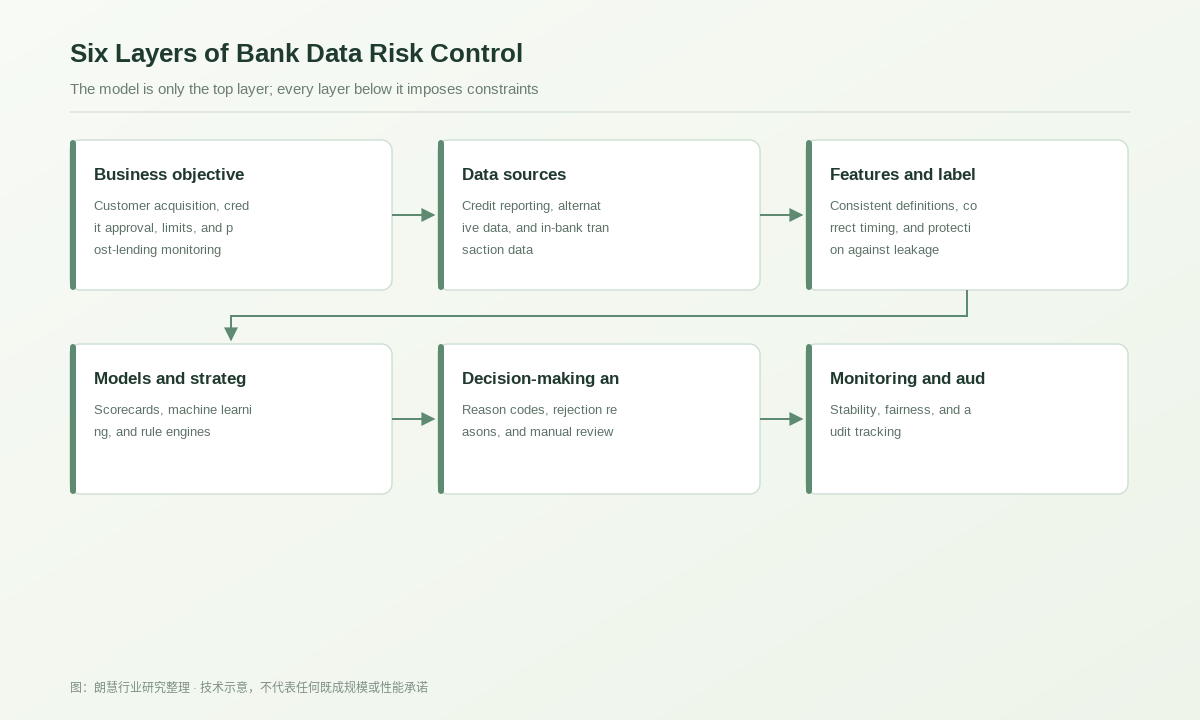
The most common mismatch in tech companies’ partnerships with banks on risk control is treating the collaboration as the purchase of a model. What banks truly lack is not an algorithm but a decision chain that can withstand regulatory inspections: where data comes from, how features are calculated, how the model sets thresholds, how reasons for rejecting customers are explained, and how performance is monitored after launch. The model is only one link in this chain, and often not the hardest one.
Four types of constraints operate simultaneously along this chain. Credit reporting business is subject to dedicated management rules; once alternative data has the attributes of credit information, both the processing entities and processing methods are restricted. Personal information protection requires notice and consent, purpose limitation, and explainability in automated decision-making. Data security requires classification and grading, and the export of important data requires assessment. Banking regulation requires that core risk control not be outsourced, and that outsourced risks be manageable and controllable. If any one is not handled properly, the partnership stops at the pilot stage.
The correct starting point for such partnerships is therefore not technology selection but boundary design: which data the technology side may access, which must be processed on the bank side, in whose environment the model is trained, and who explains and bears responsibility for the results. If boundaries are not settled before work begins, every subsequent data call becomes a patch. Eventually, no one can explain clearly how the system actually makes decisions.
Another commonly overlooked fact is that banks are not internally unified in their attitudes toward models. Business departments focus on results, risk departments on stability, compliance departments on the basis for decisions, and technology departments on maintainability. A solution that is popular in business review may be rejected in compliance review with a single sentence. Putting the concerns of all four parties on the table early is far less burdensome than explaining them item by item afterward.
2. Credit Reporting and Alternative Data: The Boundary Depends on Use, Not Source
Credit reporting business has explicit licensing requirements. The collection, organization, storage, processing, and external provision of credit information constitute credit reporting business and require the corresponding qualifications. Recent rules have brought alternative data into view: telecom payments, water, electricity and gas bills, tax, social security, e-commerce transactions, and logistics fulfillment. Under certain conditions, these data can reflect willingness and ability to perform obligations. Once used for credit decisions, they may be classified as credit information and cannot be collected and provided at will by unlicensed entities.
This line is difficult to draw because it depends on use rather than the data itself. The same telecom payment record is ordinary data when used for network optimization, but takes on the attributes of credit information when used to assess repayment capacity. In practice, the criteria generally include three questions: whether the data is used to assess credit risk, whether it forms an evaluation of a specific subject, and whether it is provided externally. If all three are met, the activity basically has to be treated as credit reporting business.
For tech companies, this means the previous direct-connection model no longer works. Directly feeding a platform’s own data into a bank model can easily be regarded under regulatory interpretations as engaging in credit reporting business in substance. A compliant path is to use a licensed credit reporting agency as an intermediary layer, or for the bank to collect and process the data itself while the technology side provides only tools and computing power. The former changes the data flow; the latter changes the responsibility allocation. Both paths require system redesign.
The authorization basis for alternative data also needs attention. Whether user consent covers credit risk-control purposes, whether it can be sub-authorized to partners, and whether the authorization period and withdrawal mechanism are clearly defined are all requirements under personal information protection rules. Much data is collected under broad service-agreement consent only, which does not hold up when used for risk control.
3. The Real Problem With Alternative Data: Correlation Is Not Usability
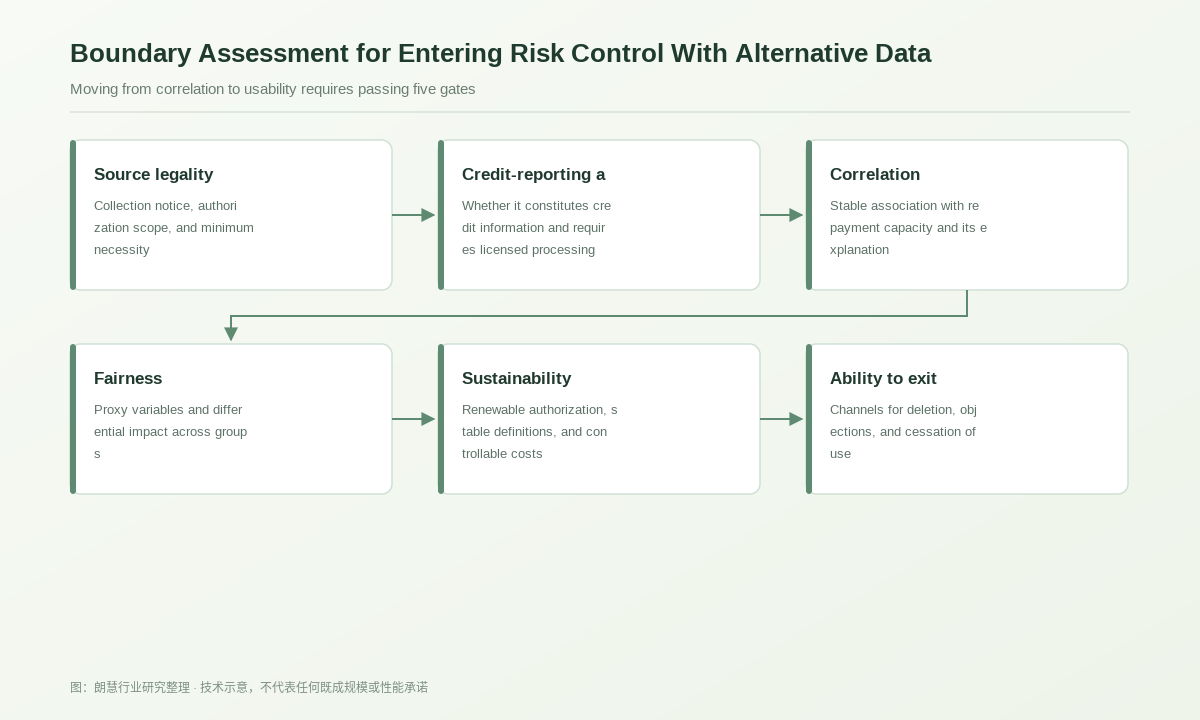
Alternative data is overvalued when correlation is mistaken for causation. Time spent online on a phone, payment punctuality, and stability of delivery addresses are statistically correlated with defaults, but the correlation may arise from common causes such as income level or residential stability. What the model learns may be proxy variables, and performance will deteriorate once the customer base changes or data definitions are adjusted.
Stability is more troublesome. Alternative data comes from third parties, and interfaces, fields, and update frequencies may all change. Adjustments to telecom billing cycles, changes to order-status definitions on e-commerce platforms, and shifts in tax-data definitions can all cause model input drift. Without stable data contracts and monitoring mechanisms, a model may deviate from its training distribution within three months of launch, while the business side often does not notice until the default rate rises.
Coverage bias must also be confronted. Alternative data is naturally missing for people without a digital footprint, such as older adults, residents of remote areas, and people newly entering the formal financial system. If the model treats missing data as high risk by default, it will systematically exclude these groups, creating de facto exclusion. A reasonable approach is to distinguish missing data from poor performance, model missing data separately, or route it through a manual channel.
There is also a practical issue: the cost structure of alternative data. Calling third-party interfaces transaction by transaction can be expensive at scale, while the benefits mainly appear among long-tail customer groups. Many institutions therefore use alternative data only within specific loan-amount ranges or customer segments, creating a tiered strategy. This tiering itself requires explanation, otherwise it can easily be challenged as differential treatment.
4. Model Explainability: Regulators Want Reproducible Decision Paths
In a regulatory context, explainability does not mean plotting attention weights. What is required is the ability to answer three questions: why was this customer rejected, which features played a role, and is the use of those features justified. The answers must be understandable to non-technical personnel and reproducible during inspections.
A technically feasible approach is dual-track. On the model side, feature-attribution methods indicate the direction and magnitude of each feature’s contribution. On the policy side, a rule engine makes key judgments explicit—for example, automatically rejecting applications when the number of delinquencies over the past twelve months exceeds a threshold, without entering model scoring. This way, even if the model is complex, part of the final decision remains readable.
Explanations must also correspond to rejection reason codes. The rejection reasons banks give customers are typically limited to a few categories, and model outputs must map to those categories rather than generating free-form text each time. The mapping requires version management. After a model iteration, the meaning of a reason code must not change silently, or historical decisions cannot be reviewed.
Explainability also has limits. Excessive pursuit of explanation can sacrifice performance, especially in scenarios with strong nonlinear relationships. A balanced approach is to stratify by risk: high-amount, high-risk decisions require strong explanations and manual review, while small-value, high-frequency decisions may allow more complex models, subject to overall monitoring and sampled re-review.
5. Consumer Protection: Notice, Consent, and Redress Must Actually Work
Consumer protection is usually treated as an appendix to compliance in partnerships of this kind, but in practice it directly affects whether a product can scale. The core is three things: notice, consent, and redress. Customers need to know which of their data is used for credit decisions, to be able to refuse non-essential data use, and to have the right to request an explanation and apply for manual review when adversely treated by automated decision-making.
Rules on automated decision-making require operators to ensure transparency and fair outcomes, and prohibit unreasonable differential treatment of individuals in transactional terms. In risk control, this means feature selection must be reviewed for the use of sensitive attributes or their proxies, such as gender, ethnicity, region, and health status. Even if those fields do not enter the model directly, postal codes, device models, and consumer brands may become proxy variables.
Differential impact must be measured, not merely declared. A practical method is to periodically compare approval and default rates by group and see whether, after controlling for risk levels, there are systematic differences in access across groups. Finding a difference does not necessarily require adjustment, but there must be records, explanations, and an improvement plan. This issue is increasingly raised in regulatory inspections.
Redress channels must actually work. If a customer who raises an objection can only receive a response that the system’s decision cannot be changed, there is effectively no redress. There must be a path for manual review, clear processing time limits, and traceable processing records. For the technology side, this means the system must retain an input snapshot at the time of decision, otherwise review months later will be impossible.
6. Cross-Border Data Transfer and Localization: Three Scenarios Must Be Separated
Cross-border data transfer must be considered by scenario rather than treated as one issue. One scenario is purely overseas institutional partnerships, where data is transferred abroad for processing. Another is sharing within an overseas parent company or group. A third is using overseas cloud services or open-source models, where data is processed on overseas servers. The compliance paths differ across these scenarios, and the third is most easily overlooked because business teams often do not consider it a cross-border transfer.
The regulatory framework is already fairly clear: there are three routes for personal information cross-border transfer—security assessment, standard clauses, and certification; exports of important data require a security assessment; and operators of critical information infrastructure face stricter requirements. Financial data is also subject to industry rules, and cross-border transfers involving customer information must meet additional conditions. In practice, the hardest part is determining whether data qualifies as important data, which requires reference to industry catalogs and data classification and grading results.
Localization does not merely mean servers are located domestically. It also includes operational access, key management, log retention, and disaster-recovery arrangements. If servers are located domestically but operational accounts are held by an overseas team, substantive control remains abroad and regulators will question this during inspections. Likewise, if a model is trained abroad and its weights are updated abroad, even if inference occurs domestically, the data flow must be explained.
For tech-finance partnerships, a practical recommendation is to map the data flows clearly before discussing architecture: which data is generated domestically, which requires cross-border transfer, whether cross-border transfer is essential or merely customary, and whether alternatives exist, such as training domestically and exporting only model parameters. Many cross-border requirements actually stem from inertia in a group’s unified architecture and are not necessarily business necessities. Clarifying this first can save substantial compliance costs.
7. Rights and Responsibilities in Joint Modeling: Allocate Responsibility by Role
Joint modeling typically involves three parties: the data holder, the technology provider, and the bank. Their claims to rights over the same model are often inconsistent, making it easier to dispute responsibility when something goes wrong. Common disputes include who owns the model’s copyright, whether gradients or intermediate results generated during training count as data, who is responsible if model performance falls short, and who responds to customer complaints.
A clearer approach is to assign responsibility by role. The bank is the responsible party for credit decisions, and core risk control cannot be outsourced; this is explicitly required in rules related to online lending. The technology party provides tools, computing power, and modeling services and is responsible for the model’s technical quality, but does not bear responsibility for credit decisions. The data party is responsible for the legality and quality of the data sources. Each party holds its own segment, and interfaces are documented in files.
Federated learning and privacy computing change the data flow but not the responsibility structure. Data does not leave its domain, and the technology party receives encrypted intermediate results, which appear to reduce risk. But if intermediate results can be reverse-engineered, or if information can be extracted from a model through malicious queries, it still constitutes a data breach. Such projects therefore require independent attack testing and access audits; relaxation is not warranted merely because data does not leave its domain.
Model ownership should be settled before the project starts, not disputed afterward. Practical agreements include: general modeling methods belong to the technology party; model instances trained with bank data belong to the bank; where ownership is shared, the scope of use and further-authorization rules must be specified. Ownership of derived statistical results from training data and outputs of feature engineering should also be agreed, otherwise switching vendors later will create disputes over assets.
8. Data Minimization and Purpose Limitation: Every Field Needs a Reason
Data minimization does not mean using less data for its own sake; it means every field must have a reason for use. Risk-control models easily fall into the habit of assuming that more fields are better, feeding in all available data and relying on regularization and feature selection to manage the result. This can improve performance in small-sample or weakly regulated environments, but under compliance review, the purpose of each field will be questioned one by one.
A practical approach is to maintain a three-column table of fields, purposes, and bases. For every field entering the model, specify what decision it informs, the basis for its use, how long it is retained, and who can access it. This table serves as both a compliance document and a model document. Adding fields must go through a change process; modelers cannot add them on their own.
Purpose limitation must also govern downstream use. Scores produced by a risk-control model may be used for marketing, limit adjustments, or collections ranking, all of which are different purposes. In practice, once a score is produced it is often reused in multiple places, and the original authorization scope is forgotten. Purpose labeling and access control must be implemented at the system level rather than relying only on institutional constraints.
Retention periods are equally important. Risk control needs historical data for retrospective analysis, but indefinite retention increases breach risk. A reasonable design sets different retention periods by purpose: decision rationales are retained until the dispute period ends, intermediate feature results are retained briefly, and raw data is retained only as long as minimally necessary. At expiration, data is automatically archived or deleted, and a deletion record is kept.
9. Monitoring and Audit Trails: Launch Is Not the Finish Line
Launching a model is not the finish line. Risk-control models face customer bases that change and counterparties that adjust strategies, so performance decay is normal. Monitoring should cover three types of metrics: discrimination, meaning whether ranking remains effective; stability, meaning whether input distributions have drifted; and fairness, meaning whether group-level performance is imbalanced. Reports on all three should be produced regularly, rather than waiting for an abnormal default rate to look back.
Audit-trail requirements are higher than most teams imagine. Every credit decision must be reconstructible: which model version was used, what feature values were present, what the thresholds were, which rule-engine rule was triggered, and whether human intervention occurred. Without this, customer complaints cannot be answered, regulatory inspections cannot be substantiated, and internal reviews cannot be conducted.
The engineering implementation of audit trails must account for cost. Storing a complete feature snapshot for every decision at full scale requires substantial storage. A feasible approach is tiering: high-risk or large-value decisions receive full audit trails, while small-value, high-frequency decisions retain key fields plus a model version number and a reference to recomputable inputs. The prerequisite is that the input data itself remains available during the retention period.
Change management is part of audit trails. Model retraining, threshold adjustments, and feature additions or deletions all require version numbers, change notes, approval records, and rollback plans. Many incidents are caused not by a bad model itself but by an unassessed threshold adjustment that raised approval rates, followed by the emergence of defaults months later.
10. Acceptance and Audit: Do Not Look at Only One Performance Metric
Acceptance should not rely on a single performance metric. Ranking metrics such as AUC and KS can show whether a model has discrimination, but cannot show whether it is compliant, stable, or explainable. A complete acceptance checklist should include proof of data-source legality, a field-purpose table, model documentation, an explanation scheme, a fairness assessment, a monitoring plan, and an emergency-response plan.
Technical acceptance must be reproducible. Use a held-out time window for retrospective testing, different customer groups for stratified testing, and perturbed inputs for robustness testing. The three tests address different questions: retrospective testing looks at performance, stratified testing looks at bias, and perturbation testing looks at fragility. Conducting only one of them can easily produce overly optimistic conclusions.
For compliance acceptance, an external perspective is recommended. Internal teams often have blind spots regarding their own systems, especially on non-technical issues such as authorization chains and purpose boundaries. Legal, compliance, and internal audit teams can participate together, and a third party can be engaged for an independent assessment when necessary. The assessment conclusions must translate into remediation items, not merely an archived report.
The audit perspective must also look ahead. Regulatory inspections often ask why a particular dataset was used, why a threshold was set, and why a particular customer was rejected. These questions must have answers during system design; documentation added afterward is often incomplete. Bringing audit requirements forward into design review is the most cost-effective approach.
11. Outlook for the Next 12 to 24 Months
The most certain change is the tightening of alternative data’s treatment as credit reporting. Rules on the determination of credit information will continue to be refined, the room for platforms to connect data directly to banks will narrow further, and the position of licensed credit reporting agencies as an intermediary layer will become clearer. For tech companies, the business model will shift from selling data to selling tools, computing power, and modeling services.
The second change is that generative models will enter auxiliary links in risk control, but will not enter core decisions. They can be used for document review, organizing customer communication records, and generating explanations of unusual transactions. Core credit decisions will remain centered on explainable scorecards and rules, because regulators require reproducible reasons rather than fluent narratives.
The third change is the institutionalization of model governance. Requirements already mature at large institutions—model inventories, risk assessments, independent validation, and ongoing monitoring—will transmit to smaller institutions and technology service providers. This means technology providers must deliver not only models but also documentation, monitoring tools, and auditable logs.
Who will benefit first? My judgment is that the beneficiaries will be licensed institutions with compliant data channels, service providers that can turn model governance into a productized capability, and teams with genuine engineering experience in privacy computing. Evaluation criteria will also shift: from how good model performance is, to whether decision chains are reproducible, whether data purposes can be proven, and whether customer objections can be handled to completion. This shift will eliminate a batch of proposals that rely on data advantages to tell a story.
Langhui's Engineering Capabilities Along This Path
Langhui Technology’s capability lies on the data side, not in credit risk-control modeling or compliance opinions themselves. What we do is collection-standard design, structured annotation, quality control and consistency reporting, data dictionaries, and version records. In healthcare, we cover CT, MR, PET, mammography, ultrasound, and other modalities. Applied to financial data scenarios, the implementation forms are field-level usage ledgers, sample annotation and review standards, definition alignment across data sources, and traceable version management.
For specific risk-control partnership projects, we can undertake methods for inventorying data assets, preparing field dictionaries and minimum-necessity lists, annotating and quality-controlling training and evaluation samples, and producing consistency assessment reports before delivery. Model development, strategy design, and compliance conclusions need to be led by banks, licensed institutions, and professional legal teams. We do not replace them, nor do we claim existing qualifications in the field of financial risk control.
If your team is preparing data for joint modeling, governing fields, or conducting delivery acceptance, you can send us the data-source structure, field scale, and timeline, and we will provide an executable annotation and quality-control plan. Build the specification once, and subsequent batches can reuse it directly.
FAQ
When is alternative data used for risk control considered credit reporting business?
The key is the purpose and three elements: whether it is used to assess credit risk, whether it forms a credit evaluation of a specific subject, and whether it is provided externally. If all three are met, the activity basically has to be treated as credit reporting business and requires the corresponding qualifications or a licensed institution. The basis for judgment is purpose rather than data source; the same payment record changes in nature when used for a different purpose.
In joint modeling between a bank and a tech company, who ultimately owns the model?
There is no single answer; it must be agreed before the project starts. A common division is that general methods and frameworks belong to the technology party, model instances trained with bank data belong to the bank, and, where ownership is shared, the scope of use and further-authorization rules are specified. Intermediate results from training and feature-engineering outputs must also be agreed, otherwise disputes over asset ownership will arise when switching vendors.
How far must model explainability go to be compliant?
It must answer three questions: why was the application rejected, which features played a role, and is the use of those features justified. The answers must be understandable to customers and reproducible during inspections. In practice, the model provides feature contributions, the policy layer makes key judgments explicit, outputs map to a limited set of rejection reason codes, and records of the version used at the time are retained.
Does training a risk-control model with overseas cloud services count as a cross-border data transfer?
It usually does. Data processed on overseas servers constitutes a cross-border transfer, even if only the model weights are ultimately brought back domestically. Operational access and key ownership also matter: if servers are located domestically but overseas teams hold the operational accounts, substantive control remains abroad. The recommendation is to map the data flows clearly first, then determine whether a security assessment, standard clauses, or certification applies.
If core risk control cannot be outsourced, what can a tech company still do?
It can provide tools, computing power, modeling services, and engineering implementation, but it cannot make credit decisions on the bank’s behalf. The boundary is that final approval authority, policy threshold settings, and customer eligibility must remain with the bank, while the technology party is responsible for technical quality. The data party is responsible for the legality of data sources. Each party holds its own segment, interfaces are documented in files, and responsibility is clear during inspections.
- Personal Information Protection Law of the People's Republic of China http://www.npc.gov.cn/npc/c30834/202108/a8c4e3672c74491a80b53a172bb753fe.shtml
- Federal Reserve, SR 11-7: Guidance on Model Risk Management https://www.federalreserve.gov/supervisionreg/srletters/sr1107.htm
- NIST AI Risk Management Framework https://www.nist.gov/itl/ai-risk-management-framework
- Regulation (EU) 2024/1689 — Artificial Intelligence Act https://eur-lex.europa.eu/eli/reg/2024/1689/oj
- ISO/IEC 42001:2023 Artificial intelligence management system https://www.iso.org/standard/81230.html