
CLINICAL GUIDELINES / RULE ENGINE
AI-ifying Clinical Guidelines: Turning Consensus into Rule Bases, Version Conflicts, and Explainable Audits
Thousands of guidelines and consensus statements are issued every year, the vast majority in PDF form: readable by people, but difficult for systems to execute. This article discusses the engineering path for converting guidelines into executable rule bases: item segmentation, decision tables and conditional expressions, evidence-level modeling, version updates and conflict handling, explainability and audit requirements for integration with CDSS and large models, and a judgment for the next 12 to 24 months.
Guidelines are written in increasingly standardized ways, yet using them still depends on human memory. Recommendations are buried in paragraphs, conditions of use are hidden in notes, and exceptions are scattered below tables; within a few minutes in outpatient clinics, doctors cannot check every item. Turning guidelines into executable rule bases looks like a text-processing problem, but it is actually a knowledge-modeling problem: each recommendation must be broken down into population, conditions, actions, evidence level, and exceptions, and must then be updated alongside version changes. This article discusses the engineering details, conflict handling, and audit requirements along this path.
I. The distinction between guidelines and consensus statements determines which texts can become rules
The definition of guidelines has evolved several times. The U.S. Institute of Medicine first defined it in 1990, and the updated 2011 definition emphasizes three points: it is based on a specific clinical question, it is based on systematic reviews of evidence, and it ultimately produces a document that can provide patients with the best possible diagnosis and treatment. Although this definition looks academic, it actually determines the structure of guideline text and whether it can be read by machines.
Two types of documents are common in China: guidelines and expert consensus statements. Guidelines are usually issued by associations and societies, follow a more rigorous process, and take longer to develop, typically one to two years. Consensus statements are mostly issued by expert groups, have a shorter cycle, and can be completed in three to six months, making them far more numerous. Both fundamentally provide guidance for clinical practice; the difference lies in the rigor of their evidence base and development method, not in their names.
For rule-ification, this distinction is critical. Guidelines usually revolve around ten to twenty key questions, each supported by systematic-review evidence and grading; recommendations have clearly defined applicable populations and conditions and are suitable for conversion into rules. Consensus statements are often broader in wording, commonly using phrases such as 'may be considered' and 'recommended,' with fuzzy condition boundaries. Forcing them into rules would turn experts' cautious statements into hard requirements.
There is also a practical premise: not all guidelines are worth rule-ifying. Public ratings show that domestic guidelines have long averaged below the passing score, with some documents containing mutually contradictory recommendations that are disconnected from clinical reality. The first step in rule-ification should be selection: choosing guidelines with reliable methodology, clear question boundaries, and no major imminent revisions, rather than stuffing every PDF into a rule base.
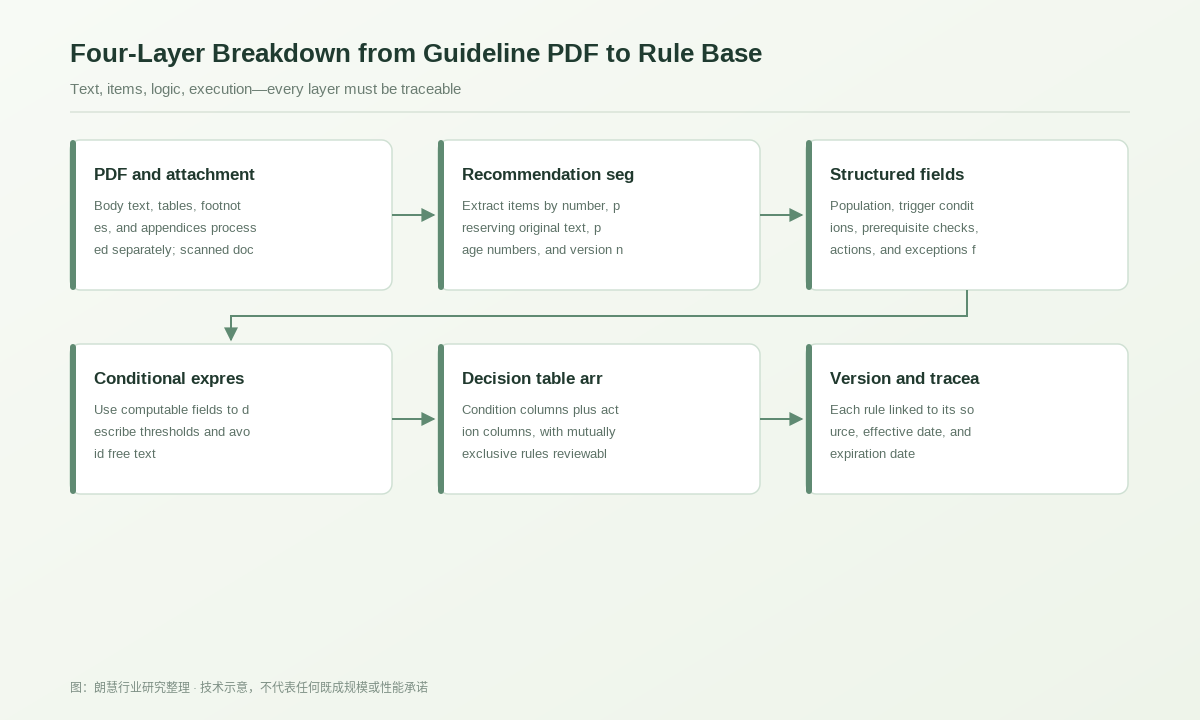
II. From PDF to Rule Base: A Four-Layer Breakdown
The first is the text layer. Body text, tables, footnotes, and appendices in a PDF must be processed separately because their semantic roles differ: body text provides reasons, tables provide thresholds, and footnotes provide exceptions. Scanned documents should first undergo text recognition; two-column layouts are prone to line interlacing, and tables crossing pages may be truncated. The output of this layer should be text blocks with coordinates and page numbers, not a cleaned-up block of plain text; otherwise, later traceability will be impossible.
The second is the item layer. Recommendations should be split by number and stored independently, preserving the original text, page number, section, and version number. Do not rewrite wording while segmenting; the original text must be kept exactly as is, with rewritten versions stored separately. Many projects go wrong here: they polish the original text for 'smoothness,' and later, during audits, it cannot be matched to the original sentence, undermining the credibility of the entire batch of rules.
The third is the logic layer. Each recommendation must be split into fixed slots: applicable population, trigger conditions, prerequisite checks, decision thresholds, recommended action, and exceptions/contraindications. Items with incomplete slots must either be supplemented or marked as not rule-ifiable. This step involves the greatest workload and most needs clinical experts; a purely engineering team cannot do it alone.
The fourth is the execution layer. Translate the logic layer into decision tables or conditional expressions, define priorities, conflict-handling methods, and audit fields, then connect to actual business systems. Stable identifiers must link all four layers, so that any rule can be traced back from the execution layer to a specific page and line of the PDF; otherwise, the system can only be demonstrated, not put into production.
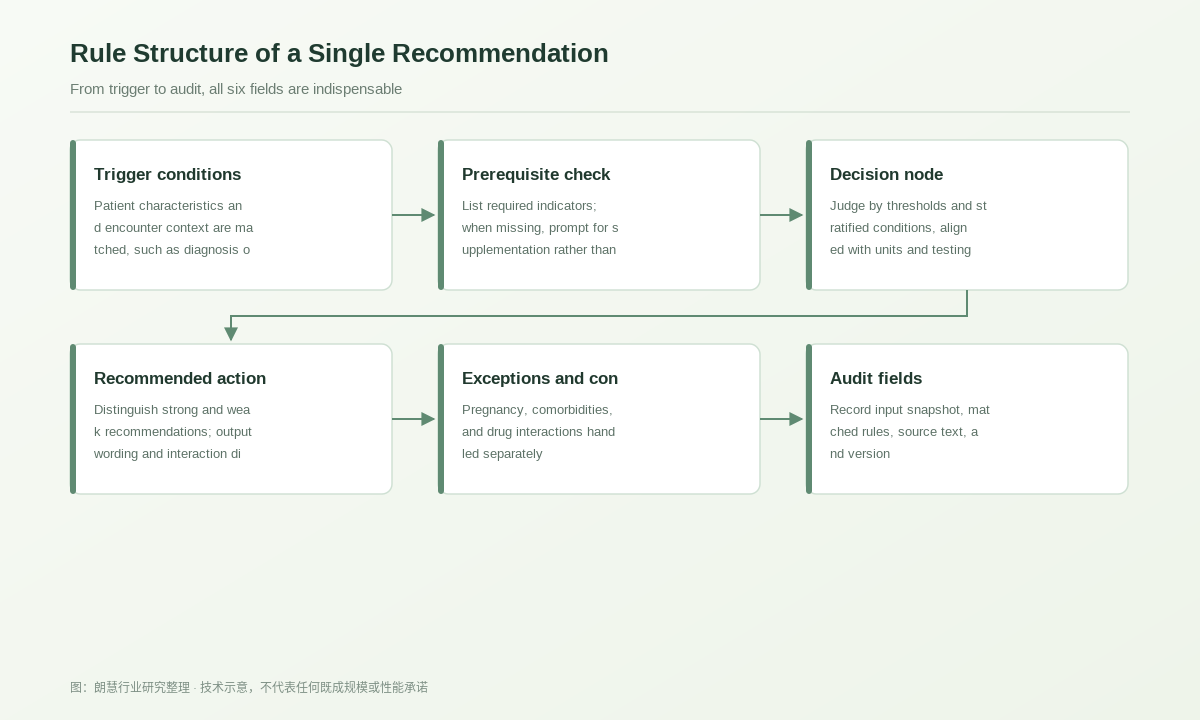
III. Decision Tables and Conditional Expressions: Writing Recommendations as Executable Structures
Decision tables are the easiest form for humans to read: several condition columns on the left, several action columns on the right, each row a complete rule, with rows as mutually exclusive as possible. Compared with nested flowcharts, decision tables can be reviewed directly by clinical experts and covered row by row by test cases. As rule counts grow, decision tables can also be split by topic into multiple tables to avoid one table with hundreds of rows.
Conditional expressions should use computable fields wherever possible rather than free text. Age, sex, pregnancy status, platelet count, multiple of transaminase elevation above the reference upper limit, eGFR range, and whether cirrhosis is present can all be mapped to specific fields. A phrase such as 'significantly abnormal liver function' cannot be executed by the system and ultimately requires human judgment, which amounts to no rule-ification at all.
Units and testing specifications are among the most underestimated pitfalls. The same indicator may use different units at different hospitals, and reference intervals may differ across testing platforms. Thresholds must include units, testing methods, sex stratification, and, where necessary, age stratification. Writing 'platelets below how many' as a number without units can be completely wrong at another hospital, and wrong in a very quiet way.
Missing-value handling must be designed separately. When a patient has not undergone a test, the system should not default to 'condition not met' and produce a negative conclusion; it should output 'additional testing required' and specify what is missing. This is an important difference between a rule base and a statistical model: a model can fill gaps through inference, while a rule base must explicitly express insufficient information, or it will create a false sense of certainty through silence.
IV. Evidence Levels and Recommendation Strength Must Be Modeled Together
A relatively common international approach is the GRADE system: evidence quality is divided into high, moderate, low, and very low, while recommendation strength is divided into strong and weak recommendations. Their combination determines how a recommendation should appear in the system. If only recommendation content is stored without its level, the rule base degenerates into an electronic handbook and loses its most useful layer of information.
Why model them together? Because a strong recommendation based on low-quality evidence and a weak recommendation based on high-quality evidence represent completely different clinical meanings. The former means 'evidence is limited but consensus is clear, and it should generally be followed'; the latter means 'evidence is reasonable but benefits and risks are close, requiring individualized weighing.' If the system renders both as the same red alert, doctors will soon stop looking at them.
System behavior should vary with the level. Strong recommendations can be checked by default and trigger blocking prompts at critical decision points; weak recommendations should provide informational prompts only, listing the evidence level and conditions of use side by side, leaving the choice to the doctor. Turning weak recommendations into mandatory blocks neither matches the original text nor is likely to be accepted by frontline staff, who will eventually bypass them in various ways.
Traceability must go down to the sentence. In addition to the guideline name and version, each rule should link to the specific section, page, and original sentence, ideally also to the corresponding row in the GRADE evidence table. When an audit asks 'why was this rule set this way,' the original text and evidence level can be retrieved directly, which is more persuasive than any explanation. Doing this at the start of a project is low-cost; adding it after problems arise is often impossible.
V. Version Updates: When a Guideline Changes One Line, How Much Must the Rule Base Change?
The formal update cycle for guidelines is usually around five years, but actual changes go far beyond that. In between, there may be supplementary documents, errata, rapid recommendations, meeting-minutes-style interim positions, and specialty subcommittees may separately issue guidance for specific populations. If a rule base only recognizes 'major versions,' these intermediate changes will be missed, yet clinical problems often arise precisely from these details.
The basic principle of version modeling is that each rule carries an effective date and an expiration date, and historical versions are not deleted. A patient may cross two versions during a long follow-up; judgments should follow the version in effect at the time, with the switch point recorded. Directly overwriting old rules is convenient, but it makes historical cases impossible to reproduce and leaves matters unclear during disputes or quality-control inspections.
Difference comparison must be granular to individual items. Perform a structured diff between old and new versions, marking five categories: additions, deletions, condition changes, threshold changes, and wording adjustments. Only wording changes require no rule modification; threshold or condition changes require regression testing; deleted items should be marked as retired rather than removed outright, because there may still be ongoing patients being managed under the old version.
The release process must support gradual rollout and rollback. First launch in a small number of departments or disease types, observe trigger volume and adoption rate, then gradually expand. Rollback capability must exist from the design stage, not be improvised by modifying the database after something goes wrong. A rule base affects clinical behavior; its release process should be aligned with software systems, not handled casually like issuing a notice.
VI. Conflict Handling: When Multiple Guidelines Give Different Accounts of the Same Issue
Conflict is the norm, not the exception. Different societies may take different positions on the same question; domestic and international guidelines may have opposite recommendation strengths; specialty and general guidelines may overlap in scope; and old and new versions may coexist for a period. If a department cites three guidelines at once, a patient may receive three mutually contradictory alerts.
The first step in handling conflicts is setting priorities, not letting an algorithm reconcile them. A common order is: hospital consensus takes precedence over national guidelines, national guidelines over international guidelines, and specialty guidelines over general guidelines; within the same level, newer versions take precedence over older ones. This order should be written into configuration and visible to doctors; otherwise, system recommendations will seem unfounded.
The second step is to present options side by side rather than force a merge. For items where genuine disagreement exists, recommendations from different sources can be placed together, with their respective scopes, evidence levels, and issuing organizations labeled for doctors to judge. Trying to calculate a 'combined recommendation' through weighted voting is clinically dangerous, because disagreement itself often reflects insufficient evidence or population differences.
The third step is to build a conflict ledger. Which questions involve disagreement, where the disagreement lies, and what each position is based on—this list is highly valuable for hospitals developing internal consensus statements and can also prompt guideline developers to pay attention to these issues. Most teams merely resolve conflicts without recording them, which means every issue must be discussed again from scratch.
VII. Integration with CDSS: Trigger Timing and Alert Fatigue
A rule base does not take effect by itself; it must be attached to specific business nodes: placing orders, writing diagnoses, receiving test results, admission assessment, and discharge summaries. Triggering too early means data is incomplete and the calculated conclusion is meaningless; triggering too late means the handling is already complete and the alert is only a retrospective record. A reasonable approach is to set trigger points by rule type rather than crowding every rule into the same interface.
Alert fatigue is the most common cause of failure for such systems. If dozens of prompts pop up in a day, doctors develop conditioned reflexes and close them immediately. The mitigation is tiering: make the few rules that truly need blocking into strong prompts, while turning the rest into lists or badges that doctors can actively review. The tiering criteria should be based on recommendation strength and risk level, not development difficulty.
Integration method also matters. As an external popup requiring doctors to switch to another system, usage will definitely be low. A better approach is to package rules as services and embed them in the workstation doctors already use, showing prompts and links to the original text directly on the ordering page. Integration depth determines whether this is a tool or a burden.
After launch, continuously measure: how many patients are covered, how many times rules trigger, adoption rate, ignore rate, and false-positive rate. A high ignore rate does not necessarily mean doctors are uncooperative; the rule itself may not fit the local population, or the wording of the alert may be incomprehensible. Only by collecting this data can the next round of revision be justified.
VIII. Integration with Large Models: Where Generative Q&A Does and Does Not Apply
What large models are good at is fairly clear: retrieving original text within a limited guideline corpus, explaining clauses, organizing natural-language cases into structured fields, and generating plain-language summaries for patients. The common feature of these tasks is that there is original text to rely on and the output can be checked. Used well, they can significantly reduce the time cost of consulting guidelines.
What they are not suited to is equally clear: answering questions not addressed in guidelines without retrieval, mixing recommendations from different versions in one answer, or making treatment decisions for doctors. Large-model outputs are probabilistic; the same question asked twice may be phrased differently, making risk uncontrollable in scenarios that require certainty.
A relatively robust architecture is retrieval augmentation with a strictly limited corpus scope: allow answers only from guideline versions adopted by the hospital, require every answer to include a source, and explicitly state when nothing is found. This 'willing to say I don't know' design is crucial: it downgrades the model's role from 'expert' to 'retrieval assistant,' making it easier for people to judge whether the output is trustworthy.
Evaluation should be done by category. Divide test questions into three types: clause location (on which page is this recommendation), condition judgment (does this patient meet the criteria), and exception identification (what contraindications exist). The error patterns of the three types are completely different; combining them into a single accuracy score is meaningless. The evaluation set should be created by clinical experts and regularly supplemented with questions the model has answered incorrectly.
IX. Explainability and Auditing: Every Recommendation Must Trace Back to the Original Text
Explainability here is not an abstract concept; it has three concrete levels. The first is rule hit: why did the system give this recommendation, which conditions were met, and which were not. The second is source text: which page, sentence, and evidence level in the guideline this rule corresponds to. The third is version information: which guideline version was in effect at the time. Missing any of the three makes the explanation incomplete.
Audit fields should be designed in advance rather than patched in afterward. At a minimum, they should include rule identifier, guideline version, trigger time, input-data snapshot, output content, whether the doctor adopted it, and the reason for non-adoption. The input snapshot is most easily overlooked: patient data changes. When reviewing a judgment from three months ago today, without the input at the time it cannot be reproduced, and it is impossible to determine whether the rule was wrong or the data changed.
The granularity of traceability should match the risk. High-risk rules involving medication initiation, discontinuation, and contraindications should be fully recorded on every trigger; general health prompts can be recorded only in aggregate. Storing all logs at the same granularity usually results in high storage costs while failing to provide the key fields when they are actually needed.
From a regulatory perspective, if the rule base is part of medical-device software, evidence requirements will be stricter; if it is only an internal quality-control tool, it still does not mean traceability can be omitted. Internal quality-control inspections, case discussions, and dispute resolution will all ask the same question: what did the system prompt at the time, and why did the doctor not follow it? If there is no answer, responsibility falls on the system designer.
X. Go-Live Acceptance Checklist: How to Judge Whether a Rule Base Is Usable
First, look at coverage. How many recommendations in the target guideline have been rule-ified, and how many have been marked as not rule-ifiable with reasons stated? Higher coverage is not always better; forcing vague wording into rules will increase false positives. A healthier ratio is full coverage of core clauses, while peripheral clauses are explicitly marked as 'information only' or 'requires human judgment.'
Second, look at consistency. Sample several rules and check them against the original text item by item to see whether population, conditions, thresholds, and exceptions were transcribed correctly. This must be done by clinical experts; an engineering team's self-review will not reveal the problems. The sampling ratio can be tiered by risk: fully inspect high-risk clauses and sample 30% of general clauses.
Third, look at maintainability. When a guideline updates, how many person-days does the rule base require, is there a regression test set, and can releases be rolled out gradually? If a team must manually edit dozens of tables for every update and is afraid to go live afterward, the system will last at most two years. Maintainability can and should be quantified and written into acceptance criteria.
Fourth, look at operational data. Within three months after launch, count triggers, adoption rate, ignore rate, and false-positive complaints, and compare them with the pre-launch baseline. Acceptance without operational data is merely functional acceptance and cannot show whether the rules hold up in the real pace of outpatient clinics.
| Acceptance Dimension | Specific Checks | Typical Signs of Failure |
|---|---|---|
| Coverage | Whether core clauses are rule-ified and whether un-rule-ified items state reasons | All marked executable while many clauses actually require human judgment |
| Consistency | Sampling and rereading the original text to verify populations, thresholds, and exceptions | Thresholds lack units; exception clauses are omitted |
| Maintainability | Person-days for updating one guideline, regression testing, and gradual rollout capability | Manual table edits, no versioning, no rollback |
| Operational Effectiveness | Trigger volume, adoption rate, ignore rate, false-positive complaints | Only functional demonstrations with no real operational data |
XI. Outlook for the Next 12 to 24 Months
First, guideline publishers are highly likely to start providing structured attachments. The body text will remain a PDF for humans, but recommendations, evidence levels, and conditions of use may be published simultaneously in tabular or machine-readable formats. This is the biggest variable in the entire chain: if upstream provides structured data, rule-base development costs will fall significantly; if not, downstream teams must continue laborious manual decomposition.
Second, rule bases will shift from project-based delivery to service-based delivery. A one-time delivery of rules quickly becomes outdated as guidelines are updated; a more sustainable model is subscription plus local adaptation, with the service provider maintaining common rules and hospitals handling only localization and threshold calibration. This saves hospital labor but requires the service provider to maintain a stable methodology team and version-management capability.
Third, large models will not replace rule bases; their division of labor will become clearer. Deterministic judgments go to rules, retrieval, explanation, and summarization go to models, and structured source citations connect the two. A plan that tries to use one large model for every step will not pass explainability and audit requirements in the short term.
Fourth, the first beneficiaries will be hospitals and regional medical alliances with strong digital foundations and demand for internal guideline implementation. They have data, scenarios, and experts who can review rules; a pure model team without guideline copyright or an expert network will struggle to take this work deep. Over the next two years, the focus of competition will not be model parameters, but who can persuade clinical experts to sit down and review rules item by item.
Langhui's Engineering Capabilities Along This Path
Langhui's approach to text- and rule-based data projects is to break a guideline into verifiable structured fields: recommendation number, applicable population, trigger conditions, prerequisite checks, thresholds and units, recommended action, exceptions and contraindications, evidence level, and source text. All fields are entered by two people and reviewed by a third; data dictionaries, field descriptions, and version records are delivered, and any rule can be traced back to its source page.
Provisions involving imaging indications and follow-up intervals can interface with our imaging-data capabilities. In medical imaging, we cover CT, MR, PET, mammography, ultrasound, and other modalities, including acquisition-specification design, structured annotation, quality control, and consistency reporting. Examination items, follow-up intervals, and imaging descriptors appearing in rules can first be defined uniformly in the annotation system and then mapped to rule fields.
The boundaries need to be clear: we do not handle registration and certification for clinical decision systems, do not claim HIPAA certification, and do not list medical-record natural-language processing or whole-slide pathology as platform capabilities. The medical correctness of a rule base must be signed off item by field by clinical experts; we are responsible for engineering-side field design, consistency checks, version management, and traceable delivery.
FAQ
What is the difference between building a guideline rule base and directly asking a large model?
A rule base is deterministic: given the same input, the output is fixed, and every conclusion can be traced to the original clause and evidence level. Large models are probabilistic; asking the same question twice may yield different wording, and they can also mix recommendations from different versions. In practical systems, the two can work together: rules handle judgment, while the model handles retrieval of original text, explanation of clauses, and summary generation.
How should weak recommendations in guidelines be handled?
Weak recommendations must not be rendered as mandatory actions. The system can prompt 'may be considered,' listing the evidence level and conditions of use side by side, leaving the choice to the doctor. Making them default-checked or blocking alerts turns experts' cautious statements into hard requirements, which neither matches the original text nor is likely to be accepted by frontline staff, who will eventually bypass them in various ways.
What should be done when multiple guidelines disagree on the same question?
Do not let an algorithm resolve the disagreement by voting. The reasonable approach is to set priorities first—for example, hospital consensus takes precedence over national guidelines, and national guidelines over international guidelines—then present the different positions side by side, labeled with their respective scopes and evidence levels, for doctors to judge. The conflict ledger itself is valuable and can help the hospital establish a unified position.
Can previously created rules still be used after a guideline is updated?
It depends on what changed. Item-level difference comparison can tell you which rules are invalidated, which thresholds changed, and which changes are only wording adjustments. Rules should carry effective and expiration dates, with historical versions retained. When following a patient across versions, judge according to the version in effect at the time and record the switch point. Directly overwriting old rules makes historical cases impossible to reproduce.
What validations are needed before a rule base goes live?
At least three things: first, sampling and rereading—check rules against the original text to see whether populations, conditions, thresholds, and exceptions were transcribed correctly; second, boundary testing—run critical values, missing values, and patients with comorbidities to see whether outputs are reasonable; third, a regression test set—rerun it after every update to confirm that other rules have not been inadvertently broken. In addition, trigger timing and alert volume must be tested.
- Institute of Medicine. Clinical Practice Guidelines We Can Trust. National Academies Press, 2011 https://nap.nationalacademies.org/catalog/13058/clinical-practice-guidelines-we-can-trust
- Chen Y, et al. A Reporting Tool for Practice Guidelines in Health Care: The RIGHT Statement. Annals of Internal Medicine, 2017 https://doi.org/10.7326/M16-1565
- Guyatt GH, et al. GRADE: an emerging consensus on rating quality of evidence and strength of recommendations. BMJ, 2008 https://doi.org/10.1136/bmj.39489.470347.AD
- World Health Organization. WHO handbook for guideline development, 2nd edition https://www.who.int/publications/i/item/9789241548960
- AGREE Enterprise. Appraisal of Guidelines for Research and Evaluation II (AGREE II) Instrument https://www.agreetrust.org/