
CONFIDENTIAL COMPUTING / PRIVACY-PRESERVING COMPUTATION
Confidential Computing Comes to Healthcare: The Real-World Boundaries and an Implementation Checklist for TEE, MPC and Federated Learning
Confidential computing is mentioned in an increasing number of healthcare projects, but the boundaries of TEE, MPC, federated learning and fully homomorphic encryption are often conflated. This article separates the performance, accuracy and trust-model trade-offs of these three types of technology, explains which tasks justify confidential computing and which do not, provides a practical engineering checklist, and assesses which areas will mature first over the next 12 to 24 months.
The common practice for collaborative research and multi-center validation is to hand de-identified data over to partners. As volumes rise from thousands to hundreds of thousands of records, this path is becoming increasingly difficult to walk: the risks of leakage and onward redistribution all rest on the de-identification step alone. Confidential computing points in a new direction, but it is not a single technology—it is a family of approaches built on different trust assumptions. TEE trusts the hardware, MPC trusts the cryptography, and federated learning trusts the aggregator. Only by laying out these three trust models alongside the performance and accuracy costs can you decide whether a particular task should adopt confidential computing and, if so, how to validate it.
1. The Real Problem Isn't That Data Can't Leave—It's That Once It Does, You Can't Get It Back
When clinical teams partner with external AI groups, the traditional approach is straightforward: clean and de-identify data in-house, then hand it over for model training. This happens every day. The issue is that the scale has changed—from thousands of cases to hundreds of thousands—and the models have shifted from traditional machine learning to networks with far more parameters. A single data export now creates a completely different exposure surface.
Multi-center validation works the same way. A lead hospital asks collaborating hospitals for a few dozen or a few hundred samples for external validation, relying on personal relationships and mutual sample-sharing. Junior clinicians without those relationships struggle to assemble a validation set. Once data needs grow large, the reciprocal model neither accumulates enough samples nor justifies taking on the risk of a second leak.
There is another layer that is often overlooked: many so-called trusted data spaces are built on sandboxes and account permissions underneath, with data stored in plaintext. Account management can constrain normal users, but it cannot prevent administrator errors or stop external attackers. Similarly, onward redistribution after a data transaction is governed mostly by agreements, with little technical means of enforcement.
So the question is not whether to share, but whether it is possible to make "invisible yet still computable" into an engineering capability. This breaks down into three requirements: data remains encrypted or isolated during computation, participants can only receive the results they are permitted to see, and the entire process leaves verifiable records. Without any one of these, a solution merely shifts the risk to a different place.
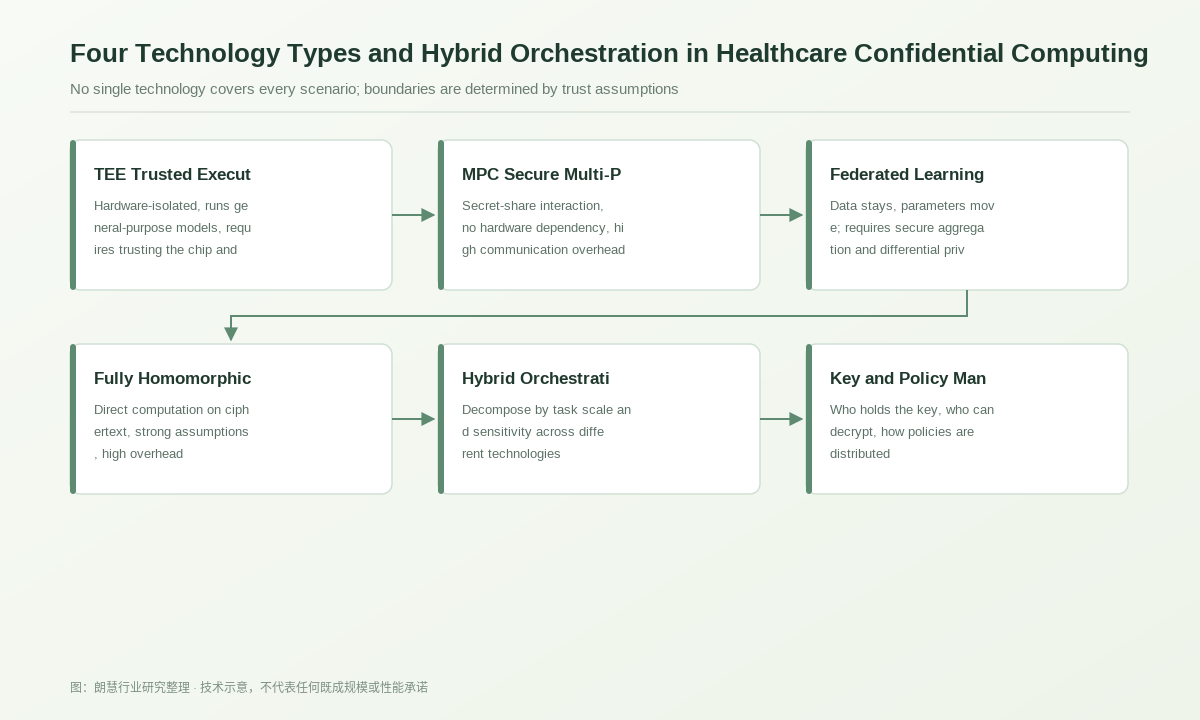
2. Four Types of Technology, Each Covering Part of the Job: TEE, MPC, Federated Learning and Homomorphic Encryption
TEE carves out an isolated execution environment inside the processor. Once data enters, it is invisible to the operating system, the virtualization layer and administrators; the integrity of code and data can be verified through remote attestation. Its advantages are relatively low modification cost and the ability to run general-purpose models on existing frameworks. The boundary is that you must trust the chip and firmware vendors, trust the remote attestation service, and contend with side-channel and supply-chain attacks.
MPC splits data into secret shares distributed among multiple parties, who interact to complete a computation without seeing each other's plaintext. It does not depend on special hardware; its security rests on cryptographic assumptions and the non-collusion of participants. The cost is a high number of communication rounds and significant overhead converting between arithmetic and Boolean circuits. It is well suited to small- and medium-scale statistics, set intersection and scorecard inference, but not to directly underpinning large-scale deep-network training.
Federated learning takes a different path: data stays put, model parameters move. It solves the problem of data not leaving the domain, but gradients and parameters themselves carry information—public research already includes methods for reconstructing training samples from gradients—so secure aggregation, differential privacy or gradient clipping is usually layered on top. The main engineering headaches are client heterogeneity, disconnections and communication scheduling.
Fully homomorphic encryption allows computation directly on ciphertext. Its security assumptions do not depend on hardware, and it does not require participants to be online in real time. The cost is overhead several orders of magnitude above plaintext, and ciphertext expansion further increases memory and bandwidth pressure. In practice, hybrid orchestration is more common: TEE carries training hot spots, MPC handles small-scale cross-institution statistics, federated learning performs joint modeling, and homomorphic encryption is applied to inference or small models.
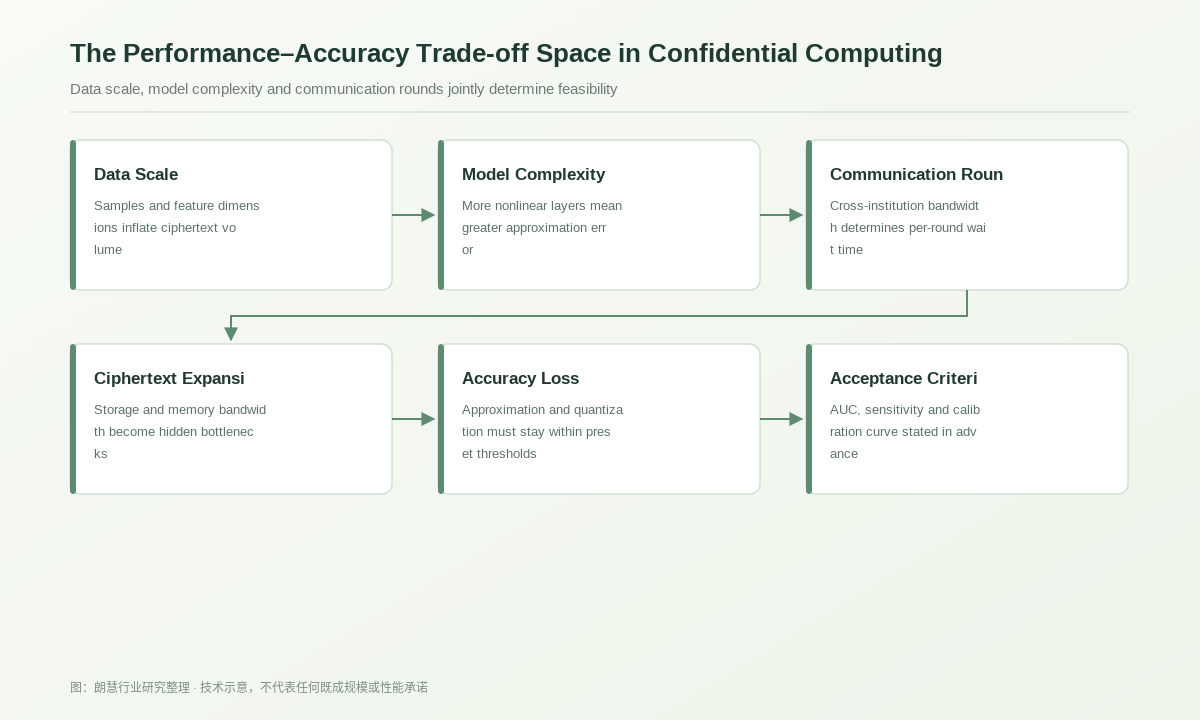
3. The Performance Ledger: Counting Encryption, Communication and Iterations Together
Training is not a single inference. Gradient descent runs for many rounds, and each round involves encryption, transmission, aggregation and decryption. In federated learning, communication volume grows with parameter count, and bandwidth on cross-institution dedicated lines is often the real bottleneck. Judging feasibility from the latency of a single-inference demo will usually lead you to the wrong conclusion.
Homomorphic encryption overhead needs to be estimated by orders of magnitude. Public research shows that operations on ciphertext are several orders of magnitude slower than in plaintext, while ciphertext size balloons several-fold, making memory and bandwidth the first limiting factors before compute becomes one. Activation functions and normalization layers in deep networks require polynomial approximations; the deeper the stack, the more apparent the accumulated approximation error—and this cost often does not appear in performance tables.
TEE overhead comes mainly from context switching, remote attestation and memory encryption. It typically produces a measurable performance decline, but it does not alter the algorithmic structure and does not require rewriting the model. The real constraint is the capacity and I/O efficiency of isolated memory: once the model or batch gets large, swapping in and out drags down overall performance.
A practical approach is to build a plaintext baseline first: with the same data and the same code, how long does a full run take, how many rounds, and what is peak memory? Then multiply by the overhead factor of the relevant technology to judge whether it fits within the project's time window. Without a plaintext baseline, you cannot prove during acceptance testing that you are only slightly slower.
4. The Accuracy Ledger: Where Bias Comes From and How to Validate It
Accuracy drift typically originates from three sources: first, approximate computation—nonlinear layers in homomorphic encryption must be approximated with polynomials; second, numerical formats—lower-precision or fixed-point representations adopted for speed; and third, noise injection—perturbation added under differential privacy to guarantee indistinguishability. When these three compound, model behavior can differ visibly from the plaintext version.
Validation is not complicated: fix the data split and random seed, run once in plaintext and once in confidential mode, then compare AUC, sensitivity and specificity—and also examine the calibration curve. Comparing ranking ability alone is not enough. When risk stratification feeds into clinical decisions, drift in probability calibration is more dangerous than a decline in ranking, because it directly shifts intervention thresholds.
Thresholds should be set in advance. What range of difference is acceptable should be confirmed jointly by clinical and statistical staff and written into the protocol, not explained away after results arrive. The common practice is to define an allowable deviation for the primary metric and check key subgroups separately, so the overall standard is not met while failing for a small population.
Record-keeping matters just as much: the confidential-mode version number, approximation parameters, random seed and aggregation rounds must all be archived. Otherwise, six months later you cannot reproduce the same result, and during review you cannot explain whether the difference came from the algorithm or the environment. Such disputes erode trust badly in cross-institution projects.
5. Trust Models: Who Are You Actually Trusting?
TEE's root of trust is the hardware and firmware. You must believe the chip vendor has not left a backdoor, that firmware updates have not been tampered with, and that the measurement values returned by the remote attestation service are genuine and valid. Side-channel attacks are nothing new in academia or engineering; whether mitigations are adequate depends on implementation quality, not marketing claims.
MPC's root of trust lies in cryptographic assumptions and protocol implementation. It does not require you to trust hardware, but it does require participants to follow the protocol and not collude—or that the number of colluding parties stays below a threshold. Vulnerabilities in protocol implementation and the quality of random-number generation are real risk points that are difficult for users to verify on their own.
Federated learning typically also requires trust in the aggregator. The aggregation server can see each party's gradients or parameters; without secure aggregation, it is itself the primary information convergence point. Even with secure aggregation, the granularity of published aggregation results and the number of queries can still leak information, requiring output restrictions as well.
Homomorphic encryption's root of trust lies in parameter selection and key management. Theoretically it does not depend on hardware or participant honesty, but once keys are compromised, all protection fails. Every solution must answer four questions: who holds the key, who can decrypt, who performs audits, and what basis governs when disputes arise. If you cannot answer these, it does not count as a deployable solution.
6. Scope of Applicability: Which Tasks Justify Confidential Computing
The first category is cross-institution joint training of small and medium models: samples are scattered across several hospitals, no one wants to hand over raw data, but everyone needs a larger sample size. The second is outsourced training by an external team: the hospital provides the data and the partner provides the code, and neither side wants the other to see its assets. The third is multi-center external validation: only metrics need to be output, with no need to exchange samples.
The fourth is subject screening: enrollment criteria are written as rules or an agent and run against medical records in a confidential environment, outputting only a candidate list that meets the criteria. The fifth is third-party statistical analysis: pharmaceutical companies or research institutions need to complete modeling and statistics without seeing raw test data—this is particularly common in cross-border collaboration.
The decision criteria can be compressed into three questions: Is the data sensitive enough that it cannot leave the domain? Can the task be structured so data and code are separated? Do the performance and accuracy losses fall within a clinically acceptable range? Only when all three hold is the complexity introduced by confidential computing worth taking on.
The recommended order of progression runs from easy to hard: start with inference and validation—these are one-off tasks with verifiable results and low cost of failure; then move to joint training, where the complexity of multi-round communication and parameter tuning is an order of magnitude higher; only then consider fine-tuning large models. Starting directly from the hardest end in reverse will leave most projects stuck at the proof-of-concept stage.
7. Inapplicable and High-Risk Scenarios
Ultra-large-scale pre-training is not suitable for confidential environments. Once communication and compute overheads compound, training cycles stretch to unacceptable lengths—unless the data already resides within the same isolated domain, the gains from encryption do not outweigh the cost.
Strongly real-time clinical decision-making is also a poor fit. Encrypted inference latency, queueing and batching strategies are hard to meet bedside response requirements; such needs are better served by on-premise local deployment with access control than by cross-institution confidential computing.
Tasks requiring manual item-by-item review are equally constrained. In a confidential environment, humans cannot see the data, so labeling, arbitration and discussion of edge cases cannot take place. A more realistic approach is a hybrid workflow: labeling and quality control are completed in the plaintext environment, training and validation in the ciphertext environment, with a controlled interface linking the two stages.
Finally, technical and compliance matters must be kept distinct. Confidential computing addresses invisibility, not whether you have the right to use the data. Whether the data source is lawful, whether the use falls within the authorized scope, and whether ethics approval covers it—these must still be completed separately. Treating the technology as proof of compliance is one of the most dangerous misconceptions in projects of this kind.
8. Engineering Implementation Checklist
Prerequisites should be stated up front: where the data's out-of-domain boundary lies, which parties are involved, who holds the keys, who performs audits, and what process governs disputes. Without consensus on these five items, every subsequent technical choice is hollow, because accountability cannot be assigned.
On the technical side, check: whether remote attestation can be independently verified, whether firmware and image versions are traceable, whether the permitted executable code is on an allowlist, whether output results are rate-limited or noised, and whether anomalous queries are detected and blocked. If any one of these is missing, the attack surface shifts from the data itself to the interface.
On the acceptance side, do three things: a plaintext-versus-confidential comparative experiment, a recorded performance baseline, and a failure rollback plan. The comparison proves accuracy is acceptable, the baseline proves timing is predictable, and the rollback plan ensures business continuity if something goes wrong. Without all three, the project can only stop at a demo.
On the operations side, which is often underestimated: key rotation, personnel changes and cross-institution agreement adjustments all require re-evaluation. The security boundary of confidential computing moves as participants change; passing one assessment does not mean it remains valid long-term. Include it in your annual security review.
- Boundaries: scope of data leaving the domain, participant roles, key holders, audit party
- Attestation: independently verifiable remote attestation, traceable firmware and image versions
- Controls: code allowlist, output rate limiting and noise, anomalous query detection
- Acceptance: plaintext-versus-confidential comparison, performance baseline, failure rollback plan
- Operations: key rotation, personnel changes, re-evaluation after agreement adjustments
9. Relationship with Trusted Data Spaces: Build a Node, Not a Replacement
Trusted data spaces solve the governance framework: identity, catalogs, authorization, audits and dispute resolution. Confidential computing solves computation at the execution layer. The two exist at different levels—they are not competing products in the same category. Calling confidential computing a replacement for the space is usually a simplification; on implementation, you will discover the governance piece is missing.
A more practical approach is to plug the confidential node into the space as a connector. The space handles registering data resources, issuing authorizations and logging tasks; the node handles executing computation in an isolated or ciphertext environment and returning results and logs. This avoids duplicated infrastructure while keeping governance responsibility from being pushed onto the technical component.
Interfaces are the make-or-break factor: how tasks are submitted, how results are returned, how logs are uploaded, how authorizations are validated. Without standards for these interfaces, the node is an island, and the requester still has to integrate with each one separately—once scale grows, headcount cannot keep up.
Another principle worth upholding: do not treat all data at the highest sensitivity tier. After classification, only genuinely sensitive portions travel in confidential mode; the rest can use aggregation or restricted access. Only then is overall cost manageable, and the team has the bandwidth to do the high-sensitivity scenarios properly.
10. Common Misconceptions and Failure Signals
Misconception one: using homomorphic encryption equals being secure. Cryptography provides strong assumptions, but implementation vulnerabilities, poor parameter choices and loose key management will all break the protection. Misconception two: inferring training feasibility from single-inference latency, while ignoring multi-round communication and aggregation overhead.
Misconception three: believing a confidential environment can substitute for ethics approval and authorization. Technology only changes the visibility of data, not the legality of its use. Misconception four: believing that outputting only results prevents leakage—when query counts are high enough and output granularity is fine enough, the results themselves can be reverse-engineered to individual information.
Failure signals are fairly consistent: no plaintext comparative experiment, no independently verifiable remote attestation, keys held unilaterally by the service provider, no frequency or count limits on output results, audit logs that cannot be exported, and participants unable to say who they are actually trusting. If you hit two or more, stop and fix the design first.
There is also an organizational signal: the project is driven solely by the technical team, with clinical and IT center personnel appearing only at acceptance. The boundary conditions of confidential computing mostly come from the business side; without participation from these two groups, a solution easily fails on real data.
11. A Forward-Looking Assessment for the Next 12 to 24 Months
First, TEE will become the default foundation. Confidential containers are gradually maturing, and confidential computing capabilities on the GPU side are being filled in. The bottleneck will shift from "can it run" to attestation and operations: how remote attestation reports gain acceptance by users, how firmware vulnerabilities are responded to, and how node failures trigger failover.
Second, homomorphic encryption will remain focused on inference and small models, with limited training-level applications. Hybrid architectures will become the mainstream framing—vendors will no longer emphasize a single technology but will decompose by task. This change benefits users, who can require vendors to explain which assumptions each segment relies on during evaluation.
Third, evaluation criteria will shift from performance metrics toward verifiable trust. Remote attestation reports, audit packages and key-ownership statements will gradually become fixed attachments in project acceptance. In healthcare, multi-center validation and subject screening are most likely to get working first, because their outputs are clear, their cycles short, and the cost of failure low.
Those who will benefit first are organizations that have made key governance and audit genuinely real, and external teams willing to run their code in the other party's environment. For teams preparing to launch a project, what you should be doing now is not selecting a technology—define the plaintext baseline, acceptance metrics and the key owner. These three things determine whether every subsequent discussion has a common language.
Langhui's Engineering Capabilities Along This Path
Langhui Technology has been working on AI training data since 2016. In healthcare, coverage spans CT, MR, PET, and mammography, ultrasound and other modalities, encompassing data collection protocol design, structured annotation, quality control and consistency reporting, along with delivery of data dictionaries and version records—providing a verifiable data foundation for confidential computing.
We do not provide a confidential computing platform, nor do we claim expertise in related cryptographic implementations. What we do is the segment before computation begins: field-definition alignment, de-identification rules, annotation and quality control, version management, and preparation of reproducible data splits for comparative experiments.
If your team is planning multi-center joint training or external validation and needs to first clarify the data-side definitions and quality controls, send us the disease areas, data sources and task formats, and we will provide actionable recommendations.
FAQ
Are confidential computing and federated learning the same thing?
No. Federated learning keeps data within the domain and exchanges only model parameters; it does not itself guarantee that parameters do not leak information, and typically requires secure aggregation or differential privacy layered on top. Confidential computing is a broader concept encompassing routes such as TEE, MPC and homomorphic encryption, and federated learning is often used in combination with them.
There are plenty of news stories about trusted execution environments being compromised—can they still be used?
Yes, but you need to be clear about the prerequisites: whether remote attestation is independently verifiable, whether firmware and image versions are traceable, and whether side-channel mitigations are in place. TEE's security boundary depends on implementation quality and operations; it is suitable as one layer of protection rather than the only one. For highly sensitive scenarios, it is recommended to combine it with other technologies.
Can fully homomorphic encryption train large models today?
In public research and engineering practice, homomorphic encryption is used more for inference and small models. Training-level applications are constrained by overhead and approximation error in nonlinear layers. Large-scale training generally uses a hybrid architecture: hot spots placed in isolated environments, cross-institution statistics handled with MPC, and homomorphic encryption taking on inference or result aggregation.
Can confidential computing replace ethics approval and data authorization?
No. What it changes is the visibility of data during computation, not the legality of its use. Data sources, scope of use, ethics approval, and informed consent or exemption basis still need to be completed separately as required. Technology does the technical work and compliance does the compliance work—the two cannot substitute for each other.
If only results are output, does that mean the raw data cannot leak?
Not necessarily. When query counts are high enough and output granularity is fine enough, the results themselves can be reverse-engineered to individual information; such attacks are discussed in public literature. Engineering-wise, you need rate limiting, noise addition and minimum-granularity control on outputs, along with query logging, so the results interface does not become a new leakage channel.
- Kairouz et al. Advances and Open Problems in Federated Learning https://arxiv.org/abs/1912.04977
- Homomorphic Encryption Standardization (HomomorphicEncryption.org) https://homomorphicencryption.org/standard/
- NIST IR 8214C, Multi-Party Threshold Cryptography https://csrc.nist.gov/pubs/ir/8214/c/final
- Confidential Computing Consortium https://confidentialcomputing.io/
- ISO/IEC 27550:2019 Privacy engineering for system life cycle processes https://www.iso.org/standard/72024.html
- Intel Software Guard Extensions (SGX) Overview https://www.intel.com/content/www/us/en/developer/tools/software-guard-extensions/overview.html