
HEPATITIS B / HOSPITAL WORKFLOW
Smart In-Hospital Management of Hepatitis B: Designing the Path from Positive Detection to Liver Cancer Surveillance
The weakness in hepatitis B prevention and control is not the volume of testing, but the lack of follow-through after detection. Starting with the in-hospital HBsAg-positive trigger point, this article breaks down duplicate-checking, supplemental testing, treatment assessment, liver cancer surveillance scheduling, follow-up adherence, and privacy boundaries; discusses information-system pathways for specialized disease centers and hospitals; presents four sets of evaluation metrics and an implementation sequence; and assesses the conditions under which in-hospital management will shift from project-based work to routine processes over the next 12 to 24 months.
Medical institutions nationwide conduct large volumes of hepatitis B testing before various invasive procedures each year, and positive results are not uncommon. The problem begins after the report is issued. Patients often come to the hospital for reasons unrelated to liver disease, receive the results, and leave. SMS notifications can only inform; they cannot answer questions such as how serious the condition is, why specialist care is needed, or where to go. A succinct observation in public academic discussions is that every positive finding should become the starting point for standardized management. Putting this into practice does not require one more screening test; it requires connecting the four stages of detection, assessment, surveillance, and follow-up. This article explains how that pathway can be designed.
I. Breakpoints in in-hospital management: detection, referral and follow-up operating in silos
The epidemiological characteristics of hepatitis B determine the importance of in-hospital management. A national seroepidemiological survey found an HBsAg positivity rate of about 5.85% across the population, corresponding to tens of millions of infected people. Among children under 5, the positivity rate has fallen to about 0.3%, meaning little new incidence but a large existing burden. A World Health Organization report also notes that, amid declining deaths from most major infectious diseases, the absolute number of hepatitis B-related deaths continues to rise. Existing patients who do not receive standardized treatment and surveillance will not have better outcomes simply because new infections decline.
In-hospital testing volume is high, but the purpose is usually not liver disease. Positive results generated by preoperative testing, pre-transfusion testing, endoscopy, and prenatal or postnatal care are received while patients are focused on their primary condition. Once the report is issued, clinical activity ends, and no one explains what the result means. Public discussions describe the scale as more than 100 million invasive-procedure-related tests each year, of which only a limited proportion enter specialty management.
SMS notification is the current common practice and can indeed improve attendance to some degree, but it cannot solve three problems: patients do not know how serious their condition is, do not know why they need specialist care, and do not know where to go. More importantly, the notification is one-way. Patients cannot raise questions, and doctors have no opportunity to explain things in person. Once the message is sent, the chain is broken.
The starting point for process design is therefore not “how do we test more,” but “who takes over after detection.” Taking over requires three things: a clear trigger rule, a contact point that can answer questions, and records that can track outcomes. If any one is missing, management reverts to a one-time notification.
II. From HBsAg positivity to treatment assessment: trigger rules and duplicate-checking
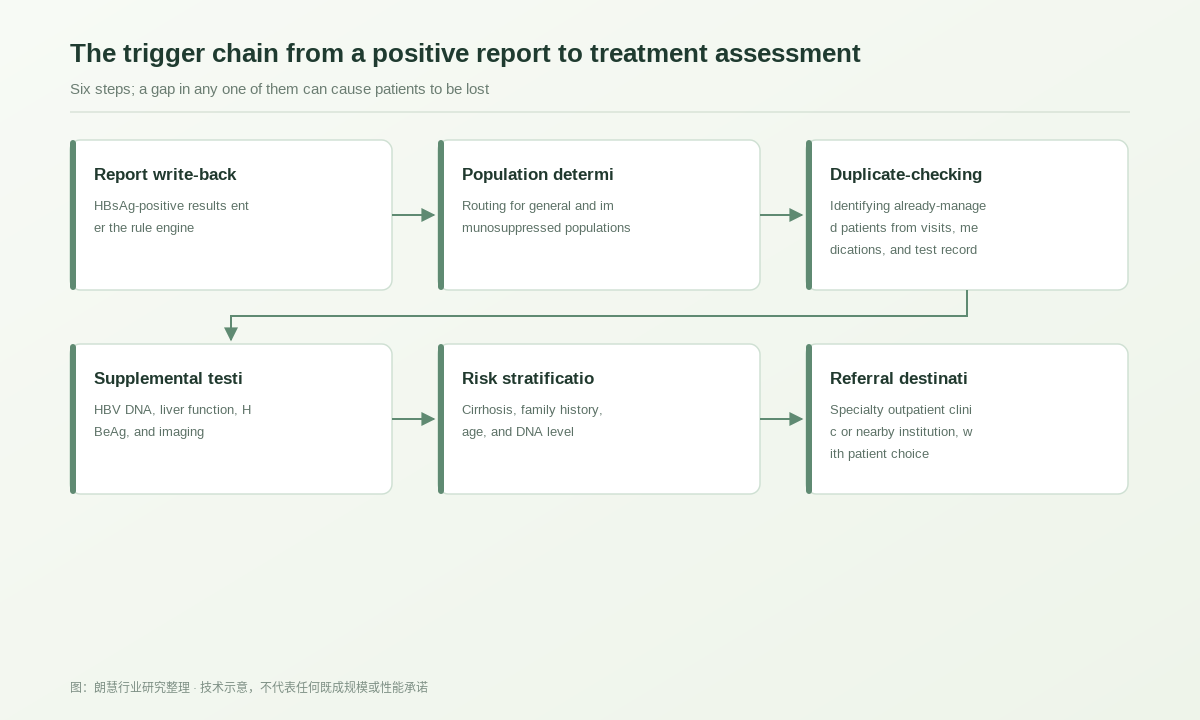
Trigger rules must be hard-coded in the system rather than monitored manually. For the general population, an HBsAg-positive result during outpatient or inpatient care triggers the subsequent process. For people preparing to receive chemotherapy, radiotherapy, or immunosuppressive treatment, anti-HBc positivity should also trigger the process because these patients are at risk of reactivation. The trigger conditions for the two groups are different. Mixing them creates large numbers of ineffective alerts and may miss genuinely high-risk patients.
Duplicate-checking is a critical step in determining the patient experience. Patients already receiving standardized follow-up in internal medicine or hepatology, currently taking medication, and recently assessed should not receive further reminders. The determination cannot rely only on the diagnosis field, because many patients do not have “chronic hepatitis B” written there. It must combine the treating department, antiviral prescriptions, HBV DNA test records, and visit frequency. If duplicate-checking is poor, reminders become harassment, and patients will quickly block them.
The first step after triggering is to complete the information needed for assessment: quantitative HBV DNA, liver function, HBeAg, blood counts, and liver imaging, with fibrosis assessment when necessary. Without these results, clinicians cannot determine whether treatment criteria are met. A consensus approach raised in public discussions is to provide guidance for the next test and specialist visit directly in the positive-result alert, rather than simply telling the patient to seek specialty care.
Rules must be tied to specific system events: writing back laboratory reports, running rule-engine checks, assigning tasks to responsible departments, and escalating reminders when handling is overdue. The entire chain needs accountable owners and logs. A process written only in policy documents will inevitably go off course within three months, because no one knows who should do what and when.
III. Treatment assessment and liver cancer surveillance: scheduling logic for AFP plus ultrasound or MRI
The core of treatment assessment is turning the question of whether antiviral treatment is needed into an executable decision. Factors considered in current guidelines include HBV DNA level, elevated ALT, presence of cirrhosis, age, and family history of liver cancer. As treatment expands, the decision threshold is lowering, but this does not mean everyone should start medication immediately. Priorities still need to be distinguished: cirrhosis and high DNA levels come first, while younger patients with low DNA and normal liver function can be observed regularly.
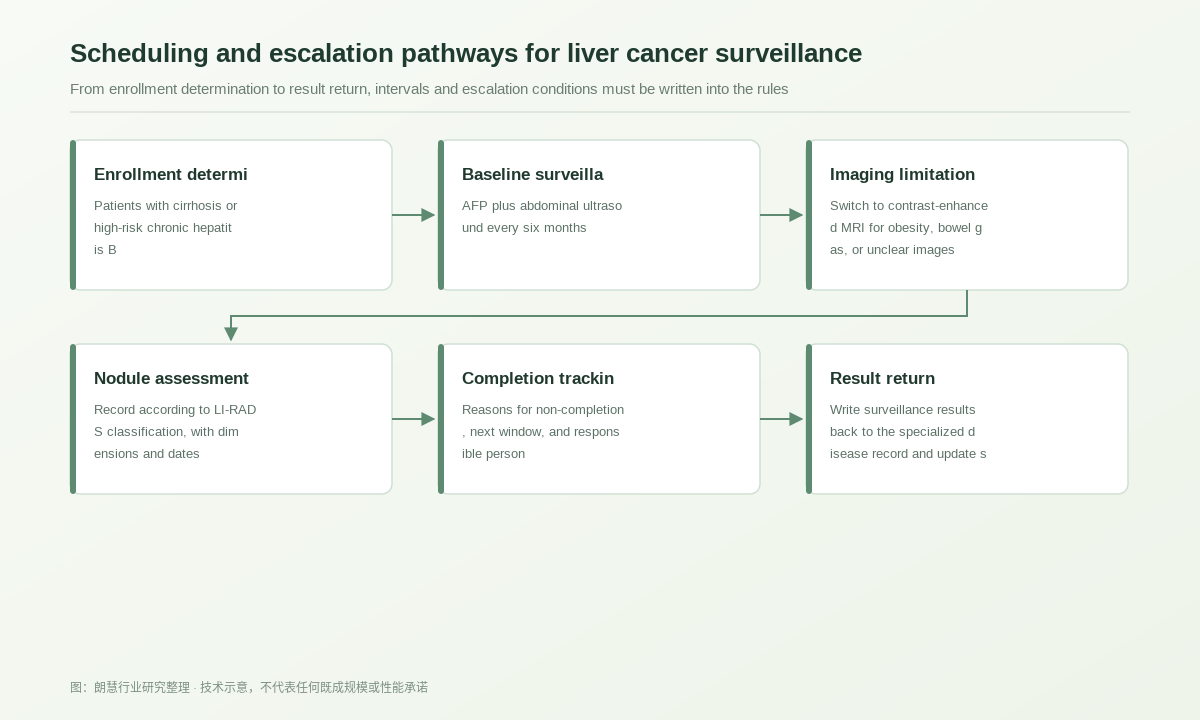
Liver cancer surveillance is a separate scheduling pathway. For patients with cirrhosis and some high-risk patients with chronic hepatitis B, the standard practice is AFP plus abdominal ultrasound every six months. Ultrasound is strongly operator-dependent, and image quality is often inadequate in patients with obesity, excessive bowel gas, or narrow intercostal spaces. In these cases, the pathway should escalate to contrast-enhanced CT or MRI rather than waiting for ultrasound to “see a problem.” Surveillance intervals and escalation conditions must be written into the rules, not left to doctors’ moment-to-moment judgment.
Imaging results must be structured. Terms in reports such as “nodule,” “abnormal enhancement,” and “further examination required” need to be mapped to categories, dimensions, and dates. Nodules in the context of cirrhosis should be recorded according to LI-RADS classification. Only after structuring can the system determine what the patient should do next, how long the interval should be, and whether the next step has been completed. Conclusions left in free text cannot enter the scheduling workflow.
To measure surveillance quality, it is not enough to see whether an order was placed. The meaningful metric is “completion within the required window”: how many people who should receive the examination actually complete it within the prescribed period. From booking and attendance after the order to report return and result confirmation, people can be lost at every link. Breaking completion rates down by department and risk level reveals where the problem lies.
IV. Follow-up adherence: tiered recall and the boundary of not disturbing patients
Recall should be tiered rather than sent as a mass message. Available stratification variables include risk level, treatment status, prior visit frequency, time since the last visit, and presence of cirrhosis or nodules. After stratification, different groups should receive different channels and frequencies: high-risk overdue patients receive phone or human follow-up, while low-risk patients receive SMS or mini-program reminders. Mass messaging over-disturbs frequent users while infrequent users still do not come.
An observation shared publicly deserves attention: recall rates are markedly lower among patients with milder disease who have not yet started treatment than among those already in treatment. The reason is not complicated: patients have no symptoms, do not believe they need treatment, and may even fear overtreatment. Follow-up reminders have almost no effect on this group. They need an explanation of the natural history of the disease, the purpose of surveillance, and answers to specific concerns. Patient education is not an add-on here; it is a prerequisite for successful recall.
Push content must match the patient’s status. Those in treatment care about medication adherence and follow-up results; those with nodules care about imaging follow-up timing; those with cirrhosis care about warning signs of complications; and those not yet treated care about when treatment should begin. Generic educational articles have very low open rates. Short, status-specific content is more useful. The format can vary—graphics and text, short videos, or questionnaires all work—as long as it addresses the patient’s current question.
The principle of not disturbing patients must be built into the system. Patients who arrive according to plan should not receive additional pushes; reminders should trigger only after they are overdue. Pushes need frequency limits, an unsubscribe option, and the ability to transfer to a human. Public discussions repeatedly emphasize that the goal is uninterrupted care, not keeping patients within a single institution. If this boundary is unclear, the process is easily interpreted as marketing and trust is damaged instead.
V. Patient profiling and pre-visit data collection: what to collect and what not to collect
The purpose of pre-visit collection is to give doctors key information before the patient sits down. Medical history, family history of liver cancer, prior tests and medications, alcohol use, and comorbid metabolic conditions such as obesity, diabetes, and dyslipidemia directly affect treatment decisions. The collection form should be as short as possible and completable in a few minutes; completion rates for long forms drop sharply.
Some information should not be collected. Fields such as income, occupation, and family financial situation have little bearing on clinical decisions and can easily make patients wonder whether someone is trying to sell them something. A practical adjustment noted in public discussions is to replace “financial situation” with “insurance type” and “treatment willingness.” This meets the need to assess access without causing offense. The collection boundary is itself part of trust design.
Collection must allow skipping, editing, and withdrawal. If a patient declines authorization, the process should return to a manual service point rather than stalling. Collected information should sync to the doctor’s workstation and form a structured summary, allowing doctors to see key and missing items at a glance and ask targeted questions during the visit. If the summary merely stacks the original questionnaire on screen, doctors will not use it and the collection effort is wasted.
A profile is not a diagnosis. The system may flag that a patient has cirrhosis and recommend assessment and surveillance, but it must not generate treatment plans, replace clinical judgment, or promise outcomes to patients. This boundary should appear in product documentation and training materials; otherwise, frontline staff will naturally treat the tool as the decision-maker.
VI. Privacy and compliance: general notices, minimum necessary data, and complete audit trails
Outreach must protect privacy. The body of an SMS should not say “hepatitis B positive.” It should say only that one test result is abnormal, further assessment is recommended, and the patient can scan a code to view details. The reason is that the phone number may not belong to the patient; it could belong to a family member, colleague, or intermediary. Patients should see specific results only after identity verification by scanning the code. This design sacrifices a little click-through rate in exchange for a significant reduction in leakage risk.
Data should be limited to the minimum necessary. The process only needs information for determining whether management criteria are met; it does not need to move an entire medical record into a new system. Interfaces should be authorized field by field and used only for the task. Third-party tools should provide capabilities without accessing raw data. All queries, exports, and modifications should be logged, and access to the logs themselves must be controlled. These are compliance baselines, not optional extras.
Recommended care resources must remain neutral. They should be ordered by proximity, expertise, and patient preference, with no commercial weighting. This point is emphasized in public discussions because once ordering becomes linked to payment, the nature of the entire project changes and later explanations will struggle to restore credibility. If cross-institution referral is involved, the process should connect to an official appointment platform or a health-alliance referral channel, with a traceable pathway.
External wording matters as well. Internal phrases such as “prevent leakage” or “retain patients” will be interpreted as marketing if they become public. A more accurate formulation is “ensure continuity of care.” Text, posters, and SMS templates should undergo compliance review, avoiding promises of efficacy, anxiety-inducing language, and suggestions of exclusive resources. These details may seem minor, but they are prerequisites for the project’s long-term existence.
VII. Cross-department coordination: management group, laboratory, and information department
In-hospital management is inherently cross-departmental. The hepatology or infectious disease department sets clinical rules; the laboratory defines result standards and positive-alert methods; the information department builds interfaces and logs; disease control and infection control handle reporting and infection-related steps; and medical administration authorizes processes and resolves disputes. Without a standing management group, work stops at discussions over who should lead the initiative.
Division of labor must be specific to actions. The laboratory should confirm which tests and thresholds trigger alerts and how report templates should be changed. The information department should confirm which system provides data, how often it synchronizes, and how exceptions generate alerts. Clinical teams should confirm alert wording and which patients require human follow-up. Every item needs a responsible person and a completion date; otherwise, cross-department coordination will be delayed indefinitely.
Performance management is essential for keeping a process alive. If assessment conversion and surveillance completion rates are not included in departmental evaluations, clinical teams have little incentive to handle tasks assigned by the system, and the process gradually degrades into “the system runs, but no one acts.” A practical approach is to create a visible dashboard first so departments can see their completion status, then gradually include the metrics in evaluations to avoid immediate resistance.
Resistance usually comes from three sources: tight schedules in the information department, the workload of interface changes, and departments’ concerns about added burden. The response is to prove one narrow path first—for example, only a positive-alert plus supplemental-testing reminder. Produce demonstrable results in two or three months, then request broader system changes. Asking for a hospital-wide system rebuild from the outset is likely to stall at project approval.
VIII. Information-system pathways for specialized disease centers and hospitals
The information system for a specialized disease center should not be a pile of attached reminder tools. A more reasonable approach is to embed rules into existing workflows: prompt supplemental testing when an order is made, automatically stratify reports on return, recommend suitable outpatient services by risk at registration, and automatically assign follow-up tasks to case-management roles. Tools that add no extra data entry are more likely to be used over the long term. Public discussions summarize this approach as “native integration,” meaning that healthcare staff are not given another layer of systems.
The foundation must be unified. Patient master indexes, laboratory and imaging tests, medications, and follow-up records should sit in the same data model to prevent one patient from having three separate files across three systems. Specialized disease centers often handle outpatient care, inpatient care, interventional procedures, and follow-up simultaneously. If each step builds its own tables, the data will never align. A unified foundation does not mean centrally storing all data; it means ensuring that key identifiers and timelines are consistent.
Automation increases capacity for human work. One builder of specialized disease hospitals cited a scale of improvement in which task-driven workflows and automatic record-keeping increased the number of patients a single case manager could handle from dozens to several hundred. This improvement comes not from greater diligence, but from systems that automatically create to-dos, archive communication records, and calculate the next follow-up date. People handle only exceptions that require judgment.
Boundaries must be written into policy. Intelligent tools do not replace diagnosis, issue prescriptions, or promise outcomes. Any step involving treatment decisions must be confirmed by a doctor; the system supplies information and reminders only. If specialized hospitals make these boundaries auditable rules rather than verbal agreements, they will not need to explain them repeatedly when adding new disease areas.
IX. Evaluation metrics: four stages from detection to outcomes
The first stage is detection and identification. Metrics include coverage of positive-result identification, duplicate-checking accuracy, and average time to outreach. This stage measures whether the system can find the people who need to be found while excluding those who should not be disturbed. Low identification coverage indicates gaps in the data-selection standard; low duplicate-checking accuracy indicates excessive disturbance, and the patient experience will deteriorate quickly.
The second stage is assessment and referral. The core metric is assessment conversion: how many people in the triggered group completed key tests such as HBV DNA and saw a specialist. Time to visit and the distribution of reasons for non-attendance come next. This stage most clearly reflects the quality of process design, because patients have moved from “receiving a reminder” to “whether they are willing to come,” involving trust, access, and whether explanations were sufficient.
The third stage is treatment and surveillance. Treatment initiation rate, adherence to prescribed medication, completion within the six-month surveillance window, and the proportion of liver cancers detected at an early stage must be viewed together. Looking only at treatment initiation ignores surveillance, while looking only at surveillance completion ignores whether treatment is standardized. The proportion of early-stage detections is affected by population composition and is better suited to trend observation than single-point evaluation.
The fourth stage is outcomes and retention. Loss to follow-up, incidence of cirrhosis complications, and liver cancer stage distribution are long-term metrics that require integration with the specialized disease database. Not all metrics need to be launched at once, but definitions and data sources must be defined in advance; otherwise, the lack of usable data will only become apparent at year-end. The four stages should be read together: high identification coverage with low conversion indicates problems in communication and access; high conversion with low surveillance completion indicates problems in scheduling and tracking. Any single number alone can easily lead to the wrong conclusion.
| Stage | Metric | Data source |
|---|---|---|
| Detection and identification | Positive-result identification coverage, duplicate-checking accuracy | Laboratory system, rule-engine logs |
| Assessment and referral | Assessment conversion rate, time to visit | Outpatient registration, laboratory records |
| Treatment and surveillance | Treatment initiation rate, completion within the surveillance window | Prescriptions, imaging and laboratory records |
| Outcomes and retention | Loss to follow-up, liver cancer stage distribution | Specialized disease database, follow-up register |
X. Common pitfalls and a pragmatic implementation sequence
The most common pitfall is “doing SMS only.” SMS is inexpensive and quick to launch, so it is easily treated as the entire project. Without interaction, duplicate-checking, or subsequent tracking, its impact soon plateaus. The second pitfall is failing to check duplicates, which puts patients already in standardized treatment into reminder campaigns and triggers complaints. The third is placing surveillance orders without tracking completion: reports say “follow-up recommended,” but if patients do not return, no one knows. The fourth is failing to reconcile data across hospitals, leaving patients with separate records in two hospitals and fragmented follow-up history.
A pragmatic sequence is: first unify standards and duplicate-checking, then implement outreach and pre-visit collection, next build surveillance scheduling and completion tracking, and only afterward apply risk-model stratification. The order cannot be reversed. Model stratification looks attractive, but if underlying fields are incomplete and follow-up is not tracked, no one will act on the model’s stratified output, and the result is effectively a demonstration.
Pilots should be small, with frequent reviews. Select one site, one department, and one disease area, run it for eight to twelve weeks, and review reasons for missed visits, duplicate-checking errors, and patient complaints each week. Fixing these issues before expanding is far less costly than attempting widespread deployment and then firefighting. The pilot should also record the workload of manual intervention, providing the basis for later staffing decisions.
When selecting a tool, evaluate three things: whether it can connect to existing laboratory and outpatient systems, where data are stored, and whether the hospital can modify the rules itself. A polished demo does not prove that a solution can be implemented. Interface capability and data ownership determine whether a project can run long-term. Configurable rules are especially important because clinical standards change as guidelines are updated. If every change requires a vendor, the process will quickly become rigid.
XI. A forward-looking assessment for the next 12 to 24 months
First, in-hospital hepatitis B management will move from “projects” to “routine processes.” As national prevention and control initiatives advance, there are clear targets for the treatment rate of newly diagnosed patients, and hospitals need verifiable process records rather than one-off screening activities. Over the next two years, more hospitals will bring positive-result management into infection-control or chronic-disease management systems, and evaluation metrics will shift from testing volume to assessment conversion and surveillance completion.
Second, regional coordination will strengthen. A single hospital can see only its own records and cannot learn about testing and treatment received elsewhere. Once regional laboratory-result recognition, disease-control registration, and hospital follow-up are connected, recall can move from a single hospital to a regional level. Privacy-preserving computation and distributed querying will be used more widely; raw data will not leave the institution, and only matching results and aggregate statistics will be exchanged.
Third, the quality of liver cancer surveillance will be assessed separately. Coverage of structured reports, including LI-RADS classification, will increase, and completion within the surveillance window will become part of quality evaluation for specialized disease centers. Escalation pathways when ultrasound image quality is inadequate will become clearer, and the use of contrast-enhanced MRI in evaluating cirrhotic nodules may rise. This will, in turn, require imaging data to be structured and searchable.
Hospitals that benefit first will be those with a unified patient master index, stable laboratory interfaces, and dedicated follow-up responsibility. Their starting point is not buying a system but straightening out existing processes, which allows faster implementation and higher data usability. By contrast, organizations that place their hopes on purchasing an “intelligent agent” will often get stuck on interfaces and standards. The risk is equally clear: once management is turned into marketing, regulatory and public backlash will be greater than the project’s own impact. Boundaries written into policy are more important than boundaries written into a presentation.
Langhui's Engineering Capabilities Along This Path
Langhui has been producing AI training data since 2016. In medical imaging, our coverage includes the design of acquisition protocols, structured annotation, quality control, and consistency reporting for CT, MR, PET, mammography, ultrasound, and other modalities. In specialized disease data projects, we build stratified databases by examination type, lesion features, measurement axes, and follow-up conclusions, delivering data dictionaries, annotation manuals, and version records so that every sample can be reviewed.
In the scenario of in-hospital hepatitis B management, we can take on data and annotation work: designing structured templates for laboratory, imaging, and follow-up records; annotating liver nodules and related imaging features; performing dual-reader consistency assessments; and producing field-completeness rates, missing-report lists, and quality-control records. We work with hospitals to structure follow-up data. Trigger rules, diagnostic conclusions, treatment decisions, and patient communication remain the responsibility of hospitals and clinical teams; we do not replace them.
If your team is planning an in-hospital HBsAg-positive management process, cleaning historical follow-up data, or building the data foundation for a specialized disease center, send us your existing system interfaces, the disease areas to be included, and the field list. We will provide executable collection specifications and quality-control recommendations. We do not claim HIPAA certification, and endoscopy, whole-slide pathology, and clinical natural-language processing are not part of our platform capabilities.
FAQ
Our hospital only has an SMS platform. Can it manage HBsAg-positive patients?
You can start, but you need to understand the boundaries. SMS is suitable for general notices and providing a scanning entry point; it is not suitable for carrying specific results and explanations. At a minimum, three things must be added: duplicate-checking rules, identity verification and data collection after a code is scanned, and follow-up records for patients who do not attend. Without subsequent handling, SMS alone will produce only limited improvement in attendance and can easily worsen the patient experience.
If HBsAg is positive but HBV DNA is negative, should the patient still be included in management?
Yes. A negative DNA result does not mean follow-up is unnecessary, especially for patients with cirrhosis and those at high risk of liver cancer; regular surveillance is still required. Some patients are in an immune-controlled phase and need periodic DNA and liver-function tests to determine whether they enter an active phase. The decision to start antiviral treatment is made by a specialist according to guidelines. The management process is responsible for ensuring that follow-up is not missed.
Should liver cancer surveillance use ultrasound or MRI?
Routine surveillance mainly uses AFP plus abdominal ultrasound, usually every six months. If obesity, excessive bowel gas, or narrow intercostal spaces cause poor image quality, or if a nodule of unclear nature has already been found, the pathway should escalate to contrast-enhanced CT or MRI. Nodules in the context of cirrhosis should be recorded according to LI-RADS classification to support later comparison and scheduling.
What if a patient does not want to leave their information?
First ensure that the process can be withdrawn from. The collection form should retain only clinically necessary items, allow skipping and withdrawal, and return to a manual service point if authorization is refused. SMS messages and web pages should explain the purpose and retention scope of the data and avoid fields such as income or occupation that can easily cause misunderstanding. Without trust, even the best tools cannot gain adoption.
How do we determine whether an in-hospital management tool is compliant?
Evaluate four things: where data are stored, whether a third party can access raw data, whether all operations leave audit trails, and whether recommended care resources remain neutral. The tool should not replace diagnosis or prescribe treatment, should not promise outcomes, and should not perform commercial ranking. These boundaries must be included in policy documents beyond the contract and be subject to in-hospital audit.
- World Health Organization. Global hepatitis report 2024: action for access in low- and middle-income countries https://www.who.int/publications/i/item/9789240094498
- World Health Organization. Guidelines for the prevention, diagnosis, care and treatment of people with chronic hepatitis B infection, 2024 https://www.who.int/publications/i/item/9789240088903
- Terrault NA, et al. Update on prevention, diagnosis, and treatment of chronic hepatitis B: AASLD 2018 hepatitis B guidance. Hepatology, 2018 https://doi.org/10.1002/hep.29800
- American College of Radiology. Liver Imaging Reporting and Data System (LI-RADS) https://www.acr.org/Clinical-Resources/Clinical-Tools-and-Reference/Reporting-and-Data-Systems/LI-RADS
- European Association for the Study of the Liver. EASL Clinical Practice Guidelines: Management of hepatocellular carcinoma. Journal of Hepatology, 2018 https://doi.org/10.1016/j.jhep.2018.03.019
- HL7. FHIR Release 4 Specification https://hl7.org/fhir/R4/