
HEPATITIS B / SCREENING NETWORK & AI
Hepatitis B Prevention and Control: Screening Networks, Treatment Gaps, and the Boundaries of AI-Assisted Follow-Up
The bottleneck in hepatitis B prevention and control no longer lies with vaccines, but with the handoffs after screening. This article breaks down real-world constraints across four stages—screening, mother-to-child transmission prevention, treatment, and follow-up—discussing how communities and hospitals should divide responsibilities, why treatment rates remain persistently low, which evidence gaps real-world cohorts can fill, and where AI reasonably belongs in risk stratification and follow-up operations, including the conditions under which it fails. It closes with a 12- to 24-month outlook.
The weak link in hepatitis B prevention and control is not technology, but the handoffs between stages. Vaccination and mother-to-child transmission prevention are already mature, and antiviral drugs have long been accessible. Yet people are lost at every transition: from a positive screening result to diagnosis, from diagnosis to treatment, and from treatment to long-term follow-up. In recent years, screening networks have expanded into communities and databases have been built. The next question is whether these data can actually be used. This article breaks down real-world constraints across four stages, discusses where AI reasonably belongs in risk stratification and follow-up operations and when it fails, and offers a 12- to 24-month outlook.
I. Break Hepatitis B Prevention and Control into Four Stages to See the Problems Clearly
Hepatitis B prevention and control is often discussed as a single issue. At the execution level, it is actually four different tasks: screening to find people, vaccines and mother-to-child transmission prevention to stop spread, treatment to get people onto therapy, and follow-up to keep them engaged. The responsible actors differ across the four stages: screening relies on communities and disease control agencies, diagnosis on county-level and higher hospitals, medication on clinicians, and follow-up on primary public health teams. When these are discussed together, the most common result is that everyone is responsible for something, but no one owns the outcome all the way through.
Another benefit of separating the four stages is that each indicator can be tied to an accountable owner. For screening, look at coverage and positive-result follow-up rates; for prevention, timely first-dose coverage and full-series completion; for treatment, treatment initiation and adherence to standard care; and for follow-up, completion and loss-to-follow-up rates. Once the indicators are separated, it becomes clear where resources should go, and which stage is leaking people becomes visible.
Over the past decade or so, progress at individual points has been real. Newborn hepatitis B vaccination was included in the national immunization program, with the first dose required within 24 hours of birth. Antiviral drug prices have fallen and access has improved, allowing some patients to achieve clinical cure. These advances have sharply reduced new infections. But isolated gains do not automatically connect into a continuous pathway. Public research repeatedly shows that diagnosis and treatment rates for chronic hepatitis B in China remain low: many infected people do not know they are infected, and among those who do, some do not enter standard treatment.
There is a frequently overlooked distinction: screening coverage can be raised within months through administrative mobilization, but treatment rates and follow-up completion cannot. The former only requires bringing people in for a single blood draw; the latter requires repeatedly reaching the same person over years and convincing them to return. Many places run impressive screening programs, but the treatment side stalls. The problem is not that doctors cannot treat them; it is that no one is accountable for turning a positive result into a concrete appointment for care.
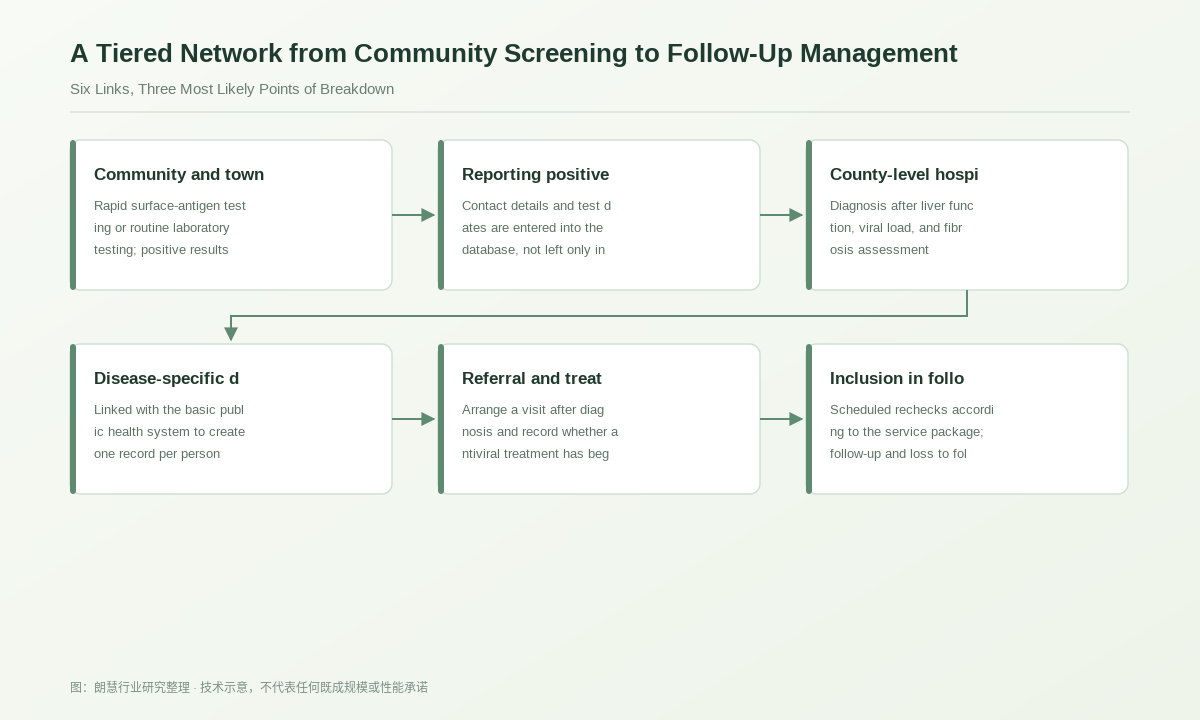
II. Screening Networks: Dividing the Work between Community-Level Screening and Hospital Diagnosis
A common division of labor is this: community health centers or township health clinics perform initial screening, using rapid tests or routine laboratory methods to check hepatitis B surface antigen. Positive results are registered and referred to county-level or higher medical institutions for confirmation, where experienced doctors make the diagnosis and assess liver function and viral load. The diagnosis is then entered back into the screening database and brought under basic public health service management. This pathway looks simple, but any link can break.
The first break is that positive results remain only in the laboratory system. The lab issues a report, but the patient never collects it, and the community does not know who the person is. The second break is that referrals receive no receipt or feedback: the community submits a list, but there is no confirmation of whether the hospital accepted it, how many people were seen, or how many were diagnosed. The third break is that diagnoses are not entered back into the screening database: the hospital's diagnosis exists only in its information system, while the screening database still shows the case as awaiting confirmation. When the three breaks accumulate, the diagnosis rate becomes distorted, and no one can say where the distortion occurred.
Linking disease-specific databases with basic public health service systems has been an effective approach in recent years. Once a person is anchored by a single unified index, follow-up, referral, and medication records can be attached to the same individual rather than creating three identities across three systems. But a database only makes visibility possible; it does not answer who is responsible. If the treatment side lacks corresponding service packages and accountability measures, the database will still contain nothing more than a pile of labels.
Another point that is easy to confuse: coverage and effectiveness are not the same thing. A region may have very high screening coverage simply because it is well organized. What actually determines disease burden is how many people start medication after diagnosis and how many are still in follow-up a year later. When reviewing screening reports, it is best to request a linkage table that arranges the number of positives, diagnoses, treatments, and follow-up cases in a vertical sequence, making gaps immediately visible.
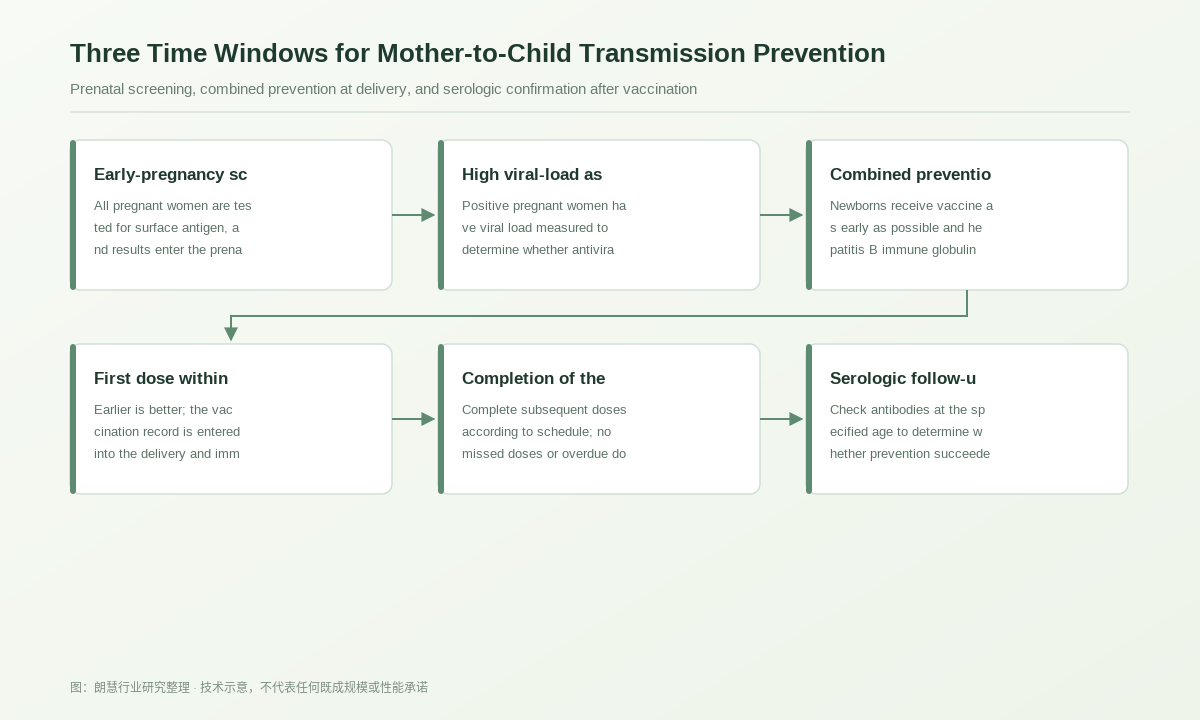
III. Vaccination and Mother-to-Child Transmission Prevention: The Most Mature Stage, Still with Execution Gaps
Mother-to-child transmission is one of the main routes of hepatitis B transmission, and prevention protocols are already mature internationally: all pregnant women are screened for hepatitis B surface antigen during pregnancy; newborns of positive mothers receive vaccination as soon as possible after birth, ideally within 24 hours, together with hepatitis B immune globulin; they then complete the full vaccination series according to schedule and undergo serologic testing at the specified age to confirm whether protective antibodies have developed. Pregnant women with very high viral loads also receive antiviral prophylaxis in late pregnancy.
Maturity does not mean there are no gaps. Timely first-dose coverage depends on whether the delivery facility has vaccine, whether someone is responsible for administering it, and whether the task is documented in the delivery record. Prenatal screening coverage depends on whether antenatal care is standardized. Late-pregnancy antiviral prophylaxis depends on whether viral load can be measured. These three tasks fall to obstetrics, the laboratory, and infectious disease, respectively. If any link is missing, the prevention effect is diluted, and the problem is often not detected until the child completes serologic testing.
The same is true of information. Obstetric records, the childhood immunization system, and the laboratory system each manage a separate segment, making it difficult to see in one interface how many doses a child has received or whether antibodies were checked on time. The main room for improvement here is reconciliation and reminders, not clinical judgment. Systems can automatically compare lists of those who should have been vaccinated but were not and push them to the responsible vaccination site. The technical threshold is low, but the effect on transmission prevention is immediate.
One caution: this stage should not be overpackaged as an AI use case. The rules for giving vaccines and using immune globulin are already clear and do not require a model to guess. What is actually needed is to put those rules into the system, ensure that the right people receive reminders at the right time, and leave an execution record. Getting a deterministic process right is more valuable than layering a predictive model on top of it.
IV. Two Real Reasons for Low Treatment Rates: Stigma and Missing Disclosure
When discussing treatment rates, it is easy to focus on drug access. But two very concrete barriers are more common in clinical practice. The first is stigma. Some patients know that someone in their family has the disease and still avoid testing, fearing that a positive result will become known to relatives and friends and affect their work, marriage, and daily relationships. Cheap medication does not remove this concern; what is needed is privacy protection and an accurate understanding of the disease, not a simple reassurance that it can be controlled.
The second is missing disclosure. A patient may seek care for another condition, and hepatitis B-related markers appear as abnormal on the test order. If the treating physician is not a hepatology or infectious disease specialist, they may glance at the result, say nothing, and neither explain it to the patient nor recommend referral. Seeing that the doctor said nothing, the patient naturally assumes everything is fine. By the time cirrhosis or even liver cancer is detected, the treatment window has long passed. This is not an isolated phenomenon but a systematic blind spot created by increasingly specialized divisions of labor; the larger and more specialized the hospital, the more likely it is to occur.
Neither issue can be solved by a model. Stigma requires education, privacy policies, and community-level destigmatization. Missing disclosure requires process controls, such as writing a requirement to notify and document abnormal hepatitis B markers into outpatient quality control, automatically pushing abnormal results to the treating physician, and requiring confirmation. What AI can do here is turn actions that should happen into system reminders; it cannot replace the conversation a person needs to have.
There is another development worth noting: treatment criteria are being relaxed. The 2024 update to the World Health Organization's hepatitis B guidelines expanded the treatment-eligible population. It no longer looks only at viral load and transaminases, but also considers factors such as fibrosis stage, age, and family history. Looser criteria mean that more people can be treated, but they also mean that primary care needs stronger testing capacity to support stratification; otherwise, the promise of being eligible for treatment will remain unfulfilled.
V. Why Family-Based Management Suits Chronic Infectious Disease Better
Chronic hepatitis B has both infectious-disease and chronic-disease characteristics. As an infectious disease, it has clear transmission routes and tends to cluster within families. As a chronic disease, it requires management over years or even a lifetime. When these two characteristics overlap, the unit of management should not be just one patient, but one household. If one person tests positive, other household members are also exposed and need screening, yet this is rarely raised proactively in outpatient care.
Family-based management includes three actions: screen household members, especially spouses, children, and parents; create a unified record for positive members that notes family relationships; and send follow-up reminders by household rather than separately to each person. The practical benefit is clear: one follow-up call can confirm whether the others have completed their checks on schedule, and adherence can reinforce itself, especially when children communicate on behalf of older patients.
The requirements for information systems change as well. A system whose primary index is the visit number will struggle to answer who else in the household has not been screened. To support family management, a family-relationship table must be added alongside the primary index, with clear rules about who can see what. This raises a privacy boundary: household members should not be assumed to share test results, and informed consent must be obtained separately; living together is not consent.
Family-based management also has a practical value: it turns screening from a one-off campaign into an ongoing activity. Newlyweds, newborns, and people moving in from elsewhere can all be identified through the household entry point rather than waiting for the next round of province-wide screening. For regions that have already built disease-specific databases, this is a low-cost supplementary path with steady output.
VI. Real-World Evidence Can Fill Gaps in Guideline Thresholds and Population Profiles
Many current laboratory reference ranges and risk thresholds come from foreign populations or older studies. China's liver disease spectrum, body-weight distribution, and prevalence of metabolic abnormalities differ, so applying them directly can create systematic bias. In recent years, China has begun building multicenter hepatitis B cohorts, combining electronic records from multiple hospitals and using real-world data to answer two questions: which markers are truly associated with outcomes, and where thresholds should be set.
The usual approach is to define outcomes first, such as cirrhosis, liver cancer, or hepatic decompensation. It then screens dozens or hundreds of laboratory markers for those associated with the outcome, uses data-driven methods to group continuous variables and determine cut points, and checks the stability of those cut points in an independent validation set. Markers that are highly correlated are consolidated to reduce dimensionality, leaving a small set of dimensions that describe a patient's state. The multicenter cohorts described in public discussions generally follow this sequence, with differences in outcome definitions and data-cleaning rigor.
The value of such results should be understood at different levels. They can be a useful stratification tool, helping hospitals decide who needs more frequent follow-up. But they are not guideline recommendations. Adding them to guidelines requires external validation, mechanistic interpretation, and expert consensus; none of those can be skipped. Treating data-derived thresholds directly as clinical standards is the most common misuse of this kind of research and the part most likely to be amplified in circulation.
Another easily underestimated output is the substitutability of missing markers. Primary care settings often cannot measure everything. If certain markers are highly correlated, already-measured markers can be used to infer unmeasured ones, which is practical in resource-limited regions. The prerequisite is to state the substitution relationship and uncertainty clearly. Inferred values must not be treated as measured values, and they must not be presented indistinguishably on reports.
VII. Where AI Belongs in Risk Prediction: Supporting Stratification, Not Making Diagnoses
Risk prediction in hepatitis B is not a new problem. Several scores based on routine markers such as age, sex, platelets, and transaminases already exist to predict hepatocellular carcinoma risk. Machine-learning models can use more and finer information, such as follow-up trajectories, medication adherence, and imaging features. But a model's ceiling is determined by input quality. If the data are seriously incomplete or follow-up intervals are irregular, even a more complex architecture cannot produce reliable predictions.
A more appropriate position is stratification rather than diagnosis. The model can output that a patient has a relatively high risk of an adverse outcome over the next several years, allowing clinicians to set follow-up density—for example, moving from annual ultrasound to every six months or adding one contrast-enhanced imaging study. This action is reversible and low risk; a wrong judgment does not directly harm the patient, making it a more suitable scenario for early deployment.
Deployment form matters more than model precision. In most hospitals, clinicians will not open a webpage and manually enter a dozen fields just to use a model. A practical approach is to embed the model into existing systems: when a new laboratory result arrives, the feature vector updates automatically, and risk changes are pushed to the physician's workstation or follow-up list. What the clinician sees is this patient needs a recheck now, not a string of probabilities.
One caution is distribution shift. Testing methods, population composition, and follow-up practices differ across hospitals. A model validated at one hospital may drift at another. After launch, calibration curves must be monitored continuously, not just discrimination. A model with high discrimination but poor calibration will overestimate or underestimate overall risk, directly distorting resource allocation, and the bias will not reveal itself automatically.
VIII. AI Handling Follow-Up Operations: Reminders, Recovering Lost Patients, and Data Collection
Follow-up work includes many operational tasks: appointment reminders, medication instructions, adverse-event collection, lifestyle information gathering, and examination booking. These tasks do not produce clinical judgments, but they consume a large amount of primary care physicians' time. Delegating them to automated conversational workflows is currently a realistic application: the technical difficulty is low, the benefit is direct, and results are easy to see in the short term.
Recovering patients lost to follow-up is harder. They are not a homogeneous group: some simply forgot and will return after one reminder; some do not want to reappear because of stigma; some are working away from home or face transportation barriers; and some have lost confidence in treatment. Using one script for everyone will produce poor results. A practical approach is to stratify by cause first, then match different outreach methods, such as phone calls, text messages, or home visits by community doctors.
The choice of interaction entry point is also practical. Asking patients to install a new app usually yields low conversion, while the chat tools patients already use have much higher open rates. This is why many teams place the entry point in WeCom or a similar instant-messaging tool, using QR-code binding and conversational forms to reduce learning costs. The closer the entry point is to patients' daily habits, the more complete the data collection will be.
When evaluating these tools, do not look only at volume sent. More meaningful indicators are reach rate, response rate, actual return-visit rate, follow-up completion rate, and the time physicians save as a result. If many reminders are sent but the return-visit rate does not change, the problem is not reminder frequency; it is that the path after the reminder is not working—for example, registration is difficult, examinations cannot be scheduled, or cross-region insurance settlement is cumbersome. None of these can be solved by a model.
IX. Boundaries: What Should Not Be Delegated to Models
Some tasks are not suitable for independent model execution. Starting antiviral treatment, deciding when to stop medication, managing drug resistance, and choosing drugs during pregnancy all require balancing a patient's complete situation. A model can provide evidence summaries and similar cases, but it cannot replace a physician's signature. Packaging these tasks as intelligent recommendations and executing them directly shifts risk to patients and frontline physicians.
Report interpretation also has boundaries. Giving a patient a conclusion such as your liver fibrosis is elevated without providing the basis is both likely to cause panic and impossible to verify. The sound approach is to provide marker values, reference ranges, the basis for the judgment, and next-step recommendations together, while clearly stating that this is supporting information and that the physician's opinion is final. The same applies to primary care physicians: conclusions must be clickable to reveal the underlying basis.
Data boundaries must be drawn clearly as well. Sharing patient data across institutions requires authorization, and data used for model training must have their scope and purpose stated. De-identification still leaves re-identification risk, especially with dates, addresses, and combinations of rare diseases. The sources and use records of training data should be traceable, not reduced to a single statement that they have been de-identified.
There is a simple test: if the model gets it wrong, who is accountable, how is the error discovered, and how is it corrected? Only when all three questions have answers is a workflow ready for deployment. If they do not, the process has not been designed; do not rush the model into use. Technology teams often leave these three questions to the hospital, and the hospital cannot answer them, so the project stalls at the pilot stage.
X. Which Indicators Should Be Used to Evaluate a Hepatitis B AI Solution
Evaluation should be based on the workflow, not the demo. In a demo environment, data are complete and the process runs smoothly; in the real environment, fields are missing, systems lag, and clinicians have no time. I suggest dividing indicators into three layers. At the workflow layer, look at positive-result follow-up rate, diagnosis rate, treatment initiation rate, and follow-up completion rate. At the model layer, look at stratification calibration, not just discrimination. At the operational layer, look at the number of steps clinicians take, the proportion of ignored alerts, and system availability.
The model layer is the easiest to falsify. Reporting only overall discrimination reveals nothing about performance among older adults, patients with cirrhosis, or people with missing data. A more credible approach is to report calibration curves by subgroup with confidence intervals, and to state the source hospitals, time span, and population composition of the training data so users can judge whether it can transfer to their own setting.
Operational indicators are often overlooked, yet they determine whether a tool survives. If a reminder requires a physician to click three extra times before it can be closed, it will be collectively ignored within two weeks. Before launch, the workflow should be tested and the number of steps minimized; after launch, the ignore rate should be tracked. A high ignore rate does not mean clinicians are uncooperative; it means the reminder is not precise enough or the task it raises is not theirs to handle.
There is also one hidden indicator: whether anyone maintains it. Models need periodic retraining, rules need updating with guidelines, and data interfaces can fail when hospitals change systems. If the project team is withdrawn, the system becomes a display piece within three months. Signing a long-term maintenance arrangement matters more than scoring a few extra points at acceptance.
| Indicator Layer | What to Look At | Common Pitfalls |
|---|---|---|
| Workflow Layer | Positive-result follow-up rate, diagnosis rate, treatment initiation rate, one-year follow-up completion rate | Reporting only screening coverage hides linkage gaps |
| Model Layer | Subgroup calibration curves, confidence intervals, training-data sources | Reporting only overall discrimination masks performance among older and data-missing populations |
| Operational Layer | Number of steps, alert ignore rate, system availability, maintenance responsibility | Treating acceptance as the finish line, with no retraining or rule-update mechanism |
XI. Outlook for the Next 12 to 24 Months
First, evaluation will shift from screening coverage to linkage rate. In regions where coverage is already high, the next question will be where the people who tested positive went. Positive-result follow-up rates, treatment initiation after diagnosis, and one-year follow-up completion will gradually enter the assessment framework. This is favorable to regions that have built disease-specific databases and follow-up teams, and a pressure point for regions that have only conducted one-off screening.
Second, after treatment criteria are relaxed, testing capacity will become the new bottleneck. Viral-load testing and liver-fibrosis assessment are not widespread in primary care. However loose the criteria are, stratification is impossible if the tests cannot be performed. Over the next two years, the division of labor between point-of-care testing and regional laboratory centers will change significantly. Whoever can bring testing to townships will control the entry point. This is an opportunity for diagnostic-equipment makers and third-party laboratories, and a constraint for teams that only build software solutions.
Third, AI will shift from standalone applications to embedded applications. Standalone apps and mini-programs struggle to sustain usage; the models that survive are those with no interface of their own, hidden inside existing workflows. To judge whether a team understands this, see whether it is willing to package the model as an interface and accept being integrated, rather than insisting that clinicians come to its platform.
Fourth, the first beneficiaries will be institutions that already have cohort data and follow-up teams. Models need data to feed on, and they need people to turn predictions into concrete actions. Without both, even the best algorithm remains trapped in papers. For industry partners, the real scarcity over the next two years is not model capability, but long-term, real-world data scenarios and organizations willing to invest personnel in follow-up.
Langhui's Engineering Capabilities Along This Path
Langhui has focused on AI training data since 2016. In medical imaging, our coverage includes CT, MR, PET, mammography, ultrasound, and other modalities. On liver disease data projects, we handle acquisition-specification design, structured annotation, quality control and consistency reports, and data dictionaries and version records, so the definition, value range, and reasons for missing values of every field can be traced.
For hepatitis B screening and follow-up scenarios specifically, we can take on the data-side engineering work: breaking screening and follow-up forms into verifiable fields, designing dual-annotator and arbitration workflows, and producing consistency reports by center and population; annotating lesions and anatomic structures in liver MR, CT, and ultrasound series, and delivering annotation manuals. Semantic understanding of original reports and diagnostic conclusions remain the responsibility of medical institutions.
It is important to state the capability boundary: we do not claim HIPAA certification, do not list endoscopy, pathology whole-slide images, or natural-language processing of medical records as platform capabilities, and do not provide registration and certification services for clinical decision systems. If your team is working on regional screening-data governance, follow-up-data structuring, or liver imaging annotation, send us the modalities, field volume, and annotation specifications; we will first run a small batch trial annotation before discussing scale-up.
FAQ
If hepatitis B surface antigen is positive but liver function is normal, is treatment necessary?
Not necessarily, but an assessment is needed; liver function alone is not enough. Whether to start treatment should be judged in light of viral load, transaminase levels, liver fibrosis stage, age, and family history. Recent international guidelines have expanded the treatment-eligible population, and some patients with normal liver function now qualify. It is advisable to have a complete assessment at an infectious disease or hepatology department and then follow the physician's schedule for periodic rechecks. Do not ignore it simply because there are no symptoms.
What should be done if no antibodies develop after hepatitis B vaccination?
First confirm the timing and method of testing. It is appropriate to check antibodies 1 to 2 months after completing the vaccination series. People with no antibodies or very low titers can complete another round according to the schedule and be retested. Some people still do not respond, which is related to age, obesity, and immune status. People whose surface antigen is already positive do not need to rely on vaccination for antibody production and should move on to treatment assessment. Follow the advice of the vaccination clinic and the treating physician for the specific plan.
How accurate is AI at predicting liver cancer risk, and can it replace a physician's judgment?
It cannot replace a physician. The role of a risk model is to stratify a population and indicate who needs closer follow-up, such as a shorter ultrasound interval. Its accuracy is affected by data completeness and population differences, and it may be inaccurate at another hospital. A model gives probabilities, not diagnoses. Whether to add tests or adjust treatment remains a decision for the physician based on the individual situation.
If a positive result is found in community screening, how can we ensure the person is not lost to follow-up?
The key is to turn the result into a concrete arrangement, not just a notification. Practical steps include reporting the positive result on the spot and registering contact details; having a community doctor call within a few days to confirm and schedule a confirmatory examination; collecting the referral form upon return; and entering the diagnosis back into the screening database. For migrant workers or people with limited mobility, a separate outreach method is needed. Regularly tracking follow-up and diagnosis rates is the only way to know which link is losing people.
If someone in the family is found to have hepatitis B, should every household member be tested?
Testing is recommended. Hepatitis B can be transmitted through blood, mother-to-child transmission, and sexual contact. Household members are exposed, with spouses, children, and parents taking priority. Tests usually include surface antigen, surface antibody, and core antibody. People without antibodies and without infection can be vaccinated; those already infected should move on to treatment assessment. Note that household members should also respect privacy, and test results should not be shared by default.
- World Health Organization. Guidelines for the prevention, care and treatment of persons with chronic hepatitis B infection, 2024 update https://www.who.int/publications/i/item/9789240090903
- World Health Organization. Global hepatitis report 2024: action for access in low- and middle-income countries https://www.who.int/publications/i/item/9789240094499
- World Health Organization. Global health sector strategy on viral hepatitis 2016–2021 https://www.who.int/publications/i/item/WHO-HIV-2016.06
- Papatheodoridis G, et al. PAGE-B predicts the risk of developing hepatocellular carcinoma in Caucasians with chronic hepatitis B on 5-year antiviral therapy. Journal of Hepatology, 2016 https://doi.org/10.1016/j.jhep.2015.11.035
- U.S. Centers for Disease Control and Prevention. Hepatitis B: clinical overview and vaccination guidance https://www.cdc.gov/hepatitis-b/index.html