
HEPATOPROTECTIVE DRUGS / MECHANISM-BASED SELECTION
Classification of Hepatoprotective Drugs by Mechanism and Rational Combination Therapy: From Strength of Evidence to Trade-offs in Drug-Induced Liver Injury
Hepatoprotective drugs are often treated broadly as adjunctive medications, but the actual choice of drug must be grounded in three layers: mechanism, evidence, and clinical scenario. This article breaks down the roles of four categories—anti-inflammatory and antioxidant, membrane repair, detoxification, and choleretic therapy—discusses how to judge the strength of evidence, the upper limit on the number of drugs that can be combined, and the pace of tapering and discontinuation, and provides concrete trade-offs for drug-induced liver injury, special populations, and monitoring, before offering a forward-looking assessment for the next 12 to 24 months.
The mainstay of liver disease treatment is treating the underlying cause, but etiologic therapy does not cover all injury. After antiviral therapy for hepatitis B, inflammation may persist; in alcoholic liver disease, hepatocytes are still repairing after alcohol abstinence; and in drug-induced liver injury, recovery also takes time after the offending drug is stopped. This is where hepatoprotective drugs fit: they address shared downstream processes such as cell membrane injury, oxidative stress, mitochondrial dysfunction, inflammatory cytokine release, and bile duct injury. The difficulty is that there are many products, the evidence varies widely in strength, and approved indications are often vaguely written, making it easy for clinical practice to drift toward stacking similar drugs and long-term maintenance. This article does not recommend specific products; it focuses on classification logic, evidence appraisal, and the conditions for making trade-offs.
I. The Burden of Liver Disease and the True Place of Hepatoprotective Therapy
China has a large population with liver disease, and the pattern of causes is also changing. Viral hepatitis still accounts for the largest share of existing cases, while the number of patients presenting with alcoholic liver disease and metabolic-associated fatty liver disease is rising, and the reported proportion of drug-induced liver injury is also not low. Different causes progress to cirrhosis and liver cancer at different speeds, and the window for intervention also differs. What they share is that etiologic therapy usually cannot return liver function to normal immediately: a patient with hepatitis B who starts antiviral therapy may have viral replication suppressed, yet inflammation in the liver may continue for some time; after alcohol abstinence in alcoholic liver disease, hepatocytes still undergo a repair process.
This is where hepatoprotective therapy fits. It does not replace etiologic therapy, nor should it be treated as a placebo; instead, it intervenes in several shared downstream pathways: lipid peroxidation of cell membranes, increased oxygen free radicals, mitochondrial dysfunction, hepatocyte apoptosis, inflammatory cytokine release, and bile duct epithelial injury. Different causes ultimately feed into several of these pathways, which is precisely the theoretical basis for selecting drugs by mechanism. Conversely, if a patient's main site of injury is not covered by the drug, adding more products only increases the metabolic burden.
Assessment also needs restraint. Transaminases are sensitive indicators, but a single elevation does not show the trend; judgment must be individualized using baseline values, dynamic changes, age, and sex. Albumin, bilirubin, and prothrombin time reflect synthetic and excretory function and are closer to true hepatic reserve than transaminases. Clinically, treating persistently elevated transaminases as a predictor of adverse outcomes is justified, but that does not mean using escalating doses to force the numbers down.
There is also a practical constraint on the payment side. Some adjunctive hepatoprotective drugs have been included in restricted reimbursement lists because their approved indications are vaguely written, narrowing the range of options. Checking the label and the list before prescribing is becoming a routine step rather than merely a cautious habit. In turn, this pushes drug selection away from product-level experience and toward mechanism and evidence: what can be used is restricted, and why it is used must be explained more clearly.
II. Four Mechanistic Categories: The Basis for Classification and How to Match Them
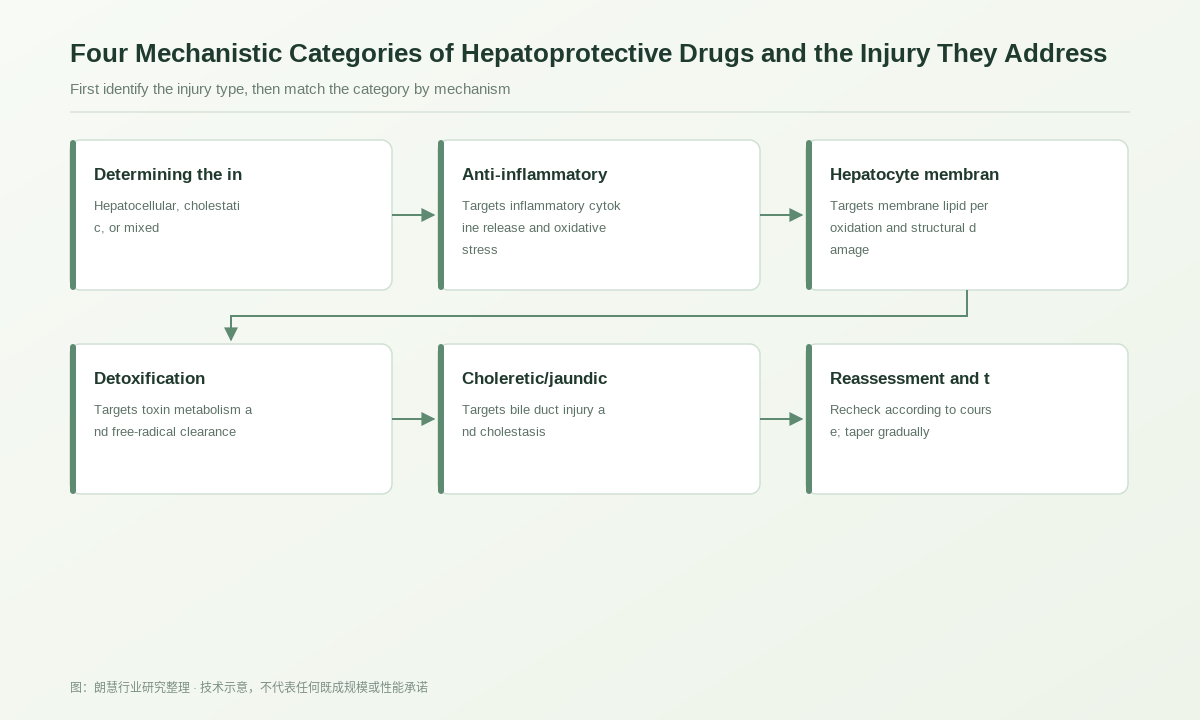
The classification commonly used in clinical practice is based on mechanism rather than brand name: anti-inflammatory and antioxidant agents (glycyrrhizin preparations, silymarin compounds, bicyclol, and others), hepatocyte membrane repair agents (polyunsaturated phosphatidylcholine), detoxifying agents (glutathione, N-acetylcysteine), and choleretic agents (ursodeoxycholic acid, ademetionine, and others). This classification is not academic fastidiousness; it directly determines two things: whether drugs can be combined, and whether a different category should be considered when efficacy is poor.
The first step in matching is to identify the type of injury. If transaminases are the main abnormality and bilirubin is essentially normal, this is usually hepatocellular injury, for which anti-inflammatory and antioxidant agents are the appropriate choice. If alkaline phosphatase and gamma-glutamyl transferase are mainly elevated with increased bilirubin, this is cholestatic injury, for which choleretic agents take priority; if both are elevated, it is mixed injury. When biochemical findings are inconclusive, pathology can provide a clearer answer—for example, autoimmune liver disease with negative autoantibodies that does not respond to conventional treatment may turn out on liver biopsy to require corticosteroids.
Only then do you choose a specific drug. Products within the same category differ in potency, speed of onset, and adverse-effect profiles, but their shared mechanism means they should not be stacked. A common clinical error is to remember products by brand name and take two products with the same mechanism together, believing this broadens coverage, when it simply doubles the metabolic burden.
Classification has another use: when efficacy is poor, first ask whether the wrong category was chosen, rather than immediately increasing the dose or adding products. A cholestatic patient who has been taking anti-inflammatory enzyme-lowering drugs will not see bilirubin fall simply because the dose is raised. Bringing this question into ward-round discussions early can save many ineffective adjustments.
III. How to Judge the Strength of Evidence
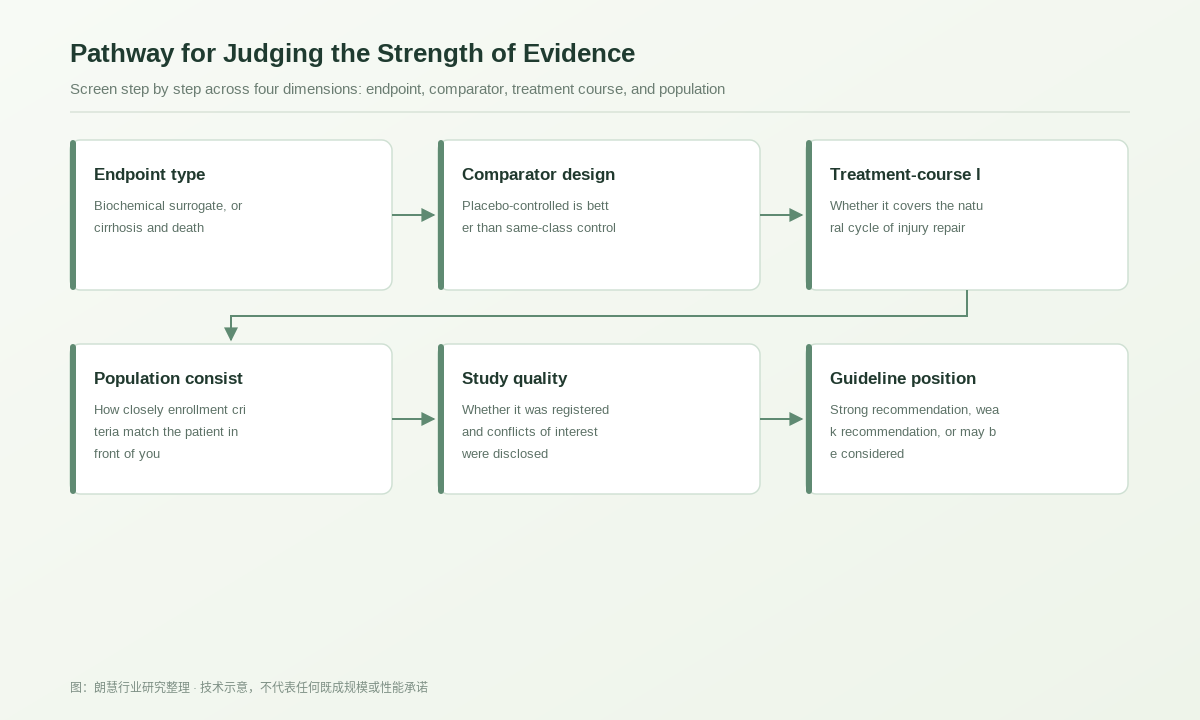
Hepatoprotective drugs share a common evidence profile: relatively more studies of single agents, fewer studies of combination regimens; most endpoints are biochemical markers, with hard endpoints (cirrhosis, liver cancer, death) rarely used; sample sizes are small, treatment courses are short, and follow-up is inadequate. This does not mean dismissing these drugs, but rather a reminder to examine what the evidence actually proves. Demonstrating a fall in transaminases is not the same as demonstrating reduced liver injury; there is a distance between the two.
Strength can be judged across several concrete dimensions: whether the endpoint is a transaminase level or a clinical outcome; whether the comparator is placebo or another hepatoprotective drug (the latter can only show non-inferiority, not efficacy); whether the treatment course covers the natural cycle of injury repair; how closely the enrolled population resembles the patient in front of you; and whether the study was registered and disclosed conflicts of interest. Asking these questions usually clarifies where most of the literature stands.
Guideline recommendation levels and effect sizes are two different things. Many hepatoprotective drugs are described in guidelines as may be considered or may be used in combination, which constitutes a weak recommendation and does not mean a significant effect. Recording that wording accurately in the medication rationale in the chart is far more valuable than writing a line such as 'hepatoprotective treatment given' in the progress note. The former records the judgment; the latter records only the action.
Real-world data can fill some gaps, but two types of bias must be watched: confounding by indication, where sicker patients receive more treatment and outcomes therefore appear worse; and discontinuation bias, where patients who improve stop treatment while those who deteriorate continue it. Real-world conclusions without these adjustments have limited reference value. However large the dataset, it cannot make up for flaws in study design.
IV. Anti-Inflammatory and Antioxidant Agents: Effects and Costs
Glycyrrhizin preparations are representative of this category. Their steroid-like anti-inflammatory effect is well established, they lower enzyme levels quickly, and their effect is immediately apparent in patients with active inflammatory hepatocellular injury. The cost is their pseudoaldosteronism effect: hypokalemia, hypertension, edema, and weight gain. Checking electrolytes and blood pressure before treatment and rechecking them periodically during treatment are basic steps for this class. Another frequently overlooked point is how to stop: abrupt discontinuation can cause rebound elevations, so the dose should be tapered gradually.
Silymarin compounds act through antioxidant and cell-membrane-stabilizing pathways. They are well tolerated and suitable for longer courses, but their effects are modest. A Cochrane systematic review concluded that milk thistle preparations have insufficient evidence in alcoholic and viral liver disease, and histological improvement cannot be promised on that basis. Using them as liver-protective health supplements is another loss of focus; treating them as the mainstay during active inflammation overestimates them.
Bicyclol's enzyme-lowering effect is fairly well established in clinical practice, but what it demonstrates is a fall in transaminases, not repair of liver tissue. The label requires a treatment course, with a period of consolidation after markers normalize, so it is inappropriate to stop as soon as results improve; equally, indefinite maintenance is not appropriate, and reassessment points should be set in advance. Rapid enzyme lowering can sometimes mask disease progression, especially when bilirubin is also rising, so bilirubin and coagulation should be assessed together rather than focusing only on transaminases.
The common scope for this category is patients with active inflammatory hepatocellular injury. It is not the first choice for patients with predominantly cholestatic injury; and for patients already showing signs of liver failure, it cannot replace etiologic treatment and supportive care. Choosing the category matters more than choosing the product, and this is especially evident in patients with multiple concurrent causes: when alcohol, fat, and drug factors are all present, a wrong mechanistic judgment makes every subsequent adjustment ineffective.
V. Membrane Repair and Detoxification Agents: Conditional Use
Polyunsaturated phosphatidylcholine replenishes membrane phospholipids and repairs damaged hepatocyte membranes; oral and injectable forms have different indications. The injection contains benzyl alcohol as a solvent and is contraindicated in children under three, and is not recommended for children under twelve, pregnant women, or breastfeeding women. This restriction appears in the label and is often overlooked. When rapid onset is needed, the injection is used, followed by oral therapy during the stable phase—this is the more common sequential approach.
Among detoxifying agents, the key distinction is between two scenarios. N-acetylcysteine has a clear evidence-based role in acetaminophen poisoning, with established dosing windows and weight-based dosing; in other types of drug-induced liver injury, it is used more empirically, and the strength of evidence is not on the same level. Conflating the two can lead to using it when it is not needed, or using too little when it is.
As an antioxidant substrate, glutathione has different expectations when given intravenously versus orally. Oral preparations have limited bioavailability, and oral effects cannot be inferred from intravenous efficacy. Adverse effects of these drugs are usually not severe, but compatibility, infusion rate, and gastrointestinal reactions still need attention, especially for hospitalized patients receiving multiple intravenous drugs.
Detoxification and membrane repair are both conditional: use them only when there is a clear corresponding injury mechanism, and there is no need to add them routinely when there is no such match. Hospitalized patients are easily given two or three additional drugs under the rationale that they cannot do much harm, and no one is responsible for stopping them at discharge; this kind of hidden stacking is often detected when medication lists are reviewed. Making review of discharge medications a fixed step is more effective than tracing the problem afterward.
VI. Choleretic Agents: Look at the Combination of Bilirubin and Enzyme Patterns
Cholestatic injury is identified by a combination of three indicators: predominantly elevated alkaline phosphatase and gamma-glutamyl transferase, rising bilirubin, and mild-to-moderate transaminase elevation. Continuing to add anti-inflammatory enzyme-lowering drugs at this point points in the wrong direction. Choleretic agents act on bile secretion and flow. Ursodeoxycholic acid has a well-established role in primary biliary cholangitis and is used empirically in other forms of intrahepatic cholestasis.
Ademetionine is used for intrahepatic cholestasis; intravenous and oral sequential therapy must be scheduled according to the treatment course. Intrahepatic cholestasis of pregnancy follows a separate management pathway and cannot be handled with a standard liver disease regimen. The effects of choleretic drugs usually emerge over weeks, so evaluation should look at the rate of bilirubin decline, improvement in pruritus, and trends in the enzyme profile, rather than transaminase changes within three days.
When treatment is ineffective, reassess the cause first. If biliary obstruction has not been relieved, choleretic therapy alone will not work; stones, tumors, and strictures must be addressed first. For drug-induced cholestasis, discontinuation is the mainstay. Attributing failure to an inadequate dose and then increasing it is the most common misuse of this class. Dose escalation often brings adverse effects before efficacy.
In mixed injury, choleretic and anti-inflammatory agents can cover two segments of the pathway at the same time, but the sequence still requires determining which segment is the main problem. For a patient with rapidly rising bilirubin and worsening coagulation, the priority is no longer choosing which choleretic drug to use, but assessing whether referral to a center with artificial liver support and transplant capability is needed.
| Injury Type | Indicator Pattern | Matching Category | Common Misuse |
|---|---|---|---|
| Hepatocellular injury | Predominantly elevated transaminases; bilirubin essentially normal | Anti-inflammatory and antioxidant agents | Stacking products with the same mechanism |
| Cholestatic injury | Elevated alkaline phosphatase and gamma-glutamyl transferase with elevated bilirubin | Choleretic agents | Continuing to add anti-inflammatory enzyme-lowering drugs |
| Mixed injury | Elevated transaminases and bilirubin together | Combination of the two categories; primary and secondary priorities must be determined first | Using three or more categories at once |
| Signs of liver failure | Rapidly rising bilirubin; worsening coagulation | Supportive care and referral assessment | Using hepatoprotective drugs to delay referral |
VII. Rules for Combination Therapy: Why More Is Not Better
The rules for combination therapy can be compressed into two sentences: different mechanisms may be combined, but the same mechanism should not be stacked; the number of products is generally limited to two. The reason is straightforward: the liver is itself a metabolic organ, and every drug entering the body must be metabolized and transported. The more products there are, the greater the burden and the higher the risk of interactions. Hepatoprotective drugs themselves also have to be metabolized—a point worth repeating silently at the prescribing desk.
Rational combination means complementary mechanisms—for example, anti-inflammatory plus antioxidant with a choleretic agent for mixed injury; or membrane repair plus detoxification for critically ill patients with prominent oxidative stress. The criterion is whether the patient's injury pathway truly has two segments that need simultaneous coverage, rather than the psychological reassurance of attacking from all sides.
Evidence for combination regimens is actually thinner than for single agents. Most combination studies are small, short, and use biochemical endpoints, making it hard to establish whether combinations are superior to single agents. The real driving force behind combination therapy in clinical practice is often the unease of doctors and families: if only one drug is used and it does not work, who will be responsible? This problem must be addressed through communication and clear reassessment points; solving it by adding drugs only pushes the responsibility to the next follow-up.
Discontinuation also needs to be designed. After the drug has worked, a gradual taper and stepwise discontinuation are used to avoid rebound, especially with glycyrrhizin preparations. Long-term maintenance requires a rationale: whether the injury mechanism still exists, whether the cause has been controlled, and whether follow-up markers are stable. Long-term maintenance without rationale is essentially postponing the decision—until no one asks why anymore.
VIII. Trade-offs in Drug-Induced Liver Injury
The sequence for managing drug-induced liver injury cannot be reversed. First, stop the suspected drug; second, assess causality and exclude other causes (viral, alcoholic, autoimmune, biliary obstruction, ischemia); only third, provide hepatoprotective treatment. If the order is reversed, the patient continues to be exposed while receiving hepatoprotective therapy; transaminases may fall temporarily while the injury continues to accumulate.
The history-taking must be specific to ingredients. Chinese herbal medicines, supplements, weight-loss products, and topical remedies are often reported by patients as 'not taking any medication.' Publicly reported drug-induced liver injury registries show that Chinese herbal medicines and dietary supplements account for a substantial share, and their complex composition and batch variability make causal judgment harder. Asking patients to list everything they have taken recently is far more effective than asking whether they have taken Chinese medicine.
When signs of liver failure appear, the role of hepatoprotective drugs must be kept in perspective. Worsening coagulation, rapidly rising bilirubin, and the onset of hepatic encephalopathy indicate that the patient has entered a stage requiring supportive care and transplant evaluation. N-acetylcysteine may be considered early, but hepatoprotective drugs cannot replace artificial liver support or the referral decision. At this point, the greatest time sink is often not choosing a drug but waiting for test results and a bed.
Immune checkpoint inhibitor-related liver injury follows a different pathway: treatment is graded, with corticosteroids and immunosuppressants as the mainstay, and hepatoprotective drugs only as adjuncts. Using enzyme-lowering drugs to force the numbers down interferes with grading and can affect the decision to continue or stop antitumor therapy. This is the point that most needs to be aligned between oncology and hepatology consultations; otherwise, both sides are looking at the same laboratory report and reaching different conclusions.
IX. Special Populations, Adverse-Effect Monitoring, and Discontinuation
The restrictions for children and pregnant or postpartum women must be memorized. Benzyl alcohol-containing injections are contraindicated in children under three; polyunsaturated phosphatidylcholine is not recommended for children under twelve, pregnant women, or breastfeeding women; glycyrrhizin preparations are contraindicated or used with caution in patients with severe hypokalemia, uncontrolled hypertension, or heart failure. These are not fine print—they are hard constraints before prescribing.
Older adults often take multiple medications, so the real risks of interactions and metabolic burden are higher. Adding antihypertensives, diuretics, hypoglycemic agents, and hepatoprotective drugs raises the incidence of electrolyte disturbances. Baseline electrolytes, blood pressure, and weight recorded before treatment serve as the reference for later judgments about adverse effects; without a baseline, any abnormality can only be inferred.
The monitoring checklist can be standardized: transaminases, bilirubin, alkaline phosphatase, gamma-glutamyl transferase, albumin, prothrombin time, electrolytes (especially serum potassium), blood pressure, weight, and edema. With a baseline before treatment and scheduled rechecks during the course, any abnormality can be traced to a specific point in time. This record is hard evidence in consultations and dispute resolution.
Chart documentation is the last line of defense. Stating the medication rationale, expected course, reassessment points, and risk disclosure clearly is more useful than writing 'hepatoprotective symptomatic treatment given.' There have been cases in which vague documentation left clinicians at a disadvantage in disputes; this lesson does not require a specific case to understand: the record captures the decision-making logic at the time, and without it, hindsight can only rely on memory.
X. Traditional Chinese Medicine and Mechanism-Based Complementarity: Real-World Boundaries
Many modern hepatoprotective drugs originate from traditional Chinese medicine: glycyrrhizin comes from licorice, silymarin from milk thistle, and bicyclol has connections with Schisandra. Setting them against traditional Chinese medicine is pointless; the real question is whether the same molecule is evaluated by consistent standards across different evidence systems. When standards differ, the discussion becomes a dispute over positions.
Research on Chinese patent medicines and decoctions in liver disease is mostly small-scale and short-course, and complex compositions make dosing and quality control difficult to standardize. At the same time, Chinese herbal medicines themselves are an important cause of drug-induced liver injury, and hepatotoxicity from Polygonum multiflorum (He Shou Wu) preparations has been clearly reported. 'Natural equals safe' is the assumption most in need of correction in these discussions.
A workable path to integration is to make the mechanism explicit: which herb corresponds to which pathway, at what dose and duration, and whether it overlaps with existing drugs. The traditional principle of combining sovereign, minister, assistant, and envoy herbs has lessons for reducing interactions and layering therapy, but it cannot replace certainty about ingredients and dosing. Mechanism-based complementarity must be tied to specific targets and clinical endpoints, not left at the conceptual level.
For hospitals, the practical approach is to bring Chinese patent medicines into the same medication-review process: indication, course, reassessment, and adverse-event reporting—none can be omitted. Leaving them outside the process implicitly assumes this area of medication use does not need to be managed, and that is precisely where risk is most likely to accumulate.
XI. A Forward-Looking View for the Next 12 to 24 Months
First, payment-side constraints will continue to tighten. Adjunctive hepatoprotective drugs with unclear approved indications will occupy an increasingly awkward position in reimbursement formularies, and checking the formulary and label before prescribing will become routine. The advantage of having many product choices will depreciate, while the value of clear mechanism and evidence will rise.
Second, diagnostic tools for drug-induced liver injury will improve slowly. Biomarker research has shown value in specific drugs and populations, but it remains some distance from routine testing; for the near future, exclusion-based diagnosis plus scoring, together with a sufficiently detailed medication history, will remain the approach. Whoever builds a solid medication history will have the more reliable judgment.
Third, the role of intelligent tools will become clearer: classification, risk stratification, and reconciliation of medication records—not recommending specific drugs. To make this work, laboratory, medication, and diagnostic data must be structured, with traceable versions. If the data are not right, the model's recommendations will only magnify the errors.
The first institutions to benefit will be those that turn mechanism, evidence, and monitoring into an in-hospital pathway: a fixed medication-review process, complete baseline and follow-up records, and a closed loop for adverse-event reporting. These capabilities do not appear in a drug formulary, yet they determine what difference the same few drugs can make. For industry players, tools that can be embedded in such a pathway are more valuable than explaining the mechanism one more time.
Langhui's Engineering Capabilities Along This Path
Langhui Technology has been working on AI training data since 2016. In healthcare, our work covers acquisition protocol design, structured annotation, quality control, and consistency reporting for CT, MR, PET, mammography, ultrasound, and other modalities. In liver disease data projects, we standardize imaging and structured fields: breaking examinations, diagnoses, laboratory tests, and follow-up into verifiable fields, and delivering data dictionaries, annotation manuals, and version records.
When organizing medication and laboratory data, what we can do is structuring and quality control; we do not participate in clinical decision-making or provide medication advice. Tasks such as field definitions, missing-value markers, unit conversion, and timestamp alignment may seem tedious, but they determine whether subsequent analyses can be reproduced.
If your team is working on structured liver disease specialty data, image annotation, or historical data cleaning, send us the disease area, field scope, and data scale, and we will suggest an actionable data acquisition and quality-control plan.
FAQ
Can two or three hepatoprotective drugs be used at the same time?
In general, no. The principle is that different mechanisms may be combined, but the same mechanism should not be stacked; the number of products is usually kept to two or fewer. The liver has to metabolize these drugs, so more products mean a greater burden and higher risks of interactions and adverse effects. When combination therapy is genuinely needed, the rationale for mechanistic complementarity and the reassessment points should be documented in the chart.
Can the drug be stopped once transaminases return to normal?
Not necessarily. Normal transaminases only mean that current inflammatory activity has decreased; they do not mean repair is complete. Some labels require continuing consolidation for a period after markers normalize, followed by a gradual taper. Abrupt discontinuation can cause rebound, which is especially noticeable with glycyrrhizin preparations. The timing of discontinuation should be judged comprehensively using bilirubin, albumin, coagulation, and control of the underlying cause.
Why should glycyrrhizin preparations be stopped gradually?
These drugs have a steroid-like anti-inflammatory effect. After long-term use, abrupt discontinuation can cause rebound markers and renewed inflammatory activity. The standard approach is to taper gradually after the drug has worked, while rechecking transaminases and bilirubin. Potassium, blood pressure, and weight should also be monitored during treatment; if hypokalemia, edema, or hypertension develops, the dose should be reduced or the drug class changed.
If drug-induced liver injury is suspected, what is the first step?
The first step is to stop the suspected drug, not to add a hepatoprotective drug. Next, assess causality and exclude other causes—viral hepatitis, alcohol, autoimmune disease, biliary obstruction, and ischemia—and perform imaging and autoantibody tests if necessary. Hepatoprotective treatment comes after discontinuation and assessment; reversing the order leaves the patient exposed to the injurious factor.
How should silymarin, bicyclol, and polyunsaturated phosphatidylcholine be chosen?
The three have different mechanisms: silymarin leans toward antioxidant effects, bicyclol primarily lowers enzymes, and polyunsaturated phosphatidylcholine focuses on membrane repair. The choice depends on the injury type and stage: anti-inflammatory and antioxidant agents may be considered when inflammation is active and transaminases are clearly elevated; membrane repair agents may be considered when there is definite membrane damage or rapid onset is needed. The specific medication must be decided by the clinician in light of the cause and test results.
- European Association for the Study of the Liver. EASL Clinical Practice Guidelines: Drug-induced liver injury. Journal of Hepatology, 2019 https://doi.org/10.1016/j.jhep.2019.02.014
- ACG Clinical Guideline: Diagnosis and Management of Idiosyncratic Drug-Induced Liver Injury. American Journal of Gastroenterology, 2021 https://doi.org/10.14309/ajg.0000000000001273
- LiverTox: Clinical and Research Information on Drug-Induced Liver Injury. NCBI Bookshelf https://www.ncbi.nlm.nih.gov/books/NBK547852/
- Rambaldi A, et al. Milk thistle for alcoholic and/or hepatitis B or C virus liver diseases. Cochrane Database of Systematic Reviews, 2007 https://doi.org/10.1002/14651858.CD003620.pub3
- Chalasani N, et al. Features and Outcomes of 899 Patients With Drug-Induced Liver Injury: The DILIN Prospective Study. Gastroenterology, 2015 https://doi.org/10.1053/j.gastro.2015.03.006