
LIVER DISEASON / SPECIALTY DATABASE
Engineering Details for Building Liver Disease Specialty Databases: Fields, Follow-Up, and Multicenter Collaboration
The value of a liver disease specialty database lies not in its storage capacity, but in whether its fields can be interpreted, its outcomes can be confirmed, and its follow-up can be sustained. This article breaks down the fields into four layers: etiology and virology, liver function and imaging, treatment exposure, and outcome confirmation. It discusses practical approaches to follow-up registration, data dictionary and version management, and multicenter collaboration; provides check items for research reuse and acceptance; and identifies several signals that, over the next 12 to 24 months, specialty databases will shift from project-based development to ongoing operations.
A liver disease specialty database may look like an IT project, but it is more accurately described as a long-term cataloging effort. Database software can be purchased, but the meaning of fields, the criteria for confirming outcomes, and responsibility for follow-up must be negotiated hospital by hospital. One detail mentioned in a public academic sharing session deserves attention: a team spent several years from planning to actually using the database in clinical practice, most of which was not spent writing code but on annotation and data cleaning. This shows that the bottleneck has never been the database itself. This article breaks the specialty database down into four areas—fields, follow-up, dictionaries, and collaboration—and discusses actionable practices and common pitfalls in each.
1. Why Liver Disease Specialty Databases Should Be Designed as Living Databases, Not One-Time Exports
Most traditional specialty databases are built through one-time extraction: inclusion and exclusion criteria are defined for a project, historical data are exported, and updates stop once the project ends. This model is sufficient for a single paper, but it quickly becomes distorted when applied to liver disease. Chronic hepatitis B, cirrhosis, and metabolic-associated liver disease progress over years, while outcomes such as liver cancer and decompensation appear late. In a static database, the last follow-up is often stuck in the year the database was created, and subsequent data can only be added retrospectively from memory. Retrospectively added data lack original collection standards, making it difficult to combine entries from different years and departments.
A living database, at its core, allows data to flow in both directions. On one hand, it sends follow-up plans, educational content, and appointment reminders to patients; on the other, it brings back outside-hospital examinations, questionnaire responses, and outcome confirmations. The act of sending information itself generates new data—for example, whether a patient attended an appointment, completed an examination, or the reason for not completing it. Only when this information flows back can fields have a continuous source of updates. A database with only input and no output will quickly run dry at the collection end, because clinicians will not see its practical value and will stop investing staff time.
Outgoing communication is not mass messaging. Push content should be determined by the patient’s annotated status: whether they are receiving treatment, whether they have cirrhosis, whether imaging shows nodules, and whether the last monitoring visit is due. Different statuses require different frequencies and content of communication. Only at this level does the database become a management tool rather than an archive system. Records generated through patient management then enrich the research cohort in turn, creating a structure in which the same data supports both uses.
The costs must be stated clearly: a living database requires a clinically driven governance mechanism, clearly defined field owners, and workable change-management processes. IT can provide only the foundation; it cannot resolve semantic issues. Whether a field records the initial diagnosis or the current diagnosis can only be determined by clinicians. Once defined, someone must monitor compliance, otherwise the collection standards will drift within three months.
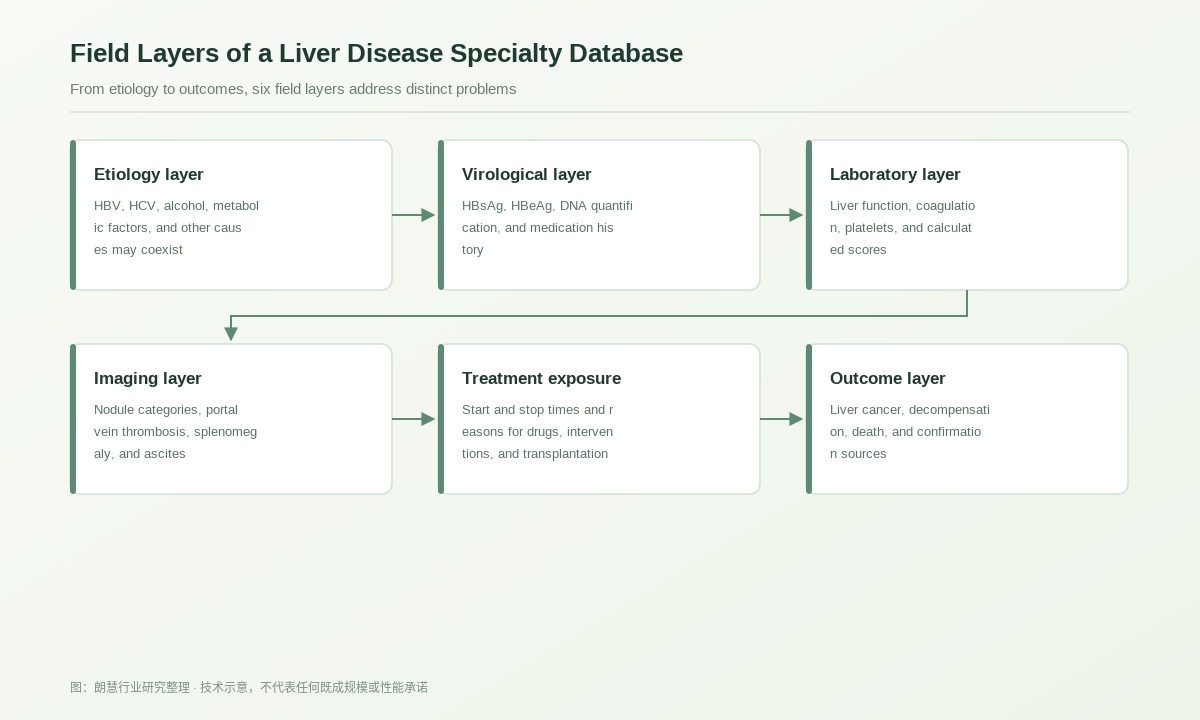
2. First Layer of Field Design: Etiology and Virological Baseline
The most common mistake in etiology fields is making them single-select. Real liver disease patients often have multiple concurrent causes: hepatitis B combined with alcoholic liver injury, metabolic-associated steatotic liver disease combined with drug-induced injury, or residual fibrosis after cure of hepatitis C. Field design should support multiple selections plus a primary-cause flag, while retaining the basis for determining each etiology, such as virological markers, alcohol-consumption records, imaging, or pathological evidence. Storing only one etiology code makes retrospective stratified analysis impossible.
The virological layer must store status and timing together. HBsAg, HBeAg, HBV DNA quantification, antiviral drug names and start dates, emergence of resistance, HCV RNA and genotype, and achievement of clinical cure are all variables that change over time. Storing only “positive” conveys no information; the test date, method, and result value must also be stored. For DNA quantification, it is advisable to retain both the original value and a log-transformed column to avoid repeated conversion errors when units differ between centers.
The baseline anchor must be defined in advance. Using the date of first confirmed diagnosis as t0, rather than the date of first enrollment, directly changes the time origin of survival analysis. A reasonable approach is to store both: the diagnosis date for describing disease progression and the enrollment date for follow-up analysis. The interval between the two is itself a variable and can reflect diagnostic delay.
Missing and negative must be kept separate. In clinical practice, a large number of “not tested” results are entered as “negative,” making this one of the most hidden errors in liver disease databases. A three-state code—positive, negative, and not tested—should be enforced in the collection interface, and the missing proportion should be reported separately in statistics. Otherwise, a key variable may appear complete while actually being filled with default values.
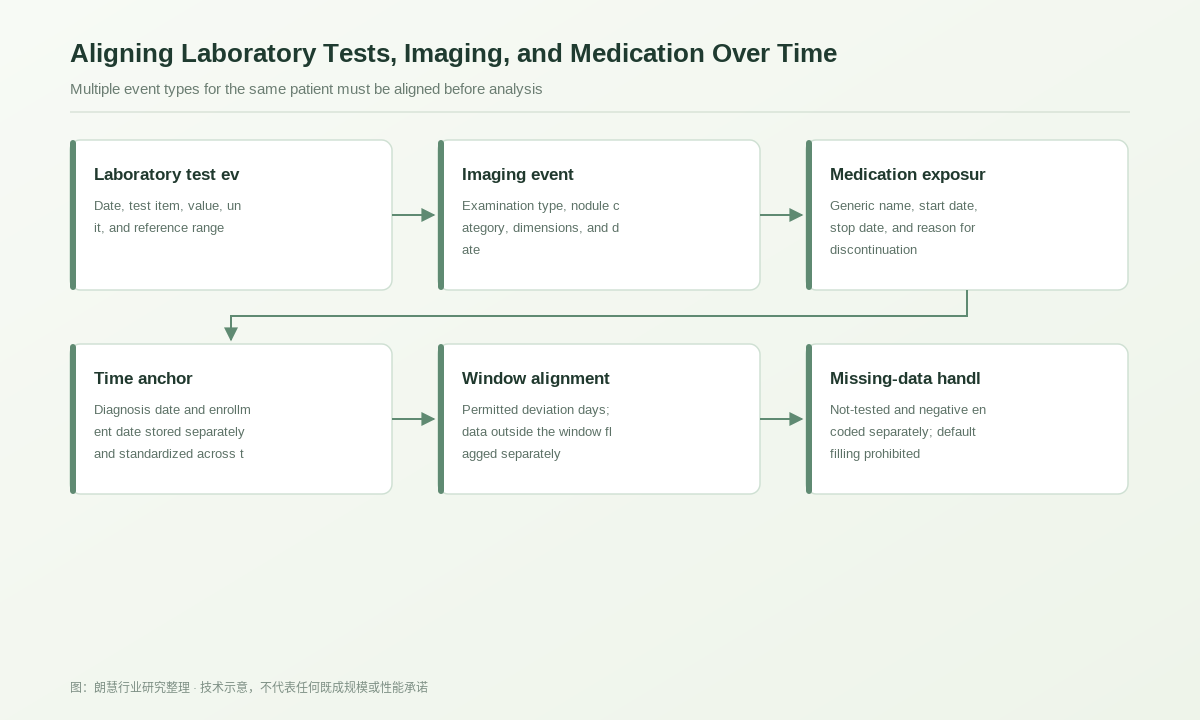
3. Second Layer of Field Design: Liver Function, Imaging, and Treatment Exposure
Laboratory fields should not store only “normal” or “abnormal.” ALT, AST, total bilirubin, albumin, prothrombin time, platelets, and creatinine should retain their values, units, reference ranges, and test dates. Reference ranges may seem redundant, but they are the primary basis for assessing comparability when data from different hospitals are combined. Ranges differ across testing platforms, and storing only values renders abnormality determination meaningless.
Scoring fields should be calculated from raw variables rather than entered manually. Child-Pugh, MELD, FIB-4, and APRI all have clearly defined inputs. Systems that generate scores according to formulas and retain the calculation version are far more reliable than doctors assigning a grade from impression. If manual overrides of scores are permitted, the person making the override and the reason must be recorded; otherwise, it is impossible to explain why a patient’s grade jumps between two time points.
Imaging fields should be structured around “presence or absence, category, dimensions, and date.” Terms such as “nodule,” “increased echogenicity,” and “widened portal vein” in ultrasound reports need to be mapped to controlled terminology. Nodules on contrast-enhanced CT or MRI should be recorded by LI-RADS category while retaining the original report text as supplementary information. Complications such as portal vein thrombosis, splenomegaly, and ascites should also be independent fields rather than buried in free text.
The treatment-exposure layer is most prone to losing information. Nucleos(t)ide analogues, interferon, TIPS, interventional therapy, and liver transplantation all require start and stop times, as well as reasons for discontinuation or switching. Storing only the drug name discards exposure duration, and exposure duration often explains outcome differences better than whether a drug was used. Generic names with a controlled vocabulary are recommended for drug names, with brand names placed in a remarks field.
4. The Hardest Outcome Fields: Confirmation Standards for Liver Cancer, Decompensation, and Death
Liver cancer outcomes must distinguish two time points: the date of first suspicion and the date of confirmed diagnosis. The former comes from imaging reports or abnormal AFP levels; the latter requires confirmation according to diagnostic criteria, typically involving characteristic findings on contrast-enhanced imaging or pathological evidence. Recording only the confirmed diagnosis date systematically undervalues monitoring, because the interval from suspicion to confirmation is precisely what reflects the effectiveness of screening. The diagnostic basis, imaging modality, and whether pathology confirmed the diagnosis should all be retained as ancillary fields.
Decompensation is not a yes-or-no question but a group of events: ascites, rupture and bleeding of esophagogastric varices, hepatic encephalopathy, and spontaneous bacterial peritonitis. Each event requires a date of occurrence, severity, and management approach. Combining them into a single “whether decompensated” field may seem concise, but it prevents later analyses from distinguishing the different effects of these events on prognosis.
Death confirmation is the most easily underestimated step. In-hospital deaths are recorded, but out-of-hospital deaths often are not. Multiple sources must be cross-checked: cause-of-death registries from disease control authorities, medical insurance settlement status, family follow-up calls, and loss-to-contact flags after the last visit. Since each source differs in reliability, outcomes should be assigned a confirmation level—for example, confirmed by medical record, matched registry, reported by family, or inferred. Performing sensitivity analyses by level is more honest than pretending that all deaths are equally reliable.
Competing risks must also be considered. Liver transplantation removes a patient from the risk set before death can be observed, as does loss to follow-up. If the outcome field records only “whether death occurred” and transplantation is treated as censoring in statistical analysis, conclusions will be biased toward optimism. Transplantation dates, loss-to-follow-up dates, and last-confirmed-alive dates should each be separate columns, leaving statistical methods with room for choice.
5. Follow-Up Registration: Managing Loss to Follow-Up as a Primary Endpoint
Loss to follow-up in liver disease cohorts is not an exception but the norm. One public sharing session noted that when a hospital reviewed its cirrhosis cohort, it found that, calculated on a five-year cycle, nearly half of the follow-up population would be lost; without follow-up there are no outcomes, and no matter how large a cohort without outcomes is, it cannot answer questions about efficacy. Therefore, the loss-to-follow-up rate should be a core operational metric of a specialty database, not a nuisance noticed only during data cleaning.
The follow-up registration form needs a minimum dataset: follow-up modality (outpatient, inpatient, phone, mini-program, outside-hospital report), follow-up date, completion status of scheduled examinations, reason for non-completion, and next planned date. Reasons for non-completion must be enumerated—for example, lost contact, refusal of examination, completed at another hospital, financial reasons, and self-assessed absence of symptoms. Only after reasons are categorized can processes be improved specifically, rather than broadly labeling the problem as poor compliance.
Recall should be stratified. Patients should be grouped by risk level, treatment status, interval since the last visit, and prior appointment frequency, with different channels and frequencies used for different groups. One observation from a public sharing session is particularly worth remembering: recall rates are markedly lower among people with milder disease who have not yet started treatment. This shows that simple appointment reminders are almost ineffective for such patients; what is needed is an explanation of “why an assessment is needed now,” rather than simply urging them to come in.
Follow-up windows should be defined in advance. Each specialty should specify the number of permitted deviation days; only data within the window count as completed as scheduled, while data outside the window must be flagged with the actual date and source. Windows set too strictly will produce a large number of “non-compliant” cases, while windows set too loosely will lose their management value. A workable approach is to start with monitoring intervals based on current guidelines and then tighten them gradually according to the hospital’s actual completion rates.
6. Data Dictionary: Making the Provenance of Every Field Traceable
A data dictionary is not a list of fields but an instruction manual for each field. At a minimum, it should include: field name, business definition, data type, unit, allowed values, collection source, responsible owner, effective version, and change history. The “business definition” should be written in clinical language, explaining what question the field answers and what it does not answer. Many dictionaries contain only technical attributes, leaving clinicians still unsure whether to use the field.
Controlled vocabularies are the backbone of the dictionary. Etiology, drugs, imaging findings, reasons for non-completion, and outcome types should all have enumerated values, with free text used only as a supplement. Enumerated values should include an “Other” option that requires an explanation; otherwise, when a case cannot be classified, data entry staff will simply choose the closest option, contaminating the entire column. The vocabulary itself must also be versioned, and adding new values must not change the meaning of existing ones.
The dictionary and the collection form must share the same source. A common situation is that the dictionary is maintained in a document while the collection interface is configured in a separate system; each side is updated independently, and after six months they no longer match. A workable approach is to use the dictionary as the configuration source, with both the interface and exports generated from the same definition. If this is not possible, at least establish a reconciliation process after every change and retain reconciliation records.
Readability determines whether a dictionary can actually be used. It is recommended that each specialty produce a one-page core-field card listing the 20 or 30 most commonly used fields and their standards, and distribute it to the doctors and nurses involved in data collection. The complete dictionary can remain in the system for reference, while the core-field card is posted in the consultation room. This practice is not new, but few teams truly carry it out, and it is often more effective than holding yet another training session.
7. Version Management: How Field Changes Can Avoid Breaking Historical Cohorts
Field changes fall into two categories that require completely different handling. New fields are backward-compatible; historical data can simply remain blank, provided the effective date is noted in the dictionary. Semantic changes are far more dangerous: changing the meaning of a field—for example, changing “antiviral treatment” from “currently in use” to “has been used in the past”—renders an entire historical column incomparable if it is not remapped. Semantic changes must increment the version, preserving the old definition and the mapping relationship.
Data snapshots must be frozen for analysis. Each time a study is conducted, a timestamped data snapshot should be extracted from the database, recording the extraction date, dictionary version, and inclusion and exclusion rules. If additional analyses are requested after manuscript submission, the same snapshot can be used for reproducibility. If the analysis is rerun against the latest database, patient status will have changed, the results will not match, and reviewers’ questions will be difficult to answer. A snapshot is not a backup; it is a reproducibility record for analysis.
Changes must go through review. Who proposed the change, who approved it, which ongoing projects are affected, and whether historical data need backfilling must all be clearly stated on the change request. Backfilling requires particular caution: backfill scripts must undergo small-sample validation and have a rollback plan, and must be tested in a test database before deployment to production. Many data incidents are caused not by the change itself but by full-scale execution of unvalidated backfill scripts.
Version numbers should be written into the metadata of every record, not only in documentation. This way, when data are exported, every row can be traced back to the field definitions in effect when it was created. It may seem verbose, but when data from two centers conflict during merging, that line of metadata is often the fastest investigative lead.
8. Multicenter Collaboration: Common Variable Sets, Master Indexes, and Distributed Analytics
The leading cause of failure in multicenter specialty databases is an oversized variable set. The initiating organization wants to collect everything at once; participating centers calculate the workload and drop out, leaving only the primary center’s data usable. A more realistic approach is a “core set plus extended set”: keep the core set to a few dozen variables that all centers must complete, while each center chooses from the extended set according to its interests, with analyses reported stratified by availability. The smaller the core set, the higher the completion rate, and the merged data become more valuable.
A patient master index is a prerequisite for merging data. The same patient may have different names, national ID numbers, and phone numbers at different hospitals; matching by name will produce many false matches and missed matches. A feasible path is to use a de-identified national ID hash together with date of birth and sex for deterministic matching, followed by probabilistic validation using visit times and test results. Match results must undergo manual sampling review, and match confidence must be written into the data. No matching process may bring original identity information out of the hospital.
Keeping data within the hospital is becoming a default requirement. Rather than centralizing raw data on one platform, it is better to distribute statistical scripts or models to each center for local execution and return only aggregated results. This distributed approach demands greater statistical capability but incurs much lower compliance costs and is more likely to pass hospital reviews for exporting data. The trade-off is that individual-level data cleaning is impossible, so consistency of standards across centers must be ensured through advance training and sample double-entry.
Inter-center consistency must be quantified. A subset of medical records should be independently entered by two people, with agreement rates calculated by field. Disagreement fields should be discussed individually and the dictionary revised accordingly. This exercise should be performed once at the start of the project and repeated every six months. Without consistency data, differences in a merged multicenter database cannot be distinguished as population differences rather than data-entry differences.
9. Research Reuse: From Annotation to Cohorts to Reproducible Models
Specialty annotations should not be one-time exercises. Patients can be tagged by specialty, allowing one patient to simultaneously belong to a hepatitis B cohort, a cirrhosis cohort, and a liver cancer monitoring cohort, with only the inclusion criteria differing. In this way, the same underlying data can support multiple research scenarios, avoiding the need to re-extract data and redefine standards every time a new project comes along. Annotation rules themselves should be written into the dictionary and become inheritable assets.
Structured fields directly determine whether modeling is possible. In a risk study of portal vein thrombosis in cirrhosis, the model variables in a public report included a history of variceal bleeding, a history of transfusion, a history of splenectomy, platelet-to-lymphocyte ratio, and portal vein trunk diameter. None of these five can be reliably extracted from free text; all depend on structured collection performed in advance. If fields are missing, the model cannot be reproduced, let alone externally validated.
Reproducibility requires three components: a data snapshot, analysis code, and a dictionary version. If any one is missing, a different person taking over two years later will not be able to produce the same results. A more common situation is the delivery of only a results table, with the extraction logic left on someone’s computer; when that person leaves, the data become a black box. Including extraction scripts in version management and archiving them alongside the dictionary is a low-cost practice with long-term benefits.
Reuse also includes external delivery. Whether conducting a joint analysis with a partner or applying for a research grant, deliverables should include field descriptions, a missing-data rate report, and an inclusion/exclusion flowchart. Providing only an Excel file leaves the recipient unable to assess data quality or respond to methodological questions during peer review. The completeness of delivery is, to some extent, proof of data credibility.
10. Common Failure Modes and an Actionable Acceptance Checklist
Failure modes recur and can be grouped into four types. Building a database without governance: the data look complete, but standards become unclear when questioned. No field owners: everyone shifts blame when problems arise. Relying on doctors’ memories for follow-up: patient attrition is discovered only after the fact. Performing aggregation without validation across centers: differences after merging cannot be explained. None of these four are technical failures; they are organizational and process problems that cannot be solved by switching systems.
Acceptance should rely on measurable indicators rather than demonstration effects. At least five should be monitored: completeness rate of core fields, confirmation rate of key outcomes, completion rate within follow-up windows, double-entry agreement rate, and dictionary coverage rate. Each indicator needs a clearly defined standard and reporting period, with reports issued monthly or quarterly. The indicators need not be numerous, but they must be produced consistently; otherwise, no one will take them seriously.
Someone in the organization must be accountable for the data. The clinical department provides field definitions and outcome criteria, the IT department provides interfaces and storage, and the data operations role handles routine quality control and follow-up scheduling. If any of the three is missing, the database will degenerate into a reporting system. This role does not require many people, but it must be full-time or part-time with protected capacity; once it becomes a secondary duty with no priority, governance work will be the first thing sacrificed.
The recommended rollout sequence is narrow to broad: first select one disease and one data chain, run the entire process from collection to outcome confirmation, and then replicate it to other diseases. Success is not defined by the system going live, but by being able to use the data to answer a specific clinical question with conclusions that withstand review. Once this stage is achieved, subsequent expansion will have a reference model.
| Acceptance Item | Standard | Common Problem |
|---|---|---|
| Completeness rate of core fields | Percentage of non-empty records in the core set, reported monthly | Filled with default values; appears complete but is actually missing |
| Confirmation rate of key outcomes | Percentage of outcomes with a clear evidence source | Only in-hospital events recorded; out-of-hospital outcomes lost |
| Completion rate within follow-up windows | Percentage of scheduled examinations completed within the window | No defined window; inconsistent statistical standards |
| Double-entry agreement rate | Agreement rate between two rounds of entry for sampled records | Only one training session; no later re-verification |
| Dictionary coverage rate | Defined fields as a percentage of fields actually collected | Fields added privately in the interface and never entered in the dictionary |
11. Forward-Looking Assessment for the Next 12 to 24 Months
First, the evaluation standard for specialty databases will shift from “how many databases were built” to “data usability rate.” Project-based development tends to look impressive at acceptance but be abandoned two years later. More hospitals will include follow-up completion rates and outcome confirmation rates in departmental performance assessments. Once these enter formal assessments, field owners and operational roles will move from optional to essential, which is the most substantive change.
Second, multicenter collaboration will increasingly adopt distributed approaches. The compliance cost of centrally storing raw data will continue to rise, making it more common to distribute statistical scripts and return only aggregated results. Supporting this will be advance validation of standards consistency across centers; sampled double-entry and consistency reports will move from “bonus features” to “entry requirements.”
Third, structured reporting will penetrate upstream. If LI-RADS classification for imaging and standardized coding for laboratory tests can be implemented as structured fields at the reporting stage, the collection burden on specialty databases will decline significantly. Over the next two years, hospitals willing to redesign report templates will establish clear advantages in data completeness, and such gaps will be difficult to recover through later annotation.
Those to benefit first will be teams that have already established field ownership and version management. Their databases may not be large, but they can continuously produce reviewable cohorts and will be more readily selected for grant applications and collaborative research. Conversely, large databases assembled through one-off intensive cleaning will rapidly depreciate as personnel change. This assessment does not require two years to validate: current follow-up completion rates already provide an early indication.
Langhui's Engineering Capabilities Along This Path
Langhui Technology has produced AI training data since 2016. In the medical domain, our work covers the design of collection specifications, structured annotation, quality control, and consistency reporting for modalities including CT, MR, PET, mammography, and ultrasound. In specialty data projects, we build databases in layers based on lesion geometry, imaging descriptors, measurement axes, and follow-up conclusions, delivering data dictionaries, annotation manuals, and version records so that every sample can be reviewed.
For liver disease specialty databases, we can take on data-side engineering work: working with clinicians to turn field definitions into executable collection rules; designing structured templates for etiology, virology, laboratory, imaging, and treatment exposure; annotating imaging findings such as nodule categories and portal vein thrombosis; conducting two-person consistency assessments; and producing field completeness and missing-data reports. Diagnostic conclusions, treatment decisions, and follow-up plans are determined by the clinical team, and we do not replace them.
If your team is planning a liver disease specialty database, cleaning historical data, or preparing a multicenter collaborative study, you can send us the disease scope, existing system interfaces, and the proposed field list. We will provide actionable recommendations for collection specifications and quality-control plans. We do not claim HIPAA certification, and endoscopy, whole-slide pathology, and natural language processing of medical records are not within our platform capabilities.
FAQ
What are the minimum fields required for a liver disease specialty database?
It is recommended to cover four groups first: patient identifiers and time anchors, etiology and virological status, key laboratory and imaging findings, and treatment exposure and outcomes. Keep the core set to a few dozen fields so that every participating center can complete it fully; extended fields can be added separately based on research interests. The smaller the core set, the higher the completion rate, and the more usable the merged data becomes.
Why can “not tested” not be recorded as “negative”?
The two have completely different clinical meanings. “Not tested” indicates missing information, while “negative” indicates evidence from a test. Filling the former with the latter artificially inflates the completeness rate and underestimates the at-risk population during analysis. The correct approach is three-state coding, reporting the missing proportion separately in statistics, and, where necessary, conducting missingness-mechanism analysis rather than smoothing over the issue with default values.
How can joint analysis be conducted when multicenter specialty database data cannot leave the hospital?
A common approach is distributed analysis: each center runs a uniformly distributed script or model locally and returns only aggregated results and sample sizes, not individual-level data. This requires variable definitions, units, and time windows to be fully consistent, so advance training, sampled double-entry, and consistency reports are necessary. Compliance costs are lower, but standards governance is more demanding.
Can historical cohorts still be used after a field definition changes?
New fields are backward-compatible; historical records can simply remain blank. Semantic changes must increment the version and preserve the old definition and mapping, otherwise historical data will not be comparable. Each analysis should freeze a data snapshot and record the extraction date and dictionary version to ensure reproducibility. Backfill scripts should first be validated on a small sample and a rollback plan must be prepared.
If the follow-up rate is low, should data be backfilled first or processes changed first?
Change processes first. Backfilled data lack collection standards and can serve only as descriptive information; they cannot support outcome analysis. A workable sequence is to first enumerate the reasons for loss to follow-up, stratify recall activities, and define follow-up windows, and only then assess whether backfilling is necessary. Once processes are stable, the quality of newly generated data becomes controllable; otherwise, backfilled data will be lost again.
- World Health Organization. Global hepatitis report 2024: action for access in low- and middle-income countries https://www.who.int/publications/i/item/9789240094498
- World Health Organization. Guidelines for the prevention, diagnosis, care and treatment of people with chronic hepatitis B infection, 2024 https://www.who.int/publications/i/item/9789240088903
- European Association for the Study of the Liver. EASL Clinical Practice Guidelines: Management of hepatocellular carcinoma. Journal of Hepatology, 2018 https://doi.org/10.1016/j.jhep.2018.03.019
- CDISC. Study Data Tabulation Model (SDTM) Implementation Guide https://www.cdisc.org/standards/foundational/sdtm
- OHDSI. OMOP Common Data Model https://ohdsi.github.io/CommonDataModel/
- HL7. FHIR Release 4 Specification https://hl7.org/fhir/R4/