
SPECIALTY DATA PRODUCTS / INSURANCE COLLABORATION
Disease-Specific Data Products Move into Commercial Insurance: A Compliance Path from Data Packages to Risk-Stratification Services
The value of disease-specific data products lies not in the data package itself, but in whether they can support risk stratification and coverage design. This article examines three product formats—cohorts, follow-up, and models—discusses the compliance boundaries of de-identification and purpose limitation, the division of labor between machines and people in governance, and the practical constraints of underwriting and chronic disease management scenarios, before offering a forward-looking assessment for the next 12 to 24 months.
Hospitals have invested in data infrastructure for years, yet direct returns are rare. The buyer pool for research data services and data trading is limited, and disease-specific datasets often struggle to find a home. Another path is gaining attention among more organizations: turning disease-specific data into infrastructure that supports insurance product design and risk stratification, bringing in parties willing to pay. The technical barrier on this path is not the highest; the hard parts are temporal continuity of data, compliance boundaries, and organizational capability. This article breaks the topic down along three dimensions—format, compliance, and scenarios—without discussing prices or specific contract arrangements.
I. Why Disease-Specific Data Products Must Find a Paying Party
Most hospitals face a similar situation in data infrastructure: compute, storage, and staff are invested in year after year, but direct economic returns are seldom seen. The information department is responsible for hospital-wide IT construction, while data governance and product development often fall to another team. Their responsibilities differ, as do their assessment methods. If a dataset has no stable user, it becomes difficult to justify continuing to invest personnel in it the following year.
The realities on the demand side must also be seen clearly. The number of companies building vertical models is limited and budgets are tightening; the scale of research data services is constrained by project funding. Completing a transaction through a data exchange can prove that the chain works, but a single transaction is not a sustainable business model. Treating one-off listings as primary revenue is likely to lead to disappointment.
Values such as efficiency gains and reduced health spending sound right, but they are difficult to translate into payment. Public hospitals are unlikely to pay separately just to improve efficiency, and public medical insurance is positioned to cover basic care. Commercial health insurance is one of the few parties with both the ability and willingness to pay; what it needs is not raw data, but information that can support risk identification, product design, and service fulfillment.
So the positioning needs to shift: from selling data to supporting risk-stratification services. This shift will also change the product format, compliance path, and mode of cooperation. A data package is only one form of deliverable; what is actually being purchased is the ability to judge the risk of a particular population, along with the data foundation on which that judgment relies.
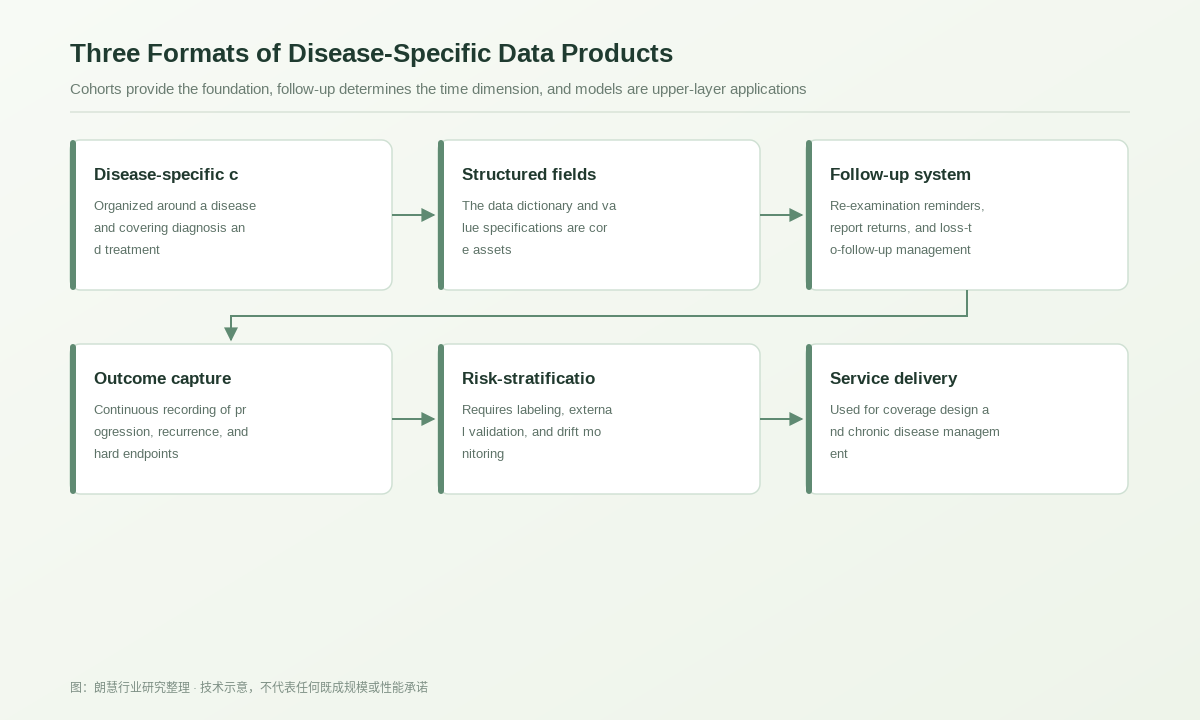
II. Three Product Formats: Cohorts, Follow-Up, and Models
Cohort-based products are organized around a specific disease, with structured fields covering diagnosis, examinations, treatment, medication, and outcomes. Their core asset is not data volume, but the data dictionary and value specifications: whether the same indicator uses consistent definitions across departments and years directly determines whether the cohort can be reused. Fields can be piled up; consistent definitions cannot.
Follow-up products cover the period outside the hospital: reminders for re-examinations, return of reports, medication adherence, and loss-to-follow-up management. They determine the temporal continuity of data, which is exactly what insurance actuarial work lacks most. The quality of in-hospital data at most hospitals is not poor; the gap begins after discharge. Without follow-up, a cohort can only support cross-sectional descriptions, making it impossible to estimate progression and recurrence rates.
Model-based products perform risk stratification and prediction, requiring labels, external validation, and drift monitoring. Their value depends entirely on the quality of the first two: if enrollment criteria are vague and outcomes are incompletely captured, the model learns only recording habits. Beautiful curves in a demonstration environment usually fail to enter the pricing process, and the reason is often not the algorithm.
These three are a progressive relationship, not three independent businesses. A cohort without follow-up cannot support a model, and a model without a cohort is only a demonstration. Selling them separately may close deals in the short term, but in the long term the same data foundation will be rebuilt repeatedly, raising costs rather than lowering them.
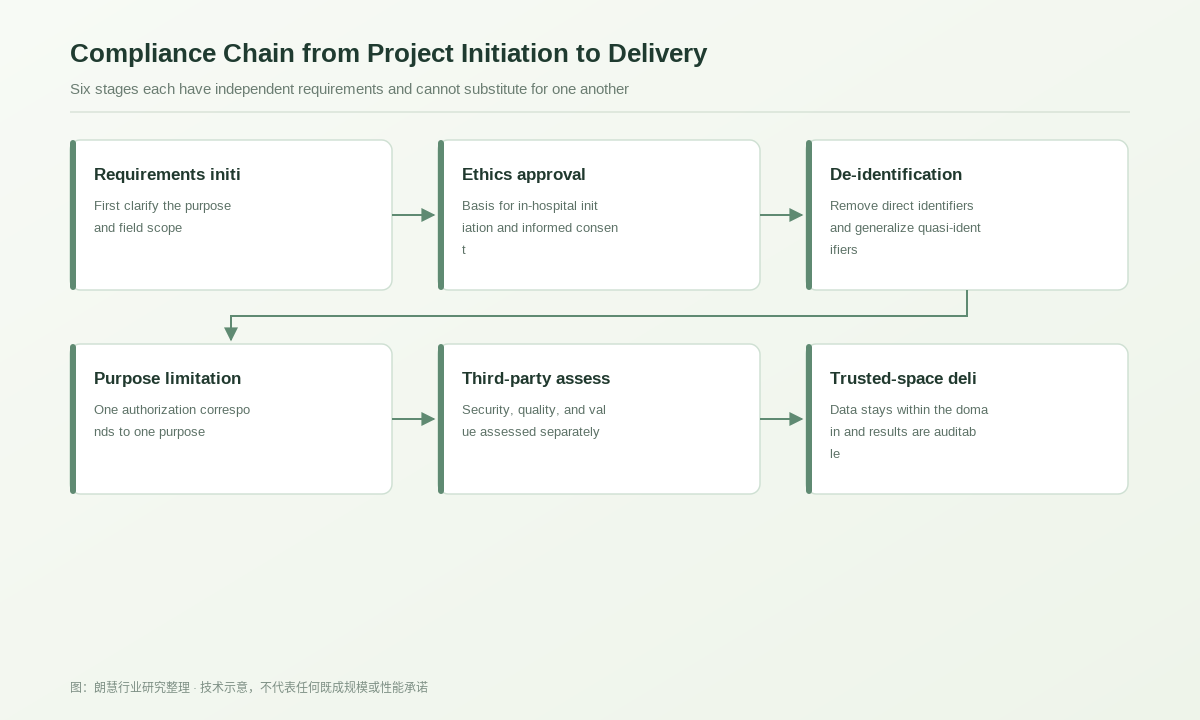
III. Compliance Boundaries: De-identification and Purpose Limitation
De-identification does not mean simply deleting names. Direct identifiers—name, national ID number, contact information, and hospital admission number—must be removed or encrypted. Quasi-identifiers—date of birth, region, visit time, and rare diagnoses—need generalization or perturbation. The more fields are combined, the higher the re-identification risk: one rare disease, one county-level region, and one birth month may point to a specific person.
Purpose limitation is another key thread and is more easily overlooked. The legal basis for research, model training, and underwriting assessment is not the same. Underwriting involves individual rights and interests, so it generally requires separate consent and minimum necessity; research authorization cannot be used to cover it. One authorization for one purpose is a safer approach, even though the process becomes longer.
The delivery method determines the exposure surface: in-hospital delivery, trusted data spaces, or sandbox analysis. Keeping data within the domain while allowing results to leave is the trend, but it places higher demands on the design of the analysis process. What can be run, what can be output, and how it will be audited must be agreed in advance. Using a sandbox as a network drive is equivalent to having no sandbox at all.
Treating already-anonymized data as a universal key is a common mistake. Anonymization reduces re-identification risk, but does not change purpose-limitation requirements or replace ethics approval and third-party assessment. These three things govern different areas and cannot substitute for one another. The sentence most feared in compliance documents is that the data has been anonymized and can therefore be used freely.
IV. Governance: How to Divide Work Between Machines and People
Data comes from at least four categories: business systems (outpatient, inpatient, examinations and laboratory tests), research systems (clinical trial management), operational data, and out-of-hospital follow-up and digital-therapy data. Fragmentation, inconsistent standards, and uneven quality are the common starting point. When a hospital says its data is very clean, it usually just has not started integrating it yet.
For clearly rule-based work such as cleaning, validation, and standardization, machines can handle a substantial share. Fields with complex semantics that require clinical judgment still need manual annotation and review. In common practice, machines perform initial screening and people make final decisions. The ratio varies by field type, so there is no need to place blind faith in any fixed number. Writing the ratio into acceptance criteria is more useful than emphasizing intelligence in a report.
The output of governance is not a single dataset, but a replicable model: field dictionaries, value specifications, quality-control rules, and version records. The more parts can be reused, the lower the marginal cost of the next specialty disease. Conversely, starting every specialty disease from scratch will eventually drag the team down by the third project.
Quality metrics must be acceptable: completeness, accuracy, timeliness, and consistency. A data product without acceptance criteria cannot define responsibility after delivery; if a dispute arises, both sides are left relying on impressions. Writing metrics into delivery documents protects both buyer and seller.
V. How Cohort Data Can Support Underwriting and Actuarial Work
Insurance pricing needs group-level incidence, progression, and recurrence rates, stratified by enrollment criteria—not precise individual prediction points. This distinction determines the design priorities of the data product: enrollment criteria must be executable and outcomes must be capturable. A one-percentage-point improvement in model accuracy may matter less to pricing than completing one more year of follow-up.
The core of pre-existing-condition products is enrollment criteria plus follow-up outcomes. Enrollment criteria must be translated into actionable examinations and staging; otherwise adverse selection cannot be controlled. Outcomes require sufficiently long follow-up; otherwise progression rates cannot be estimated and assumptions are the only option. No matter how conservative the assumptions are, they will struggle to convince actuaries and regulators.
Data scarcity drives conservative pricing, and conservative pricing limits accessibility, creating a cycle. Breaking the cycle depends on long-term follow-up and the accumulation of real-world evidence, not more complex models. This is especially clear in pediatrics and rare diseases: samples are small, so every complete follow-up is worth more.
Compliance must distinguish between group-level actuarial work and individual underwriting. The former uses de-identified group data; the latter involves individual medical information, with a completely different path and authorization requirements. Mixing the two into one process is one of the easiest places for this kind of cooperation to go wrong, and the problem is often discovered only afterward.
VI. Chronic Disease Management: From Claims to Intervention
Insurers' motivation is shifting from screening out risk to managing risk. Conditions with long courses, modifiable risk, and measurable outcomes are suitable for this work, including chronic liver disease and pediatric growth and development disorders. The logic is straightforward: if one severe hospitalization can be avoided, the savings can cover years of management costs.
Service packages usually include reminders for re-examinations, medication adherence, lifestyle intervention, and referral support. Outcome indicators must be defined in advance: follow-up visit rate, adherence rate, or the incidence of hard endpoints. Reporting only participation rate and satisfaction cannot answer whether the program has actually reduced claims.
If payment is linked to outcomes, credible outcome data is required. Here, the data product is infrastructure rather than an add-on. Without a stable data feedback loop, pay-for-performance can only degenerate into pay-per-service, changing the direction of incentives.
A common pitfall is turning health management into a marketing campaign: no control group, no follow-up, no endpoints, and in the end only the number of participants can be used to prove value. To avoid this, the control group and follow-up should be built into the program design from the start, even if the scale is smaller.
VII. Three Commercial Insurance Formats and Their Respective Risks
Recurrence and pre-existing-condition medical insurance: enrollment criteria, waiting periods, and the definition of recurrence are three key points. Adverse-selection risk is highest, and dependence on follow-up data is strongest. A slightly loose definition can send claims out of control; an overly strict definition means no one buys the product. The balance point can only be found through data.
Long-term medical insurance for specific populations: relies on graded assessments based on imaging or examinations and on follow-up pathways, such as the management of people with pulmonary nodules. If grading standards are unstable, the product becomes distorted. The data foundation for this type of product often does not lie in inpatient records, but in standardized descriptions of imaging and follow-up.
Chronic disease management products: rely on service fulfillment and adherence, while the claims-reduction effect takes time to validate. Their risk is not pricing but execution: if the service network cannot reach patients or no one responds to re-examination reminders, even the best model cannot be implemented.
The shared premise of all three is the same: the population can be defined, outcomes can be measured, and the process can be traced. If any one is missing, product design can only rely on assumptions—and assumptions usually do not survive two years of claims data.
| Product Format | Key Data Dependencies | Primary Risks |
|---|---|---|
| Recurrence and pre-existing-condition medical insurance | Enrollment criteria, recurrence definition, long-term follow-up outcomes | Adverse selection; loose definitions leading to uncontrolled claims |
| Long-term medical insurance for specific populations | Imaging or examination grading, follow-up pathways | Unstable grading standards; population drift |
| Chronic disease management products | Adherence, follow-up visit rate, hard-endpoint incidence | Insufficient service fulfillment; effects cannot be verified |
VIII. Hospital Side: Organization, Ethics, and Asset Compliance
Separating data operations from the information department and establishing an independent data center is the approach taken by many organizations: the information department manages technology construction, while the data center manages data governance and products. Whether this division of labor can work depends on having a stable team and institutional framework, not on hanging up a sign. Once the team moves, the accumulated definitions and rules move with it.
In-hospital compliance includes project initiation, ethics approval, data-use processes, and security agreements. Out-of-hospital compliance includes third-party security assessment, data quality assessment, and value assessment. Value assessment is not a formality; it concerns how intangible assets of public institutions are defined. Whether it is done changes the nature of the matter.
Responsibility boundaries remain after delivery: whether the purpose has been followed, whether data has been transferred onward, and how security incidents are handled. These must be written into processes and audit mechanisms, not left to trust. Once data leaves the hospital environment, traceability becomes the final point of control.
Discussions of bringing data assets onto balance sheets and establishing ownership are still at an early stage. Accounting recognition is not the same as compliance. Treating balance-sheet recognition as proof of compliance is the kind of misunderstanding that causes trouble: confirming value on the books does not mean use and transfer are lawful.
IX. Differences Between Pediatric Subspecialties and Liver Disease
Pediatric subspecialties are characterized by small sample sizes, distinctive growth and development indicators, guardian authorization, and long follow-up periods. Data scarcity is even more pronounced, so product design leans more toward coverage and services than fine-grained pricing. When a disease has only a limited number of new cases each year, every case in the cohort becomes more valuable.
Liver disease is characterized by long courses and delayed outcomes. The development of cirrhosis and liver cancer requires years of observation, so follow-up requirements are high. Data generated by antiviral treatment and clinical-cure pathways is highly valuable for long-term risk stratification, but it also means data products require longer patience.
The common ground is that enrollment criteria are executable, outcomes are capturable, and follow-up does not break. If these three cannot be achieved, differences between diseases are only a secondary issue. If they can, the product logic for pediatric and adult specialty diseases can learn from one another.
Differences determine the commercial path. The pediatric direction is more suitable for co-creating products with insurers, designing coverage and service packages together. The liver disease direction is more suitable for risk stratification and long-term management: first prove that intervention can change outcomes, then discuss coverage. Both paths take time and cannot be rushed.
X. Common Misconceptions and Failure Signals
The first misconception is to build a large database before finding demand. Hundreds of fields are added, but no one pays to use them. The correct order is demand-driven: define fields by purpose. A data product is not a data pile. This sounds simple, but in practice it requires rejecting many fields that look useful.
The second misconception is to pursue de-identification to the extreme and make the data useless. Removing all personalized information leaves data that cannot support analysis. There must be a dynamic balance between privacy protection and data value, not one-directional tightening. The standard is simple: can this data still answer the original question?
The third misconception is to treat a one-off transaction as a business model. A single listing can prove the chain works, but not that it is sustainable. The fourth is to treat model accuracy as the selling point while ignoring data compliance and follow-up. What buyers really care about is often whether data can be supplied continuously and whether its use has defects.
Failure signals can be listed as a checklist: interrupted follow-up, field definitions changing by department, no version records, no third-party assessment, and buyers unable to clarify the purpose. If two or more appear, the project will probably stall after delivery rather than fail on the technical side.
XI. Forward-Looking Assessment for the Next 12 to 24 Months
First, trusted data spaces will move from concepts to pilot deliveries, and keeping data within the domain will become the default requirement for more projects. This is good for hospitals: they can participate in joint analysis without handing over raw data. For buyers, it creates new engineering requirements, as analysis workflows in sandboxes must be redesigned.
Second, the number of pre-existing-condition insurance products will increase, and rules for underwriting and data use will become clearer. Regulators will gradually clarify the boundaries for using medical data in insurance. Practice will build consensus on what can be used for group actuarial work and what requires separate authorization. As gray areas narrow, compliance costs become more predictable.
Third, the number of follow-up years for disease-specific cohorts will become a core valuation variable, while the weight of field counts declines. A cohort of 1,000 people with five years of complete follow-up may be worth more than a database with hundreds of thousands of records but missing outcomes. This assessment will change hospitals' investment direction: from collecting more to following longer.
Those to benefit first will be organizations with long-term follow-up systems and governance capability, as well as service providers that can standardize compliance processes. Organizations with only one-off datasets and no follow-up system will see their negotiating room narrow. For teams preparing to enter this path, the most worthwhile investment now is not the model, but follow-up and field definitions.
Langhui's Engineering Capabilities Along This Path
Langhui Technology has produced AI training data since 2016. In healthcare, our work covers the design of acquisition standards, structured annotation, quality control, and consistency reports for CT, MR, PET, mammography, ultrasound, and other modalities. In disease-specific data projects, we are responsible for organizing field definitions, writing annotation specifications, designing quality-control rules, and preparing delivery documentation. We deliver data dictionaries and version records so that every batch of data can be reviewed.
Compliance assessments, ethics approvals, and legal opinions are issued by qualified institutions. We do not replace them or claim to hold the relevant certifications. What we can do is make the data-side work solid: fields are traceable, missing values are marked, and definitions are versioned, so there is evidence to consult during third-party assessment.
If your team is planning a disease-specific data product, needs to organize fields and quality-control standards, or is preparing to clean historical data, send us the disease type, data sources, and intended use. We will provide actionable recommendations.
FAQ
Is it legal for hospitals to provide disease-specific data to companies?
A series of conditions must be met: the data source must be lawful, ethics approval and in-hospital initiation must be completed, de-identification must be applied according to sensitivity level, purpose and duration must be clearly defined, third-party security and quality assessments must be passed, and delivery must follow the agreed method. The key is purpose limitation and traceability, rather than a simple judgment about whether the data can be provided. Uses involving individual rights and interests also require an appropriate authorization basis.
Is patient consent still required after de-identification?
De-identification reduces re-identification risk but does not automatically waive authorization requirements. Whether an exemption applies depends on the purpose, data type, and specific provisions of applicable law. Scenarios involving individual rights and interests, such as insurance underwriting, generally require separate consent and minimum necessity. The safer approach is to handle de-identification and purpose limitation separately rather than treating them as substitutes.
Can commercial insurance underwriting directly use hospital treatment data?
No, it cannot be used directly. Group-level actuarial work and individual underwriting follow two different compliance paths: the former uses de-identified group data, while the latter involves individual medical information and requires separate authorization and strict minimum necessity. Hospitals providing individual treatment data to insurers for underwriting carries high risk and is generally not within the scope of feasible practice.
Must a disease-specific data product be built as a model?
Not necessarily. Cohorts and follow-up are products in themselves. What insurance actuarial work lacks most is often long-term outcome data, not models. Model value is built on data quality and follow-up completeness; a model without follow-up can only serve as a demonstration and cannot enter pricing or underwriting processes.
What is the difference between listing on a data exchange and delivery through a trusted data space?
Exchange-listed transactions are closer to one-off deliveries and suit datasets with clear boundaries. Trusted data spaces emphasize keeping data within the domain, authorizing by purpose, and releasing results, making them suitable for scenarios requiring continuous use or joint modeling. They are not substitutes for each other; the choice depends on purpose, number of participants, and security requirements.
- Personal Information Protection Law of the People's Republic of China (2021) http://www.npc.gov.cn/npc/c30834/202108/a8c4e3672c74491a80b53a172bb753fe.shtml
- Data Security Law of the People's Republic of China (2021) http://www.npc.gov.cn/npc/c30834/202106/7c9af12f51334a73b56d7938f99a788a.shtml
- U.S. Department of Health and Human Services. Guidance Regarding Methods for De-identification of Protected Health Information https://www.hhs.gov/hipaa/for-professionals/privacy/special-topics/de-identification/index.html
- NIST Special Publication 800-188, De-Identifying Government Datasets https://csrc.nist.gov/pubs/sp/800/188/final
- ISO/IEC 20889:2018 Privacy enhancing data de-identification terminology and classification of techniques https://www.iso.org/standard/69373.html