
TRUSTED DATA SPACE / MEDICAL DATASET QUALITY
High-Quality Medical Datasets and Trusted Data Spaces: Five Gates Before Classification, Measurement, and Circulation
A high-quality dataset is not simply a large dataset, and a trusted data space is not just a network drive with permissions. This article separates the two concerns: classifying datasets by purpose and sensitivity, translating six quality principles into field-level acceptance criteria, clarifying source compliance and purpose limitation for multicenter aggregation, setting out five tasks and the minimum requirements for audit trails before circulation, and assessing which capabilities will become thresholds over the next 12 to 24 months.
Discussions of medical AI often stop at two terms: high-quality datasets and trusted data spaces. The former is misread as a matter of scale, while the latter is misread as a permission-enabled network drive. What truly determines project success is the layer between them—field definitions, missing-value indicators, authorization scope, and traceable records. This article breaks the issue into five parts—classification, measurement, compliance, purpose, and audit trails—and aims to provide actions that can be written into acceptance documentation, rather than mere conceptual explanations.
1. Aligning Two Concepts First: A Dataset Is Not Just Size, and a Space Is Not a Network Drive
Start with high-quality datasets. Under publicly available construction guidelines, these are collections of data that have undergone standardized collection, processing, and transformation, can directly support the development of artificial intelligence models, and can improve model performance. Scale is not among the criteria used to judge them. A hospital may have imaging, medical records, and laboratory values across many dimensions and in large volumes, but if they all come from the same patient population, representativeness remains limited.
Next, consider trusted data spaces. A trusted data space is an infrastructure carrier for data, supported by identity and permission controls, end-to-end traceability, and privacy protection mechanisms. Its goal is to make data usable but not visible. Treating it as a network drive is a common misconception: a network drive manages where files are stored, whereas a data space governs who can use the data, for what purposes, at what level of detail, and what records remain after use. The two manage entirely different things.
The relationship between the two is content and channel. A dataset without a channel cannot leave the hospital, forcing multicenter research to rely on personal favors to obtain samples. A channel without content leaves the data space empty, with no fields or volumes to display in its catalog. Many projects stall not because the technology is insufficiently advanced, but because teams build the space first and look for data afterward, or accumulate data first and later think about how it will be used.
Another easily overlooked premise is that the data landscape in clinical research is evolving from 1.0 electronic data capture and 2.0 in-hospital big data platforms toward 3.0 cross-institutional spaces. Each generation has different bottlenecks: 1.0 lacks cross-institutional coordination, 2.0 lacks continuity outside the hospital, and 3.0 lacks usable processing capabilities and clear allocation of rights and responsibilities. Recognizing which generation you are in is more useful than chasing concepts.
2. Classification: Cutting Along Two Axes—Purpose and Sensitivity
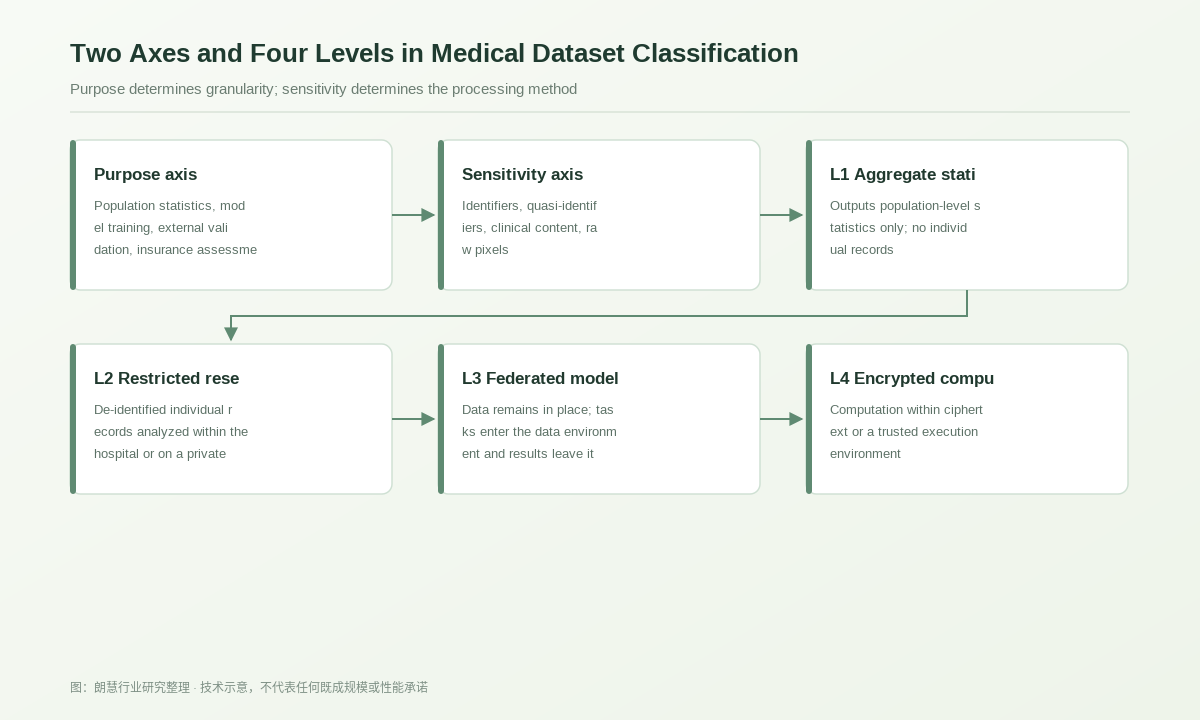
Classification is not about applying labels; it is about giving a clear answer to “who should receive the data, and at what level of detail.” The purpose axis should be divided into at least four categories: population statistics, model training, external validation, and insurance or actuarial assessment. These four purposes have different requirements for field granularity, identifiability, and traceability. Using a single deliverable to cover all four will inevitably overexpose one of them.
The sensitivity axis focuses on the fields themselves: direct identifiers (name, identification number, contact details, hospitalization number), quasi-identifiers (date of birth, region, visit time, rare diagnoses), clinical content (diagnoses, laboratory results, medications, imaging reports), and raw pixels and waveforms. The corresponding processing methods, in order, are deletion or encryption, generalization or perturbation, aggregation, and encrypted computation. Methods must match the fields; a one-size-fits-all approach is inappropriate.
Combining the two axes, practice commonly uses four levels. The aggregate statistical level outputs only population-level statistics. The restricted research level provides de-identified individual records for analysis within the hospital or on a private network. The federated modeling level requires data to remain in place, with tasks entering the data environment and only results leaving it. The encrypted computation level performs calculations within ciphertext or a trusted execution environment. Higher levels involve greater engineering complexity, and not every dataset warrants the highest tier.
Classification is not a one-time label. If the purpose, field scope, or participating parties change, the dataset must be reclassified. The most common mistake is treating “already de-identified” as a classification outcome. De-identification addresses identifiability only; it cannot answer whether the data may be provided to a particular organization for a particular purpose.
| Level | Typical Delivery Method | Applicable Scenarios |
|---|---|---|
| Aggregate statistical level | Population-level statistics and distributions only | Disease burden description and resource allocation assessment |
| Restricted research level | De-identified individual records analyzed within the hospital or on a private network | Single-center cohorts and retrospective studies |
| Federated modeling level | Data remains in place; tasks enter the data environment and results leave it | Multicenter training and external validation |
| Encrypted computation level | Computation within ciphertext or a trusted execution environment | Highly sensitive data and cross-party collaboration |
3. Quality Measurement: Turning Six Principles into Field-Level Acceptance
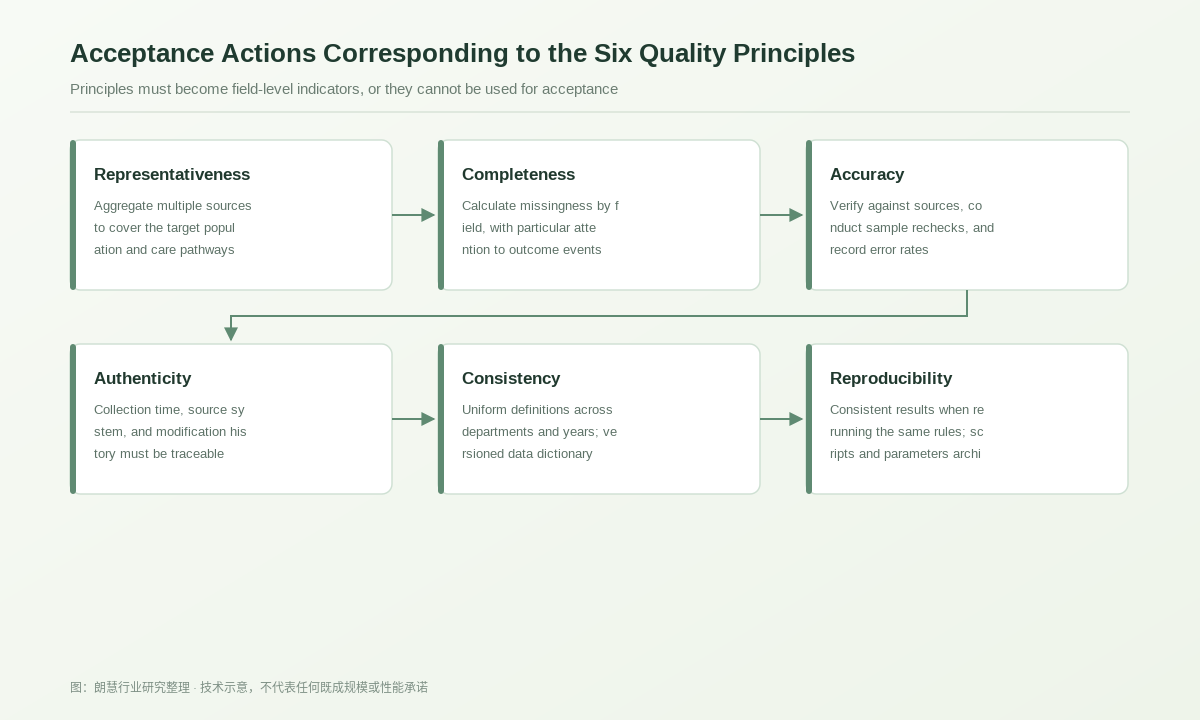
Publicly available data quality assessment frameworks typically identify six principles: representativeness, completeness, accuracy, authenticity, consistency, and reproducibility. The principles themselves are not difficult to understand; the challenge is turning them into indicators that can be written into delivery documentation. Principles that appear only in presentations cannot establish accountability after delivery, leaving both sides to rely on impressions when disputes arise.
Representativeness determines whether the data can answer the intended question. The representativeness of single-center data is inherently limited, making multi-source aggregation a necessary path. However, different institutions apply different definitions and methods to the same fields, and the industry lacks unified standards, making field-by-field alignment extremely time-consuming. This work is often underestimated and should be listed separately when scheduling the project.
Completeness must be assessed at the field level, not merely by total row count. The most prominent problem in current medical data is missing outcome events. If key outcomes such as progression, recurrence, and death are not captured, the cohort can support only cross-sectional descriptions. Missing rates should be calculated separately by field, year, and department, and identified as either random or systematic missingness, since the two require completely different handling.
Accuracy and consistency depend on source verification and the codification of rules. Third-party shallow cleaning and structured extraction can introduce errors at the source. Analysis based on erroneous data will not become correct merely because the algorithm is complex. Consistency requires uniform definitions across departments and years, and data dictionaries must carry version numbers. Reproducibility requires that rerunning the same rules produce the same results, with scripts and parameters archived. Algorithms cannot replace data quality assessment. Metrics can be made to look good through algorithmic combinations, but their weaknesses emerge when generalizing to a different setting.
4. Source Compliance: Multicenter Aggregation Requires Three Categories of Evidence
The first category is source evidence: data generated through clinical activities at the hospital, including the scope of collection, the basis—or exemption—for notification and consent, ethics approvals, and internal project initiation documents. This category is relatively mature in single-center research but can break down in multicenter studies because original authorizations often cover only use within the originating institution.
The second category is processing evidence: who processed which fields, when and under what rules, the de-identification methods and validation records, and the conclusions of the security assessment. The value of this category lies in reconstructing the process when something goes wrong, not in proving that “we were careful.” Without process records, no explanation will hold up.
The third category is the authorization chain: whether the original authorization covers secondary use, multicenter use, model training, and external validation. If it does not, authorization must be obtained again or an applicable exemption pathway must be followed. Treating research authorization as a universal pass is the most common compliance gap in this kind of collaboration, and it is often discovered only when the results are being published.
The practical situation must be recognized: there is currently no unified third-party qualification that can provide blanket compliance certification for a medical dataset. Assessment is conducted separately across security, quality, and value. Evidence must therefore be assembled internally. The more complete it is, the easier subsequent assessments become and the more readily collaboration partners will accept it.
5. Purpose Limitation: One Authorization Corresponds to One Purpose
Research, model training, external validation, and insurance assessment have different legal and ethical foundations. Scenarios involving insurance and actuarial evaluation affect individual rights and typically require separate authorization and data minimization; authorization obtained for research cannot cover them. This boundary must be established at the beginning of a project. Revisiting it after delivery is far more costly and can damage trust in the collaboration.
The technical implementation should be a policy, not merely a document. The data space must support definitions of which type of entity, under which project, may run which type of task, produce output at what level of detail, and query how many records. Creating a task space for each project and revoking access when the project ends is far safer than granting standing access to the same data pool.
Data minimization must extend to field scope and time range. Delivering all fields is a common overreach: a study may need only a few indicators and outcomes, yet receives the entire structured medical record. Fewer fields reduce re-identification risk, make auditing easier, and can even improve analytical efficiency.
Purpose drift requires detection mechanisms. Query frequency, number of output records, and task type are all signals. When out-of-scope use is detected, there must be processes for suspending access and assigning accountability. Relying solely on retrospective review is insufficient: by the time misuse is discovered, the data may already have circulated, with little likelihood of recovery.
6. Five Tasks Before Circulation
First, confirm the need and purpose in one sentence: who will use the data, what question it is intended to answer, and what output is required. If this sentence is vague, neither the field requirements nor compliance can be defined. Second, prepare a list of fields and levels of granularity, indicating which fields are mandatory, which can be generalized, and which should be deleted outright. The list must be understandable to non-technical staff.
Third, produce a quality and missing-data report. At a minimum, it should include field-level missing rates, how outcomes are captured and over what time span, deduplication rules, and known biases—for example, coverage limited to inpatients or to a particular hospital campus. This report is the requester’s basis for judging usability and a record that can be produced if questions arise later.
Fourth, assemble the compliance evidence package corresponding to the three categories described in the previous section. Fifth, agree on exit and destruction: how long data will be retained within the space, how copies will be managed, and whether model parameters count as derivatives. The last point is particularly contentious because parameters may encode information about the training data; treating them as freely transferable products carries significant risk.
None of these five tasks is technically profound, but the absence of any one will stop delivery at some stage. A more common pattern is that the first two are completed quickly while the last three are postponed to “before launch,” ultimately resulting in a bare delivery without a quality report, evidence package, or exit agreement.
- One-sentence description of need and purpose: who will use the data, what question it answers, and what output is required
- Field and granularity list: separate mandatory, generalizable, and fields to be deleted
- Quality and missing-data report: field-level missing rates, outcome capture method, and known biases
- Compliance evidence package: three categories of documents covering source, processing, and authorization chain
- Exit and destruction agreement: retention period, copy management, and ownership of model parameters
7. Audit Trails: What Must Be Preserved Is Decisions, Not Hashes
At minimum, three categories of audit trail are required: access and task logs (who, when, what was run, and how much was output), field and rule versions (which version of the data dictionary and cleaning rules), and approvals and conclusions (who approved them and on what basis). If any one of the three is missing, the chain is broken and no key decision can be reconstructed afterward.
Blockchain can prove that a record has not been tampered with, but it cannot prove that the record is complete. Any process step omitted before recording will remain permanently blank. The sequence should therefore be: first record every process node, and only then decide whether to put the records on a blockchain. Doing it in reverse merely adds an immutable shell to an incomplete process—it looks rigorous but reveals nothing when problems are investigated.
Audit trails must also be usable. When an incident occurs, the people reading the logs are often not engineers, so exports must be understandable to humans: timelines, decision points, responsible parties, and scope of impact. If that is not achieved, logs merely consume storage, and audits still depend on human memory—effectively equivalent to having no audit trail.
There is tension between retention periods and the right to deletion. Deletion requests for personal information may conflict with audit trail requirements, so the rules must be designed at the institutional level: which records are retained long term, which are anonymized after a specified period, and who may approve extensions. Ideally, these rules should be written into the agreement at the start of a project rather than discussed only after a conflict arises.
8. Three Eras of Multicenter Research and the Practical Shortcomings of Data Spaces
1.0 is the electronic data capture platform, still used today for small cohort studies, with mature capabilities such as automated recognition and logical checks. Its limitation is that hospitals increasingly discourage exporting electronic medical records, so cross-institutional collaboration depends on separate data entry at each center, which becomes unsustainable as data volume grows.
2.0 is the in-hospital medical big data platform, which integrates multi-source data and provides visual querying and field quality-control modules; use applications require ethics and project approval. It works well for single-center studies, but cross-institutional collaboration still returns to the old problem of sending data out—only with a different interface.
3.0 is the trusted data space, which can be deployed locally or centrally according to control requirements. Surveys reveal very specific shortcomings: the absence of standardized data catalogs, preventing requesters from seeing which fields exist and how much data there is; unclear allocation of rights and responsibilities among data providers, users, operators, and service providers; tension between closed environments with real-time statistical tools and large-scale parallel training; and a poor upload-and-download experience for high-volume data.
These shortcomings point to the same conclusion: the value of a space lies not in building it, but in its ability to process data. If a complete analytical workflow cannot run inside the space, it is merely a more expensive storage repository. Conversely, getting the processing pipeline working first and then gradually completing the catalog, responsibilities, and tools will lead to a much more stable deployment.
9. Clinicians Are the Hub, Not a Supporting Party
How variables are defined, how inclusion criteria are translated into executable checks and staging rules, and how outcomes are determined all depend on clinical knowledge. Field dictionaries produced by purely technical teams commonly fail in clinical practice: the definitions appear rigorous, but no one can actually complete them as written.
Annotation and quality control can be divided as follows: machines handle initial screening and rule-based checks, while clinicians handle adjudication and borderline cases. The balance varies by field type and need not be fixed at a specific number. Writing this division into acceptance criteria is more meaningful—and easier to review—than emphasizing intelligence in presentations.
Organizationally, there must be a clinical lead and a fixed review cadence. Every revision of the data dictionary should have a review record and an effective date. Otherwise, the same indicator may use different definitions across projects, data can never be aggregated, and several years later all that remains is a collection of tables that cannot be aligned.
Incentives are often overlooked. If clinicians’ investment in data governance is reflected neither in evaluation systems nor in authorship, sustaining that effort will be difficult. Unless this issue is addressed, even the best standards will depend on individual enthusiasm, and the process will fall apart when key people leave.
10. Common Misconceptions and Warning Signs of Failure
Misconception one: a large volume means high quality. Misconception two: de-identification equals compliance. Misconception three: build the space first and find the data afterward. What these three misconceptions share is mistaking a means for an end: data exists to answer questions, not to demonstrate construction achievements.
Misconception four: using algorithms to mask data defects. A model may perform well on an internal test set and then decline at another hospital. In most cases, this is not algorithmic degradation but the effect of differences in definitions, missingness, and selection bias in the source data. Misconception five: treating a one-time delivery as a long-term supply. By the time the second batch arrives, the fields may have changed, making the analysis of the previous batch impossible to reproduce.
Warning signs can be presented as a checklist: an unclear outcome missing rate; field definitions that vary by department; no version records; no one able to explain the full purpose of the data; an audit package that cannot be exported; and a requester that receives the data but produces no analysis for an extended period. If two or more signs appear, the project will most likely stall after delivery.
There is one simple criterion: if a dataset cannot be reused by a second team without consulting its original authors, it is not yet a product—it is merely an intermediate product of a one-time analysis. This criterion is unappealing, but it is highly accurate.
11. Forward-Looking Assessment for the Next 12 to 24 Months
First, trusted data spaces will move from concepts to pilot deliveries. Publicly released action plans propose building more than 100 industry-level and regional-level spaces by 2028, and a number of nodes are likely to be implemented over the next one or two years. However, the basis of evaluation will shift from how many spaces were built to how many projects have been proven to work, with teams that can run end-to-end data processing pipelines gaining a clear advantage.
Second, data catalogs and metadata standards will become competitive differentiators. The first step for a data requester is to inspect the catalog: which fields are available, how much data exists, what time period it covers, what its quality is, and under what authorization conditions it may be used. Whoever can standardize the presentation of these five things will be found first—this will matter more than explaining the technical architecture again.
Third, tiered encryption will become the default approach rather than applying the highest level to everything. Medical data already has different security levels; processing all data at the highest level is unsustainable in both cost and complexity. Tiering by sensitivity is what can scale and leave room in the budget for the data that is genuinely sensitive.
The first beneficiaries will be institutions with long-term follow-up systems and governance capabilities, as well as service providers that can productize quality-control processes. Institutions with only one-time datasets and no follow-up or version management will see their bargaining position narrow. If investments are to be made now, the priority should be field definitions and follow-up, rather than purchasing yet another platform.
Langhui's Engineering Capabilities Along This Path
Since 2016, Langhui Technology has been producing AI training data. Its healthcare work spans CT, MR, PET, mammography, ultrasound, and other modalities. The team can undertake the design of data collection protocols, structured annotation, quality control, and consistency reporting, and can deliver data dictionaries and version records so that every batch of data can be reviewed.
For disease-specific dataset projects, we handle the scope of field definitions, the writing of annotation guidelines, the design of quality-control rules, and the preparation of delivery documentation. Ethics approvals, legal opinions, and compliance certifications are issued by qualified organizations; we do not replace them or claim to hold the relevant certifications.
If your team is planning a disease-specific dataset, preparing to clean historical data, or needs to turn field and quality-control standards into acceptance-ready documentation, send us the disease area, data sources, and intended use, and we will provide actionable recommendations.
FAQ
Does a higher-quality dataset simply mean more data?
No. The criterion is whether the data can directly support model development and improve model performance; scale is only one condition. Even if single-center data has many dimensions and a large number of rows, its sample representativeness remains limited. Conversely, a cohort that is not large but has complete outcomes, consistent definitions, and reproducibility often has greater value.
What is the difference between a trusted data space, a network drive, and a data exchange?
A network drive provides storage and access, while a data exchange handles one-time listing and delivery. A trusted data space addresses authorization, computation, and audit during ongoing use: who may use the data, what tasks they may run, what output granularity is permitted, and what records remain. The three can coexist, but they cannot substitute for one another.
Once data has been de-identified, can it be shared freely?
No. De-identification reduces re-identification risk, but it neither changes purpose-limitation requirements nor replaces ethics approval and security assessment. The more fields are combined, the higher the re-identification risk. Scenarios involving individual rights, such as insurance and actuarial assessment, typically also require separate authorization and data minimization.
Which step takes the most time in multicenter data aggregation?
Usually, aligning field definitions. Institutions differ in how they define the same indicators, their units, and their value conventions, while the industry lacks unified standards, making field-by-field checking and conversion extremely time-consuming. Providing data dictionaries and value specifications in advance can substantially reduce this back-and-forth.
Must audit trails use blockchain?
Not necessarily. First ensure that all key nodes are recorded and that the records are readable and exportable; only then consider tamper-resistance mechanisms. Blockchain can prove that records have not been modified, but it cannot recover parts that were never recorded. Putting an incomplete process on a blockchain merely makes the incompleteness permanent.
- Data Security Law of the People's Republic of China (2021) http://www.npc.gov.cn/npc/c30834/202106/7c9af12f51334a73b56d7938f99a788a.shtml
- Personal Information Protection Law of the People's Republic of China (2021) http://www.npc.gov.cn/npc/c30834/202108/a8c4e3672c74491a80b53a172bb753fe.shtml
- ISO/IEC 25012:2008 Data quality model https://www.iso.org/standard/35736.html
- NIST Special Publication 800-188, De-Identifying Government Datasets https://csrc.nist.gov/pubs/sp/800/188/final
- Wilkinson et al. The FAIR Guiding Principles for scientific data management and stewardship https://www.nature.com/articles/sdata201618
- OHDSI OMOP Common Data Model https://ohdsi.github.io/CommonDataModel/