
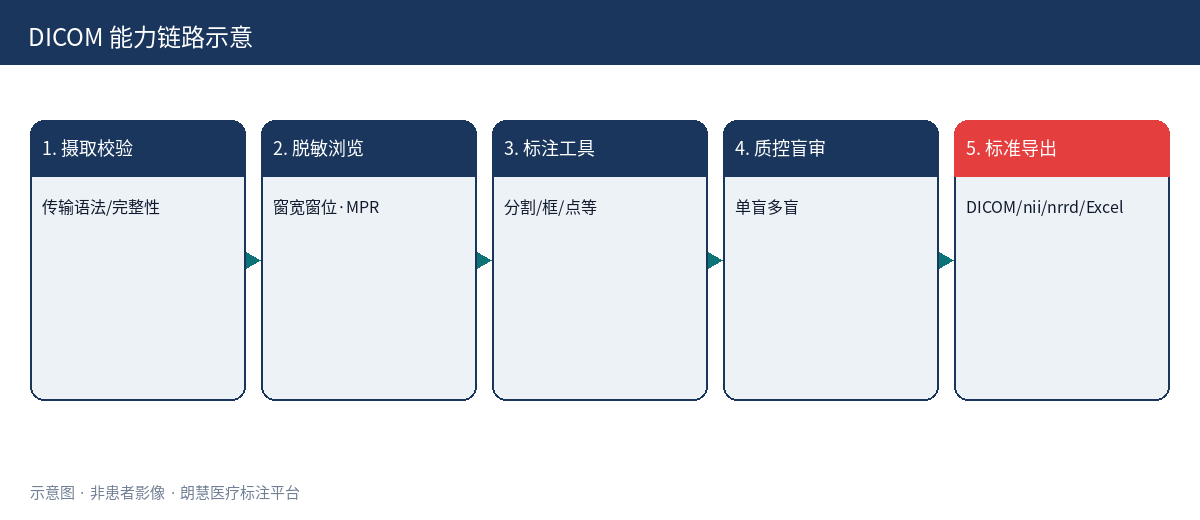
Bottom line: Score a DICOM annotation platform across ingest → desensitized viewing → tools → blind QC → standard export → deployment/collaboration. A pretty brush demo is not a CT/MR/PET delivery system.
2026 directions
Public standards and research discuss segmentation object interoperability, local DICOM governance under federated settings, and coupling annotation with privacy-preserving training. Keep “export opens downstream” and “on-prem” as hard gates; keep unfinished frontier features as bonuses.
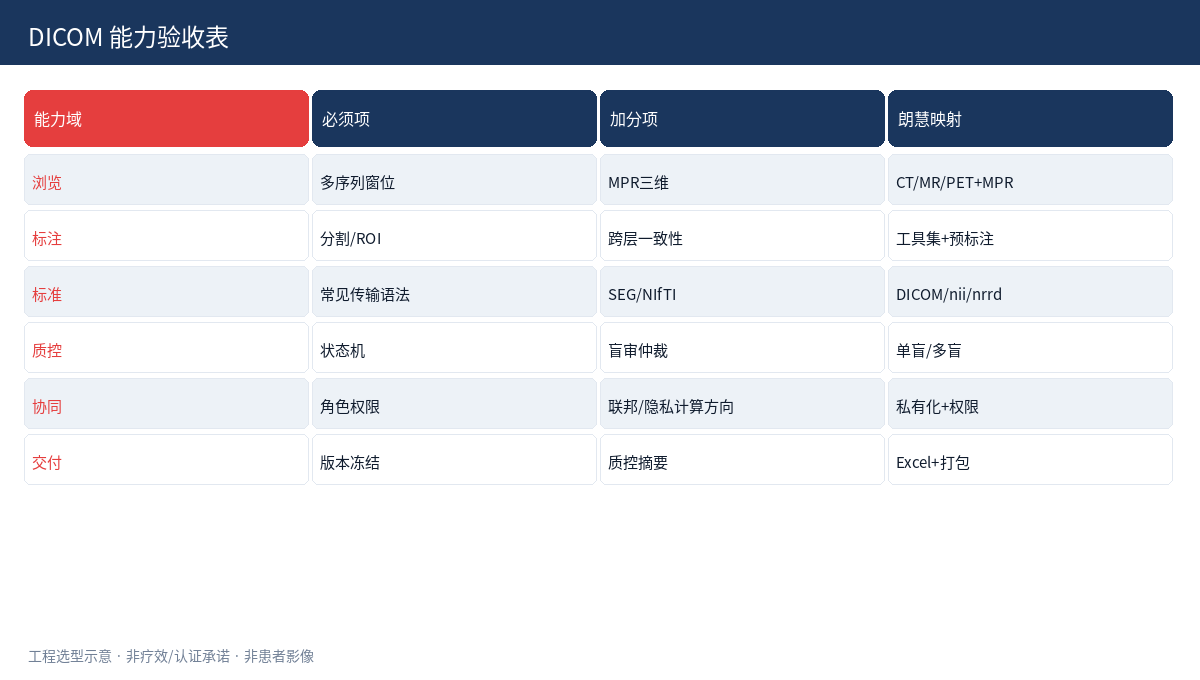
Capability checklist
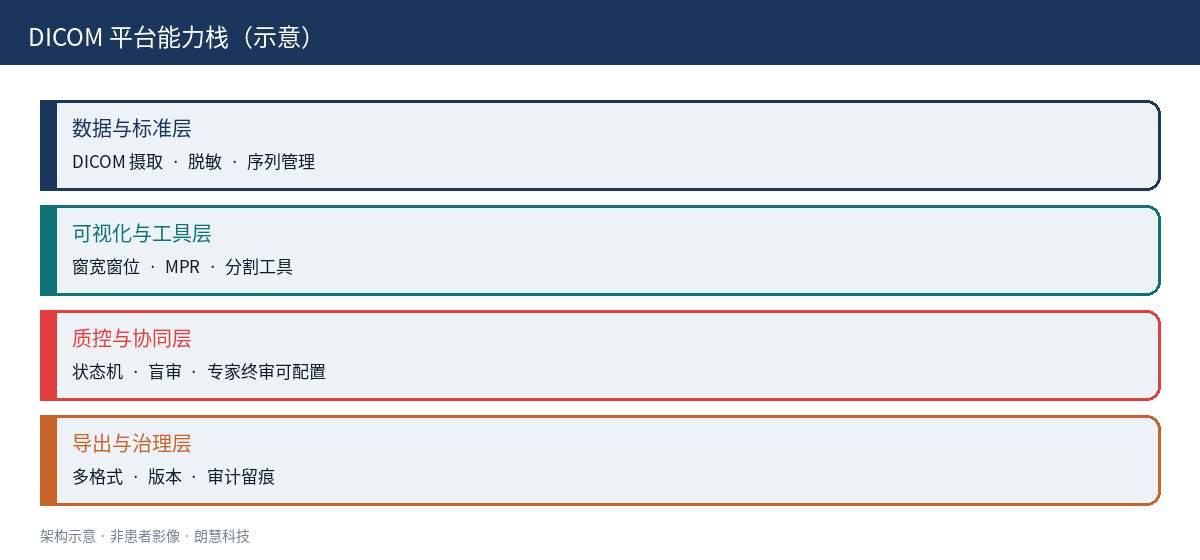
- Ingest & validation (transfer syntax, integrity, quarantine).
- Desensitized viewing (windowing, multi-series, MPR for CT/MR/PET).
- Tools (segmentation/ROI; cross-slice checks; pre-label drafts).
- QC (state machine; single-/multi-blind; expert final review).
- Export (DICOM/nii/nrrd/Excel; version; dictionary; QC note).
- Collaboration & residency (RBAC; on-prem; audit; clear pixel-egress policy).
Pitfalls
Vendor-perfect series only; missing MPR on 3D work; proprietary export with no converter; promising federated learning as if it were the annotation product.
LangHui mapping
CT/MR/PET + MPR; 180+ pretrained segmentation; single-/multi-blind; on-prem; desensitization on upload; DICOM/nii.gz/nrrd/Excel.
Transfer syntax vs “it opens”
First prove ingest on your authorized, already-desensitized samples—not only the vendor’s showcase studies. If downstream insists on DICOM-SEG or a private schema, isolate that in the PoC export drill and document converters. Reproducibility beats premature automation claims.
Operational notes for procurement
Translate each checklist row into three columns in the RFP annex: requirement, evidence artifact, and non-conformity handling. Require the vendor to run the PoC on a timeline you control, with your roles (admin, labeler, reviewer, expert final reviewer) rather than a single superuser. Capture screenshots of fail-closed desensitization, a rejected case with reason codes, and an export opened in the receiving toolchain. Keep language free of absolute marketing adjectives and free of therapeutic promises.
For multi-site studies, document whether pixels, labels, or model updates move. If only labels or gradients move, say so explicitly. If pixels must never move, say that as a hard constraint and verify network controls during the PoC. Align contracts with PIPL/data-security themes applicable to your jurisdiction, and treat foreign frameworks such as HIPAA as principle references unless your counsel states otherwise.
LangHui Technology publishes product capabilities on langhuiai.com without fabricating traffic metrics or unverifiable accuracy numbers. Use those public facts as the ceiling for marketing claims in your own internal decks. When in doubt, demote a claim to “engineering practice direction” and ask for a staged proof.
Finally, keep the earlier Chinese pillar articles under medical-annotation-seo-2026 as complementary reading for YY/T educational mapping and dataset QC narratives. This 2026 matrix focuses on selection intent queries and bilingual discoverability with hreflang between zh-CN and en.
Operational notes for procurement
Translate each checklist row into three columns in the RFP annex: requirement, evidence artifact, and non-conformity handling. Require the vendor to run the PoC on a timeline you control, with your roles (admin, labeler, reviewer, expert final reviewer) rather than a single superuser. Capture screenshots of fail-closed desensitization, a rejected case with reason codes, and an export opened in the receiving toolchain. Keep language free of absolute marketing adjectives and free of therapeutic promises.
For multi-site studies, document whether pixels, labels, or model updates move. If only labels or gradients move, say so explicitly. If pixels must never move, say that as a hard constraint and verify network controls during the PoC. Align contracts with PIPL/data-security themes applicable to your jurisdiction, and treat foreign frameworks such as HIPAA as principle references unless your counsel states otherwise.
LangHui Technology publishes product capabilities on langhuiai.com without fabricating traffic metrics or unverifiable accuracy numbers. Use those public facts as the ceiling for marketing claims in your own internal decks. When in doubt, demote a claim to “engineering practice direction” and ask for a staged proof.
Finally, keep the earlier Chinese pillar articles under medical-annotation-seo-2026 as complementary reading for YY/T educational mapping and dataset QC narratives. This 2026 matrix focuses on selection intent queries and bilingual discoverability with hreflang between zh-CN and en.
Operational notes for procurement
Translate each checklist row into three columns in the RFP annex: requirement, evidence artifact, and non-conformity handling. Require the vendor to run the PoC on a timeline you control, with your roles (admin, labeler, reviewer, expert final reviewer) rather than a single superuser. Capture screenshots of fail-closed desensitization, a rejected case with reason codes, and an export opened in the receiving toolchain. Keep language free of absolute marketing adjectives and free of therapeutic promises.
For multi-site studies, document whether pixels, labels, or model updates move. If only labels or gradients move, say so explicitly. If pixels must never move, say that as a hard constraint and verify network controls during the PoC. Align contracts with PIPL/data-security themes applicable to your jurisdiction, and treat foreign frameworks such as HIPAA as principle references unless your counsel states otherwise.
LangHui Technology publishes product capabilities on langhuiai.com without fabricating traffic metrics or unverifiable accuracy numbers. Use those public facts as the ceiling for marketing claims in your own internal decks. When in doubt, demote a claim to “engineering practice direction” and ask for a staged proof.
Finally, keep the earlier Chinese pillar articles under medical-annotation-seo-2026 as complementary reading for YY/T educational mapping and dataset QC narratives. This 2026 matrix focuses on selection intent queries and bilingual discoverability with hreflang between zh-CN and en.
Operational notes for procurement
Translate each checklist row into three columns in the RFP annex: requirement, evidence artifact, and non-conformity handling. Require the vendor to run the PoC on a timeline you control, with your roles (admin, labeler, reviewer, expert final reviewer) rather than a single superuser. Capture screenshots of fail-closed desensitization, a rejected case with reason codes, and an export opened in the receiving toolchain. Keep language free of absolute marketing adjectives and free of therapeutic promises.
For multi-site studies, document whether pixels, labels, or model updates move. If only labels or gradients move, say so explicitly. If pixels must never move, say that as a hard constraint and verify network controls during the PoC. Align contracts with PIPL/data-security themes applicable to your jurisdiction, and treat foreign frameworks such as HIPAA as principle references unless your counsel states otherwise.
LangHui Technology publishes product capabilities on langhuiai.com without fabricating traffic metrics or unverifiable accuracy numbers. Use those public facts as the ceiling for marketing claims in your own internal decks. When in doubt, demote a claim to “engineering practice direction” and ask for a staged proof.
Finally, keep the earlier Chinese pillar articles under medical-annotation-seo-2026 as complementary reading for YY/T educational mapping and dataset QC narratives. This 2026 matrix focuses on selection intent queries and bilingual discoverability with hreflang between zh-CN and en.
Operational notes for procurement
Translate each checklist row into three columns in the RFP annex: requirement, evidence artifact, and non-conformity handling. Require the vendor to run the PoC on a timeline you control, with your roles (admin, labeler, reviewer, expert final reviewer) rather than a single superuser. Capture screenshots of fail-closed desensitization, a rejected case with reason codes, and an export opened in the receiving toolchain. Keep language free of absolute marketing adjectives and free of therapeutic promises.
For multi-site studies, document whether pixels, labels, or model updates move. If only labels or gradients move, say so explicitly. If pixels must never move, say that as a hard constraint and verify network controls during the PoC. Align contracts with PIPL/data-security themes applicable to your jurisdiction, and treat foreign frameworks such as HIPAA as principle references unless your counsel states otherwise.
LangHui Technology publishes product capabilities on langhuiai.com without fabricating traffic metrics or unverifiable accuracy numbers. Use those public facts as the ceiling for marketing claims in your own internal decks. When in doubt, demote a claim to “engineering practice direction” and ask for a staged proof.
Finally, keep the earlier Chinese pillar articles under medical-annotation-seo-2026 as complementary reading for YY/T educational mapping and dataset QC narratives. This 2026 matrix focuses on selection intent queries and bilingual discoverability with hreflang between zh-CN and en.
From gap analysis to contract annex
After reading the matrix, spend five working days on an internal gap analysis. Day one: IT sketches the network boundary and residency status. Day two: the research office lists modalities, approximate cohort size ranges, and whether guidelines are frozen. Day three: QC owners define when single-blind or multi-blind triggers. Day four: counsel or ethics staff verify authorization scope and retention. Day five: consolidate must / nice / never columns, then book a LangHui Medical Annotation Platform demo or another shortlist candidate against the same sheet.
Contract annexes should include topology and egress lists, desensitization policies, RBAC matrices, state transitions, export formats and version fields, PoC pass criteria, operations duties for patching and account revocation, and the path to expert final review. Prefer process verbs—“fail closed on ingest”, “pre-labels remain drafts”—over unverifiable adjectives.
Foundation-model buyers should emphasize provenance: who labeled and reviewed under which guideline version, how sampling metrics are defined, how exclusion lists are maintained, and how batch IDs map to training runs. Hospital buyers should emphasize on-site residency, desensitization on upload, exportable audits, and ethics packets. Do not copy throughput marketing from dataset vendors into hospital projects unchanged.
QC calendar and stratified sampling
Blind-review features do not replace a sampling calendar. Tier by risk: integrity checks for low risk; stratified samples for medium risk; higher review rates plus configurable expert final review for high risk. Feed top error types back into guideline edits and dictionary freezes. Define Dice/Kappa-style metrics yourselves; do not accept fabricated public accuracy or customer-count claims. LangHui’s public materials intentionally stay within verifiable tooling and deployment facts.
Training and trial rounds
Run at least two trial rounds before production: boundary calibration, then blind review with dispute taxonomy. Use authorized site data that includes artifacts and anatomical variants. Archive training records, guideline versions, and pass criteria. External collaborators get separate roles and timely offboarding. Any remote support egress on private installs must be approved and time-boxed—these details decide whether “data never leaves” survives an audit.
Reading order: the matrix article closest to your intent, then the product dual-path matrices, then optional earlier Chinese pillars under medical-annotation-seo-2026. English pages live under /en/news/medical-annotation-matrix-2026/ with hreflang both ways. Compliance: no absolute ad claims; no therapeutic substitution language; HIPAA principle-aligned only; YY/T educational only; vendor credentials never replace customer duties under privacy and data-security regimes applicable to you.
From gap analysis to contract annex
After reading the matrix, spend five working days on an internal gap analysis. Day one: IT sketches the network boundary and residency status. Day two: the research office lists modalities, approximate cohort size ranges, and whether guidelines are frozen. Day three: QC owners define when single-blind or multi-blind triggers. Day four: counsel or ethics staff verify authorization scope and retention. Day five: consolidate must / nice / never columns, then book a LangHui Medical Annotation Platform demo or another shortlist candidate against the same sheet.
Contract annexes should include topology and egress lists, desensitization policies, RBAC matrices, state transitions, export formats and version fields, PoC pass criteria, operations duties for patching and account revocation, and the path to expert final review. Prefer process verbs—“fail closed on ingest”, “pre-labels remain drafts”—over unverifiable adjectives.
Foundation-model buyers should emphasize provenance: who labeled and reviewed under which guideline version, how sampling metrics are defined, how exclusion lists are maintained, and how batch IDs map to training runs. Hospital buyers should emphasize on-site residency, desensitization on upload, exportable audits, and ethics packets. Do not copy throughput marketing from dataset vendors into hospital projects unchanged.
QC calendar and stratified sampling
Blind-review features do not replace a sampling calendar. Tier by risk: integrity checks for low risk; stratified samples for medium risk; higher review rates plus configurable expert final review for high risk. Feed top error types back into guideline edits and dictionary freezes. Define Dice/Kappa-style metrics yourselves; do not accept fabricated public accuracy or customer-count claims. LangHui’s public materials intentionally stay within verifiable tooling and deployment facts.
Training and trial rounds
Run at least two trial rounds before production: boundary calibration, then blind review with dispute taxonomy. Use authorized site data that includes artifacts and anatomical variants. Archive training records, guideline versions, and pass criteria. External collaborators get separate roles and timely offboarding. Any remote support egress on private installs must be approved and time-boxed—these details decide whether “data never leaves” survives an audit.
Reading order: the matrix article closest to your intent, then the product dual-path matrices, then optional earlier Chinese pillars under medical-annotation-seo-2026. English pages live under /en/news/medical-annotation-matrix-2026/ with hreflang both ways. Compliance: no absolute ad claims; no therapeutic substitution language; HIPAA principle-aligned only; YY/T educational only; vendor credentials never replace customer duties under privacy and data-security regimes applicable to you.
LangHui Medical Annotation Platform — Capability Map
Public product capabilities mapped to this article (educational reference; not a certification or clinical claim):
- Models & modalities: 180+ pretrained segmentation models; CT / MR / PET; MPR 3D verification.
- QC & review: single-blind / multi-blind review; status workflow; configurable expert final-review network.
- Security & deployment: desensitization on upload; role isolation; on-premises so data stays in the customer environment. Vendor security credentials do not replace the customer's classified-protection / privacy / ethics duties.
- Export: DICOM / nii.gz / nrrd / Excel packages with version freeze for reproducibility.
Product: Annotation Platform · About
FAQ
Required modalities?
Per study; commonly CT/MR/PET. LangHui publicly covers these with MPR.
MPR for 3D delivery?
Treat as required when 3D consistency matters.
Only NIfTI OK?
If downstream agrees; keep a manifest/version note.
Is federated learning the product?
Usually separate; prove on-prem DICOM annotation first.
Minimal QC set?
State machine + blind modes + reject reasons + expert final review option.
LangHui exports?
DICOM / nii.gz / nrrd / Excel.
Book a demo: selection, QC, and on-prem in one platform
LangHui Medical Annotation Platform: 180+ segmentation models, CT/MR/PET, MPR, single-/multi-blind review, desensitization on upload, on-premises.
View platform Contact / demo