
REGIONAL IMAGING DATA / DELIVERY MANAGEMENT
Regional Imaging Data Project Delivery Management: Scheduling, De-Identification Pipelines, and Quality-Control Sampling
The success or failure of a regional imaging data project usually depends less on collection than on delivery. This article breaks delivery down into six areas: scheduling and capacity, de-identification pipelines, quality-control sampling, hospital coordination, milestones, and risks. Drawing on public observations from regional digital health conferences, it discusses how to manage work as a structured process, why rework occurs, and how the next two years may change. It is intended as a reference for project leaders and data teams, and can also serve as a working document for internal project initiation and acceptance discussions.
For a regional imaging data project, the technical solution can often be written in a few days, while delivery can take months. Multiple hospitals, heterogeneous environments, fixed time windows, and the need to keep hospitals' routine operations running mean that a single scheduling problem can bring progress to a halt. What looks like a data problem on the surface is often a process and coordination problem. This article divides delivery into manageable stages and discusses how to estimate capacity, how to maintain de-identification records, and how to determine sampling results. It also identifies the stages most prone to rework. The evaluation criteria in this article can be adapted directly into your team's checklist, without starting from scratch, making revisions quick.
1. Why Regional Imaging Projects Are Difficult to Deliver
Regional imaging data projects sound like a collection problem, but once work begins they turn out to be a delivery problem. Collection is only the entry point. What follows includes retrieval and export, structuring, de-identification, quality control, packaging, and hospital acceptance. Every step can become blocked. Delays are rarely caused by an inability to solve a particular technical issue; more often, a process lacks sufficient capacity or no one has the authority to make a decision in a coordination step.
Regional projects have three defining characteristics: multiple hospitals, heterogeneous environments, and fixed time windows. Multiple hospitals mean that systems and data definitions differ. Heterogeneous environments mean that the same script may fail at another hospital. Time windows are often tied to conferences, milestones, and assessments, and cannot simply be postponed. Only by taking all three factors into account can scheduling become meaningful; otherwise, the plan is merely a transcription of an ideal scenario.
There is also a variable that is often underestimated: hospitals' routine operations. Imaging departments must produce reports every day, PACS retrieval uses bandwidth during peak hours, and engineers can only work in gaps between operations. If scheduling does not account for these constraints, even an attractive plan cannot be implemented. In practice, the larger the hospital, the more fragmented the available windows tend to be, and the more important it is to reserve time in advance. Mapping available windows on a calendar is more effective than repeatedly chasing people at regular meetings.
2. Scheduling and Capacity: Breaking the Total Timeline into Process Steps
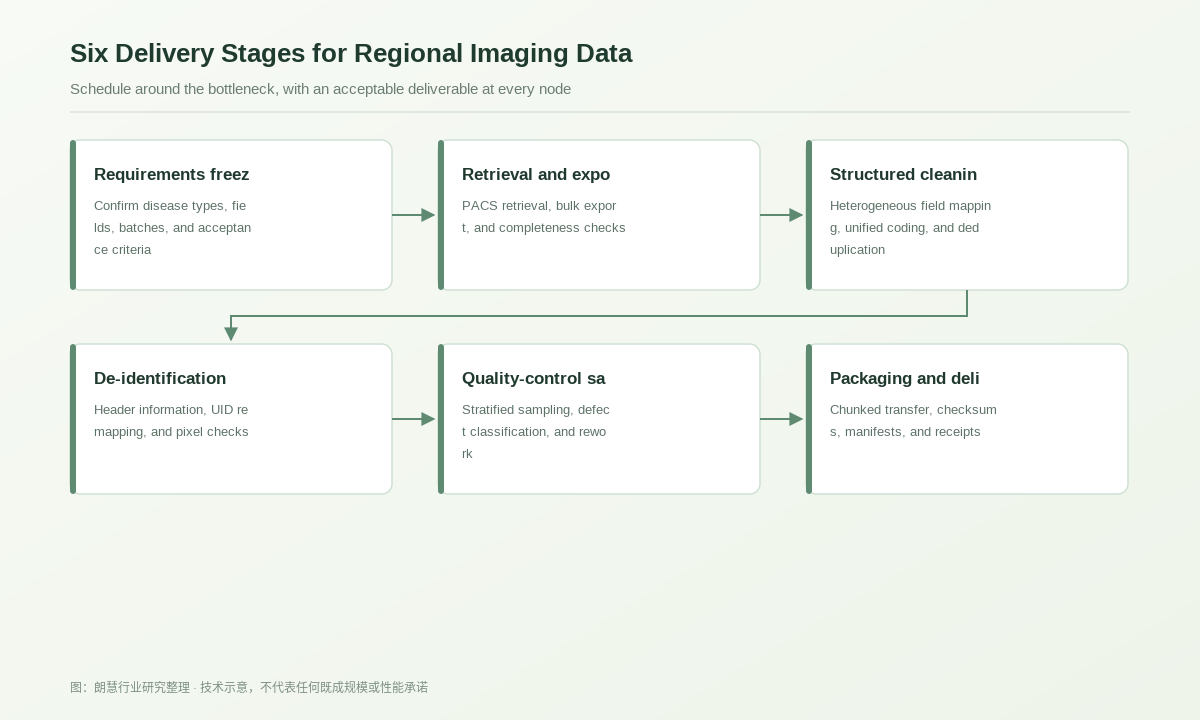
Scheduling should work backward from the delivery date, rather than adding time forward from today. The first backward-planned stage is not processing but authorization and coordination: the method for data export, the hospital contact person, the on-site schedule, and the acceptance criteria. Until these are settled, subsequent steps will merely spin their wheels. Only after that comes export, cleaning, de-identification, quality control, and transfer. Each stage should produce an intermediate artifact that can be inspected.
Each process step should have its unit capacity estimated rather than assigning an arbitrary total duration. Export is constrained by PACS retrieval speed and network limits. Cleaning is affected by field heterogeneity. If de-identification relies on manual review, capacity is measured in person-days. Quality-control sampling depends on batch definition. Identify the slowest process step: that is the bottleneck. Scheduling should be designed around the bottleneck rather than distributing resources evenly.
Buffers must be written into the plan. Hospital equipment maintenance, system upgrades, urgent tasks, and network throttling can all cause actual output on a given day to fall below expectations. A practical approach is to reserve a buffer for critical process steps and define trigger conditions in advance. If a batch is delayed beyond the agreed number of days, activate multi-hospital scheduling or adjust the batch order, rather than discovering one week before delivery that there is no time left.
3. De-Identification Pipelines: From Header Information to Pixels
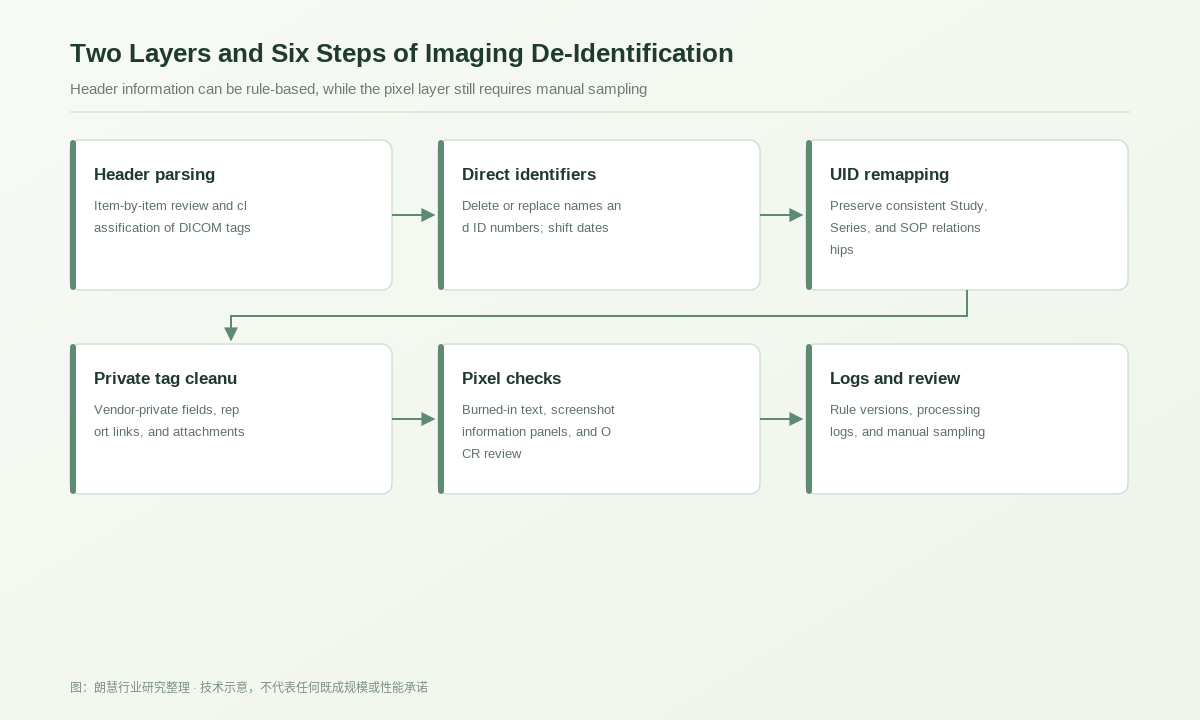
Imaging de-identification has two layers: header information and pixels. Header processing includes deleting or replacing direct identifiers, shifting dates, remapping examination numbers and UIDs, cleaning vendor-private tags, and removing report links. UID remapping must preserve the relationships among Study, Series, and SOP for the same examination. Otherwise, reconstructed sequences will fail, and the delivered data may not open in reading software.
The pixel layer is more easily overlooked. Names on ultrasound screenshots, subtitles in endoscopy videos, and text burned into images during secondary export are not covered by DICOM tags. OCR or manual sampling is needed, with particular attention to the four corners and information panels. Processing only the header without checking pixels is the most common gap in a de-identification pipeline, and the easiest place for a project to be rejected during acceptance. When sampling pixels, retain a sample list so reviewers can quickly locate problematic frames.
The pipeline must support rollback and auditing. Rules should be version-controlled, and every processing run should produce logs recording which fields were changed, the rules applied, and which batch used which version. Internal mapping tables must be stored separately under access control for traceability when necessary, but must not be delivered with the data. Without logs, a de-identification failure cannot be traced to a specific step, and the entire batch may have to be redone.
4. Quality-Control Sampling: Ratios, Decisions, and the Rework Loop
Sampling requires batching first. Batches should be defined by hospital, equipment, examination type, and time period, with results kept as homogeneous as possible within each batch. Sampling should be stratified by risk: batches with a higher risk of residual identifiers, older equipment, or secondary exports should receive a higher sampling ratio, while routine batches can use a lower one. The ratio does not need to be fixed, but it must be documented before work begins to avoid explanations after the fact.
Defect severity determines the response. Critical defects include residual identity information, patient-examination mismatches, and missing key sequences. Major defects include missing fields, unreadable images, and coding errors. Minor defects include nonstandard naming and descriptions. Critical defects trigger rework for the entire batch. Major defects trigger proportional rework and resampling. Minor defects are recorded and accepted. Without clear severity levels, rework becomes a negotiation.
Rework should return to the process, not to individuals. Repeated defects of the same type indicate a problem with rules or tools; changing people alone will not help. Record the rework rate and defect-type distribution for each batch so the next schedule can be more accurate. Sampling records must be reproducible: retain the sampling list, random seed, and decision table so that another person can reach the same conclusion. Records do not create value by themselves, but they provide evidence during disputes.
5. Hospital Coordination: Three Types of Departments Have Different Needs
A regional project must coordinate with at least three types of departments. The IT department is concerned with interfaces, networks, and security. The imaging department is concerned with equipment usage and reading workflow. Medical records and data management departments are concerned with coding, authorization, and data export methods. Because the three parties focus on different things, they may talk past each other in meetings, leaving the project at a standstill. Coordination does not mean bringing all three parties into one room; it means answering each party's concerns separately.
The coordination mechanism should be fixed: one contact person, one weekly meeting, and one change request form. The contact person must have authority to coordinate resources within the hospital, rather than merely relaying messages. The weekly meeting should use a fixed template to review progress, blockers, and the following week's plan. Every requirement change must be documented in writing; verbal adjustments are a major source of rework. These three practices may seem routine, but omitting any one of them will cause the project to slip.
On-site acceptance should also be designed in advance. Decide whether acceptance will occur inside the hospital or off-site, which cases will be sampled, and whether problems found on the spot will be corrected immediately or sent back for rework. Scrambling to find data or people on acceptance day is a common reason projects drag on at the end. Sending the acceptance checklist to the hospital in advance allows both sides to inspect the same list and saves substantial explanation. If there is no responsible owner for remediation, the same problem will recur in the next batch.
6. Milestone Design: Use Acceptable Deliverables as Nodes
Milestones should be more than dates; they should be acceptable deliverables. Field confirmation sheets, batch manifests, sampling reports, and delivery receipts can all be checked. A milestone with only a date and no deliverable makes it impossible to identify the blocker when there is a delay, or to define responsibility.
Each stage should include a rollback point. After field mapping is confirmed, run a small batch first and scale up only after sampling passes. Validate de-identification rules on a small data set before applying them to the full data set. Stopping problems early in the process is the least expensive approach. Discovering mismatches only after full delivery can multiply the rework volume, and the work often misses the original deadline.
If a project is tied to a conference or milestone, schedule the demonstration sample separately from full delivery. A sample can be carefully selected, but it must come from the same batch and follow the same rules. Full delivery should proceed at a normal pace; do not compress quality control to meet a demonstration deadline. Projects with impressive demonstrations but poor delivery quality will struggle to win similar work later. Reputation matters more than any single demonstration.
7. Capacity Flexibility: Multi-Hospital Scheduling and Staffing
When capacity at a single hospital is insufficient, multi-hospital scheduling is a common solution. However, it introduces heterogeneity in equipment and parameters, so previously standardized processing rules must be revalidated. Before scheduling additional hospitals, confirm their system versions, field structures, and imaging protocols, then decide whether they can be included in the same batch. When data from different protocols is mixed in one batch, sampling criteria must be adjusted accordingly.
Staffing flexibility should be allocated by process step. Export and cleaning can be handled in concentrated bursts, while de-identification and quality control are better suited to stable teams because familiarity with the rules directly affects defect rates. Adding temporary staff is possible, but they must be trained and validated on a small batch first; otherwise, rework caused by new staff may exceed the output they provide.
Outsourcing boundaries must be clear. Work with explicit rules, such as format conversion and initial screening, can be outsourced. De-identification review and quality-control decisions should remain in-house. This is not because external teams cannot do the work, but because errors in these two stages carry the highest responsibility and remediation costs. Clearly defined boundaries make collaboration smoother.
8. Risk List: Authorization, Interfaces, Transfer, and Staff
Authorization and official approval are the first risk. Internal hospital approval processes are long, and work stops if the responsible person is traveling. The response is to start early and run authorization in parallel with data preparation, rather than waiting until all documents are complete before beginning. The larger the institution, the more important it is to include this period in the plan.
The second risk is interface failure. Hospital system upgrades, PACS patches, and network policy changes can all invalidate scripts that previously worked. Running a small regression test before each on-site visit saves more time than troubleshooting afterward. The third risk is transfer. Large files may have unstable speeds across inter-hospital networks, so chunking, checksums, and resumable transfer should be prepared in advance. Transfer should not be treated as an afterthought at the last step.
The fourth risk is staff turnover. The project's operating definitions are often held by only a few people, and knowledge gaps appear when they leave. The response is straightforward: document the rules, place scripts under version control, and use a successful small-batch run as part of handover acceptance. Documentation is not for inspection; it is for the next person to use.
9. Regional Conference Observations: Platforms, Standards, and Data Exchange
At regional digital health conferences over the past two years, imaging-data-related content has generally clustered around three lines: imaging annotation platforms, data compliance and anonymization standards, and trusted data spaces and data exchange. Platforms emphasize pre-annotation plus quality control. Standards emphasize anonymization and compliance guidance. Data spaces emphasize keeping data within the data domain while making results auditable. Although these three lines may appear separate, they all point to the same goal: making data usable and traceable.
The significance of these developments for delivery management is not simply that there are more tools. It is that acceptance criteria can now reference public standards. There are public documents defining fields, the required level of de-identification, and the expected form of sampling reports, which can substantially reduce disputes between buyers and suppliers. Putting standards upfront is one of the most effective ways to reduce rework, and it works better than explaining decisions after the fact. When multi-hospital projects cite the same guidance, they can also reduce rework caused by inconsistent interpretations across hospitals.
It is also important to distinguish conference demonstrations from project delivery. What is demonstrated on stage is capability. What determines success behind the scenes is capacity, coordination, and documentation. Treating a platform as the delivery solution while ignoring process management will still cause delays. A more practical approach is to embed the platform into the process and use it for part of pre-annotation or quality control, rather than replacing the workflow.
10. Common Rework Causes and Checkpoints
The leading causes of rework are usually not algorithms. Incorrect field mappings, wrong date shifts, sequence mismatches, improper handling of duplicate cases, and delivery manifests that do not match the actual data account for most failures. None of these issues is difficult, but each requires checkpoints in the process. Without checkpoints, errors travel all the way to delivery day.
Duplicate cases are the easiest to mishandle. When one patient has multiple examinations, deduplicating by patient loses longitudinal information, while deduplicating by examination may treat follow-up scans as independent samples. Rules must be defined in advance, and the manifest must state the deduplication criteria. Otherwise, during acceptance, each side may defend a different interpretation and neither will be able to persuade the other.
Rework costs rise rapidly as work moves later in the process. If a field is found to be wrong during export, the script can be changed. If sequence mismatches are discovered only after delivery, the data must be retrieved, de-identified, and quality-controlled again. Moving checkpoints earlier is one of the most cost-effective practices in delivery management and also the one that requires the least additional investment.
11. Outlook for the Next 12 to 24 Months
First, regional projects will shift from one-off datasets to continuous supply. Buyers will want not just one batch of data but a data stream updated quarterly or annually with version records. This will push suppliers to formalize their processes, scripts, and documentation, while teams built around one-off bursts will increasingly struggle to win work.
Second, de-identification and quality control will become more tool-driven, and sampling reports will become a standard delivery component. The share of trusted data spaces and sandbox-based delivery will rise, and the requirements that data remain within the data domain and results be auditable will move from pilots to routine expectations. For delivery teams, this means designing analytical workflows in advance, not merely packaging files.
Third, regional collaboration will bring standards to the forefront. Public documents such as anonymization guidance, data compliance guidance, and imaging platform specifications will gradually become the shared language of acceptance. The teams that benefit first will be those with structured process capabilities, the ability to coordinate across hospitals, and complete documentation. Teams that rely on temporarily assembled staff and personal connections will be held back by capacity and rework. Over the next two years, the most worthwhile investment is making delivery processes repeatable. Process assets last longer than people and are easier to reuse.
Langhui's Engineering Capabilities Along This Path
Since 2016, Langhui Technology has produced AI training data. In healthcare, it covers acquisition specification design, structured annotation, quality control, and consistency reports for CT, MR, PET, mammography, ultrasound, and other modalities. In regional imaging delivery projects, Langhui Technology handles field-definition alignment, de-identification rule design, sampling plans, and quality reports, and delivers data dictionaries, batch manifests, and version records so that every batch of data is traceable and reproducible.
We can work with hospitals and project teams to build process-based schedules: break export, cleaning, de-identification, quality control, and transfer into inspectable nodes, and define the inputs, outputs, and decision criteria for each process step. Compliance assessments, ethics approvals, and legal opinions are issued by qualified organizations; we do not replace them and do not claim to hold related certifications.
If your team is preparing a regional imaging data delivery, needs to define de-identification and sampling workflows, or wants to reduce rework, send us the modalities, number of hospitals, and delivery milestones. We can provide actionable process recommendations and a milestone list. Build the process once, and later projects can reuse it.
FAQ
How long does a regional imaging data project usually take to deliver?
It depends on the data volume, number of hospitals, and complexity of the definitions; there is no single answer. A controllable approach is backward scheduling: first reserve time for authorization and coordination, then estimate capacity step by step across export, cleaning, de-identification, quality control, and transfer, identify the bottleneck, and leave a buffer. Rather than providing a vague total duration, it is more important to agree on stage deliverables and delay-trigger conditions.
Is it enough for de-identification to process only DICOM header information?
No. Header information covers most identifiers, but ultrasound screenshots, endoscopy video subtitles, and text burned into images during secondary export are not contained in the tags. The pixel layer must be checked, using OCR plus manual sampling with particular attention to the four corners and information panels. Private tags and report links should also be checked, as these areas are often overlooked.
How should rework proceed when sampling finds defects?
Classify the defects first. Residual identifiers, patient mismatches, and missing sequences are critical defects and require the entire batch to be returned. Missing fields and unreadable images are major defects and require proportional rework and resampling. Minor defects such as nonstandard naming are recorded and then accepted. Rework should be traced to the process rather than the individual, and the rework rate should be recorded for future scheduling.
Will multi-hospital scheduling affect data consistency?
Yes. Equipment, parameters, field structures, and coding standards vary across hospitals, creating heterogeneity when they are mixed in one batch. Before scheduling, confirm the system versions and imaging protocols of new hospitals. Where necessary, sample and record sample sizes by hospital, and mark data sources in the data dictionary to prevent downstream users from making incorrect interpretations.
What if the hospital cannot cooperate with the schedule?
Separate the concerns first. The IT department, imaging department, and data management department have different priorities, so targeted communication is more effective than a large meeting. Use a fixed weekly meeting and a change request form, and lock in available time windows in advance. If the work truly cannot fit, adjust the batch order or activate multi-hospital scheduling rather than leaving all pressure until delivery week.
- DICOM PS3.15 Security and System Management Profiles https://dicom.nema.org/medical/dicom/current/output/chtml/part15/PS3.15.html
- DICOM PS3.14 Grayscale Standard Display Function https://dicom.nema.org/medical/dicom/current/output/chtml/part14/PS3.14.html
- U.S. FDA, Artificial Intelligence-Enabled Medical Devices https://www.fda.gov/medical-devices/software-medical-device-samd/artificial-intelligence-enabled-medical-devices
- HL7 FHIR Release 4 Specification https://hl7.org/fhir/R4/
- ISO/IEC 20889:2018 Privacy enhancing data de-identification terminology and classification of techniques https://www.iso.org/standard/69373.html
- 中华人民共和国数据安全法(2021 年) http://www.npc.gov.cn/npc/c30834/202106/7c9af12f51334a73b56d7938f99a788a.shtml