
MEDICAL DATA PROCUREMENT / ACCEPTANCE
Acceptance Criteria for Medical Data Procurement: Sample Representativeness, Annotation Consistency, and Sampling Plans
Whether a batch of medical data is worth buying is rarely a question of volume. This article breaks acceptance down into six areas: sample representativeness, annotation consistency, follow-up completeness, device and parameter distribution, reproducible materials and sampling plans. It provides actionable decision criteria, common failure signals, and the boundaries of responsibility after acceptance, along with expected changes over the next two years. It is intended for hospital information departments, algorithm teams, and procurement leads to use side by side, with items checked off stage by stage according to the project phase.
Discussions about data procurement can be lively, but acceptance is often closed out hastily: if the volume matches and the files are complete, it is considered passed. The real problems usually emerge six months later—performance drops when the model moves to another hospital, cohorts cannot produce progression rates, and follow-up records fail to reconcile. Acceptance is not a procedural formality; it is about surfacing these problems in advance. This article covers six areas—representativeness, consistency, follow-up, device parameters, reproducible materials, and sampling—and discusses technical judgment only, not pricing or commercial arrangements. The six areas are not parallel: if the preceding one fails, the conclusion of the following one does not hold either.
I. First Define Whether It Is Worth Buying: Three Hard Conditions
The easiest mistake in medical data procurement is to start the discussion with volume: how many cases, how many terabytes, and how many hospitals are covered. Volume certainly matters, but it cannot answer the most critical question—whether the data can support the research or model you intend to build. The first step in acceptance is to state the intended use clearly: whether it is for training a segmentation model, conducting a cohort analysis, or performing external validation. Different uses impose completely different requirements on representativeness, annotation, and follow-up.
Against this premise, the judgment can be reduced to three hard conditions. First, traceable provenance: every case can be matched to the collecting institution, collection time, and authorization chain, so the source can be found when a problem arises. Second, reproducible criteria: field definitions, code mappings, and de-identification rules are documented, allowing another team to calculate the same statistics. Third, quality can be sampled: defects can be defined, sampled, and recomputed, rather than relying on verbal assurances from the supplier.
Of the three, the second is the easiest to gloss over. Many suppliers are willing to provide a field list but cannot provide criteria documentation. The field names may be the same while the value rules differ, and combining them creates disaster. A more common approach is to start with a small pilot procurement of a few hundred to a few thousand cases to work through the criteria before deciding whether to scale up. Problems exposed during the pilot cost far less than problems discovered after full delivery.
II. Sample Representativeness: Four Distributions—Disease, Region, Time, and Population
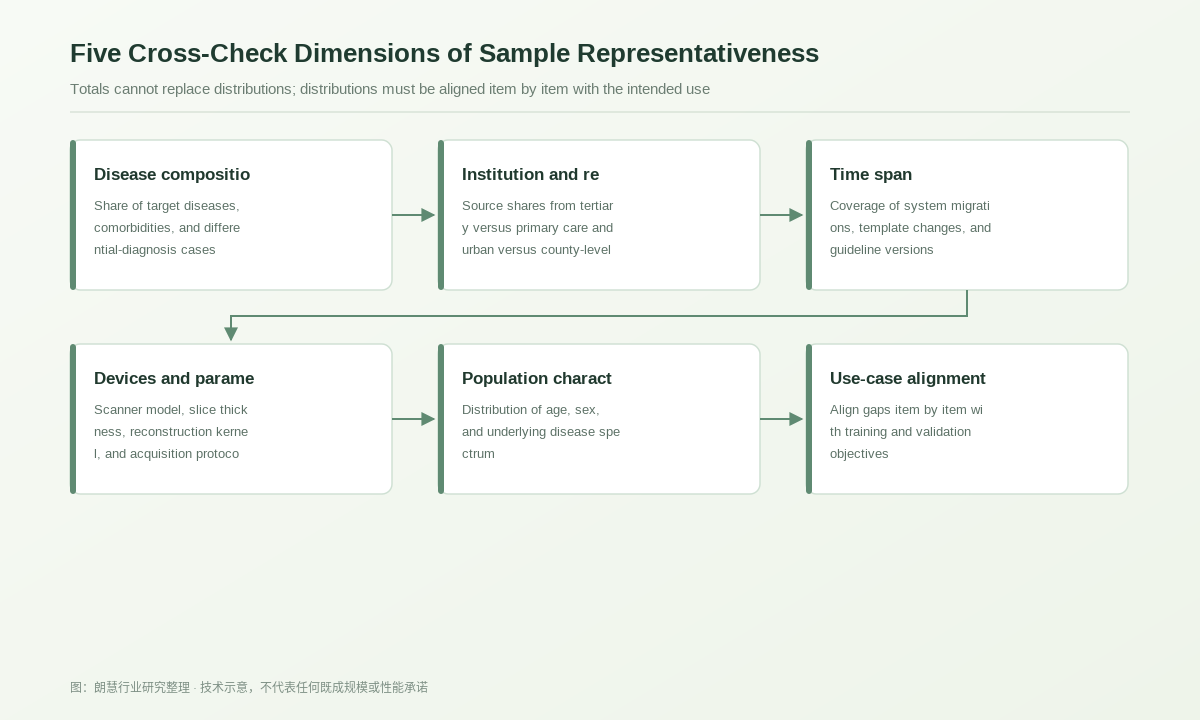
Medical data are almost always convenience samples, not random samples. The data a hospital is willing to open up tend to concentrate in its strongest specialties and in years when records are easy to retrieve. Therefore, when assessing representativeness, do not look only at the total; look at the distribution. At least four dimensions matter: disease composition, institution level and region, time span, and population characteristics. Obtain the distribution tables and compare them item by item with the intended use; the gaps become immediately apparent.
For disease composition, check not only the share of the target diseases but also cases involving comorbidities and differential diagnoses. If you collect only confirmed positives without negative controls, the trained model will classify all suspected cases as positive in real-world settings. Institution level determines case complexity: if the data consist entirely of difficult cases from tertiary hospitals, the model will struggle at the primary-care level; if they consist entirely of health-screening populations, severe cases will be insufficient.
The time span is often overlooked. Hospitals have changed systems, revised report templates, and updated guideline versions, so identically named fields may carry different meanings in different years. Require suppliers to mark the dates of system migrations and template changes, and stratify acceptance checks by time period. Data that are large in total but concentrated in a single year are fine for cross-sectional analysis but distorted for trend analysis.
III. Annotation Consistency: From Annotation Manuals to Disagreement Adjudication
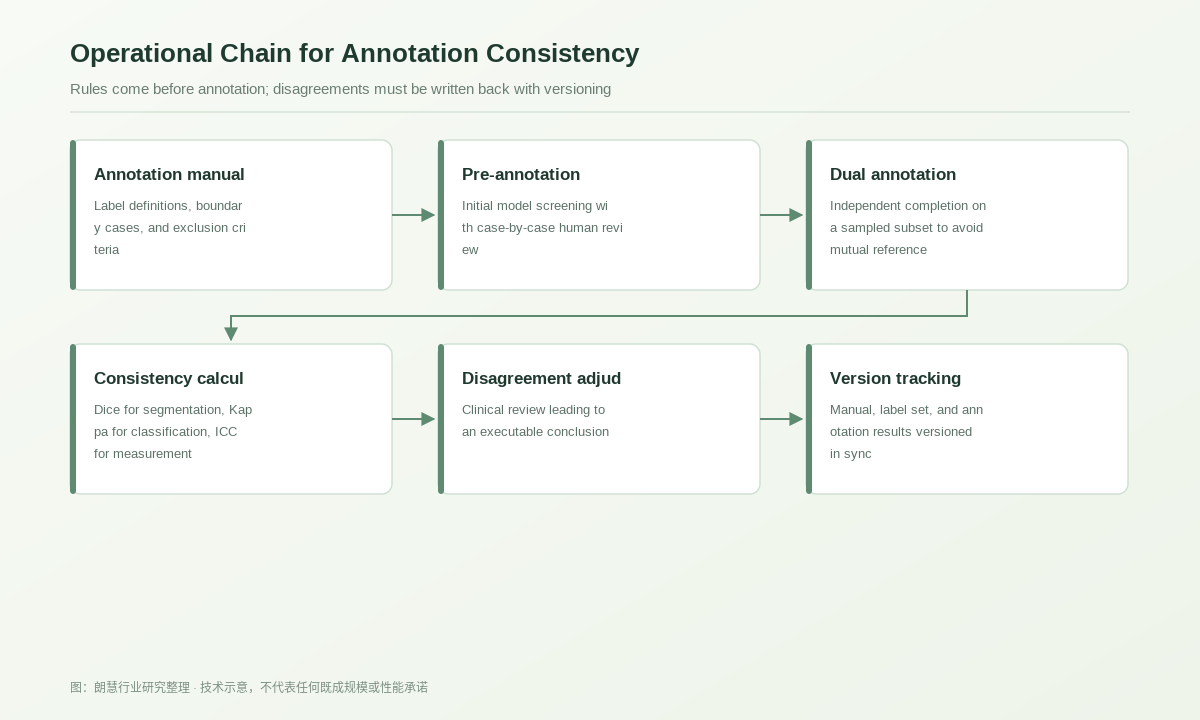
Consistency does not mean making everyone annotate identically; it means first making the rules executable. Before receiving annotated data, check whether an annotation manual exists: label definitions, boundary cases, exclusion criteria, and how difficult cases are handled. If the manual consists of only a few slides, consistency is essentially impossible to establish. A sufficiently detailed manual should enable a physician who did not participate in the project to complete the annotation independently.
An executable approach is to sample a subset for independent annotation by two people, calculate consistency metrics, and then discuss the disagreements item by item. For segmentation tasks, use Dice or boundary distance; for classification tasks, use Kappa; for continuous measurements, use ICC. Low metrics do not necessarily mean the annotators were careless; the more common cause is ambiguous definitions. Whether spiculation is included within lesion boundaries and whether multiple nodules count as one case or several are issues that must be fixed explicitly in the manual.
The consistency report must be traceable to a version. If the manual is revised once, there must be clear rules on whether previous annotations need to be redone. Using an expert's final adjudication to paper over missing rules is the most common shortcut: adjudication can save one batch but cannot save the next. What genuinely reduces rework is writing disagreements back into the rules and recording the version number.
IV. Follow-Up Completeness: Whether the Data Can Support Longitudinal Research
Follow-up determines whether the data can support longitudinal research and also defines its scope of applicability. During acceptance, three things must be defined first: what the endpoint is, how long the follow-up window is, and what counts as loss to follow-up. Without these three, any attractive-looking follow-up rate can be produced. For example, a re-examination rate calculated by counting a repeat examination opened on the same day will lead to a completely different conclusion from one calculated by annual follow-up.
Examine four indicators: median follow-up duration, follow-up rates at each time point, distribution of reasons for loss to follow-up, and how endpoint events are captured. The reliability differs greatly depending on whether endpoint events come from inpatient records, pathology, or death registration. Relying only on in-house re-examinations to capture recurrence will systematically underestimate it. If the lost-to-follow-up population is concentrated in a particular type of patient, the resulting bias is more concerning than the loss rate itself.
Imaging data add another layer of follow-up: whether the re-examination interval and equipment are consistent. If two examinations are three years apart, the scanner model has changed, and slice thickness differs, longitudinal comparisons must be approached cautiously. Single-examination data are not unusable, but it must be clear that they can support only cross-sectional description, not progression-rate or efficacy assessment. Writing this into the acceptance conclusion is more useful than debating it afterward.
V. Device and Parameter Distribution: The Most Easily Overlooked Variables
A large part of imaging data quality is determined by the equipment and acquisition parameters. For CT, consider slice thickness, reconstruction kernel, tube voltage, and contrast-agent phase; for MR, field strength, sequences, and coil; for ultrasound, scanner model, probe, and operator technique. If these variables are not aligned, the model may learn not pathology but the imaging characteristics of a particular device. This is often why external validation across hospitals fails.
During acceptance, request a device-and-parameter matrix: which scanner models each source hospital has, their respective shares, and whether key parameters are standardized. Also check metadata completeness and how many key fields are missing from the DICOM headers. Screenshot exports, secondary re-transfers, and accidental field deletion during de-identification can all cause parameter loss. Even with lost parameters the data may still be trainable, but reproducibility and external validation become impossible.
The solution is not to require every hospital to use the same equipment, which is unrealistic. A more feasible approach is stratification: sample and stratify by device and parameters, split training and validation sets by stratum, and record the sample size of each stratum in the data dictionary. If a stratum has too few samples, flag it in the acceptance report and let the user decide whether to collect more data or accept the limitation.
VI. Reproducible Materials: Provenance Chains, Data Dictionaries, and Version Records
Reproducibility means that another team, using the same materials, can calculate the same results. The materials list should include at least the source and authorization chain, acquisition protocol, de-identification rules, field dictionary, code mappings, version and change records, and quality-control reports. If even one item is missing, acceptance can rely only on trust—and trust does not work when disputes arise.
Code mappings are a major failure point. ICD versions, internal codes, and examination names differ across hospitals, so simple string matching can split one disease into dozens of categories. Mapping tables should provide the source code, target code, mapping rules, and how unmatched items are handled. The unmatched rate is a highly useful acceptance metric: it directly indicates whether the data can be used in a unified way.
Version records are equally important. Any addition, deletion, or change to field values must leave a trace. A relatively reliable practice is to assign a version number to the dataset and include a change note with every delivery. Without version records, the second delivery makes it impossible to tell whether differences come from new data or changed criteria, reducing acceptance to repeated rounds of rediscovery.
VII. Sampling Plans: Batching, Stratification, and Defect Grading
Sampling is not about randomly clicking through a few files. First define batches by hospital, equipment, time period, and disease; data within the same batch should be homogeneous. Then define strata: high-risk strata such as rare diseases, older equipment, secondary exports, and screenshot-sourced data should have higher sampling rates; routine strata can have lower rates. The rates need not be fixed, but they should be set according to batch size and risk level and agreed in advance.
The decision rules must include defect grading. Critical defects include residual identity information, mismatched examinations and patients, and missing sequences; major defects include missing key fields, coding errors, and unreadable images; minor defects include nonstandard naming and inconsistent descriptions. Different levels require different actions: reject the entire batch for critical defects, rework a proportional share for major defects, and release minor defects after recording them.
The sampling process must be recomputable: retain the sampling script, random seed, sampling list, and decision results. This makes it possible to answer two questions: what is the defect rate of this batch, and can the same criteria be applied to the next delivery. Sampling that provides only a pass/fail conclusion without the process is equivalent to no sampling at all.
VIII. Acceptance Checklist: Turning Judgment into a Checkable Table
Condensing the sections above into one table makes acceptance actionable. Each dimension corresponds to required materials and decision criteria; missing materials mean failure, with no room for argument. The table does not need to be complex. The key is that both parties agree on the same table before work begins, avoiding a situation where each side applies a different standard at delivery.
Beyond the table, there are two softer judgments. First, can the supplier clearly state the boundaries of the data—what can and cannot be done? Suppliers willing to say clearly what they cannot do are usually more reliable; those who agree to everything often discover problems only at delivery. Second, response speed: how quickly can a criteria question raised during the pilot be answered in writing is more persuasive than any verbal assurance.
The acceptance conclusion should be classified into three tiers: pass, conditional pass, and fail. A conditional pass must specify the conditions and re-inspection method, such as completing follow-up for a particular time period or remapping a certain type of code. Tiering avoids black-and-white disputes and leaves room for improvement in subsequent batches.
| Dimension | Required Materials | Decision Criteria |
|---|---|---|
| Sample representativeness | Four distribution tables for disease, institution, time, and population | Compare item by item with the intended use; list the gaps |
| Annotation consistency | Annotation manual, dual-annotation results for the subset, disagreement records | Select metrics by task; disagreements must be written back into rules |
| Follow-up completeness | Follow-up plan, follow-up rates at each time point, loss-to-follow-up analysis | Endpoint, window, and loss-to-follow-up definitions must be executable |
| Devices and parameters | Device-parameter matrix, metadata missing rates | Stratified sample sizes must be sufficient; causes of missing data must be explainable |
| Materials and sampling | Data dictionary, code mappings, version records, sampling table | Materials complete; sampling results must be recomputable |
IX. Common Pitfalls and Failure Signals
The first pitfall is inconsistency between samples and the full dataset. Samples are often carefully selected—clear, typical, and complete—while the full delivery later reveals many screenshots, missing sequences, and missing reports. The countermeasure is to apply the same rules to sample-based and full-data sampling, and to sample by batch during the pilot rather than relying on one polished sample.
The second pitfall is complete fields with high missing rates. The field list appears complete, but in practice half the values are blank or filled with defaults. Acceptance should calculate the missing rate and default-value proportion for each key field; if the missing rate exceeds a threshold, the cause must be explained. The third pitfall is the deduplication criteria. For a patient with multiple examinations, deduplicating by patient loses longitudinal information, while deduplicating by examination may treat follow-up visits as independent samples. The rule must be defined in advance.
Failure signals can be listed as follows: no authorization chain can be produced; criteria documentation exists only as verbal explanations; the consistency report has no disagreement records; follow-up rates cannot be broken down by time point; device parameters are largely missing; and sampling provides only conclusions without the process. If two or more signals appear, narrow the procurement scope or conduct a pilot first—do not expect to fix the problem after delivery.
X. After Acceptance: Scope-of-Use Restrictions and Responsibility Boundaries
Passing acceptance does not mean the data can be used arbitrarily. Scope-of-use restrictions, secondary transfers, and re-identification risks are issues that emerge only after delivery. A relatively reliable practice is to state clearly in the acceptance report which uses are applicable and which are not—for example, that the data are suitable for training segmentation of a particular body region but unsuitable for estimating population incidence.
Traceability is the final safeguard. Once the data leave the organization, if a batch is found to have systematic problems, the ability to locate the source, notify users, and supplement or replace the data depends on whether a batch-to-source correspondence was established at delivery. Without that relationship, the problem can only be addressed through memory.
Organizationally, it is advisable to separate the acceptor, reviewer, and adjudicator. The acceptor checks against the checklist, the reviewer redoes a portion of the work, and the adjudicator handles disagreements. These three people can be different roles within the same team, but they cannot be the same hands. Only when the roles are separate can the acceptance conclusion withstand scrutiny.
XI. Forward-Looking Assessment for the Next 12 to 24 Months
First, the focus of acceptance will shift from volume to proof of quality. Buyers will require criteria documentation, consistency reports, follow-up statistics, and sampling records to be standard attachments rather than materials added at the last minute. Whoever can turn these documents into standardized products will incur fewer communication costs in the next procurement round and will be more easily included on a stable-supplier list.
Second, sampling will become tool-based. Batch management, stratified sampling, defect grading, and result recomputation will gradually move from spreadsheets to dedicated tools, and report formats will also converge. This benefits suppliers: building the process once allows reuse across all projects. For buyers, it means shorter acceptance cycles and a common language when comparing suppliers.
Third, the weight of follow-up and device metadata will increase. Demand for multimodal and full-pathway data is growing, and data with only a single imaging examination and no parameter records will have less bargaining room. The first beneficiaries will be institutions with stable follow-up systems and complete equipment registers, as well as service providers that can standardize the acceptance process. For teams preparing to enter this path, the investment worth making now is not more data, but better criteria and records.
Langhui's Engineering Capabilities Along This Path
Langhui has produced AI training data since 2016. In the medical domain, it covers acquisition protocol design, structured annotation, quality control, and consistency reports for CT, MR, PET, mammography, ultrasound, and other modalities. In data procurement and acceptance projects, we handle field-criteria organization, annotation-manual writing, dual-annotation subset design and consistency calculation, and deliver data dictionaries, defect lists, and version records so that every batch of data can be reviewed.
We can design and execute sampling plans: batching, stratification, defect grading, sampling records, and result recomputation, while writing discovered problems back into the rules. Compliance assessments, ethics approvals, and legal opinions are issued by qualified institutions. We do not replace them or claim to hold the relevant certifications.
If your team is preparing data procurement acceptance, needs to organize criteria documentation, or wants to standardize the sampling process, send us the modalities, sources, and intended use. We will provide actionable checklist recommendations and sample tables. Acceptance is not a one-time action. Once the tables and records are retained, the next batch will require much less effort.
FAQ
Which indicators matter most in medical data procurement acceptance?
Usually six categories: whether the sample distribution matches the intended use; whether annotation consistency has a recomputable report; whether follow-up defines endpoints and loss to follow-up; whether devices and parameters are fully recorded; whether materials support independent reproduction; and whether sampling includes batching, stratification, and defect grading. The indicators do not need to be numerous. What matters is that each one has supporting materials and that both parties agree on the decision criteria in advance.
What level of annotation consistency is considered acceptable?
There is no universal threshold; it depends on task difficulty and intended use. Metrics differ for segmentation, classification, and continuous measurement, and rare diseases and lesions with ambiguous boundaries are inherently harder to align. A more practical approach is to establish a baseline on the pilot batch, agree on an acceptance line that will not be relaxed, and require an adjudication record for disagreements. Looking only at a coefficient without reviewing the disagreements can lead to misjudgment.
Are imaging data with only one examination worth buying?
It depends on the intended use. For cross-sectional description, single-time-point segmentation, or screening models, one examination is sufficient. For progression rates, efficacy assessment, or recurrence prediction, follow-up is essential. Single-examination data are not low-quality data, but the questions they can answer are limited. Stating the applicable scope clearly during acceptance is more valuable than a blanket pass/fail judgment.
The data have already been de-identified. Do we still need quality acceptance?
Yes. De-identification addresses re-identification risk, not completeness, consistency, or accuracy. The de-identification process itself can also introduce new problems, such as accidentally deleting key fields, UID remapping disrupting sequence relationships, and distorted follow-up intervals after date shifting. Quality acceptance and de-identification checks are two separate lines of work and cannot substitute for each other.
What sampling rate should be set?
There is no fixed rate. First batch by hospital, equipment, and time period, then stratify by risk: increase the rate for batches with high residual-identifier risk, older equipment, or secondary exports, and lower it for routine batches. Set the rate clearly before work begins and agree on both the decision rules and rework method. The key is that the sampling process be recomputable, not that a large number of samples be taken.
- DICOM PS3.3 Information Object Definitions https://dicom.nema.org/medical/dicom/current/output/chtml/part03/PS3.3.html
- DICOM PS3.15 Security and System Management Profiles https://dicom.nema.org/medical/dicom/current/output/chtml/part15/PS3.15.html
- NIST Special Publication 800-188, De-Identifying Government Datasets https://csrc.nist.gov/pubs/sp/800/188/final
- ISO/IEC 20889:2018 Privacy enhancing data de-identification terminology and classification of techniques https://www.iso.org/standard/69373.html
- HL7 FHIR Release 4 Specification https://hl7.org/fhir/R4/
- Personal Information Protection Law of the People's Republic of China (2021) http://www.npc.gov.cn/npc/c30834/202108/a8c4e3672c74491a80b53a172bb753fe.shtml