
MEDICAL DATA TRADING / LICENSING CHAIN
Medical Data Trading and Licensing: Three-Party Authorization Chain, Purpose Limitation, and Audit Trails
The difficulty in medical data trading is not delivery, but whether the authorization chain can be closed. This article unpacks the authorization relationships among patients, hospitals, and platforms, discusses how to draft purpose limitation, de-identification and re-identification risk, minimum requirements for audit trails, and the processes for data product registration and compliance assessment, and finally offers a 12- to 24-month outlook.
On the negotiating table for medical data trading, price is often not the hardest item. What truly blocks projects is the authorization chain: whether the patient level has a legal basis, whether the hospital level is willing to sign, and whether the platform level can sublicense. If one link is missing, data taken away cannot be used securely. This article does not discuss commercial terms; it focuses on how rights are allocated, how purposes are written, how logs are kept, and how registration and assessment should proceed.
I. The subject of trading is not the data, but a set of limited rights
The subject of a data transaction is hard to describe as 'a dataset.' The same batch of imaging data can be licensed for research, model training, quality assessment, or product evaluation; each has a different scope of rights. Buyers may think they are buying the data itself, and sellers may think they are licensing the right to use it. Both may feel the matter is clear during negotiation, only to discover at signing that they are not talking about the same thing.
What transaction documents really stipulate are five things: who can use it, what it can be used for, how long it can be used, whether it can be passed to third parties, who owns the results, and who is liable when something goes wrong. Of these, purpose and sublicensing are most often ambiguous—and also the two most likely to be questioned afterward.
Many projects fail not because of technology, but because the purpose is written too broadly or too narrowly. A phrase like 'for medical research' will not pass compliance review because its boundaries cannot be determined; enumerating every field is too rigid, requiring changes and reapproval after signing. The drafting should be verifiable: specify the scenario, field scope, and output format clearly.
Breaking rights into four categories—right to use, right to reproduce, rights in derivative works, and right to sublicense—and negotiating them one by one is much clearer than a blanket 'right to use data.' In particular, model ownership—who owns a model trained on the data and whether it can be provided externally—should be written down, or disputes will easily follow.
II. The authorization chain: how patients, hospitals, and platforms connect
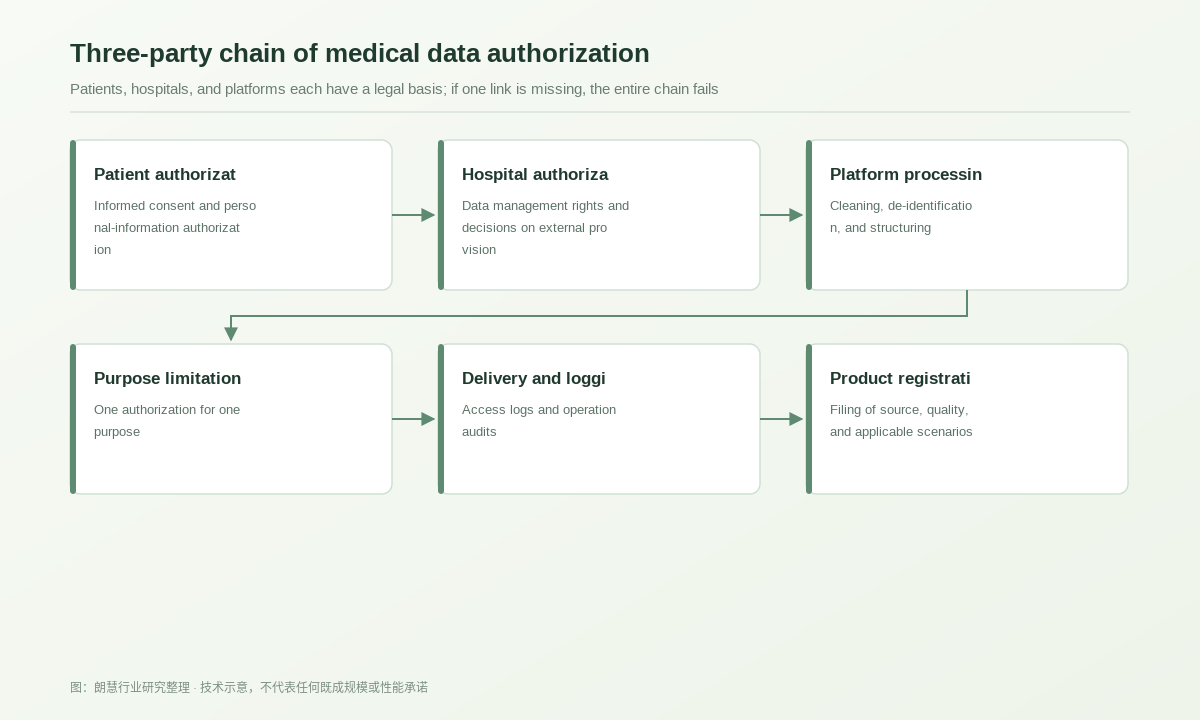
The chain has three layers. At the patient level, informed consent and personal-information authorization determine whether the data may be used for the purpose; at the hospital level, data management rights and decisions on external provision determine whether the hospital is willing to provide it; at the platform level, processing, delivery, and redistribution determine what may be done with the data after it leaves. Each layer has its own legal basis, and none can substitute for another.
Breaks usually occur at the hospital. Hospitals worry about risk, lack experience with external provision processes, and lack internal capability to judge whether a purpose is compliant. The common outcomes are 'no' or 'wait a little longer.' Demand parties then turn to out-of-province or third-party providers. The data can be obtained, but the provenance chain becomes less clear—common in regional projects. Worse, after switching providers two or three times, authorization documents for the same data may be scattered among different entities, and no one can reconstruct the complete provenance.
An authorization letter is not a master key. A one-page stamped document that does not specify the data scope, purpose, period, security responsibility, and liability for breach provides little legal support for subsequent actions. In practice, a more reliable approach is to structure the authorization as a main document plus attachments: the main document states the parties and scope of authorization; the attachments list the fields, describe the purposes, and set out security measures.
Sublicensing must be agreed separately. Receiving data does not mean a platform may sublicense it downstream, unless the original authorization explicitly permits it. Every downstream redistribution layer must be traceable to the original authorization document; otherwise, once the chain breaks, the entire path cannot prove itself.
III. Purpose limitation: one authorization for one purpose
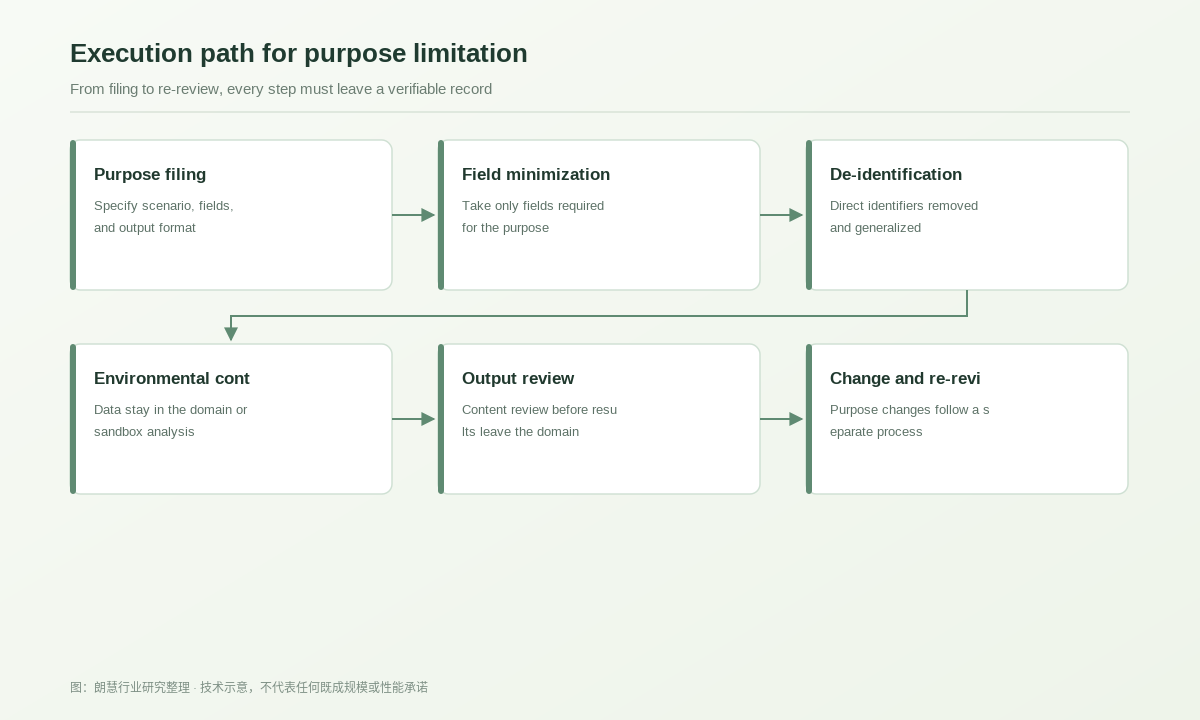
One authorization for one purpose is currently the most reliable approach. Research, model training, product evaluation, and insurance underwriting have different legal bases; combining them in one authorization effectively uses the broadest basis to cover the strictest scenarios. The process becomes longer, but when issues arise, the rationale is clear.
Purposes should be written to a verifiable level. 'Train a CT lung-nodule detection model' is more actionable than 'AI research'; 'output nodule location, size, and follow-up recommendations' is more auditable than 'output analysis results.' Actionable means a third party can use the wording to determine whether a particular operation crosses the line.
The principle of necessity ultimately comes down to fields. Do not use an ID number if unnecessary; use age groups instead of exact dates of birth; use batch numbers instead of full inpatient IDs. The shorter the field list, the lower the re-identification risk, and the lower the cost of delivery and audit.
Purpose changes must go through a change process; verbal consent is not enough. The change record is itself audit material and the basis for assigning responsibility in later disputes. A loosely defined change process creates a backdoor around purpose limitation.
IV. De-identification and re-identification risk
Direct identifiers and quasi-identifiers must be handled separately. Names, ID numbers, contact details, and inpatient IDs should be deleted or encrypted; dates of birth, regions, visit times, and rare diagnoses require generalization or perturbation. The two types of fields require different strategies; handling them together either over-sanitizes the data until it is useless or leaves obvious gaps.
Re-identification risk comes from combinations, not individual fields. A rare disease, a county-level city, and a specific month, when combined, may uniquely identify one person. Assessment should look at the uniqueness of field combinations, not check fields one by one. The more and finer the fields, the higher the uniqueness—especially apparent in small-sample disease-specific data.
Imaging has its own risk points. DICOM headers contain not only names but also device serial numbers, institution names, accession numbers, and referral sources; some institutions also burn patient information into image pixels, so clearing tags alone is insufficient—pixel-level detection and remediation are required. This step is often missed; an audit can detect it by sampling a few original images.
After de-identification, an effectiveness assessment is required rather than a declaration that the data have been 'sanitized.' Common approaches include uniqueness metrics and expert review; assessment records must be retained. The conclusion should state the conditions under which it applies: the sample size and field combinations under which risk is acceptable, and whether reassessment is needed when the scenario changes.
V. Audit trails: making every access traceable
Trails must answer four questions: who accessed which data, when, what operations were performed, and where the results went. The last is hardest, because once results are exported, control transfers. Therefore, exports require separate approval and content review.
Logs must be tamper-resistant, timestamps must be standardized, and the same identifiers must be used across systems. If multiple systems keep their own logs and use separate account systems, they cannot be reconciled when something goes wrong, as if nothing were recorded. Audit requirements should be written into the technical solution, not added as a log table at the last minute before acceptance.
Post-delivery tracking is the hardest. Once data are copied out, access logs stop; this is an inherent flaw of copy-based delivery and why trusted data spaces are promoted—data stay within the domain, activity is recorded inside the domain, and outputs go through review.
Audit is not material to be added after the fact; it is the product of process design. Logs added afterward usually cannot withstand scrutiny: timestamps do not match, operators are missing, and export records are empty. Truly usable audit trails grow within the system; they are not written into documents.
VI. Data product registration and compliance assessment
Registration answers 'what is this': data source, field scope, update frequency, quality indicators, applicable scenarios, and restrictions. If registration information is vague, every subsequent transaction must be re-explained, often differently by different people.
Compliance assessment usually has three parts: legality of the source, compliance of processing, and security of circulation. Security assessment, quality assessment, and value assessment are three separate tracks; they cannot substitute for one another. Passing a security assessment does not mean the quality is usable; usable quality does not mean the value is established.
Value assessment is often treated as a formality, but it affects how intangible assets of public institutions are defined; doing it or not has different implications. The conclusion need not produce a single number, but it must explain the basis: data scale, scarcity, follow-up years, and substitutability.
Registration is not the endpoint. After a product is listed, versions must be maintained, assessments updated, and delistings handled. Data have a lifecycle, and so do registration records; a registration table left unchanged for years is more misleading than none at all.
VII. Differences between on-exchange and off-exchange trading
Off-exchange trading is the norm. For many years, demand parties have signed agreements directly with hospitals or providers: the process is short and flexible, but compliance evidence is weak and hard to substantiate when problems arise. On-exchange trading standardizes and records the process, turning 'I think it is compliant' into 'verifiable.'
On-exchange does not mean easier or faster. It adds steps but also certainty: templates exist for entity qualifications, authorization documents, delivery methods, settlement, and acceptance. Whether buyers need that certainty determines the path. For small research datasets, off-exchange may be more practical.
Local data exchange operators are mostly state-owned enterprises or telecom operators. Their goal is matching and compliance, not brand endorsement for providers. This is often misunderstood: people assume a completed on-exchange transaction can be publicly promoted, but announcements usually state only the data type and scale.
A practical reminder for providers: treating official announcements as a precondition for a transaction can lead to misjudgment. What can genuinely substantiate the deal are the stamped authorization documents and delivery records themselves, not press releases. Bringing complete authorization materials to negotiations is more useful than screenshots.
VIII. Delivery methods: copies, interfaces, and trusted data spaces
Copy delivery is the simplest and most dangerous. Once data leave the hospital environment, later access falls outside the original system's logs and can only be constrained by contract. This method suits one-time datasets with clear boundaries and a fixed field scope.
Interface delivery suits continuous supply but requires authentication, rate limiting, field-level permissions, and invocation logs. Interfaces look more 'advanced,' but the operational cost is high: system upgrades, network-policy changes, and certificate expiration can interrupt supply.
Trusted data spaces and sandboxes suit joint analysis, with data staying in the domain and results leaving it. The analysis flow must be designed in advance: what can run, what can be output, and how it will be reviewed. Using a sandbox as a remote network drive is no sandbox.
The three methods can be combined. Raw data stay in the hospital, derived features leave the domain, and the model is trained in the domain with only parameters taken out. Combined designs are costly but often the most practical path for highly sensitive data. Agree on output granularity in advance: feature-vector dimensions, whether reversible transformations are included, and whether inversion is allowed—these details determine the risk level after results leave the domain.
IX. Common misconceptions and failure signals
Misconception 1: a stamp means compliance is complete. A stamp proves only that a party agrees; it does not prove process compliance. Ethics approval, de-identification assessment, and third-party security assessment are separate matters. Even a thoroughly stamped document may impose no constraints on purpose.
Misconception 2: de-identification is a safe harbor. Sanitization reduces re-identification risk; it does not change purpose limitation or authorization requirements. Using sanitized data for unauthorized purposes does not make the risk disappear because it was sanitized.
Misconception 3: one authorization covers all downstream parties. Sublicensing and redistribution must be stated separately, and every downstream layer must be traceable to the source. If a link is missing in the middle, compliance at the end is useless.
Failure signals can be listed: a one-page authorization with no attachments; a purpose written as 'research'; no term; no security-responsibility clause; no audit clause; no change process. Three or more signals mean the project will likely be rejected at the first review.
X. Organization and timeline expectations for regional projects
Regional imaging or regional medical-record projects usually span multiple hospitals, and coordination costs far exceed technical costs. The information department, medical-records office, medical affairs, and legal office of each hospital must all review the project; if any one blocks it, the overall schedule slips.
The schedule should be divided into four phases for each hospital: data export, de-identification, quality-control sampling, and delivery acceptance. Each phase requires hospital approval, and approval time is outside the project team's control. Fixing the delivery date to a specific day usually requires rework.
For staffing, one project manager to liaise with hospitals, one data engineer for extraction and de-identification, and one quality-control person for sampling is the minimum viable configuration. Smaller means no one performs review; larger raises communication costs, and the middle layer becomes the bottleneck.
Timeline expectations should include a buffer, and the buffer should be written into the plan rather than kept in mind. Regional-project experience shows that technical work hours are relatively estimable, while waiting for approvals is hardest to estimate—and often accounts for the largest share.
XI. Outlook for the next 12 to 24 months
First, purpose limitation will be written in greater detail, and authorization documents will move from a single page to structured documents with attachments: field lists, purpose statements, security measures, and audit requirements each in their own table. This will increase upfront work but significantly reduce later disputes.
Second, trusted data spaces will move from concept to routine delivery. The share of copy-delivered highly sensitive data will fall; sandbox analysis and output review will become default options. Buyers will begin asking for an analysis environment, not just a compressed package.
Third, audit requirements will move from 'logs exist' to 'logs are verifiable.' Third-party audits will enter more projects, and log completeness and tamper resistance will become acceptance criteria, not merely technical highlights.
First to benefit will be organizations that standardize processes: teams with reusable authorization templates, de-identification rules, and audit logs will see the cost of the second project fall significantly. Teams that still handle each case separately and rewrite authorizations each time will see delivery cycles grow longer.
Langhui's Engineering Capabilities Along This Path
Langhui has been building AI training data since 2016. In healthcare, we cover imaging-acquisition protocol design, structured annotation, quality control and consistency reports, and data dictionaries and version records for CT, MR, PET, mammography, ultrasound, and other modalities. In data-delivery projects, we handle field-definition alignment, de-identification and sampling-rule design, quality-control reports, and delivery documentation.
Boundaries to state clearly: compliance assessments, ethics approvals, and legal opinions are issued by qualified institutions; we do not replace them and do not claim to hold related security certifications. What we can do is solidify the data-side work—traceable fields, marked missing values, and retained de-identification assessment records—so that third-party reviewers have verifiable evidence.
If your team is preparing data-authorization materials, needs help organizing field lists and purpose statements, or wants to turn a batch of historical data into a deliverable, high-quality dataset, send us the data type, source, and intended use; we will provide an actionable plan recommendation.
FAQ
What authorizations does a hospital need to provide medical-record data to a company?
At least three layers are needed: patient-level informed consent or another legal basis under the law; hospital-level decisions on external provision and internal approval; and company-level commitments to use and safeguard the data. In addition, a de-identification assessment must be completed, purpose and term clarified, and audit records retained. A hospital stamp alone does not make the chain complete.
If the data have been de-identified, is purpose limitation still needed?
Yes. De-identification reduces re-identification risk; it does not change the legal requirements for the purpose of use. Purpose limitation governs 'what it is used for'; whether fields are sanitized is a separate matter. Using sanitized data for unauthorized purposes is still a problem.
Is removing the name from DICOM enough to de-identify imaging data?
No. DICOM headers also contain information that may identify an individual, such as institution name, device serial number, accession number, and referral source; some institutions also burn patient information into image pixels, requiring pixel-level detection and processing. After de-identification, an effectiveness assessment should be performed and retained, rather than merely declaring the work complete.
How should we choose between on-exchange and off-exchange trading?
It depends on whether compliance evidence and audit trails are needed. Off-exchange is short and flexible, suitable for small datasets with clear boundaries; on-exchange adds steps but provides standardized processes and records, suitable for projects that must demonstrate compliance externally. Neither is inherently better; the choice depends on purpose, number of participants, and review requirements.
What materials are needed for data product registration?
Typically, a data-source description; field list and update frequency; quality indicators; applicable scenarios and restrictions; de-identification methods; security measures; and third-party assessment conclusions. The registration information must support explanations for every subsequent transaction; vague wording causes repeated communication and inconsistent accounts.
- Personal Information Protection Law of the People's Republic of China (2021) http://www.npc.gov.cn/npc/c30834/202108/a8c4e3672c74491a80b53a172bb753fe.shtml
- Data Security Law of the People's Republic of China (2021) http://www.npc.gov.cn/npc/c30834/202106/7c9af12f51334a73b56d7938f99a788a.shtml
- U.S. Department of Health and Human Services. Guidance Regarding Methods for De-identification of Protected Health Information https://www.hhs.gov/hipaa/for-professionals/privacy/special-topics/de-identification/index.html
- NIST Special Publication 800-188, De-Identifying Government Datasets https://csrc.nist.gov/pubs/sp/800/188/final
- ISO/IEC 20889:2018 Privacy enhancing data de-identification terminology and classification of techniques https://www.iso.org/standard/69373.html