
MEDICAL IMAGING ANNOTATION / PRODUCTION PIPELINE
Medical Imaging Annotation Platforms: Workflow Breakdown, Quality-Control Sampling, and Capacity Design
Medical imaging annotation platforms are becoming increasingly similar; differences in delivery capability come down to workflow—how tasks are broken down, how pre-annotation is used, whether review and arbitration are separated, who is selected for sampling, how capacity is calculated, and whether deliverables include geometric and version information. This article breaks down the real structure of imaging annotation production section by section, explains the trade-offs at each stage, provides actionable quality-control and acceptance practices, and assesses the direction of the market over the next 12 to 24 months.
When discussing medical imaging annotation, it is easy to focus on the tools: whether the brush is easy to use, how smooth the three-dimensional interaction is, and whether pre-annotation is supported. These matter, but what truly determines whether a team can deliver consistently is everything beyond the tools—how cases are assigned, who defines boundary rules, whether review and arbitration involve the same people, how far sampling goes, and whether masks are delivered with geometric information. These issues are invisible in a demo environment but become fully apparent during the second week of batch delivery. This article breaks the process down into six areas—workflow, quality control, tools, capacity, training, and delivery—and keeps the discussion as concrete as possible.
1. The Capacity Bottleneck Is the Workflow, Not the Tools
The capabilities of mainstream annotation platforms are converging: DICOM read and write, window width and level, 3D viewing, brushes and lassos, multi-class masks, and pre-annotation import. Nearly every vendor offers these features, with differences showing up more in usability and stability. What really separates teams is the workflow: how many stages a task passes through from assignment to delivery, what the inputs and outputs of each stage are, and where an error returns the task. Teams with vague workflows cannot deliver reliably, even on the best platform.
A common mistake is to treat platform procurement as capacity building. Accounts are opened, and training spends half the day on software operation, yet frontline doctors still do not know where to draw the boundary when they open a case: Does a nodule close to a vessel count? Should an equally dense lesion with its surroundings be outlined? How should discontinuities between slices be connected? This is not a tool problem; it is a specification problem. Tools set the efficiency floor, while specifications set the quality ceiling. Neither can substitute for the other.
Passing a trial annotation does not mean a batch can be delivered. Trials are often handled by the people most familiar with the specifications: small samples, ample time, and issues that can be discussed at any moment. During batch production, the people carrying out the work are part-time doctors distributed across different locations, with uneven understanding of the specifications. When they encounter unfamiliar morphologies, they can only judge for themselves, and rework rates rise immediately. Extrapolating batch capacity directly from trial results will almost certainly overestimate it.
Therefore, when evaluating an annotation team, ask three questions first: How are tasks broken down, who performs review, and how is rework calculated? If these questions are answered vaguely, no amount of scale should be expected to produce reliable delivery. Conversely, a team with a clear workflow can predict capacity more accurately even with fewer people.
2. Workflow Breakdown: Pre-Annotation, Execution, Review, and Arbitration
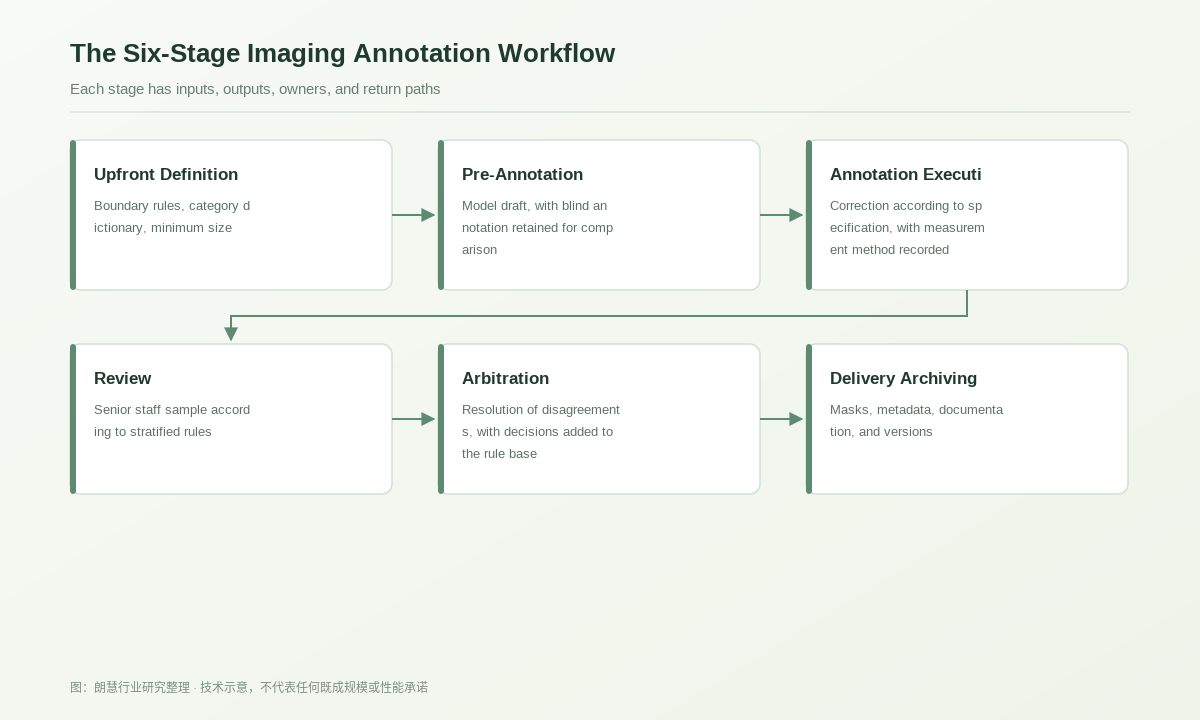
A complete workflow consists of six stages: upfront definition, pre-annotation, annotation execution, review, arbitration, and delivery archiving. Each stage needs a clear input, output, owner, and return path. If one stage is missing, problems accumulate downstream; if ownership is unclear, disagreements turn into repeated revisions, and no one can say which version is final.
Upfront definition is the easiest stage to skip, but also the most valuable. It must specify what to annotate and what not to annotate, how to handle boundaries in ambiguous areas, the minimum acceptable size, the category dictionary, units, and measurement methods. If this stage is skipped, the rest depends on annotators guessing. Guessed results cannot be unified when merged, so the entire batch must be redone.
Pre-annotation—using a model to create a draft followed by human correction—can significantly improve efficiency, but it has two pitfalls. First, systematic biases are inherited: if a model consistently misses a type of small nodule and annotators do not review slice by slice, they will miss it too. Second, confirmation bias: annotators fix obvious errors and accept everything else by default. The countermeasure is to retain a proportion of blind annotations, regularly compare purely manual results with corrected pre-annotation results, and quantify the direction of the bias.
Review and arbitration must be separate. Review involves senior personnel checking quality according to sampling rules; arbitration makes a final decision when the annotation and review disagree. If the same person performs both, the result is usually that they revise the work according to their own method, and the specification does not become embedded in the process. Arbitration decisions should be recorded and added to the rule base so that similar issues can reference them directly next time. This is where workflow knowledge accumulates.
3. Quality-Control Sampling: How Much, Who, and Who Decides
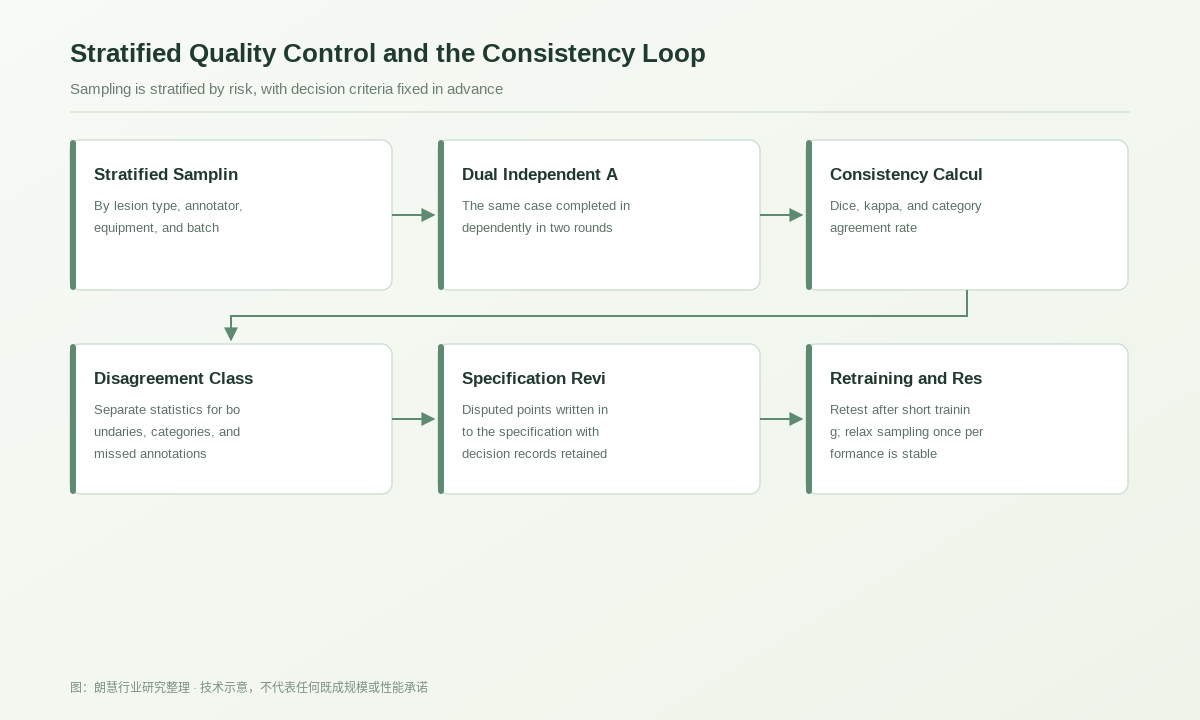
There is no universal sampling rate; it depends on task risk and team maturity. New tasks, newly added annotators, tiny lesions, and high-uncertainty tasks such as multi-phase comparisons should initially be sampled close to full inspection. Once the process is stable and staff are experienced, sampling can be reduced to stratified checks. Sampling every task at the same rate either wastes labor or misses risk.
Sampling must be stratified. Stratification dimensions should include at least lesion type and size, annotator, equipment and scanning parameters, and time batch. Overall random sampling alone can miss concentrated problems—for example, if one scanner has excessive slice thickness, causing boundary judgments in that batch to shift consistently, a few random samples will not reveal the issue. By the time it surfaces, hundreds of cases may already have been processed.
Decision criteria must be fixed in advance: whether categories agree, whether boundary tolerance is measured in millimeters or relative area, and how missed secondary lesions are counted. Using the Dice coefficient alone as the sole criterion can conceal missed small lesions: missing a very small lesion barely changes overall overlap, yet clinically it may be the most important one. Metrics must serve judgment, not force judgment to accommodate metrics.
Consistency metrics and clinical acceptability should be reported separately. Kappa and Dice indicate whether annotators agree with one another, not whether the work meets clinical requirements. Two people can use the same incorrect standard and still show high consistency. A practical approach is to use consistency data for trend monitoring, have senior doctors who do not participate in annotation judge clinical acceptability, and include both in the delivery report.
4. Tool Capabilities: Segmentation, Detection, Registration, and Temporal Annotation
Segmentation is the most fundamental capability: pixel-level masks, multiple categories, 3D connectivity, interpolation between slices, hole filling, undo, and history. The difficulty lies not in large organs but in fine structures and ambiguous boundaries. The tool must let annotators zoom in enough to work precisely, compare adjacent slices, and temporarily hide other categories; otherwise boundary judgment becomes guesswork.
Detection and measurement include nodule bounding boxes, long and short axes, volume, and doubling time. The measurement method must be recorded: manual, semi-automatic, or model-generated with correction. The same lesion measured in different ways can produce noticeably different results. If the method is not recorded during follow-up comparisons, no one can determine whether a change comes from the condition or the tool.
Registration capability determines whether follow-up and multimodal tasks are possible: registering different time points for the same patient, CT with MR, or non-contrast with contrast-enhanced sequences. The tool should display registration error or residuals rather than only providing an attractive fusion image. A good-looking fusion image does not mean accurate alignment, and relying on visual judgment can lead to errors on critical structures.
Temporal annotation is the fastest-growing area of demand: phases in dynamic enhancement, cine sequences, and perfusion curves. The target changes from a single lesion to variation within a time period, so the data structure must express start and end frames and key frames. When tools do not support this, teams improvise with folder naming. This can work for short-term delivery but cannot support batch processing or integration with model-training pipelines long term.
5. Capacity Estimation: Person-Days, Rework, and Effective Output
Capacity is not simply headcount multiplied by working hours. A closer calculation is effective output equals available case volume divided by invested hours, with rework, waiting, communication, and arbitration included in the cost. Counting only annotation time omits substantial hidden costs and naturally distorts scheduling.
Time per case varies enormously: outlining a large organ may take a dozen minutes, while checking a tiny lesion slice by slice may take an hour or more; registration and comparison across multiple phases take even longer. Converting all cases uniformly into working hours will inevitably make some tasks lose time and others gain it. Scheduling must be stratified by task type, not averaged across total case count.
Scheduling must reserve time for rework and arbitration, especially for new tasks. Rework rates can be very high at the beginning and gradually decline as specifications become more precise and staff become experienced. Ignoring this stage makes early progress look fast, but acceptance triggers concentrated rework, pushing the final delivery date later and increasing quality disputes.
The most reliable capacity baseline comes from trials: the same group of people, the same specification, dozens of consecutive cases, with time per case, first-pass rate, and major problem types recorded, then extrapolated from there. Applying experience from other projects directly often produces large errors because anatomy, lesion characteristics, sequence count, and interface familiarity all affect performance.
6. Training and Staff Tiers: From Onboarding to Independent Work
Onboarding tests should assess boundary judgment rather than software operation. Software training can make someone productive in half an hour, but boundary rules take months of practice. A practical test is to give candidates several cases containing disputed points, have them annotate independently, compare the results with those of an expert panel, see which structures produce the greatest deviations, and use that information to decide whether to admit them and which areas of training need reinforcement.
Authorization should be tiered: during shadowing, annotators are read-only; during assisted annotation, all results must be reviewed; during independent annotation, they enter sampling checks; and only after stable performance do they become eligible for review. Admission thresholds differ by task. Subspecialty lesions—such as small pancreatic lesions or small adrenal nodules—should require relevant background knowledge or additional assessment rather than a one-size-fits-all rule.
Staff turnover and retraining are frequently underestimated costs. Part-time doctors work in fragmented time, and after a long break they forget specification details. A short refresher plus a consistency test before each project start is far more effective than one large training session and can also identify people with misunderstandings. Training records themselves are part of the evidence supporting delivery quality.
The communication cost of remote work must be included in capacity. Backlogs, drift in terminology, and explanations for rework all consume time. A fixed question-and-answer window and a continuously updated FAQ document can capture recurring issues, saving extensive one-to-one explanations and reducing differences in understanding between batches.
7. Deliverable Specifications: Masks, Coordinates, Versions, and Documentation
Delivery format depends on downstream use: radiotherapy planning often uses RTSTRUCT, model training commonly uses NIfTI or DICOM SEG, detection tasks use coordinates with category labels, and statistical analysis may only require structured measurement tables. If the format is wrong, the recipient must either convert it or return it for rework; the conversion process itself becomes a source of errors.
Geometric consistency is the most common point of failure. Masks must be strictly bound to the original image space: slice thickness, slice spacing, orientation, origin, and whether resampling was applied. A one-slice misalignment, flipped orientation, or inconsistent interpolation during resampling may be invisible during training and only surface during inference, when troubleshooting becomes extremely expensive. A case-by-case geometric check should be performed before delivery.
Category dictionaries and versions must be complete. Each category needs its own ID, name, definition, and examples of inclusion and exclusion; data version, annotation version, and model version must be traceable to one another. Otherwise, reproducing an experiment six months later depends on memory, which is usually unreliable.
Documentation and quality reports are part of the deliverables, not extras. Boundary rules, typical counterexamples, records of disputed cases, sampling rates, first-pass rates, and a known-issues list should be delivered with the data. A pile of masks alone leaves the recipient unable to judge quality or trace disagreements, which usually turns into arguments based on impressions.
8. Working Within Data-Residency Constraints
Keeping data within the hospital is becoming a default requirement, especially for regional imaging and in-hospital imaging data. There are roughly three practical approaches: on-hospital annotation workstations, trusted regional data environments, and cloud desktops with dedicated lines. Each affects efficiency, and this trade-off must be acknowledged during design rather than discovered later when schedules are tight and capacity falls short.
When cloud-desktop resources are limited, multiple users sharing sessions can crowd each other out, causing frequent interruptions. A half-finished 3D mask can be costly to restart. Mitigation options include binding sessions to users, allocating time windows, and running pre-annotation server-side while returning only results. All of these require advance coordination with the information department; relying on ad hoc requests will not produce stable operations.
Screenshot prevention and audit trails usually include watermarks, clipboard restrictions, peripheral-device controls, and operation logs. The stricter the restrictions, the greater the efficiency loss—an objective reality. A sound approach is to build compliance requirements into workflows and schedules, specifying which stages must leave a trail and which can be relaxed, rather than promising perfect results on both sides.
Permissions should follow the principle of minimum necessity: annotators see only the sequences required by the task and do not access the full medical record; export channels are single and auditable; accounts are bound to tasks to prevent shared credentials. Coarse permission design means that any data leakage has hospital-wide consequences and cannot be traced.
9. Interfaces With Model Training: Splitting, Evaluation, and Feedback
Data splits must be made by patient, not by image. If different phases or follow-up time points for the same patient end up in both training and testing sets, the model has effectively seen the answer in advance, inflating metrics. This is one of the most common forms of leakage in imaging projects and is difficult to detect directly in results; it can only be checked through split scripts and metadata.
Evaluation sets should be fixed and managed separately, not continuously updated as the project progresses. Once an evaluation set has been used for tuning or repeatedly inspected, every subsequent comparison loses meaning. A practical approach is to store the evaluation set separately, audit access, and use it only at agreed evaluation checkpoints.
Annotation versions and model versions must be traceable: which data version the model was trained on, which version was used for evaluation, how many times the annotation specification changed, and what changed each time. Without these records, three months later no one can explain whether a metric change came from a model improvement or a shift in annotation policy, and the team will repeatedly explore unproductive directions.
Active-learning feedback loops can improve efficiency: the model selects low-confidence or highly disputed cases for human annotation, which then feed the next training round. However, sampling bias must be watched: labeling only difficult cases distorts the population distribution and can reduce performance on common cases. Retaining a proportion of random samples for calibration is essential for keeping such a process running over time.
10. Common Failure Modes and an Actionable Acceptance Checklist
Failures cluster into four categories. Missing specifications lead everyone to draw boundaries differently, making merged results impossible to unify; over-reliance on pre-annotation causes systematic omissions to be inherited across an entire batch; sampling checks only overall performance rather than strata, so problems are discovered only when they erupt in a particular batch; and deliverables lack metadata, leaving mask misalignment or category mismatches unnoticed. These four issues are not algorithmic and cannot be solved by switching models.
Acceptance should rely on verifiable metrics rather than demo effects. Five are recommended: first-pass rate, sampling consistency rate, rework rate, metadata completeness rate, and process reproducibility. Each needs a defined statistical scope and period, with reports issued by batch. Reporting a single aggregate number is meaningless because problems often concentrate in specific batches or with specific individuals.
A recommended rollout strategy is narrow first, then broad: choose one disease, one sequence type, and a small sample of several hundred cases; run the full process—specifications, pre-annotation, execution, review, arbitration, and delivery—before scaling up. Success is not when the platform goes live, but when newly added annotators work according to the specification and meet sampling standards within an acceptable time.
One frequently overlooked point: responsibility and cost for rework should be clarified in advance. Whether the annotation provider bears all rework costs or shares them according to responsibility directly affects how strictly the specification is followed. When rules are vague, the annotation provider tends to rush progress, leaving problems to surface at acceptance, with both sides paying a higher price.
| Acceptance Item | Measurement Basis | Common Problem |
|---|---|---|
| First-pass rate | Share of cases meeting sampling standards on first submission | Standards are not quantified and rely on subjective judgment |
| Sampling consistency rate | Share of sampled cases matching review results | Only overall sampling, missing high-risk batches |
| Rework rate | Share of delivered cases returned for revision | Rework reasons are not categorized, preventing improvement |
| Metadata completeness rate | Share of deliveries containing geometry, categories, and versions | Missing slice thickness and orientation information causes mask misalignment |
| Process reproducibility | Whether rerunning the same data and specification versions yields equivalent results | Specifications are passed verbally and versions are not recorded |
11. Forward-Looking Assessment for the Next 12 to 24 Months
First, pre-annotation will become the default starting point, and tasks requiring purely manual slice-by-slice outlining will decline significantly. The value of annotators will shift from operational speed to boundary judgment and difficult-case arbitration, and training will move from software operation toward understanding specifications and discussing cases. Teams that still measure output by the number of bounding boxes will find it increasingly difficult to recruit suitable doctors.
Second, quality control will shift from end-stage sampling to process auditing and batch monitoring: tracking first-pass rate, types of disagreement, and rework reasons by batch, with automatically tightened sampling for anomalous batches. This requires a stronger data foundation but surfaces problems early and avoids redoing entire batches. Teams willing to invest in statistical process monitoring will deliver noticeably more stable results than peers.
Third, delivery specifications will converge on DICOM SEG and structured reporting, with masks plus structured measurements becoming standard. Delivering only images or bare NIfTI files without geometry and category information will be rejected by more downstream teams because conversion and verification costs are too high. The specification itself is becoming part of competitive advantage.
Fourth, annotation will integrate more deeply with data governance: teams able to design collection specifications, perform structured annotation, produce quality-control and consistency reports, and manage data dictionaries and versions will secure longer-term projects. The space for providers offering only labor will narrow, and bargaining power will decline. Organizations that have already turned specifications and quality control into reusable assets will benefit first, and this will become increasingly obvious over the next two years.
Langhui's Engineering Capabilities Along This Path
Langhui Technology has produced AI training data since 2016. In medical imaging, coverage includes CT, MR, PET, mammography, ultrasound, and other modalities. We can undertake collection-specification design, structured annotation, quality control, and consistency reporting, and provide data dictionaries and version records. Segmentation, detection, registration, and temporal tasks are organized in layers according to lesion geometry, category definitions, and measurement axes, with deliverables reviewable case by case.
In annotation production, our role is to break the workflow down clearly: upfront specifications and category dictionaries, pre-annotation with blind-annotation comparison, stratified sampling, separation of review and arbitration, classification of rework reasons, and delivery metadata with documentation. Physician resources participate on a part-time basis, receive tiered authorization according to task difficulty, and receive batch-level reports on sampling results and first-pass rates. We do not provide clinical diagnostic conclusions or treatment decisions.
If your team is building imaging annotation capacity, assessing the quality of a batch of annotation data, or preparing an evaluation set for model training, send us the modalities, task types, sample scale, and compliance constraints, and we will recommend an actionable workflow and quality-control plan. We do not claim HIPAA certification; endoscopy, whole-slide pathology, and clinical natural language processing are not within our platform capabilities.
FAQ
Can a medical imaging annotation platform be purchased and used immediately?
A platform is only a tool; whether it works well depends on specifications and workflow. After procurement, you still need to define annotation boundaries, the category dictionary, minimum sizes, review and arbitration rules, and supporting training and sampling processes. Without them, however intuitive the tool is, disagreements will emerge within two weeks of launch and rework rates will rise quickly. Platform selection should focus on export formats and metadata support, not only interface feel.
The trial annotation passed, so why is batch delivery still delayed?
Trials are usually completed by the people most familiar with the specifications, with small samples and plenty of time. During batch production, the work shifts to part-time doctors in different locations whose understanding of the specifications is inconsistent; when they encounter unfamiliar morphologies, they can only judge for themselves. Delays usually come from rework and arbitration rather than annotation speed. When calibrating capacity from trials, estimate using the same staffing composition and sampling intensity.
How should consistency in segmentation annotation be measured?
Dice and surface distance are commonly used, but looking only at overall overlap can hide missed small lesions. Report category agreement rate, missed-annotation rate, and the proportion within boundary tolerance together, with statistics stratified by lesion size. Consistency only shows whether annotators agree with one another; clinical acceptability must be judged by senior doctors who do not participate in annotation, and the two should be reported separately.
Will pre-annotation make annotators lazy and reduce quality?
There is a risk, mainly in the form of confirmation-based work and inherited systematic omissions. Mitigations include retaining a proportion of blind annotations, regularly comparing against purely manual results, making lesion types the model consistently misses mandatory review items, and separately tracking missed-annotation rates for pre-annotated cases in sampling checks. Pre-annotation improves efficiency but cannot replace slice-by-slice review.
Data cannot leave the hospital, so how can remote annotation be organized?
Common approaches include on-hospital workstations, trusted regional data environments, or cloud desktops with dedicated lines. All three require advance coordination of resources and permissions and some loss of efficiency. The key points are binding accounts to tasks, using a single auditable export channel, and configuring permissions to the minimum necessary. Building compliance requirements into the schedule is more realistic than compressing deadlines afterward.
- DICOM Standards Committee. DICOM PS3 — Current Edition https://www.dicomstandard.org/current
- Isensee F, et al. nnU-Net: a self-configuring method for deep learning-based biomedical image segmentation. Nature Methods, 2021 https://www.nature.com/articles/s41592-020-01008-z
- Cardoso MJ, et al. MONAI: An open-source framework for deep learning in healthcare https://arxiv.org/abs/2211.02701
- Image Biomarker Standardisation Initiative. IBSI Reference Manual https://ibsi.readthedocs.io/en/latest/
- U.S. Food and Drug Administration. Artificial Intelligence and Machine Learning (AI/ML) Software as a Medical Device https://www.fda.gov/medical-devices/software-medical-device-samd/artificial-intelligence-and-machine-learning-software-medical-device
- Medical Imaging and Data Resource Center (MIDRC) https://www.midrc.org/